Grab a feed and share!
 XML Bookmark and Share Add Jim Carroll's blog Mippin widget

Appicon

Join the e-mail list!

Categories

Monthly

Jim Carroll's blog

Recent video clips

Loading...
Most recent blog posts
. . . . . . . . . . . . . . . . . . .
. . . . . . . . . . . . . . . . . . . . . . . . . . . .

Food industry trends: Faster is the New Fast!

fm-web_logo.gif Here's an article that I wrote for Food Manufacturing on trends in the consumer, food and packaging sector.

I spend a huge amount of my time as a keynote speaker at countless conferences and events, many of them within and to the food, packaging, retail and restaurant sector. I also spend quite a bit of time with smaller, strategy-oriented leadership session designed around the theme of 'how to innovate in a high velocity economy.'

And I do know that while volatility rocks the economy, some fundamental truths about that velocity remain: the food, packaging and retail industries continue to be subject to dramatic rates of change—and innovative organizations succeed by mastering the pace of this new high-velocity economy.

Think about what is going on out there: customer mindset has become increasingly difficult to capture as we become a society with massive attention deficits—the Twitter era is having a profound impact on brand image. Marketing and advertising dollars are fleeing traditional media and moving online at a pace that surprises even the more hard-core technology-evangelists. Faster innovation means faster in-store format change. New digital signage technologies and other innovations march forward at a furious pace, providing yet another new influencer in the retail space.

And in the midst of all this change, business models are subject to upheaval due to economic turmoil, commoditization of product and the rapid emergence of new competitors.

It's a fast paced world—and that's why cutting-edge organizations are focused on key leadership strategies that provide for a fast-paced future. So what should you do to confront the "big trends" that have so much velocity—and what you should be doing right now?

I approached this very question as the opening keynote speaker for an audience of 5,000 at a recent Las Vegas event. The client organization certainly finds itself in the midst of high-velocity change. There are fast paced trends in terms of new branding challenges and marketing methodologies (think Web 2.0), consumer behavior, and many other issues. Yet, there are tremendous opportunities for growth through innovation.

My keynote addressed a variety of trends that impact every aspect of the food, packaging and retail sector today. For example, to be a leading edge innovator, you must confront and have a strategy that deals with a variety of fast-paced trends:

  • Rapid emergence of new methods of customer interaction. For example, in the next few years, we will likely see the emergence of contact-less payment technology, as our credit card infrastructure migrates to Blackberry, iPhone, and smart phones. This presents new opportunities in terms of customer contact.
  • New methods of brand and product promotion. Organizations must be able to scale to meet the demands of new intelligent infrastructure, and that will require a tremendous amount of innovation. Consider text messaging: technologies that provide for the remote retrieval of mobile coupon offers will define the future of brand interaction. With 147 million people already interacting globally on social networks via their mobile phone—and up to 1 billion in but five years—there are tremendous opportunities for new methods of achieving brand and product awareness.
  • Rapid change in consumer choice. Take the issue of health concerns and balanced diet. Fresh-cut snack foods grew from $6.8 billion in to $10.5 billion in a short time, according to the International Fresh-Cut Produce Association. Innovation comes from changing product mix to keep up with fast-changing consumers.
  • Rapidly emerging new menus and taste trends. It's estimated that new flavors now move from upscale kitchens to chain restaurants in 12 months, compared to 36 months 5 years ago. This means that faster innovation is not a luxury—it's a necessity. Change faster, and you'll yeild new growth-based products.
  • Fast emerging issues involving green strategies. The Grille Zone, a restaurant chain in Boston, generates about 15 pounds of waste per restaurant, compared to an industry average of 275 pounds. The Green Restaurant Association took 14 years to go to 90 restaurants; it's now at close to 1,000, with thousands more going through the certification program. Growth can come from evolving a brand so that it matches the social desires of the customer base.
What I stress at events like this is that organizations need to realize that innovation isn't just about "big innovation"—the launch of new products and services. There's also the issue of "fast innovation"—in which success is defined by the ability of the organization to respond to rapidly changing products, markets, business models, economic trends, competitive moves, consumer trends and just about everything else.

Innovation today is moving from more than just "products" to process, structure, capability, and speed.

Here's the thing: in my keynotes, I focus on growth opportunities. There are enough people out there who are so focused on the doom and gloom of the economy, that they lose sight of the fact that if they focus on fast innovation—and keeping up with rapid trends—they can discover all kinds of new ways to grow the business.

Faster is the new fast. Think growth. Think innovation.

Permanent link to this item ...posted February 8, 2010
. . . . . . . . . . . . . . . . . . . . . . . . . . . .

Article - "The Closest Thing to a Crystal Ball" - Future of the Meetings Industry

2010Globalevents.jpgHere's an article that just ran that offers some of my thoughts on what's up with the global meeting and events industry.

--------- Convene Magazine, January 2010 by Maureen Littlejohn

During 2009, many organizations battened down the hatches and waited for the recession to pass. As we enter the new year - and a new decade - the time for waiting is over. It's the organizations that keep their eyes peeled for budding opportunities - and are prepared to pounce on them - that will succeed. Convene asked futurist and trends and innovation expert Jim Carroll to identify five emerging megatrends of particular interest to the meetings industry.

  1. Faster business-model reinvention - Industries need to listen to what clients want and be able to change without getting bogged down in traditional, time-consuming approval stages or administrative red tape. In the meetings industry, according to Carroll, this means that organizations need to watch for members' shifting needs and respond quickly. For example, delegates might want more customized options during online registration, or more room to make last-minute confirmations. "The newer model, based on agility and flexibility, is the model that will take many businesses into the future," Carroll said. "To understand the link between future trends and innovation, you must get into that mindset."

    Since the economic meltdown, some business procedures have been turned upside-down. Carroll points to the American automobile industry: "The big automakers used to build up their assembly lines to produce 700,000 cars in a year and hope to sell them. Then they would tear the assembly line down a year later and rebuild for the next year's model. That formula is broken. Honda looks at this week's consumer demands, sees what is working, and can tear down and rebuild the assembly line in 10 days."

    Carroll said that organizations seeking an edge over their competitors are motivated to mess up their rivals' business models. "Before that happens [to you], you should mess it up yourself, so that you better control the endgame. Technology has and will play a huge role in business-model transformation, and your infrastructure has to be up to the task," he said.

  2. Rapid ingestion of new technologies - Companies must stay current with technology, especially in the delivery of services, Carroll said. "There's going to be a huge amount of adaptation as the tsunami of technology continues unabated," he said. "An example would be in retail, where there will be a rapid transition to cell-phone-based payment technology. Credit-card companies need to stay on top of this. Winners will be able to transition at the speed of Silicon Valley. The leaders will be those who continue to find operational innovation in ways they had not thought of before."

    The lesson for meeting planners? Integrate the latest technologies into the meeting's infrastructure by partnering with technologically up-to-the-minute companies, Carroll said. Planners need to be early adopters of technologies at every stage of the meeting - prior to, during, and after the face-to-face event. This includes everything from promoting the meeting to Web sites, to offering the latest technology-enabled services to delegates on site, to gathering metrics and following up after the event.

  3. Faster knowledge requirements - Carroll believes that "the future belongs to those who are fast." Organizations need to get smart quicker. "There are a tremendous number of new companies and new industries being built around the high velocity of ideas that surround us - which is increasing the pace of business startups," Carroll said. "New ideas continue to be explored, markets grow, and industries emerge as rapid innovation occurs in health care, agriculture, and countless other fields. It's all about rapid science - and exponential knowledge growth - leading to faster discovery of the next thing."

    That translates into the need for meetings to deliver more education, to be seen as "knowledge events." Carroll said: "This can take the form of short-term, high-level management meetings where the intent is to do things differently. Rapid ingestion of knowledge is needed by sales forces, management, and associations. Face-to-face education, done off site, will continue to be very effective. Networking is important for relationships and learning, especially human bonding with beer at 5 p.m. That's when participants are willing to share tips and ideas."

  4. Rapid partnerships - Social networking is the best way to form more successful partnerships in a short amount of time, according to Carroll. "This way, people with expertise can be brought in to help work out the problems on new projects," he said. "Teams that are gathered rapidly and work quickly are critical to solving problems and achieving success."
  5. End of the "AIG effect" - This, Carroll believes, is the biggest trend. "It is silly to think we shouldn't go to meetings," he said. "It's time to beat back the hysteria. In Las Vegas, where so many workers were laid off, it's had an effect. Politicians are paying attention and realizing they were shooting themselves in the foot by discouraging meetings."

    Carroll predicts that 2010 will usher in a return to long-term thinking. "Companies and associations will be making plans and strategizing how to reach goals in the next two to 10 years," he said, adding, "To that end, I've noticed an increased demand in my services as a futurist. We're all coming back with a vengeance."

Permanent link to this item ...posted February 3, 2010
. . . . . . . . . . . . . . . . . . . . . . . . . . . .

Video: Is Your Brand from the Olden Days?

Could you be so out of touch with your customers that you have no clue how they truly perceive you?

More information:

  • Blog post Is your brand from the olden days?

Permanent link to this item ...posted February 1, 2010
. . . . . . . . . . . . . . . . . . . . . . . . . . . .

Video : Brand authenticity is the new benchmark

How is social networking impaacting brands? Take a look!

Permanent link to this item ...posted January 28, 2010
. . . . . . . . . . . . . . . . . . . . . . . . . . . .

14 Key Innovation Strategies for Financial Advisors & Financial Organizations

2010FinancialAdvisor.jpgI spend a lot of time speaking to global financial organizations -- some of the world's largest institutions -- helping them understand what they need to do from an innovation perspective to stay ahead of fast paced change.

These talks are often aimed at the idea of "how do we need to transition our advisory services -- financial planners, investment advisors, insurance agents and brokers -- to keep up with fast paced change?"

Here's a laundry list of some of the strategies that I've been talking about:

  1. Focus on growth:

    With so much volatility in the financial sector, it's all too easy to take your eye off of the opportunity -ball. As I noted in my remarks for a recent keynote to a group of senior bankers:

    "Never before has the need for financial advice for Australians been greater; only 20% of Australians are currently getting professional advice."

    That means there are tremendous opportunities for growth! For many, access to financial advice is still too hard and complicated - that's why its' a great time to innovate, in order to build market share!!!!

  2. Structure for fast paced change: There are several certainties in the financial sector:
    • more business model change
    • more sophisticated competition
    • continuous business model disruption with new, young upstarts
    • continual shifts in consumer behaviour
    • technology-driven fast change, such as with the impact of mobile technologies
    Quite simply, an innovative financial organization concentrates on aligning its structure and capabilities so that it can change quickly

  3. Reshape brand messages faster: Clearly there's a lot of fast-paced change in financial services with the rapid economic pullback, and it's critical that financial institutions continue to reshape their brand at the pace of rapidly changing consumer perception.

    Noted Jim Buchanan, Senior VP of Consumer Marketing at the Bank of America in an article in Advertising Age, October 2009:

    "Six months ago, we were trying to re-assure the market and consumers that we are safe and secure....now consumers are telling us they're not worried about those things anymore.....What they are interested in is 'How can you help me manage my finances?'"

    Innovative organizations ensure that the brand message evolves at the pace of a world in which volatility is the new normal.

  4. Adapt to momentum of financial consumer change: Quite simply, the new financial client is online in a big way, and smart financial organizations will evolve their service and support message to these platforms. The number are staggering; in the case of my Australian keynote, I emphasized that:
    • 147 million people interact globally on social networks via their mobile phones - we can expect 1 billion within five years!
    • there are 1.6 million Twitter users in Australia - up 1,000% from last year
    • Australian's now spend 16.1 hours a week on the Internet, compared to 12.9 hours watching TV
    • 25% of that time is spent on Facebook
    The impact is clear: as noted by Mondaq Business Briefing in November 2009: "Australians visit social networking sites more often than financial services sites."

    The bottom line for financial and investment advisors is that social networks are an extremely effective tool to keep core clients in the loop; as an outreach tool, they're fast, effective, unique, quirky, and certainly the story of the day. The bottom line is that financial advisors have to go where the client is going, and should be thinking about how to become socially-networked oriented advisors.

  5. Adjust platforms to this changing behaviour: I continue to emphasize with my global financial clients that the impact of mobile technologies on financial services is absolutely massive. Think about Wizzit, a South African service that is essentially a text message based banking system.

    The reality is that the new financial consumer expects to be served on new platforms: as noted by Thomas Kunz, Senior VP at PNC Financial:

    "Gen-Y doesn't reconcile checkbooks, and they don't believe in float. For them, their balance is their balance."

    That's why PNC has released a "virtual wallet app" available for iPhones. They're reaching out to this new financial consumer in a big way.

    Aggressive change with business platforms provides big opportunity for business model disruption. A key factor here has to do with new client acquisition: what's happening is the point of origination of the relationship might change as people transition their banking to mobile devices. Opportunity can come from continuing to build the advisor and distribution channel into these new platforms.

    And that's not a threat - that's a huge opportunity!

  6. Leverage off of new peer-to-peer behaviour trends: The new financial consumer relies more than ever before for advice from their social networks.

    Peer-to-peer social driven advice through sites such as TradeKing is coming to the forefront: it's a service that allows people to share stock tips and research through extended social networks.

    Does this diminish the role of advisory services -- not at all, if you dive in and become a part of the peer-to-peer conversation!

  7. Re-orient distribution channels : Here's another key point: I've emphasized to my insurance and other financial clients that the next-generation advisor/broker/agent expects ever more sophisticated technology platforms to help support their role.

    You've got to make sure you are keeping up with their needs. In one survey in the insurance sector, 80% of brokers indicated that the sophistication of the technology platform of the provider would influence who they would choose to do business with.

    According to Kevin Murray, EVP and CIO at New York-based AXA Equitable:

    "The younger generation of financial professional will almost demand online self-service....they will want to text any questions they have in to the service centre or self-service from their mobile device. We're going to have to be able to provide that capability. It's how they will operate."
  8. Build your own peer-to-peer collaborative knowledge networks: The new financial advisor is also thinking socially, and is actively looking for peer-to-peer collaborative knowledge.

    Imagine building a financial advisory team that is collaborative for ideas, shares insight on market wins, constantly leverages insight from new branding campaigns that work in unique ways, and constantly shares great ideas on new methods of converting leads into clients -- that's how this next generation works!

    Back to Kevin Murray:

    "They will also want an online collaboration tool to ...find answers concerning product or questions from their customers. The X and Y generations are going to demand a different way of selling and servicing their customers.”
    What it's really all about? Freeing up their time to build opportunity, make sales, close deals.

  9. Reduce churn through electronic relationships: Here's something else to think about according to Chief Marketer (October 2009),
    "The average brand saw one third of highly loyal consumers in 2007 completely defect to another brand in 2008".

    People are far less loyal, and far more likely to jump ship at the drop of a hat. That's why continuous innovation in terms of the relationship is critical -- and that's maybe why continually transitioning to new technology platforms such as an iPhone app might reduce that churn

  10. Better, more focused niche marketing: We're in the new era of analytics and analysis, which provides new opportunities for advisors to reach out to markets previously unattainable. As noted by Money Management Executive in October 2009:

    "Financial advisers generally prefer to manage a small number of high-net-worth clients rather than a large number of small accounts, but recent advances in automation technology could change this dynamic."

  11. Innovate hard with the next generation: one of the biggest trends going forward is that right now, we are witnessing the early stages of a massive transition of wealth from one generation to another. The numbers are staggering: we'll see $12 to $18 trillion in intergenerational wealth transfer In the next 12 years (US GDP is $12 trillion); and by 2053, some $130 trillion will have moved from one generation to another. That's a lot of money sloshing around -- and much of it is going to this new, tech-savvy financial consumer.

  12. At the same time, rethink importance of boomer market: It's easy with all of these points to think that new markets will come from new, uber-hip young people and hot new technologies. But don't stop with innovating with that market -- also realize that there continues to be huge growth potential with the boomer market. In Australia, baby boomers will control 51% of the nations wealth. Put that in the context of the reality that there is a huge adoption by Boomers of Facebook. They continue to more aggressively integrate technology into their lives; they're busy researching health care, insurance, retirement planning and investment advice. Online makes more sense than ever before -- get your advisors there!

  13. Evolve the approach: Insurance and financial services are products that are always sold based on fear -- they aren't bought. This reality doesn't go away because of new technologies. What does change is that technology is a powerful enabler that frees advisors from having to focus on the mundane, routine, time wasting stuff, in order to focus on providing the advice & guidance that advisors can provide. Focus on the core role!

  14. Enact change: Many advisors will be in comfortable, established routines. Change is not easy. That's why organizations in the financial sector that are trying to be innovative need to help existing advisors focus on the opportunity and the benefits that come with rapid change, rather than being fearful of the change that technology is bringing to the industry.

Bottom line? As I summed up in my talk -- "Innovative organizations make bold leaps, in order to keep up -- and stay ahead -- of a faster future."

Permanent link to this item ...posted January 27, 2010
. . . . . . . . . . . . . . . . . . . . . . . . . . . .

What do world class innovators do that others don't do?

2010WorldClassInnovators.jpgI was in Chicago earlier this week; I had a keynote for a leadership team of a company that's involved in a sector of the construction industry.

They've had some challenges with the economic downturn; they're also likely to see a resurgence as infrastructure spending kicks in.

But they're thinking beyond what happens after that -- they're positioning themselves for long term growth -- and so they brought me in to stir up some creative thinking as to what they need to do.

The focus on my keynote was on the theme: "What is it that world class innovators do that other organizations don't do?" Here's some of the insight that I cover.

  1. World class innovators possess a relentless focus on growth: I deal with a lot of CEO's at a lot of organizations, and in almost every instance, they've engaged me because my message of future growth opportunities resonates with their own attitude. In my view, there are unprecedented opportunities for growth in almost every industry. Spend some time on this blog; read my Where's the Growth overview and other information, and you'll come away convinced we live in transformative times that offer tremendous opportunities for growth through innovation.
  2. World class innovators continually transition their revenue source: they're focused on 'chameleon revenue'. They know that have to evolve from being a commodity product competing on price, to one that offers a more complex, revenue rich solution. They're aware that they need to have continuous, relentless product innovation in order to keep their new revenue pipeline full.
  3. World class innovators solve customers problems - before the customer knows it's a problem: They excel at anticipatory thinking: where do we need to go with our customers to ensure that we continue to have a strong revenue relationship? What key trends can we ride to maximum advantage that will allow us to provide a constant flood of new, irresistible innovations for our customer base?
  4. World class innovators source innovation ideas through their customers.: Simply put, they derive new innovation ideas by observing what their customers are doing with their products or services. They know that they aren't fully in control of the innovation agenda anymore, and that some of the most brilliant ideas are coming from a new source. Notes John Hanks, vice-president, industrial and embedded products for National Instruments: "We have the advantage of working with some of the most innovative people in the world. For example, we could find a customer who is using one of our products in an unexpected and innovative way. It's then possible for us to take that and add value for another customer, which is one of the ways we can help the innovation process as a whole."
  5. World class innovators focus on ingesting fast ideas: there are new technologies, business models, customer trends, product developments, scientific advances and countless other things that are increasing the pace of change. Innovators know that if they plug into the global idea machine, they can constantly discover a tremendous number of insights that help them to move forward.
  6. Innovators check their speed and focus on corporate agility: they know that to keep up with fast paced trends, it's their ability to quickly act, react and do that will allow their future success. There's not a lot of time for debate, studying; inertia is abhorred. They simply DO.
  7. World class innovators focus on long term wins through constant incremental improvements: they know that some pretty big growth can come from continual small wins and improvement on margins. For example, 7% of power on transmission and distribution lines are lost as heat. Reduce that loss by 10% - and that would equal all the new wind power installed in the US in 2006. That's why 'smart grids' are such a hot topic. Take the auto industry: todays' typical automotive system uses only 25% of the energy in the tank -- the balance is lost to waste, heat, inefficiency. Work on increasing that on a year over year basis, and there are some pretty solid gains through innovation.
  8. World class innovators focus on skills partnerships as a key success factor: they know that with rapid change, knowledge is becoming an ever more precious commodity, particularly niche oriented knowledge. If they are entering a fascinating new, fast paced market, they realize that there might be but a few individuals or organizations in the world who could help them tackle that new market. They focus on forming fast teams and fast partnerships, drawing a lot of innovation oxygen from that external insight.
  9. World class innovators focus on pervasive connectivity for next generation product: they know that one of the key trends out to 2020 is that everything around us is plugging together. Soon, every device on the planet will have an IP address on the Internet; we'll be able to access it's status and its location. This is transformative stuff, and is one of the primary sources for the next new billions of dollars of revenue in countless industries. Consider the world of HVAC -- industrial heating, ventilation and air conditioning equipment: as it is transitioned to the world of "HVAC 2.0", an intelligent, interlinked, fascinating new world of massive connectivity.
  10. World class innovators aren't afraid to back away from big ideas: they know that right now it's a great time to made bold decisions, and take decisive advantage to forge aggressive new paths against their competitors. While everyone else wallows in aggressive indecision and organizational sclerosis, world class innovators know that it is a great time to do great things.

You know what?

World class innovators win!

Did my keynote go well? Here's what the client had to say: "Thanks again for your first class presentation! It really hit home and was right on the money!"

More information:

  • Where's the Growth? (PDF)
  • Blog post HVAC 2.0

Permanent link to this item ...posted January 21, 2010
. . . . . . . . . . . . . . . . . . . . . . . . . . . .

The future: "...think in terms of transformation .. & .. manage the expectation gap..."

2010ExpectationGap.jpgAnother report on my keynote for 4,000 at the annual meeting of the National Parks & Recreation Association, putting into a concise summary the key trends that I covered (from the Parks & Rec monthly magazine).
"... a solid turn-out of nearly 6,000 park professionals and advocates made the 45th edition of Congress a resounding success. .... The theme, "Looking to the Future," permeated nearly every facet of the event held at the Salt Center Convention Center.

In keeping with the Congress theme, Looking to the Future, opening session keynote speaker Jim Carroll did not disappoint. The Canada-based futurist built his address around key themes and issues likely to confront the field of parks and recreation in the next 10 to 15 years.

Carroll encouraged the packed convention hall to think in terms of transformation. Other trends Carroll advised attendees to be aware of included:

  • healthcare (we'll be treated for the conditions we're likely to have before they set in)
  • hyper connectivity (mapping, body sensors, and sports equipment)
  • Next-Gen re-engagement
  • fragmentation (the result of a faster, more connected world that will shape sports, recreation, and hobbies)
  • re-defined communities (society's big problems will be solved locally)
  • water/energy/environmental conservation issues
  • demographics (think baseball diamonds that evolve into cricket pitches)
  • workforce trends (Gen Y has a radically different set of job expectations than its predecessors)
  • gaps in expectations (expect a disconnect between what the public wants and what it can afford)

If someone today were to ask me what the most challenging trend will be for first-world nations to deal with -- it would have to the last issue.

I've got a lot to write and say about the "expectation gap" issue, and have been covering this in dozens of speeches over the last while.

The "expectation gap" is a trend that will define both the opportunity for innovation, as well as distinct perils for standards of living should it not be carefully managed. And to a huge degree, it relates to the political and social maturity that a country can display as it tries to deal with and manage the gap.

More to come!

Permanent link to this item ...posted January 20, 2010
. . . . . . . . . . . . . . . . . . . . . . . . . . . .

10 Phrases to Think About for 2010

The chance that your company, markets, competitors will be the same in ten years is virtually zero - so what do you do about that? 2010TenPhrases.png

Here's 10 phrases I often use to challenge my clients -- often CEO's of large, multinational organizations -- to think differently about our fast paced future:

  • experiential capital: it's the cumulative experience you gain by trying to do new things. Do you have enough of it?
  • momentum management: is this a core capability that your organization possesses - can you steer your team through ever more fast paced change?
  • chameleon revenue: is your revenue stream capable of it? Can you keep generating new streams of revenue as old streams disappear?
  • global idea cycles: do you tap into the global R&D mind for innovation insight, or is your thinking stale, old, out of date, based on the same old sources?
  • idea intensity: can you turn the ideas that are out there into reality quickly enough, or do you lose the opportunities to others?
  • energy of engagement: is your brand boring and dull, or edgy and interactive?
  • ingestion capability: can you ingest new trends, technologies, concepts, business models ... before they're obsolete ... or are you stuck in a hopeless rut of indecision?
  • fast teams: can you form them as quickly as necessary to get the faster things done?
  • massive incrementalism: the oil industry currently retrieves only 1 out of 3 barrels per well on average. A 1% improvement represents huge revenue gains. Every industry I am dealing with sees small marginal wins adding up to huge tactical advantage.
  • depth of boldness: are you still thinking small wins, or large, massive tactical manoeuvres?
In other words, when it comes to the future, are you with it, or are you going to wimp out?

Permanent link to this item ...posted January 19, 2010
. . . . . . . . . . . . . . . . . . . . . . . . . . . .

Video: innovators focus on "corporate agility'

How quickly can you scale if you encounter a new market opportunity? How quickly can you react to a crisis. In this clip, JIm takes a look at the concept of corporate agility

Permanent link to this item ...posted
. . . . . . . . . . . . . . . . . . . . . . . . . . . .

Video: Food industry trends - it's all about velocity!

In the food industry -- it's all faster.

A faster focus on 'fresh' food. New taste trends happen faster. There's faster innovation with ethical packaging.

And so it's all about time to market. Challenge yourself to think and act differently, when the food industry continues to speed up, and the process of innovation undergoes a deep transformational change.

Permanent link to this item ...posted January 15, 2010
. . . . . . . . . . . . . . . . . . . . . . . . . . . .

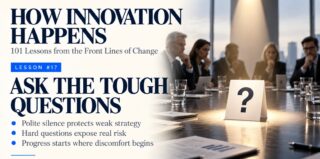
Innovators aren't afraid to ask tough questions!

2010Questions.jpg

Tweet me, retweet this post with your "bullet point" for the list, and I'll add it in! Note -- I'll have a new blog within the month that will allow for comments!

-----------

In fact, the realities are that not only are innovative people unafraid of to ask questions, they aren't afraid to:

  • ask the tough questions
  • act on the answers to those tough questions!
  • ask questions that make people uncomfortable
  • challenge others to ask tough questions
  • ask why it has become acceptable to not ask questions!
  • ask questions that challenge fundamental assumptions
  • ask questions that show their complete lack of knowledge about something -- which is ok
  • ask questions that might make their boss unhappy
  • indicate that while they don't know the answer to the tough questions, they're prepared to find out
  • suggest that maybe there have now been too many questions, and now something simply must be done in order to move forward

What's the key to this line of thinking?

Organizations can become too comfortable with routine, and unless this is challenged on a regular basis, complacency becomes a killer.

By constantly putting a whole bunch of tough questions on the table, innovators can ensure that innovation paralysis does not set in.

Tweet me, retweet this post with your "bullet point" for the list, and I'll add it in! Note -- I'll have a new blog within the month that will allow for comments!

Permanent link to this item ...posted January 14, 2010
. . . . . . . . . . . . . . . . . . . . . . . . . . . .

Video: Cardboard people, plasmas people: Generational change and innovation!

How do you master innovation? Through the powerful story in this video clip, I point out the challenges that organizations face with the different generations in the workplace -- and introduce the concept of "generational collaborative capability" as being a key component of succcesful innovation.

Permanent link to this item ...posted January 13, 2010
. . . . . . . . . . . . . . . . . . . . . . . . . . . .

How to get faster when the world is faster...

2010Faster.jpgWhat should innovative organizations do? When everything is faster still, focus on these things:
  • build up experiential capital - think big, start small, scale fast. The experiential projects are the "start small" part of the equation. Know what you don't know, and set out to learn those things
  • master collaboration and share: the world is changing too fast, and things are too complex, to do it all on your own. Innovators have mastered the skill of learning from others
  • focus on tactical to strategic transitions: innovators don't have staff who perform a lot of routine tasks. Each and every single person helps to achieve the core strategic goals of the organization, even if just in a small way
  • monitor global idea cycles: your future is being invented all around you, and you success comes from your ability to plug in, tune in, and turn on
  • fuse generational insight: we've got really disparate viewpoints, capabilities and levels of patience amongst generations. Innovators bring these differences together in order to get the best from each generation.
  • take on anticipatory projects: one thing is certain: tomorrow won't be like today. Innovators look at what might happen tomorrow, and try those things out, in order to be better prepared for when the future arrives.
  • be a farmer: it's all about growth, and learning how to relentless focus on that mission
  • displace indecision: it's simply unacceptable to waver, wait, and pause. Innovators get things done.
  • implement quicker: there's not a lot of time to get things done when markets, customers, expectations, competitors and business models all change at a furious pace. Innovators are religious on agility and speed.
  • think bold: this isn't a time for small visions and small ideas. We're witnessing the birth of transformative new industries, companies, careers and ideas. Jump on board and go for the big win, not just the small stuff.
If five years, your business, markets, products, customers, industry and structure will look nothing like they do today. What are you going to do about it?

Permanent link to this item ...posted
. . . . . . . . . . . . . . . . . . . . . . . . . . . .

Location intelligence, financial industries and business model change!

2010FinancialLocationIntelligence.jpgI had quite a few financial oriented keynotes through the last year, for banks, mortgage groups, credit unions and others. If there was a key theme as to the insight my clients were seeking, it was this: what are the BIG trends that are going to impact us (I'm a futurist), and what do we need to do about it (I specialize in insight on what global leaders are doing in the area of innovation.)

The scope of some of these engagements is pretty significant; Diners' Club featured me as the opening speaker for their global franchise conference; my focus was on the big trends that would impact the organization into the future.

I guess I and generated enough buzz on my theme within the financial services industry such that I was booked for a keynote down into a major bank in Sydney, Australia, via a fibre optic link. (I couldn't make a flight connection work!)

What should financial executives be thinking about? There are dozens of significant trends. Perhaps the most important has to do with the fact that 2010 is the year that location intelligence is coming to the industry as a significant business model disruptor.

Here's a snippet from an article that captures a bit of what I've been talking about. The world of banking is going to witness massive change as mobile and location intelligence technology becomes married together. Consider:

Jim pointed to an Australian study that found 65 per cent of children in preschool today will work at jobs that don't exist today.

"Think about the concept of a location intelligence professional."

He discussed the possibilities presented by marrying smartphones equipped with global positioning systems to spatial-oriented information websites such as Google Maps.

"In the not-too-distant future, it's quite likely some real estate organization is going to roll out an iPhone app that you will go through and you will pre-identify the types of properties that you're interested in. It's going to use the location capabilities built into the iPhone to build you an interactive tour of those properties. And you're going to use your (iPhone) to drive around the neighbourhood and look at these homes through your phone."

The same application might refer users on to a mortgage broker, he said.

"What do you do when the essence of your business model and the nature of the referrals that you get into your business begin to change?"

Halifax Chronicle Heradld, "Expert: Essence of life is change", November 25, 2009

Give me any financial organization, and I can give you an organization that likely isn't prepared for the fact that their innovative agenda is going to be subject to some pretty significant change.

What I've been doing is outlining for my clients the trends that are going to impact them, and the innovative thinking they need to pursue to capitalize upon those trends.

Permanent link to this item ...posted January 11, 2010
. . . . . . . . . . . . . . . . . . . . . . . . . . . .

Video: The future of customers and branding

"Do you we truly appreciate just how quickly things are going to evolve"

What should brand leaders be thinking about in terms of the velocity of change with customers and branding.

This clip takes a look at the trends impacting brands....

Permanent link to this item ...posted January 8, 2010
. . . . . . . . . . . . . . . . . . . . . . . . . . . .

What do innovative companies do that other companies don't do?

innovativecompanies.jpgInnovative organizations focus upon the concept of agility: they can manage fast change, new risk, business market turmoil, staffing challenges, and market commoditization. They can do this because they are relentless focused on the future and the trends that will impact them. They ensure that they innovate and adapt based on rapidly changing circumstances, on a continuous basis. Innovation isn't just about new product; it's an inclusive mindset, in which everyone knows that they must stay relentlessly focused on the religion of innovation: how do we do things differently to run the business better, grow the business and transform the business. How do they do this? By adopting several key guiding principles that form the basis for all corporate strategy and activities going forward:
  • plan for short term longevity: No one can presume that markets, products, customers and assumptions will remain static: everything is changing instantly. Business strategies and activities must increasingly become short term oriented while fulfilling a long term mission.
  • presume lack of rigidity: Many organizations undertake plans based on key assumptions. Agile organizations do so by presuming that those key assumptions are going to change regularly over time, and so build into their plans a degree of ongoing flexibility.
  • design for flexibility : In a world of constant change, products or services must be designed in such a way that they can be quickly redesigned without massive cost and effort. Think like Google: every product and service should be a beta, with the inherent foundation being one of flexibility for future change.
  • build with extensibility: Apple understood the potential for rapid change by building into the iPod architecture the fundamental capability for other companies to develop add-on products. Think the same way : tap into the world. Let the customer, supplier, partners and others innovate on your behalf!
  • harness external creativity: In a world in which knowledge is evolving at a furious pace, no one organization can do everything. Recogize your limits, and tap into the skills, insight and capabilities of those who can do things better.
  • plan for supportability: Customers today measure you by a bar that is raised extremely high -- they expect you to deliver the same degree of high-quality that they get from the best companies on the planet. They expect instant support, rapid service, and constant innovation. If you don't provide this, they'll simply move on to an alternative.
  • revisit with regularity: Banish complacency. Focus on change. Continually revisit your plans, assumptions, models and strategies, because the world next week is going to be different than that of today.

Permanent link to this item ...posted
. . . . . . . . . . . . . . . . . . . . . . . . . . . .

Is it time for an innovation audit?

2010InnovationAudit.jpg Is it time for an innovation audit within your organization? Maybe so!

After all, 2010 is likely going to continue to be a challenging year for many. With ongoing economic challenges, rapid business model change, competitive disruption, fast paced technological developments, rapid and new branding challenges, customer churn, social networks and all kinds of other challenges! Right now, you need to make sure that you have an organization that is open to new ideas, and is thinking about innovative ways of turning challenge into opportunity.

Where do you start? Take the time to do this simple to test to determine if your organization is in the right frame of mind for remarkably new and innovative things, or whether you are stuck in a rut, unable to respond and deal with the change that is swirling around you.

Here are the signs I would watch for. If you are guilty of more than a couple of these indicators, then you've got an organization that has a significant change anti-virus in place:

  • people laugh at new ideas
  • someone who identifies a problem is shunned
  • innovation is the privileged practice of a special group
  • the phrase, "you can't do that because we've always done it this way"is used for every new idea
  • no one can remember the last time anyone did anything really cool
  • people think innovation is just about R&D, and forget that it's also about the way things are done, and about deliverables
  • the organization is focused more on process than success
  • there are lots of baby boomers about, and few people younger than 30
  • after any type of surprise -- product, market, industry or organizational change -- everyone sits back and asks, "wow, where did that come from?"

Innovative companies act differently. In these organizations:

  • ideas flow freely throughout the organization
  • subversion is a virtue
  • success and failure are championed
  • there are many, many leaders who encourage innovative thinking, rather than managers who run a bureaucracy
  • there are creative champions throughout the organization -- people who thrive on thinking about how to do things differently
  • ideas get approval and endorsement
  • rather than stating "it can't be done," people ask, "how could we do this?"
  • people know that in addition to R&D, innovation is also about ideas about how to "run the business better, grow the business and transform the business," an attitude that is equally applicable to associations
  • the word "innovation" is found in most job descriptions as a primary area of responsibility, and a percentage of annual remuneration is based upon achievement of explicitly defined innovation goals

Every organization should work to develop innovation as a core virtue -- if they don't, they certainly won't survive the rapid rate of change that envelops us today.

How can you do this? With some 80 keynotes under my belt through the last year, many of which have focused on instilling an innovative culture, I've seen some of the best and worst approaches to innovation and creativity. Analyzing what I've seen, I've come up with a quick list of 10 more things that smart, innovative organizations do to create an overall sense of innovation-purpose.

  • Heighten the importance of innovation. One major client with several billon in revenue has 8 senior VP's who are responsible for innovation. And the fact is, they don't just walk the talk -- they do it. The message to the rest of the company? Innovation is critical -- get involved. You can do the same thing by elevating specific responsibility to various committee or executive members.
  • Create a compelling sense of urgency. With product lifecycles compressing, markets witnessing fierce competition, and entire skills and professions changing overnight, now is not the time for studies, committee meetings and reports. It's time for action.
  • Simply do things. Now. Get it done. Analyze it later to figure out how to do it better next time.
  • Ignite each spark. Innovative leaders know that everyone in the organization has some type of unique creativity and talent. They know how to find it, harness it, and use it to advantage.
  • Re-evaluate the mission. You might have been selling widgets five years ago, but the market doesn't want widgets anymore. If the world has moved on, and you haven't, it is time to re-evaluate your purpose, goals and strategies. Rethink the fundamentals in light of changing circumstances. This is particularly important for associations in fast- moving industries.
  • Build up experiential capital. Innovation comes from risk, and risk comes from experience. The most important asset today isn't found on your balance sheet -- it is found in the accumulated wisdom from the many risks that you've taken. The more experiential capital you have, the more you'll succeed.
  • Shift from threat to opportunity. Innovative organizations don't have management and staff who quiver at the thought of what might be coming next. Instead, they're alive from breathing the oxygen of opportunity.
  • Banish complacency and skepticism. It's all too easy for an organization, bound by a history of inaction, to develop a defeatist culture. Innovative leaders turn this around by motivating everyone to realize that in an era of rapid change, anything is possible.
  • Innovation osmosis. If you don't have it, get it -- that's a good rule of thumb for innovation culture. One client lit a fuse in their innovation culture by buying up small, aggressive, young innovative companies in their industry. They then spent the time to carefully nurture their ideas and harness their creativity. You might be able to do the same type of thing with a merger with a similar, smaller and more innovative organization, or by seeking out some new, creative talent for your executive ranks.
  • Create excitement. I don't know how many surveys I saw this year which indicated that the majority of most people in most jobs are bored, unhappy, and ready to bolt. Not at innovative organizations! The opportunity for creativity, initiative and purpose results in a different attitude. Where might your organization be on a "corporate happiness index?" If it's low, then you don't have the right environment. Fix that problem -- and fix it quick.

You need to do this soon. Sit back and think about how different the world is going to be five years from now -- in a world of hyper-change, it will be very, very different.

Is your organization in the right frame of mind to do what needs to be done to get there?

Permanent link to this item ...posted January 7, 2010
. . . . . . . . . . . . . . . . . . . . . . . . . . . .

Silicon Valley innovation velocity set to dominate every industry

2010SiliconValleyInnovation.jpgMy January / February CA Magazine article is out; entitled "Stranger than Science Fiction," it examines a major theme that has been part of many of my keynotes throughout 2009: what happens to your industry when the pace of innovation is no longer set within the industry itself, but rather, is set by the blistering rate of change as set by Silicon Valley?

Stranger than Science Fiction

by Jim Carroll, CAMagazine, January 2010

Is your industry in the midst of a transition at Silicon Valley speed? If it isn't, it could be very soon, because I'm seeing it happen wherever I go. Take the global credit card industry. For a long time, the pace of innovation has been relatively slow and deliberate; aside from the chip found in your new credit card, it's still been about the same old piece of plastic.

All that is about to change, because as I observed at a recent global financial conference, it is quite likely that our cellphones, BlackBerrys and iPhones will become the credit card of the not-too distant future. When you enter a store, you'll punch a code into your iPhone to confirm the transaction, and you'll get an instant receipt. As this transition occurs, the financial payment industry will find it has suddenly lost control of its innovation agenda. Rather than having the future figured out in boardrooms of bank towers, control will have been wrested away by someone in Silicon Valley who innovates at hyper-speed.

The trend is happening everywhere I look, even in the world of sports. I spoke to 4,000 professionals at the National Recreation and Parks Association's annual conference in Salt Lake City. I challenged the audience - most of them responsible for civic or state recreational activities and park infrastructure - to think about the baseball bat of 2015 or 2020. From my vantage point, it's going to look the same, but it's likely to have a variety of sensors built into it that will provide players with instant feedback regarding the strength and accuracy of their swing; the same sensors will trigger their nearby cellphone to automatically capture a video of their time at the plate.

Retail will change at the same fast and furious pace. I'll walk into a store, and behind the scenes, the store will recognize me through an interaction with my mobile device. That will cause a plasma TV in the corner to start displaying a customized advertisement for me based on prior shopping history, at the same time I'm zapped a coupon for a 20% discount for a few items over on aisle 12.

Farfetched? I don't think so. Creepy? To us maybe, but perhaps not to the next generation. When we think of the strangeness of the future and our likely negative reaction to some of what might come next, we have to remember this: it's not bad, it's just different.

The key point is that entire industries will be swept along at a raging rate of innovation. All of a sudden, those people who have managed in-store design, layout and promotions will find their old skills don't transfer as easily to this strange new world as the digital denizens reshape the customer experience.

Even the slow, staid senior citizen housing industry is being impacted. Five to 10 years out, we'll have a lot of baby boomers living out their golden years in regular homes as opposed to retirement homes (simply because society won't be able to afford it). Medical professionals will manage their care from afar using a vast array of bio-0connectivity medical devices; sensors embedded throughout the home will detect if their behaviour patterns are out of the norm and will trigger an alert. Science fiction? Research into this type of sensor-application is well underway at the University of Missouri.

Here's a good way to think about innovating at Silicon Valley speed: in my home office, I have an MP3 player from somewhere around 1999. It can hold about three or four songs. It seemed cool at the time. Today, it's positively a joke compared with the modern iPod.

Could the fundamentals of your industry as quickly become something like a joke?

---------

Think about this article, and then ask yourself:

  • what are the big transformations that are going to occur in my industry as Silicon Valley Velocity takes over?
  • where will there be business disruption as result?
  • how can I be a disruptor, and establish opportunity?
  • how will my target customers change - how can I reach new customers -- how can I build new customer revenue that hasn't existed before?
Think of many more questions like that, and you've found countless opportunities for innovation.

More information:

  • Video: Pervasive connectivity
  • Video: Location intelligence and the future of recreation
  • Video The future of seniors care " "BIG challenges, transformations, opportunities!
  • Blog entry Reinventing the future with transformative technology</b>

Permanent link to this item ...posted January 6, 2010
. . . . . . . . . . . . . . . . . . . . . . . . . . . .

Video: The future of seniors care & innovation in the health sector

I'm a big believer that many of the big transformations that will occur in the future -- and which will drive new billion dollar industries -- will come from innovations around solving the "big problems" that society faces.

Here's a video clip from a recent keynote, in which I talk about what will happen in the long term care industry, as we transition to a world of home based, community oriented senior citizen care A lot of people have convinced themselves that there aren't a lot of growth markets out there. They don't see what I see. Think "BIG challenges = BIG transformations = BIG opportunities!"

Permanent link to this item ...posted
. . . . . . . . . . . . . . . . . . . . . . . . . . . .

Key 2010 Trend: The Rise of the Personal Brand App

Appicon

Grab Jim Carroll's iPhone App at the iTunes App Store

Early in December, I was contacted by an AP reporter who was doing a story on the key trends that would impact the economy into the future.

A brief part of my comments appeared in an article, "Crystal ball for 2010 sees changes in work, home", that appears to have run in several hundred newspapers and Web sites over the last few weeks.

The key trend they used in this article was this:

Further adding to a nomadic work force: Many companies will look to hire employees on a contract basis, avoiding the risks and costs of full-time staff, said Jim Carroll, futurist, trends and innovations expert and author of "Ready, Set, Done: How to Innovate When Faster is the New Fast".

I'm a big believer that one of the key trends going forward is that we are entering the era of the permamently contracted employee. Let's expand on that thinking a bit: here's what the AP was originally going to run:

THE TREND: A nomadic workforce. Many people will discover that the "new economy" is going to require them to think differently about their careers, said Carroll, who predicts that people will have four or five different careers throughout their lifetime.

A lot of companies won't be willing to hire new full-time staff, given that the cost of future severance packages and benefits can be high. But they will hire someone on a contract basis.

"So the secret to success for many people in the year to come will be shifting their mindset from 'how do I find a job' to 'how do I remake myself so I can find a few good contracts,'" he said.

THE IMPACT: More people will position themselves as consultants, he said. They will abandon dead careers and pursue new ones, heading to community colleges for fast hits of knowledge, skills and career training.

This is a trend that I've been speaking about over the last fifteen years. This particular recession has caused it to pick up more steam than ever before -- even though the recession of 2001-2002 gave it some pretty good momentum.

As more people establish careers based on a constant stream of new contracts, they'll realize that they've become a personal brand. And as they get into the contract game, they'll learn that they don't need a resume; they need a Web site that positions their personal brand.

But wait! Personal Brand Web sites are already passe; with the explosion in mobile usage, more and more of the fast-paced organizations that are looking to hire short, sharp shocks of creative staff are likely to be searching for them on their mobile device.

How do you get a leg up in this game?

You develop an App. If you think about it, an App is a simple recognition of the fact that the iPhone Safari browser simply doesn't work well. Make it easy for the client to find you, and you're ahead of the game.

That's what I've done with the new Jim Carroll App. I've been a nomadic worker for almost twenty years. I like to joke that I work really hard to not have to go and get a job. I seem to have some unique insight, and the ability to deliver that insight in a compelling fashion, such that world class organizations like the Washington Speakers Bureau and Harry Walker Agency introduce me to their clients. I'm a unique brand, and I'm continually working to evolve my brand so that it keeps up with the fast paced future. That includes making my insight and knowledge -- the essence of my personal brand -- easily accessible to potential clients.

The big question for you as you find yourself living an increasingly nomadic career existence is this: how do you keep your personal brand up to date, relevant, and accessible to your audience?

Welcome to the era that involves the End of the Resume, and the Rise of the Personal Brand App!

For those who have asked, my App was designed by the fine folks at iEveryWare.com. They've got an interesting product. Check it out!

Related posts:

  • Article: Crystal ball for 2010 sees changes in work, home
  • Video: The new workforce
  • Blog entry Today's jobless recovery was predicted in 1987
  • Blog entry Advice for a flat world: take your skills to a global audience
  • Blog entry 10 Unique Characteristics of 21st Century Skills by Jim Carroll
  • Book: The Rise of the Project Workforce
  • iEveryWare

Permanent link to this item ...posted January 5, 2010
. . . . . . . . . . . . . . . . . . . . . . . . . . . .

"How is the recession changing the way we do business?"

2010GoForward.jpgHere's a quick quote from a year end article that Computer Dealer News:
CDN: How is the recession changing the way we do business?

Jim Carroll: "There's a realization that we need to get to market faster, because consumer trends are happening faster, and IT plays a big role. If we don't have a solid infrastructure, if we can't collaborate, then we can't push ideas through the organization faster.

And if you think about the rollout of IT, it's becoming more critical than ever before - it's the lifeblood by which we develop this ability to act fast.

I talk [to clients] about business model disruption. In the next few years it's likely that our iPhones, BlackBerrys and mobile devices are going to become credit cards, and the entire financial industry will find that innovation will occur not at the previous speed of banking innovation, but at the speed of Silicon Valley innovation.

So going forward into this next economy they need to ingest new technology faster and respond to faster business model disruption."

That's a key trend that impacts every single industry today : into 2010 and going forward, many industries are going to find that the pace of innovation is no longer dictated by the traditional suspects, but by the pace of innovation as set by Silicon Valley. More on that theme to come!

Permanent link to this item ...posted January 4, 2010
. . . . . . . . . . . . . . . . . . . . . . . . . . . .

Jim Carroll iPhone App: Now available!

09iPhoneApp.pngAt 2pm yesterday, the new Jim Carroll iPhone App became available on the iTunes App store.

The app runs on any iPhone or 2nd generation iPod. It does require Wi-fi or cell connectivity for most content.

With the app, you'll have a direct link to my Twitter feed, blog posts, Youtube videos, a group of videos embedded in the app itself, and other information pertaining to the future and trends.

It's a 1.0 release: clearly, I'm looking for feedback and insight into what you'd like to see in the app. Future releases are likely to include a daily trends overview, weekly newsletter, and other regular updates on trends and innovation issues.

The project was pulled together by iEveryWare (http://www.ieveryware.com/), and was based on some earlier work they did for the entertainer Sonny Rollins. They've actually now rolled the architecture into a system that would let have your own app for $995US.

Grab the app, give it a try, put your ratings into iTunes, and send me feedback!

Jim Carroll iPhone App:

  • Launch iTunes and grab the app

Permanent link to this item ...posted December 29, 2009
. . . . . . . . . . . . . . . . . . . . . . . . . . . .

Key trends and insight from 2009

2009-2010.jpgI'll be shutting down through the next several weeks from today; I'll still be picking up email, but my blog posts will slow down till the New Year.

I'll mostly be hacking away at improving my pathetic abilities as a skier. (Actually, I'm not that bad....)

It certainly was an extraordinary year; I spoke at some 75 conferences, annual meetings and executive retreats. Global powerhouses such as Rockwell Collins, General Dynamics, Burger King, Yum! Brands, Diners Club and National Australian Bank had me in for executive level global meetings.

Perhaps the most exciting news is that it seems my insight is becoming recognized as being unique ; the world's two most prestigious speakers bureaus, the Washington Speakers Bureau and the Harry Walker Agency began to represent me this year. There are now some 40+ bureaus who actively put me out to their clients as a futurist, trends & innovation expert.

  • Jim's profile at WSB
  • Jim's profile at Harry Walker Agency

Looking back at this amazing year, it's probably a good time to give a retrospective on what I think were some of the best blog posts I wrote here through the year. So here goes:

There were a whole bunch of reports on various keynotes in various industries, ranging from recreation to health care to technology. When I had the time, I'd write a little summary of the key trends that I was covering in these talks:

  • Innovating for growth in the restaurant industry!
  • It's January 15, 2020 : Do you know where your healthcare system is?
  • Innovation and the future of energy
  • HVAC 2.0 - Thoughts on my Las Vegas keynote
  • Thinking big - the transformative ideas that will shape our future
  • The future of education
  • Reinventing the future with transformative technology

A key theme was "innovating during a recession" -- how do you stay out in front?

  • 10 Things You Need to Do to Innovate in a Recession
  • Failing at the future: 10 reasons why some companies will miss out on the economic upturn!
  • A conscious decision - don't take part in this recession!

As the year progressed, my message started to change to "the new rules for the next economy."

  • Insight on deep, transformation change - and the "next economy"
  • A conscious decision - don't take part in this recession!

What is thrilling about this job is the feedback that you get when you change lives and outlooks. Here's a few posts with some of the observations by some in the audience:

  • "Thanks for changing lives!"
  • "....a whirlwhind of a speech..."
  • "Anticipating the future"

Along the way, I kept my blog up to date with observations about innovation and other issues. Here's some of the more notable posts:

  • "The hollowing out of corporate R&D"
  • Being innovative - it depends on the company you keep!
  • "The importance of innovation in the era of the "new normal"
  • "Innovation and the concept of "chameleon revenue"
  • Trend - The Emergence of the Chief Momentum Officer

2010 looks to be just as interesting; I've alerady got a solid list of events booked and confirmed. Stay tuned!

Permanent link to this item ...posted December 21, 2009
. . . . . . . . . . . . . . . . . . . . . . . . . . . .

A Key Trend for 2010 - increasing business velocity

A huge number of global organiztions have me in to challenge their team to think about how to deal with the increasing speed of change in the world of business.

Here's a clip from a Las Vegas keynote, in which I speak to the topic of business velocity. I believe that in 2010, a greater number of organizations will need to deal with ever increasing rates of change!

Permanent link to this item ...posted December 16, 2009
. . . . . . . . . . . . . . . . . . . . . . . . . . . .

Location intelligence and the conference industry

Screen shot 2009-12-15 at 7.27.06 AM.pngConvene Magazine is the official publication of the Professional Convention Management Association.

In their December 2009 issue, they've got part 2 of their annual technology forecast : how will technology continue to shake up the meetings and convention industry.

My prediction focuses upon the impact of location intelligence on the industry; here's what I wrote:

With the meeting and convention industry still all abuzz about the impact of Twitter, a far more dramatic and far-reaching trend is soon upon us, with the impact of what has come to be known as location intelligence.

Let's put it this way: in the next several years, many of the things that surround us in our daily lives will become linked into the ever pervasive network. I often joke on stage that one day I'll get on my weigh scale, and it will proceed to send an email to my fridge if I happen to skew in terms of weight gain.

This trend is unfolding now: in my home and ski chalet, I have thermostats that have their own Web page and Internet connectivity. Link that trend to mobile applications, and we're not too far away from a day when my iPhone might sense that I'm getting close to home, and will turn the heat on automatically.

What does this have to do with the future of meetings? We're entering an era where delegates cell phones will sense when friends are nearby, and will spontaneously organize a social get-together. Planners will use applications which will pull together spur-of-the-moment topic sessions when a certain number of attendees fitting a profile approach a particular room. We'll have automatic, interactive maps that will help us track the flow of folks through a trade show floor, giving us the opportunity to dynamically adjust the layout to better steer the crowd toward a key sponsors booth.

Location intelligence is likely the biggest of the many waves that are already impacting the industry -- and it will be here sooner than you think.

It's a timely topic. I'll be the keynote speaker for the International Association of Convention Centers annual conference in March 2010, speaking to the trends that will impact this all-important industry.

More information:

  • Convene Magazine technology predictions
  • IACC 2010" with a keynote by Jim Carroll

Permanent link to this item ...posted December 15, 2009
. . . . . . . . . . . . . . . . . . . . . . . . . . . .

Video - the new workforce!

A brief video clip on just how different our workforce is set to become ; from a keynote in Salt Lake City in the autumn.

I've been speaking about the new challenges of the new workforce for some time; some previous blog posts and articles are below.

  • Blog post: Here We are Now, Entertain Us
  • Related article: Don't Mess with My Powder, Dude!
  • Keynote topic: What's Happening with Our Workforce: Achieving Competitive Advantage Through Skills Agility
  • Critical Trends Analysis: 10 Unique Characteristics of 21st Century Skills

Permanent link to this item ...posted December 14, 2009
. . . . . . . . . . . . . . . . . . . . . . . . . . . .

Article: "Anticipating the Future"

2009BoardingNRPA.jpgThe feedback on my Salt Lake City keynote for the National Recreation and Parks Association continues; earlier in this story, I had a blog entry from a message from someone at the event thanking me for "changing lives."

The Past President of the NRPA has weighed in with an editorial in Perspectives, the NRPA's national magazine. Headlined "Anticipating the Future," Jodie Adams has this to say (excerpted).

Last month I saw the future, and it was exciting. Granted, it was one person's version of what parks and recreation may look like a decade from now, but the view is compelling. At NRPA's Congress last month in Salt Lake City, renowned futurist Jim Carroll outlined key areas where professionals and citizen advocates can expect to see major changes in the field. We chose Carroll as keynote speaker for our opening session as a way to crystallize the conference theme, "Prepare for the Future Today." Virtually each of his points held importance for our field. Even the best speakers quote others, and Carroll's quote by media magnate Rupert Murdoch spoke volumes about how we pursue our mission.

"The future will not be about big beating small, but fast beating slow."

And nowhere is this message more applicable than to the young people entering our field. Considering that they are in large part a product of the Internet Age- infinite choices at lightning speed in interconnected ways- it's no wonder they view work differently today. Carroll's statistics point this out- 65 percent of preschoolers today will pursue careers that do not exist today. For those entering the held today, two to five years is a long-term career. When you're interviewing them today, realize that they are looking right through you. two thirds of them say they are actually thinking about their next job and not the one for which you are interviewing them.

Because young professionals are increasingly more demanding in terms of flexibility, recognition, and loyalty, senior administrators must also think in these terms. It's a sure bet they reflect the views and values of the citizens they will eventually be serving. As Carroll pointed out, we can expect entirely new sports and activities to come at us faster and faster, while "old" sports will evolve in similar ways. Characteristic of a generation fully wired with itself, Carroll only half kiddingly pictured snowboards with embedded chips and webcams that communicate a good run down a mountain to the friends and family of its user.

As Carroll explained, if you are not preparing for the "next economy," you're way too late.

More information:

  • Video: Location intelligence and the future of recreation
  • Blog entry "Thanks for changing lives! A note from the NRPA Congress..." by Jim Carroll
  • Blog entry The future of snowboarding and skiing by Jim Carroll

Permanent link to this item ...posted December 8, 2009
. . . . . . . . . . . . . . . . . . . . . . . . . . . .

Video - pervasive connectivity!

I still believe the defining trend of the next decade -- from 2010 to 2020 -- will involve "pervasive connectivity," as everything around us "plugs into the cloud." Here's a brief video clip from a recent keynote.

Permanent link to this item ...posted December 7, 2009
. . . . . . . . . . . . . . . . . . . . . . . . . . . .

Article - "The Future Belongs to Those Who Are Fast"

2009FutureFastHalifax.jpgExpectation gaps create tremendous opportunity

Chronicle Herald, November 2009

By Kelly Hennessey, ABC

There are two ways your community can look at the rapid-fire pace of change we are experiencing: Bury your collective heads in the sand and hope it goes away, or embrace the opportunity change presents for transformative growth.

Jim Carroll would strongly encourage you to seize transformative growth and the opportunities it presents.

Mr. Carroll, a Halifax native, is a world-leading global futurist, trends and innovation expert speaking today at the Greater Halifax Partnership's Building Our Future event, the last in a series for 2009.

"There are two trends communities need to face now to stay strong for tomorrow," says Mr. Carroll. "One trend is the expectation gap."

Take any segment - health care, pensions, post-secondary education - and boomers expect there is enough money to fund these costs for themselves and their children in the future. The gap?

"We can't fund our current levels in many sectors into the future," says Mr. Carroll, "but that's okay. This quickly changing environment creates the opportunity to innovate - and innovation opens the door to all kinds of new possibilities, new jobs, and new growth."

Take the health care and life sciences sectors in Halifax. These groups are critical to the economic stability of our region and Mr. Carroll believes as they solve the expectation gap in their sector, it will open up big potential here - and on a worldwide basis.

Which brings us to Mr. Carroll's second trend: That overseas markets present the next big opportunity for this region.

"Canada has always thought it important to look overseas to reduce reliance on one economic partner. What is happening now is there are more, and more frequent, border irritants to the south. This makes the overseas markets even more attractive and more important.

"Given the global knowledge economy, there is no better time for Nova Scotia to turn aggressively outward and do more of the Bermuda-type ‘in-shoring' deals." In January 2009, the provincial government signed a memorandum of understanding between Nova Scotia and Bermuda to encourage new business growth in the areas of knowledge, finance, education and tourism.

Amid the trends, Mr. Carroll makes one other key point: Complacency is not an option for organizations seeking future growth.

"There's so much going on in terms of disruptive innovation, the rapid emergence of new opportunities and fascinating new technologies for marketing and promoting your business. I think the best thing to do is simply to adopt an attitude that it's fast, it's scary, but you're fully prepared to experiment, try out new ideas, and always stay focused on potential new opportunities."

"The timing of Jim Carroll's insight couldn't be better," says Paul Kent, President and CEO of the Greater Halifax Partnership. "We're pleased to bring him back home to invigorate our thinking and open our eyes to the trends we can capitalize on for economic growth."

The Greater Halifax Partnership is the catalyst for economic growth and confidence in Greater Halifax, the economic hub of Atlantic Canada.

Permanent link to this item ...posted December 4, 2009
. . . . . . . . . . . . . . . . . . . . . . . . . . . .

"How cool is that?" "Let's focus on growth!"

09FocusonGrowth.jpgMy news tracker picked up this small interview that appeared in Food Processing Magazine a few months
In a tough economy like this, it's time to hold the line on spending and to be especially cautious of leading-edge technology. Right?

History's full of companies that leapt ahead of competitors by increasing spending, especially on innovation, during down times. Jim Carroll (www.jimcarroll.com), author and innovation consultant, recalled a speaking engagement in which he followed the CEO of a global restaurant chain, who spoke for a brief but powerful 20 minutes.

"For the first minute, he spoke about the global economy and the meltdown. He then spent the next 19 minutes identifying eight growth opportunities and how this organization could do great things if they relentlessly obsessed over them.

"How cool is that?" asks Carroll. "All these other companies are retrenching, pulling back, and here's a guy who's saying to his team, 'Let's focus on growth.' "

He says growth plans and strategic if judicious spending is mandatory for managing during a downturn. Companies that aren't paralyzed by total spending freezes can get the jump on those competitors who are. And when the economy is back on track a year or whatever from now, Carroll says only then will we be able to point to companies and say which ones lagged and failed and which ones "took risks and did great things."

More information:

  • Read the original article

Permanent link to this item ...posted December 3, 2009
. . . . . . . . . . . . . . . . . . . . . . . . . . . .

Pacman in the streets! Challenge Yourself to Think Differently!

When you've got 4,000 people from large cities and small towns across America, thinking about how to solve some of the big problems faced by society, you can suggest small ideas, or whacky ideas. Here I am on stage, with a suggestion involving the latter.

More information:

  • PacManHatten

Permanent link to this item ...posted December 2, 2009
. . . . . . . . . . . . . . . . . . . . . . . . . . . .

Video - "Courage to Go Forward Into The Future!"

When you open up a conference for 4,000 people, you really need to get them inspired and ready to take on the challenges that they face in the future!

Here's the first few opening seconds from my keynote earlier this year for the National Recreation and Parks Association annual congress. An insprirational clip!

Permanent link to this item ...posted December 1, 2009
. . . . . . . . . . . . . . . . . . . . . . . . . . . .

Innovation and the concept of "chameleon revenue"

09Chameleon.jpgI am not alone in thinking we're in the midst of a significant economic transformation. As Mick Fleming, president of the American Chamber of Commerce Executives, said recently, "It's going to be a move from a bad economy to the next economy."

What is the shape of the next economy? In many cases, it will involve structural change based on an acceleration of business cycles. Consider manufacturing, for example. We're moving from a world of mass production to mass customization, or what I call agility-based manufacturing. I often cite the case of Honda, as noted in a 2008 article on the financial website Bloomberg: "Honda's assembly lines can switch models in as little as 10 days." By contrast, the article suggests, it could take months for most rivals to make the same change.

Companies such as Honda can see what's selling strongly and quickly reorient their production to fit that demand. In the meantime, its competitors are busy cranking out 700,000 versions of the same old car, hoping to sell it to consumers who have already moved on to something different. It's no wonder Detroit is being killed off by its long-term reliance on gas-guzzlers.

Everyone now understands that the old Detroit-based manufacturing business model was deeply flawed. The newer model, based on agility and flexibility, is the model of the future. If an organization can rapidly change its production to accommodate what consumers are willing to buy, it has a good chance of future success.

This ability to respond quickly to change is a corner-stone of opportunity. Competitors will emerge, particularly as the new connected generation rejects existing business models and innovative people continue to shake up the fundamentals. Take the business model of Wizzit, a South African cellphone-based banking system, which could cause upheaval throughout the banking sector as mobile technology garners more of our attention.

Furthermore, the nano-cannibalization of markets is becoming a business trend rather than an aberration. For example, Apple broke new ground years ago by tossing out an entire iPod Nano product line worth billions of dollars of revenue, replacing it with a newer, up-to-date product. Imagine even considering that. How could it cannibalize its own product revenue?

I recently spoke at a leadership meeting for a global organization, where the CEO spoke of a future in which the company's success would come from what he called "chameleon revenue" - the sales derived from entirely new product lines. The chart he presented said it all: the organization's future consisted of a steady decrease in baseline revenue and accelerating revenue streams from markets it currently does not participate in.

I think this will become the norm for most organizations. The ability to rapidly enter and exit markets will define future success. The ability to sustain multiple, short-term product life cycles, each perhaps no more than 36 to 48 months long, will be a critical success factor. Agility at discovering, producing and capitalizing on new revenue sources will be a fundamental necessity. In other words, your ability to change your spots and your colour on a dime will be the key driver for your potential.

Which begs the question: does your financial system have the capability to provide information on your chameleon revenue streams? Does it provide the insight and analytical tools to tackle product life-cycle revenue so the organization can assess how quickly its chameleon revenue streams are evolving? If it doesn't, what do you need to do to adapt?

From Jim Carroll's CAMagazine December column

Permanent link to this item ...posted November 30, 2009
. . . . . . . . . . . . . . . . . . . . . . . . . . . .

Video - Location Intelligence and the Future of Recreation!

Here I am speaking to an audience of 4,000 at the National Recreation and Parks Association Congress in Salt Lake City - a keynote in which I challenge recreation professionals to think about the future!

This was the keynote in which I received an email thanking me for "changing lives." It was a powerful day, a powerful talk, and I've got lots more video to share in the days to come!

Permanent link to this item ...posted November 27, 2009
. . . . . . . . . . . . . . . . . . . . . . . . . . . .

Keynote: Toronto to Sydney, live and interactive via fiber optic

0-sydney_master.jpgEarlier this week, I spoke to a group of executives for a financial institution in Sydney, Australia, live via a fibre optic link -- a distance of almost 10,000 miles (or 15,000 kilometres)

The client had wanted to bring me directly to Sydney, but the timing conflicted with a number of other events. Hence, the alternative method of "getting me there."

Utilizing the services of Toronto based TV2GO, we had a direct fiber optic video and audio link into the conference at the Hotel Intercontinental in downtown Sydney. In addition, I had a live feed of the audience; not only that, but a number of "runners" had microphones available which provided for a direct, instant 2-way Q&A session at the end of my talk. In addition, I had a full Powerpoint deck running on separate screens in Sydney, transitioning to my cue from Toronto.

I've worked with TV2Go before, including on a live feed into CNBC for the Business of Innovation show.

If you are looking to me into your next event, you might consider this type of fiber optic or satellite link. With TV2Go, I can get myself via satellite and fiber connectivity to major conference centers or hotels in North America and South America, Europe, the Middle East, and Asia, if they are properly equipped. In the case of Sydney, the financial institution set out to find the facility with the greatest technical experience with this type of thing: hence, the Hotel Intercontinental.

The folks at TV2Go are experts in such international link-ups : their staff speaks, in addition to English, "Italian, French, Spanish, Romanian, Hungarian, German, Egyptian Arabic, Russian, Turkish, and even a little Japanese." The organization routinely sends feeds into Mexico, Brazil, Argentina, the UK, Spain, France, Germany, Poland, Romania, Russia, Israel, Lebanon, Afghanistan, Iraq, Iran, India, South Africa, Tanzania, and even the Sudan.

What we need at your end is a facility that is capable of receiving a fibre optic feed via one of their global partners; or that can 'see' one of the dozens of satellites to which they can uplink. These include Telesat, Intelsat, PanAmSat, SES Americom, New Skies, Hispasat, LORAL and Eutelsat satellites.

The key to making this work is having a fibre/satellite friendly AV team at the other end. In the case of my Sydney, Australia event, Stuart Haynes was a real pro. He's with the Intercontinental Sydney, and has managed dozens of such events through the years. On short notice, he pulled together an AV team that managed the feed, provided for several cameras in the room to feed back to Toronto, and an AV team that transitioned through my slide deck on cue.

Overall, a tremendous experience, and one that you might consider for your next corporate event.

More information:

  • TV2Go

Permanent link to this item ...posted
. . . . . . . . . . . . . . . . . . . . . . . . . . . .

Regions that rock: and how quickly Dubai lost it's image!

Dubai.jpgBack in the spring, when the entire world was caught up in the midst of global economic doom, I had a long conversation with a Dubai-based journalist. He was seeking my insight for an article on what a nation, city or economic region should do to remain competitive in the global economy.

I didn't realize it at the time, but I suspect his call was related to an article that had run the day before ("Dubai turns to PR to revive its image," The Financial Times, April 2, 2009), noting that the city state had hired a public relations firm to handle its financial communications strategy and "head off negative media coverage of its troubled economy."

The world certainly changes fast and, as I stated in my August column, "a brand is no longer what you say it is -- it's what they say it is." I was talking about consumer products, but we now live in a time when the perception of an entire economic region can change literally overnight.

Think about that in the context of Dubai: just a short time ago, it was one of the world's most dazzling success stories. Then came the market meltdown, the huge challenges in the global economy -- and suddenly the shine was off this burgeoning world-class city. Today, of course, it's looks a bit more like a financial basketcase than a shimmering global success story.

I spoke to the fellow about a wide variety of issues, but emphasized that one of the most important things politicians, economic development officers, community leaders, boards of trade executives and others should be thinking about now is their region's image on the global stage. Given the rapidity of the meltdown and changing circumstances, locations that were once seen as vibrant, progressive and growth-oriented are suddenly finding themselves with a different "brand."

And who would want to rest their personal future economic success upon the brand of an economic region in decline? Who would want to relocate a business to such an area, or consider a career-based move to an area that had a damaged brand?

Clearly, success in a global economy on the rebound will go to those regions that can continue to draw growth industries, specialized skills and global attention; and to those willing to innovate in terms of how they promote their brand.

More information:

  • Read Dubai turns to PR to revive it's image

Permanent link to this item ...posted
. . . . . . . . . . . . . . . . . . . . . . . . . . . .

Report: The future of education

2009EduReport.jpgEarlier this year, I was invited to keynote a conference of leading US higher educators and academics at the College Board Colloquium. This is one of the leading educational conferences of the year.

The group has issued their report from the conference, and there is some pretty good coverage of the essence of my talk. Here's a key quote:

"The future of higher education is huge." Carroll shared the following observation from Microsoft: "Probably about 50 percent of the U.S. gross domestic product will be taken up by training and knowledge activities within the decade." Carroll then spoke about what is happening with "the knowledge economy." The reality is, he said, that "American workers today, whether in a trade or profession, are in a situation in which the knowledge they have is continuously going out of date and needs to be continuously replenished. What is there to be concerned about when we have such massive growth potential?"

In a nutshell, my perspective on the future of education (as found within the report) is that we need to rethink the context of "how we teach" in light of the realities that:

  • knowledge is growing exponentially'
  • the foundation of knowledge generation has forever changed
  • the velocity of knowledge is accelerating
  • exponential growth of knowledge leads to massive career specialization we are in the midst of a fundamental structural organizational and career change
  • By 2020 or sooner, it will be all about "just-in-time knowledge."
What is this leading to?
  • rapid knowledge obsolescence
  • rapid knowledge emergence
  • disappearance of existing careers
  • rapid emergence of new careers
  • an ongoing need for continuous knowledge replenishment
  • the migration of knowledge generation further away from academia
  • a massively increased challenge from overseas knowledge generation
  • the fast emergence of new micro-careers
  • an economy that succeeds through knowledge deployment
  • a fundamental transformation in the role of educational institutions
In other words: much of the education structure that we have in place today doesn't match the reality of what we really need to do, given the rapid change occurring in the fundamentals of knowledge.

More information:

  • Read Jim's comments at the from 2009 College Board Colloquium by Jim Carroll
  • Read the entire reportNew Visions, New Voices for the 21st Century from 2009 College Board Colloquium by Jim Carroll

Permanent link to this item ...posted November 18, 2009
. . . . . . . . . . . . . . . . . . . . . . . . . . . .

Reinventing the future with transformative technology!

2009InstrastructureChip.jpgWe live in transformative times. The sad fact is, many are unaware of that fact, and as a result, are missing out for opportunities for innovation.

Bill Gates once observed that "most people overestimate the amount of change that will occur in two years and underestimate the change that will occur over ten years."

Certainly that's true today. All around us, there's a tremendous amount of creative thinking occurring as people work to solve some of the biggest challenges of our times. Ten years from now, we'll sit back in awe at some of the fascinating ideas that came to fruition.

Much of this transformation is coming about as we enter the next phase in our often unique relationship with technology --what we might call pervasive connectivity. Quite simply, everything around us is starting to "plug in" --and there are tremendous opportunities for change as this happens. To ensure that we capture these opportunities, business and government must ensure that they've got a good, solid technology infrastructure that can carry them into this odd new world.

Consider the issue of energy and the environment, and the revolution that is now underway in terms of intelligent building infrastructure. In the not too distant future, most residential and commercial properties will have an HVAC (heating, ventilation and air conditioning) infrastructure that has 'gone smart.' Right now, major industrial players are adding intelligence to the next generation of HVAC systems. We're seeing remote monitoring and management through Internet-linked thermostats; better analysis and insight into energy usage through remote management of energy production assets ; rapid response to out-of-norm operations. In the not too distant future --maybe by the time you read this article --you'll use a mobile application that will utilize its GPS connection to determine when you are getting close to home --and it will turn your furnace on.

Technologies such as these allow people to more actively control overall energy usage, and reduce the environmental impact of that use. There are broad benefits to society from encouraging the more rapid adoption of such technologies.

Then there's the revolution in thinking that is occurring in the world of long-term seniors care. Clearly, the future challenges we face are pretty stark: a massive ramp-up in demand with a shortfall in available and planned units; a funding crisis brought about by plunging investment / housing values, and a bigger tax deficit as a result of the economic challenges of today; not to forget ongoing skills and staffing issues as they very same baby boomers exit the economy in staggering numbers.

So what's going to happen? We're starting to see some big, transformative thinking that involves a lot more community and family care. With this, we'll witness the emergence of the concept of the "virtual retirement home." By 2020, most seniors will live in their own homes, and their health conditions will be actively monitored by medical professionals through a network of intelligent bio-connectivity and other devices. We won't have a lot of senior citizen homes -- we'll have virtual seniors networks.

Research is already well underway into the concept; at the University of Missouri, they're actively working with technology that allows for the use of sensors and other technologies to monitor seniors living at home. Behavioral changes involving sleeping patterns, a reduction in physical activity or other changes can trigger contact; and remote medical devices will allow for routine blood pressure and other medical test.

Then there's the transformation that is occurring throughout many industries as they learn to rethink the basic business models by which they operate. Think of efforts towards 'Car 2.0′, which involves a fundamental reinvention of current transportation mindsets. There is a strong belief that we will see a reinvention of the auto industry as the restructuring occurs; particularly as Silicon Valley begins to laser-aim its focus at the next generation of business model. Contrast the thinking of Ford versus Honda. The former retools their plant annually, building several hundred thousand models of a particular vehicle, hoping it will sell. The latter can change things up on a dime, shifting production to meet changing consumer demand in as little as ten days. It's that type of fundamental transformation that will help to encourage the economic recovery, because business organizations will be operating with far more agility and flexibility.

There are thousands of similar, low-key trends that put together, will have a huge impact on our future.

And here's a key point: all of these trends involve connectivity and technology; intelligent infrastructure and the intelligent deployment of computing horsepower. We are already in the midst of the next phase of our march to the world of pervasive connectivity. Society is only to become more reliant upon sophisticated, reliable computer infrastructure. We won't be able to get by with some of the creaky, tired, slow-to-scale systems that many of us have in place.

Here's the conundrum: one impact of the slowing economy is that leaders have stopped "thinking big" when it comes to the transformative opportunities for innovation through technology. And yet, it is clear that the world of transformative thinking and the solution to our big problems is increasingly occurring at the pace of Silicon Valley.

That means, to keep up with innovation, you have to keep up with that pace of change.

Permanent link to this item ...posted November 17, 2009
. . . . . . . . . . . . . . . . . . . . . . . . . . . .

The importance of innovation in the era of the "new normal"

09NextEconomy.jpgThe CEO of the American Chamber of Commerce recently caught the essence of the state of our "new normal", when he observed that we're in the midst of "this move from a really bad economy, to the next economy."

What is the shape of that next economy? While we can't be certain as to the specifics, we do know that it is going to involve a lot more high velocity business change. If that's the case, then the ability of an organization to respond to rapid, relentless, continuous change that will increasingly define its future success.

And so as we climb our way out of a global recession, it's perhaps a good time for business organizations to ask themselves if they're well positioned for what comes next - whatever that might be!

Are they? I'm not so sure. In the last decade, as a futurist and innovation consultant speaking at countless numbers of global conferences, I've had the remarkable opportunity to spend time with the senior leadership of some of the worlds most innovative, world-class organizations, ranging from Rockwell Collins and General Dynamics, to the Walt Disney Corporation, Lincoln Financial and Ingersoll Rand, among others.

In doing so, I've witnessed first hand what innovation leaders are doing to ensure that they can survive and thrive in a period of n rapid economic change.

What are they focused on?

  • Mastering fast markets: they're immersed in a world in which product innovations occur so fast that that "time to market" is now measured in weeks rather than years.
  • Product innovation: They're busy ensuring that they have a continual pipeline of new products or services that will generate new revenue as old revenue is displaced.
  • Dealing with disruptive technology: They're dealing with the fact that a furious pace of technological innovation continues unabated, with the rapid emergence of new technologies that change entire industries: what happens, for example, when our cell phones and smart phones become the credit card infrastructure of the future?
  • Customer engagement: They are involved in rapidly changing the method by which they engage with their customer base and re-energizing their brand, knowing that consumer mindset has become increasingly difficult to capture as the relentless march of social networking technologies continues unabated.
  • Business model innovation: They are busy innovating with business models, knowing that the only certainty for future success is uncertainty. Consider Wizzit, a South African bank that is based entirely upon the exchange of text messages. That business model disruption right there!

No matter what type of high velocity change organizations are dealing with, in many cases it comes down to their adaptability and capability to share ideas, collaborate, and form 'fast teams" to tackle new opportunities and challenges.

It's not just these areas that they are focused upon. They also know that their ability to compete on the global stage requires that they operate with a startling degree of efficiency. They ensure that they have a cost structure that permits them to operate in a world of razor tight margins. They know that their success increasingly comes from the existence of an intelligent, up to date network and technology infrastructure that provides the foundation for their innovation engine.

That's the new world of business, and we'd do well to pay attention to it. The reality for many organizations going forward is that they must learn to act and operate at the same high degree of razor-sharp clarity of action as any other global competitors. That means squeezing out every drop of potential efficiency as operating margins become thinner. Managing with continued ongoing cost input volatility, particularly as a result of the wild gyrations in global currency markets. Learning to collaborate and generate innovative insight at blinding speed.

In a nutshell, many companies must operate more efficiently, and learn to contend like global competitors. They need to learn to scale, act fast, innovate fast, and compete fast.

To do that, they've got to make sure that they've got the necessary foundation in place that allows us to do what the global competition does.

Permanent link to this item ...posted November 16, 2009
. . . . . . . . . . . . . . . . . . . . . . . . . . . .

Today's jobless recovery was predicted in 1987

CareersEnd.jpgWay back in 1987, I was immersed in many of the early networking technologies which would one day form the Internet. I was convinced that we were at the edge of a transformative time, and that the emerging global network would have a profound impact on our world -- politics, the structure of organizations and jobs.

I remember being stunned when I read an editorial in the New York Times that October, which forever shaped my view of the future.

The article essentially predicted a future in which organizations would become smaller, grow and contract as needs arise, and become something fundamentally different.

That one article forever shaped my view of the future, and has formed the basis of much of what I focus upon today in terms of the transformative trends that surround us.

Fast forward to today's economy. With this recovery, as with all others before, organizations are increasingly reluctant to hire staff as they continue to shed even more staff. Organizations are going to go forward with a smaller employee footprint. They're expanding and contracting as necessary. It's all about contract work, part time relationships, and external partnerships.

This is not a new trend; indeed, back in the mid-90's, I wrote a variety of articles and chapters in various of my books that touched on this theme in a variety of ways. I've put online a chapter from my 1997 book, Surviving the Information Age, which took a look at this trend. Read it now, and it was stunningly accurate. (The link is below).

For now, this editorial from 1987 makes for a great read.

"Tomorrow's Company Won't Have Walls", New York Times, October 1987

The hub of the network organization will be small, centralized and local. At the same time, it will be connected to an extended network that is big, decentralized and global. People from the network and from outside the company will join the group at the hub for periods of time and then leave it.

But the network organization will also present its own set of paradoxes. For instance, how will these new organizations be able to manage the often conflicting interests of the centralized hub and the decentralized network? And how can a system that is both centralized and decentralized be unified and coordinated and quick to respond to changes in the market place?

For the global organization of the future, the ability to acquire new products, services, technologies and capital will not be the problem. The marketplace is crowded with each of these as never before.

But for exactly this reason, the challenge for each company will be to nurture its own unique culture and develop the quality of its human resources. That is because competitive advantage will rest increasingly in the way each network organization gathers and assesses information, makes its decisions and then carries out those decisions.

The 21st-century will be full of organizational surprises. The challenge of arranging cooperative efforts between companies to achieve strategic gains is beginning to emerge. Changes in the marketplace have given companies from around the world the opportunity to develop these new linkages. Advances in telecommunications technology also enable companies to bring people together for competitive advantage. The time has now come to form new global collections of companies, and to fully utilize human relationships.

Now read the chapter from my book of 12 years ago, Surviving the Information Age, in which I wrote about what this 1987 New York Times article really meant. The predictions were pretty bang on.

Today? We're in the midst of the jobless recovery - exactly what was predicted. Companies aren't hiring back staff but they will be hiring back lots of people through contracts and partnerships!

More information:

  • Read Careers End from Surviving the Information Age by Jim Carroll

Permanent link to this item ...posted November 11, 2009
. . . . . . . . . . . . . . . . . . . . . . . . . . . .

How future ready is your organization?

iStock_000000405800XSmall.jpgHow do you prepare people for the future, if they have no interest in it?

That might seem an interesting question, but I've come to the conclusion, after dealing with hundreds of industries and thousands of executives and professionals, that there are quite a few people out there who love the sentiment once professed by Ogden Nash: "progress is great but it's gone on way too long."

I've learned that there are two types of business executives: those who think about the future quite a bit and who are very forward-oriented in their thinking. They are very innovative, realistic, creative, and open to new ways of thinking, because they are actively preparing for rapid change in terms of skills, markets and industry fundamentals.

Then there are others who are stuck in the status quo.

Once you get into the idea that everything around you is changing at a furious pace, and you had better adapt to it, you might consider doing something about it. This might include 'change-quotient' inventory of your organization. If your people are hopelessly mired in the issues of "today" and aren't thinking how their market and industry will be changing tomorrow, then you've got a pretty big problem.

How do you determine the change-quotient? Focus on these issues:

  • velocity ratio : what is the rate of change within your industry? What's the velocity of business model change? How many new competitors are there, and how quickly is the industry blurring as they come into play? What's the staff turnover rate? How quickly do new products come to market?
  • the rate of 'rising tides': how quickly are customer expectations changing? If you're in an industry in which there are rapidly rising tides in terms of minimum service delivery, you've got an industry in which there are countless opportunities for innovative, future oriented products and processes.
  • innovation index: is the industry widely innovative, or are there only a few scattered folks who dare buck the current reality? Is everyone in the industry generally stuck in the past, or is there a widespread focus on the future, with a lot of innovative activity as a result?
  • retirement rate: Not to be crude, but how many boomers are there hanging around who want the benefits, want the salary, and want the executive responsibility, but don't want to have to do anything to confront change? This, more than anything, can be one of the key measures for change-capability.
  • generational tolerance:: Out on the speaking circuit, I've been meeting thousands of Gen-X and Gen-Connecters in a lot of industries who scream in silent frustration each and every day. They're stuck in organizations with management who actively work to kill new ideas. They're full of innovation, but they have no outlet for it. On the other hand, there are other industries where the frustration doesn't boil away, but instead, is tapped for opportunity. Spot those industries -- where "young people" are welcomed as a source for ideas -- and you've got an industry with massive agility and a high change-quotient
  • wisdom wealth: Boomers need not be change-barriers; indeed, there are some who understand where change is occurring, and who are using their years of experience - often with devastating effect - to spot and capitalize on opportunity. These are some of the most powerful organizations on the planet. They've merged the generations, and are change-masters.
Take the time to look at how quickly the future is coming at us today, and then assess whether you, and the organization you work for, are ready for it.

Permanent link to this item ...posted November 9, 2009
. . . . . . . . . . . . . . . . . . . . . . . . . . . .

Video: Five big trends!

Permanent link to this item ...posted November 5, 2009
. . . . . . . . . . . . . . . . . . . . . . . . . . . .

Video - What do innovative organizations do?

Here's a quick little rap on what innovators focus upon:

There's more on this line of thinking in the Innovation category of this blog. Enjoy!

Permanent link to this item ...posted November 4, 2009
. . . . . . . . . . . . . . . . . . . . . . . . . . . .

The future - opportunity or threat?

Here's a short video clip about the fast future, and a challenge as to how you think about the future.

Which camp are you in?

Permanent link to this item ...posted November 2, 2009
. . . . . . . . . . . . . . . . . . . . . . . . . . . .

Video clip - Choosing optimism and innovation!

Here's another short video clip about the mindset that you can -- and should - carry forward as we continue to work our way through challenging economic times!

Permanent link to this item ...posted October 29, 2009
. . . . . . . . . . . . . . . . . . . . . . . . . . . .

The new rules for the next economy .... and the role of IT

09Tech.jpgOver the next several weeks, I will be speaking at a series of events sponsored by Microsoft related to their Windows 7 launch. The audience includes key executives (CIO's, CFO's, CTO's and IT managers) from a wide variety of industries.

While much of the news coverage of Microsoft focuses around the "consumer" side of the Windows 7 launch, of equal significance is the release of several new server infrastructure upgrades that permit large and small business to take their business into the next level of operational innovation.

In Toronto the other day, Steve Ballmer was speaking to this aspect of innovation. I find that some media give the message short shift, because their planned story spin doesn't fit his message.

That's too bad, because the reality is that having an infrastructure that provides for a lot of business flexibility is going to be critical as we transition into the "next economy." Clearly, there's a lot of business turmoil out there, and organizations need to be able to change quickly to deal with new circumstances.

Given that, part of my my message at these events will focus on what I've come to call the "new rules for the next economy." What are those rules?

  • structure for growth: in many industries, the painful process of contraction is either over, or coming to an end. Once you've done the cost cutting, you only grow the profit line through new revenue. New revenue means new products and services; that comes from insight, collaboration, and thinking. Smart companies are ensuring they have a razor-sharp growth oriented culture, and technology enablers that help them get there.
  • focus on "chameleon revenue": in many industries, the revenue stream five years from now won't come from the products or services offered today. You have to keep a product/service innovation pipeline full in order to generate these new revenue sources -- and do it faster and better than before. Crayola has two supply chains: one for existing revenue, and one for innovation-based revenue. Interesting concept!
  • speed up: I spoke at a global travel conference a few weeks ago, and noted that 1/3 of all leisure travel is now last-minute; the average time frame for planning now down to just 15 days; 36% of last minute vacations are 3-4 nights; and 30% are 1-2 nights. Smart travel companies have in place an infrastructure that allows them to rapidly change their product lineup, marketing message, brand image, and the flexibility to communicate a new message to a massive client base quickly.
  • ingest new technology faster. There's going to be a huge amount of business model change as the tsunami of technology continues unabated. Anyone in retail will be hammered by the rapid transition to cellphone based payment technology. Winners will be able to transition at the speed of Silicon Valley -- with the result that leaders are those who will continue to find operational innovation in ways they hadn’t thought of before
  • shake up methodology: think Manufacturing 2.0, and a blog post I wrote here some time ago. The future is all about Honda's thinking: "how quickly can I change" is the defining question in terms of market flexibility. Manufacturing models are undergoing a huge shakeup, and those who transition them for maximum agility and flexibility will dominate the next marketplace.
  • be offensively defensive: no matter what industry you are in, there is someone out there who wants to mess up your business model. Before that happens, you should mess it up yourself, so that you better control the end game. Technology has and will play a huge role in business model transformation, and your infrastructure has to be up to the task.
Bottom line: business will continue to get faster, more complicated, and far more challenging.

Will you be able to ahead with a creaky, finger-in-the-dyke infrastructure?

Permanent link to this item ...posted October 23, 2009
. . . . . . . . . . . . . . . . . . . . . . . . . . . .

"Thanks for changing lives! A note from the NRPA Congress..."

WhatsNext.jpgWhen you want off stage, you always wonder how you did!

Last week, I was the opening keynote speaker for an audience of up to 4,000 parks and recreation professionals, at the National Recreation and Parks Association annual conference in Salt Lake City.

Expectations were running high; many tweets were going out under the #nrpacongress tag, indicating enthusiasm for my upcoming talk.

I came off stage feeling like I did a real barnburner of a motivational talk, encouraging the crowd to adapt to the high rate of change that surrounds them.

It must have hit home with some: I received this wonderful email today.

Dear Jim,

I just wanted to let you know that in my 20 years of attending the NRPA Congress, no one has captivated me more than your keynote address. And, all during the week, when we talked about the Keynote, everyone agreed!

In fact, I presented a seminar "Creating the Wow---New Marketing Trends for Everyone", and mentioned a few of your insightful comments. It was amazing to see how everyone was captivated with your session. In fact, it is the only time I can remember, that people were upset that we were running late and you had to wrap up your talk rather quickly.

In addition, Vendors raved about you pressing attendees to visit the trade show, talk to peers, and see how technology is changing our profession. It was quite a Home Run!

We have a saying in our department, the 2008 NRPA Gold Medal Winner (Class II---100,001 to 250,000), which is, "Engage. Inspire. Change a Life Today!" I wanted to leave you with this... YOU Engaged. YOU Inspired. YOU changed lives that day! Thanks again for sharing your keen insight and talents with all of us!

Respectfully,

Rick Herold

Director of Parks and Recreation

City of Grand Prairie, Texas

www.GrandFunGP.com

Nice!

Permanent link to this item ...posted October 19, 2009
. . . . . . . . . . . . . . . . . . . . . . . . . . . .

The strategic value of thought leadership speakers

Screen shot 2009-10-16 at 9.26.24 AM.pngShaping Tomorrow is one of the world's leading trend watching services, observing on it's home page that:

"We help 13,284 people and organisations anticipate, and respond to, how we will live". Find opportunities for growth, discover new solutions, conduct risk and intelligence assessments, make strategic choices, plan and act on decisions, construct scenarios and join our global innovation and foresight network.
A tremendous number of global organizations use Shaping Tomorrow to track future trends. In line with that, the group has just launched a speakers bureau to provide its clients with the additional insight they need to deal with a high velocity economy.

I was asked to write an article for the launch of the site, and it is featured on the home page for Shaping Tomorrow Future Voices.

In "Our Brightest Minds -- and the Strategic Value of Thought Leadership Speakers", I make several observations that outline the role I play an increasing number of organizations today:

Steering an organization into the future is often akin to navigating a ship. You can only get so much momentum, and when it necessary to take a change in direction, it takes a lot of time for the turn to take effect.

That's where the role of a high profile futurist with a track record comes in. We help you to steer the ship.

I spend my time with a large number of global Fortune 1000 organizations, associations and government bodies. I'm often called in by a CEO or other member of senior management to achieve one particular goal: to help to place emphasis on the issues, challenges and opportunities that the organization faces in the future. In many cases, senior management knows what needs to be done; but being aware of the art of leadership, they also know that they must carefully lead their team through what are often, significant mindset changes.

The leadership team -- including you -- knows that they need to wake their people up, shake them out of their complacency, and give them a clear understanding that they had better start thinking about the future -- and fast -- in order to keep up with high velocity change. And perhaps, if they are lucky, stay one step ahead of everyone else.

That's what we do. We've chosen a career path that has us assisting organizations in making the transition into the future. I've been doing this for well over fifteen years.

You can read the full article online.

More information:

  • Read Our Brightest Minds -- and the Strategic Value of Thought Leadership Speakers

Permanent link to this item ...posted October 16, 2009
. . . . . . . . . . . . . . . . . . . . . . . . . . . .