Europe saw a 68% increase in the use of mobile mapping & location services last year

Home > Archives

Faster

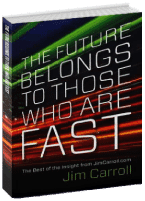
Going forward, the reality of the new economy is that the future belongs to those who are fast. Have you checked your speed?


At the recent Consumer Electronics Association CEO summit in Ojai, CA, I focused on how social networks are coming to have a huge impact on brand perception.

But aside from that main thread, I also concentrated on my message of innovation in an era in which “faster is the new fast.” Here’s an older clip that looks at what’s happening in the world of product innovation.

I pointed out to the crowd – which included the CEO’s of some of the largest digital technology companies in the world — that some product lifecycles are collpasing to ZERO. Case in point — Lenovo announced a tablet computer at the CES show in January. They dropped it after the iPad came to market, perhaps because it was bound to be a dud compared to the feature set of the iPad.

But maybe if they got it out sooner, it could have established a beachhead.

What do you do in a world in which a product is dead before you can get it to market? Innovate faster. Focus on fast. Do fast. Be fast. In the high velocity economy, speed and agility are everything.

I just came from giving a keynote for the annual conference of a major customer loyalty organization, with the talk focused on some of key trends impacting the world of retail today.

There’s certainly a lot going on and a lot to think about. Extremely rapid business model change, the emergence of new competitors, ongoing consumer confidence volatility, rapid product turnover and faster product life-cycles.

So what are they really, really worried about? Let’s put in context the people I had in the room — senior VP’s and managers in major retailers representing several billions in revenue in a wide variety of markets, including pharmaceutical, grocery, consumer goods and electronics. Not to mention quite a few bankers, responsible for credit card portfolio’s, loyalty programs and other customer oriented programs and infrastructure.

Given all that, the top of mind issue is — new methods of customer interaction.

Look at the poll results below. The issue stands out far and away as the most important concern of the day!

Hence, my keynote was bang-on. I didn’t touch too much on the social networking phenomena, as this type of crowd has been drowning in social-networking Powerpoints.

My focus was on interactivity, location, and intelligence,, and the extremely rapid emergence of new forms of in-store interaction and product sales uplift. Things like digital signage, in-store electronic promotional displays, iPod based coups. A flood of new stuff and new ideas that promote new ways of

Listen folks, I know I’ve said it here before, but I’ll say it again.

2010 is the year of location, combined with mobility, and it’s happening faster than you think.

I’m pumped about this topic and the reaction, so I’ve rolled this into a new keynote description:

Location is the New Intelligence: Customer Interaction in the Era of Pervasive Mobile

We’re at the leading edge of the merger of three perfect trends: the rapid and massive emergence of a massive mobile infrastructure with increasingly intelligent devices. Pervasive location awareness as a results of GPS and location intelligence/mapping trends in those very same tools. And a consumer mindset that is increasingly open to new forms of interaction. The result is massive business model disruption, absolutely transformative market change, and complete obliteration of old assumptions as to the nature of the customer relationship. Smart, innovative super-heroes know that this is an unprecedented time to jump on the emergence of location as the new intelligence, in order to provide for new ways of product uplift in the retail space, changing the very nature of customer loyalty through new forms of interaction, and enhancing existing one-to-0ne conversations through a more direct, distinct and fascinating new form of location based relationships. Futurist, Trends & Innovation Expert Jim Carroll is setting the retail, marketing and advertising world on fire with his fast paced insight into one of the most important trends to shape the customer-business relationship in the last few decades. Move over social networking — location is the new intelligence!

Read more: Location is the new intelligence

What do innovative organizations do? They re-orient themselves for an economy in which their ability to react to fast paced change will increasingly define their success.

In this clip, Jim Carroll outlines for an audience of several thousand the key attributes of today’s innovation heroes:

In essence, these organizations concentrate upon:

  • an accelerated innovation cycle
  • the rapid ingestion of new technologies / methodologies
  • faster time to market
  • rapid re-focusing of resources to deal with new opportunity or threat
  • a rabid focus on operational excellence
  • a  rapid response to volatility
  • and a re-orientation to fast paced consumer and brand perception

Jim has studied the innovation attitudes of hundreds of global organizations, and has carefully come to define what it is that allows some organizations to achieve stunning levels of innovation success, while others become innovation laggards. These attributes are a good part of the defining characteristics for success.

What do you think?

What happens when Silicon Valley takes over the innovation agenda within an industry? In this video clip from a recent keynote, Jim challenges his audience to think about what happens in the world of banking, particularly with the likely fast paced emergence of contact-less payment technology based on mobile devices.

Innovative organizations need to make sure that they understand the external factors that will influence their future, and need to react appropriately. And as we enter the era of hyper-connected intelligent devices, with the impact of location-intelligence technology and the rapid adoption of mobile technologies, we’re likely to see every industry — even beyond financial services — impacted.

New business models, disruptive competition, a shift in control, customer churn — everything is up for grabs once Silicon Valley seizes control and defines your future!

A key innovation message that I spend time with my clients focusing upon involves the concept of “thinking big, starting small, and scaling fast.”

(With all due respect, the thought process comes from a customer-service oriented strategy at McDonald’s many years ago, but it is easily extended to encompass innovation in general.)

What does the message imply:

  • think big: identify the long term transformative trends that will impact you. These could include significant industry change, business model disruption, the emergence of new competitors, product or service transformation; anything. Essentially, you need to get a good grounding in the “big changes” that will impact your future over a five or ten year period
  • Continue Reading

It’s big, and its’ getting bigger!

That’s the location intelligence industry, which is resulting from the rapid dominance of location-aware mobile devices, the rapid emergence of massive sources of spatial (geographic oriented information, i.e. Google Maps), the rapid user adoption of location-based applications (i.e. iPhone Apps), and a significant amount of innovative thinking as to how to capitalize on these very fast paced trends.

There’s a lot of people building a lot of new businesses around these trends. And it’s happening extremely quickly:

  • in a just-announced test of location based advertising in Finland, MacDonalds’ has reported that location-relevant mobile ads resulted in a 7.0% click-through rate. Of those who clicked through, 39% then used the click-to-navigate option to find the closest restaurant. These are significant numbers Continue Reading

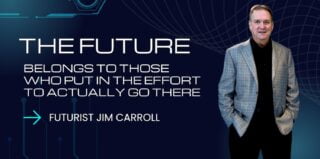
The future belongs to those who are fast — Jim Carroll, from the opening to a keynote to an audience of thousands in Las Vegas!

ToyotaGoldAward.JPG.jpegBack in May 2007, I was invited to be the keynote speaker at the 4th World Conference on Quality and Improvement on behalf of the American Society for Quality; I spoke to an audience of about 2,000 individuals involved in “quality” issues — everything from construction to pharmaceuticals, consumer products to automobiles.

The key premise of my message was that in a world of accelerated innovation and fast paced change, organizations would find that new and more challenging quality issues would appear. The result, I suggested, was that organizations need to pay a new and different type of attention to ‘quality’, since quality issues could now spiral out of control faster than ever before.

(I’ve got the entire keynote on tape, with the slide deck, and might put a few clips up).

Fast forward three years, and we’ve got a situation in which the CEO of Toyota, previously one of the world’s most respected organizations when it came to quality, is on the ropes.

Continue Reading

fm-web_logo.gif
Here’s an article that I wrote for Food Manufacturing on trends in the consumer, food and packaging sector.

I spend a huge amount of my time as a keynote speaker at countless conferences and events, many of them within and to the food, packaging, retail and restaurant sector. I also spend quite a bit of time with smaller, strategy-oriented leadership session designed around the theme of ‘how to innovate in a high velocity economy.’

And I do know that while volatility rocks the economy, some fundamental truths about that velocity remain: the food, packaging and retail industries continue to be subject to dramatic rates of change–and innovative organizations succeed by mastering the pace of this new high-velocity economy.

Continue Reading

How quickly can you scale if you encounter a new market opportunity? How quickly can you react to a crisis. In this clip, JIm takes a look at the concept of corporate agility

2010Faster.jpgWhat should innovative organizations do? When everything is faster still, focus on these things:

  • build up experiential capital – think big, start small, scale fast. The experiential projects are the “start small” part of the equation. Know what you don’t know, and set out to learn those things
  • master collaboration and share: the world is changing too fast, and things are too complex, to do it all on your own. Innovators have mastered the skill of learning from others

Continue Reading

2010FinancialLocationIntelligence.jpgI had quite a few financial oriented keynotes through the last year, for banks, mortgage groups, credit unions and others. If there was a key theme as to the insight my clients were seeking, it was this: what are the BIG trends that are going to impact us (I’m a futurist), and what do we need to do about it (I specialize in insight on what global leaders are doing in the area of innovation.)

The scope of some of these engagements is pretty significant; Diners’ Club featured me as the opening speaker for their global franchise conference; my focus was on the big trends that would impact the organization into the future.

Continue Reading

2009-2010.jpgI’ll be shutting down through the next several weeks from today; I’ll still be picking up email, but my blog posts will slow down till the New Year.

I’ll mostly be hacking away at improving my pathetic abilities as a skier. (Actually, I’m not that bad….)

It certainly was an extraordinary year; I spoke at some 75 conferences, annual meetings and executive retreats. Global powerhouses such as Rockwell Collins, General Dynamics, Burger King, Yum! Brands, Diners Club and National Australian Bank had me in for executive level global meetings.

Continue Reading

A Key Trend for 2010! A huge number of global organiztions have me in to challenge their team to think about how to deal with the increasing speed of change in the world of business.

Here’s a clip from a Las Vegas keynote, in which I speak to the topic of business velocity. I believe that in 2010, a greater number of organizations will need to deal with ever increasing rates of change!

2009BoardingNRPA.jpgThe feedback on my Salt Lake City keynote for the National Recreation and Parks Association continues; earlier in this story, I had a blog entry from a message from someone at the event thanking me for “changing lives.”

The Past President of the NRPA has weighed in with an editorial in Perspectives, the NRPA’s national magazine. Headlined “Anticipating the Future,” Jodie Adams has this to say (excerpted).

Continue Reading

2009FutureFastHalifax.jpgExpectation gaps create tremendous opportunity

Chronicle Herald, November 2009

By Kelly Hennessey, ABC


There are two ways your community can look at the rapid-fire pace of change we are experiencing: Bury your collective heads in the sand and hope it goes away, or embrace the opportunity change presents for transformative growth.

Continue Reading

09Chameleon.jpgI am not alone in thinking we’re in the midst of a significant economic transformation. As Mick Fleming, president of the American Chamber of Commerce Executives, said recently, “It’s going to be a move from a bad economy to the next economy.”

What is the shape of the next economy? In many cases, it will involve structural change based on an acceleration of business cycles. Consider manufacturing, for example. We’re moving from a world of mass production to mass customization, or what I call agility-based manufacturing. I often cite the case of Honda, as noted in a 2008 article on the financial website Bloomberg: “Honda’s assembly lines can switch models in as little as 10 days.” By contrast, the article suggests, it could take months for most rivals to make the same change.

Companies such as Honda can see what’s selling strongly and quickly reorient their production to fit that demand. In the meantime, its competitors are busy cranking out 700,000 versions of the same old car, hoping to sell it to consumers who have already moved on to something different. It’s no wonder Detroit is being killed off by its long-term reliance on gas-guzzlers.

Continue Reading

Here I am speaking to an audience of 4,000 at the National Recreation and Parks Association Congress in Salt Lake City – a keynote in which I challenge recreation professionals to think about the future!

This was the keynote in which I received an email thanking me for “changing lives.” It was a powerful day, a powerful talk, and I’ve got lots more video to share in the days to come!

Here’s a short video clip about the fast future, and a challenge as to how you think about the future.

Which camp are you in?

2009ThinkingFast.jpgBack in 2006, I keynoted the Society of Cable Telecom Engineers at their annual conference in Tampa. At the time, YouTube was only just beginning to have an impact, and social networking was still in a nascent stage. It was January — Twitter wasn’t even around!

But there was a lot of talk at the conference about the rapid rate of change that the cable and telecom industry was facing. My job, as opening keynote, was to get them in the right, innovative frame of mind to deal with an upcoming tsunami of change.

I ended up writing an article for Broadband Magazine, on my keynote theme, Are We Thinking “Fast” Enough? I dug the article out the other day with respect to another upcoming talk within the industry.

Continue Reading

UA-117171-1

Powered by Web Design Company Plugins