The solar thermal industry employs at least 624,000 people worldwide

Home > Archives

Gen-Y & Gen-Connect

67% of Gen-Connect admit that on their very first day on a new job, they'are already thinking about looking for another job!


Many of my keynotes and leadership meetings in dozens of industries and corporate events involve a good, hard look at serious future trends. It’s a lot of work, takes a lot of research, but is a hugely rewarding “job.”

And then, every once in a while, something completely different comes along. So it was with a major US financial company that was holding the 30th anniversary of their key customer meeting. And since they’re somewhat in the IT business, they wanted a keynote that looked back in time, rather than looking forward. Something fun, engaging, and which would help folks have a good laugh at the unique experiences baby boomers have been through over the last 30 years. As it turns out, they found me, through one of the speakers bureaus that represents me.

The results was a rollicking, hilarious 45 minute keynote based on lots of my material from one of by books from the 1990′s: Surviving the Information Age, but a lot more material that I’ve developed and have used on stage over this 20 year career as a speaker.

Here’s a great clip — where I’m talking about how quickly our world is changing, as things that are a part of our lives have become things from the “olden days” — and it has happened before our very eyes.


The entire keynote was a blast. I’m going to do a few minor edits and will put the entire thing up online over the next few days. Let’s have some fun with it!


Late last year, KOA (Kampgrounds of America) brought me in to keynote the annual franchisee conference in Orlando, Florida.

There’s a lot of change in the world of camping, and KOA is in the midst of a re -branding exercise. They liked me because I promised, as part of my preparation, to do a lot of original research on a wide variety of trends impacting the ‘outdoor hospitality’ industry. And I did!

Here’s a little gem on why there’s a decrease in the amount of camping that you people do. Kind of fun to watch!

Was it a good talk?

The feedback has just come in, and the clients comments are just absolutely thrilling:

Jim Carroll’s session with our franchisees was extremely timely and exactly what we were looking for.  Based on where we are in our system and the changes and innovations we are implementing, we could not have selected a better speaker.   One of the things that made Jim’s message so powerful for our franchisees was the amazing detail and customization Jim included in his session.  We’ve gotten a great reaction from our franchisees and I’d highly recommend Jim to any franchisee system looking for a message of change and innovation delivered with a lot of great energy and humor.  He was great!” Mike Booth, Assistant VP, Franchising, KOA Franchise Services

and

Jim Carroll was fantastic!  He was funny, well organized, and communicative.  The effort and detail he put into finding out about our industry and our franchise system made it possible for him to connect immediately with our franchisees.  He was by far the easiest speaker we have ever worked with and anticipated our needs every step of the way.  I’d recommend Jim to anyone looking for a futurist who delivers an outstanding presentation – in both relevant content and a dynamic and fun delivery style.  We loved him!” Jenny McCullough, Director of Training and Events,KOA Franchise Services

I think the thing which really makes me stand out in the market is the effort, research and customization I put into my keynotes. You can read about this: I wrote a blog post some time back, “What Goes Into Building a Great Keynote?

In May, I was the opening keynote speaker for Manufacturing Innovation 2012, held in Orlando, California. In the room were a thousand or so folks from throughout the manufacturing sector throughout the US. This is one of MANY manufacturing conferences that I’ve opened — I’ve developed a reputation in the sector for what is really going on, without any political spin.

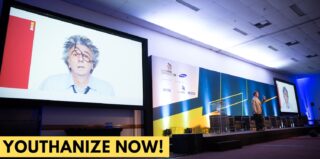
Here I am speaking about the next generation -today’s uber-connected generation –  and how their attitudes towards careers and new business models — are coming to reshape the world of business startups and manufacturing.

A report from T. Rowe Price on my recent keynote for the 2011 Investment Symposium follows, where I was one of three keynote speakers (the other two being Colin Powell and Charlie Cook). You can find some blog links to each of the three key themes in the article at the end of the article below.

""We thought Jim was amazing - just the positive message we wanted to leave folks with"

It was a fabulous event, and a great opportunity to get a pretty impressive audience — investment managers for a broad range of investment managers for a broad range of Fortune 1000 organizations, pension funds and government agencies.

Summary:

Futurist Jim Carroll, one of the world’s leading experts in global trends and innovation, described how advances in technology and human innovation will combine to create positive change in the future. He explained how businesses can be held back by what he calls “aggressive indecision”— postponing action because they are constantly waiting for economic conditions to improve. Carroll noted that as the pace of change accelerates, the companies that prosper will be those that can adapt and innovate most quickly.

Key Points

  • Long-term trends that will lead us into the future. Silicon Valley is redefining everything—industries that get involved with Silicon Valley will be brought up to their speed. One powerful trend is pervasive interconnectivity—the fact that electronic devices are connected and can communicate with each other—as a driving force. For example, a staid industry such as air conditioning and heating benefits when people can control their entire home environment remotely through a cell phone. On the health care front, sensors can monitor the activities of seniors and report any changes in behavior, allowing people to live independently longer. On a more dramatic note, he believes advances in exploring the human genome will change medicine’s focus from reactively treating disease to proactively searching for potential health problems before they occur.
  • The paradox of pessimism and reality. While many business people are pessimistic about the future and believe economic recovery is at least two years away, technological advances are creating the potential for greater productivity and efficiency. For example, the auto industry now has the flexibility to produce in response to demand instead of building huge inventories that may go unsold. Products can also be brought to market much faster to take advantage of changes in consumer tastes.
  • The next generation. The next generation has grown up with rapid advances in technology, so they are at home with change. This familiarity means young people will greatly increase the rate of innovation as they enter the workforce. This group is not afraid to take independent action—50% believe self employment offers more job security than working for a company. The next generation will receive $12 billion to $18 billion in intergenerational wealth transfers in the next 12 years alone, which could help fund their ambition.

More information:

  • Major 10 year trend: The future of every industry to be controlled by Silicon Valley Innovation  
  • The new face of manufacturing: agility, insight and execution 
  • Creativity and the new workforce 


Creativity and the new workforce
November 15th, 2011

Jim on stage in West Palm Beach, Florida, with a keynote for the Personal Care Products Council. He’s just been asked a question about of his previous observations that new workforce dynamics might drive faster innovation.

For more on Jim’s insight on this topic, check the Gen-Y & Gen-Connect category of this blog.

What happens when you ask 200 high school students to do EXACTLY what they’ve always been told to NEVER do — take out their cellphones and start texting!

You get some fascinating insight…. from the instant text message polling system that I use in all my keynote presentations.

Such was the scene the other day when I ended up doing a rather unusual kind of keynote — a talk about the future of careers for my son’s grade 12 Science & Technology program. I normally find myself on stage in front of senior level business executives in Las Vegas, Orlando .. and just previously this week,the CEO’s of a few global organizations with two events in Washington, DC.

My son asked if I could speak to his group, and we picked a date in the schedule. The theme? How would future trends impact their career – and what should they be thinking about in terms of future career and skills flexibility.

What a wonderful session! There was absolute shock in the room when I asked the students right at the start, seconds in, to take out their phones. We were going to do a live text message poll, I told them — and there were absolute murmurs of excitement.

My first question to them? The poll put to them asked if they had any degree of certainty on “what they wanted to be” when they grew up. The results weren’t unsurprising.

You can watch this section from the keynote in the video clip below; it is quite fascinating to watch the mechanics of the poll as it unfolded.

Later during the session, I asked them how many careers they thought they might have throughout their lifetime

This generation gets it — by far the vast majority knows that they will have multiple different careers throughout their lifetime.

Next up? How many jobs might they have?

Bingo! They definitely know that they are going into a workforce that will demand a lot of change and flexibility!

Last but not least, we spent some time looking into the concept of innovation. Check out what they think are some of the attitudes that most often hold them back from exploring new ideas:

Which begs the question: do their older peers discount their ideas and insight all too readily? There’s lots more to explore from this unique day, but I thought the results of the text message polls were particularly enlightening.

Watch the clip and see the fun unfold… (you might need to turn up the volume; we’ve got to adjust the audio a bit and are working on that!)


A classic clip from the first season of Mad Men. Could we not have a more inappropriate clash of the generations in the workplace? A more inexplicable view of the clash of generations in the world of politics? Consider how quickly an entire generation has changed global politics – Egypt, Tunisia, Syria, Lybia..

The key line comes in at about 1:42 into the video.

Back in 2003, I wrote this into this blog, in a piece about trends and the future:

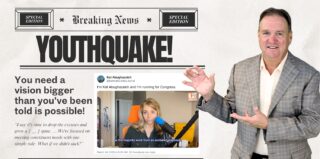
Kids are about to become politicians. That‘s right — the “Napster generation,” raised on computers, instant messaging and file swapping will come to make their presence felt on the political stage through the next decade. There is no doubt that they have views that differ from those of their forefathers. They carry with them an entirely different set of values and beliefs, and vastly different perceptions of what is required in terms of the laws and regulations that guide our society. The result? On the political, economic and social stage, we‘ll see an increasing generational dysfunction that will challenge business markets, industry structures, and accepted business norms. Smart organizations will work to understand the political and moral views and perspectives of this generation, and will take the time to learn how to tap into their uniqueness in order to thrive.”

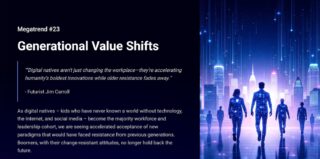
Take a look around you. Egypt and the Middle East, Africa … significant political transformation driven by a generational desire for change. The corporate world – business models under siege from disruptive thinking, social networking, transformative ideas driven by a younger generation that has never known a world without connectivity.

Then ask yourself this question: as a leader, are you permitting some type of generational divide to stifle and kill your ability to innovate? Do you have your own Mad Men culture, some sixty years after the time-period that this video clip represents?

Just asking!

In a clip from his keynote for the 94th Annual General Meeting of the PGA, Jim takes a look at the challenges the profession and industry must face in trying to reach out to the new demographic — the socially networked generation, and what Jim calls “Mom 3.0″.

It’s a good look at trends with member-based organizations, and the impact of social networking in general.

Here’s a clip from my 2010 keynote in Tucson, Arizona on the future of the workforce. It covers everything from generations in the workplace, the future of outsourcing, and the impact of specialized skills.

The best part? The story of a snowboarding kid who turned down a job because it messed with his time in the powder!

It’s a true story, and tells you much of what you need to know about the future of the workforce. Make sure you read the PDF story, “Don’t mess with my powder, dude!

I’ve got a new Web traffic monitoring tool – Re-Energize — which is quite wonderful! And every day, when I look at how people are finding my site, it’s become quite obvious that a lot of traffic comes in for people looking for information on the sport of ‘zorbing.’

Why do they find my site? Because back in 2008, I wrote a blog post, “Zorbing – And Why It’s In To Be Out.” I guess the search engines have ranked it highly, particularly for the picture! It gets a LOT of traffic.

What is also interesting is that for years, I’ve been using the story of zorbing on stage for years, often in the context of what I’ve come to call “the big global idea machine.” Here I am on stage with that theme — and a story on zorbing – from an event in Salt Lake City for a few thousand people:

What is another way to think about the big global idea machine? In my overview of “What Do World Class Innovators Do That Others Don’t Do?”, I made the observation that “world class innovators focus on ingesting fast ideas: there are new technologies, business models, customer trends, product developments, scientific advances and countless other things that are increasing the pace of change. Innovators know that if they plug into the global idea machine, they can constantly discover a tremendous number of insights that help them to move forward.”

Kids today spend some 7.5 hours a day engaged with some type of media; with with multitasking, that’s 11 hours of screen time per day, or almost  53 hours a week, according to the Kaiser Family Foundation!

That’s more than a full time job, and more time than their parents spend at work.

Here’s a video clip where Jim was the opening keynote speaker for the 2010 US Navy, Air Force & Marine Child Youth Program Conference in Dallas, Texas, putting these numbers into perspective and speaking to the new realities in providing support services today.

When you’ve got 4,000 people from large cities and small towns across America, thinking about how to solve some of the big problems faced by society, you can suggest small ideas, or whacky ideas. Here I am on stage, with a suggestion involving the latter.

More information:

  • PacManHatten

During a CEO strategy session last week in Miami Beach for a major global publisher, I outlined that one of the key areas of focus for innovative organizations is effective “generational collaboration.”

There’s no doubt that the transformation in politics in the last year is due to the way the “next generation” has utilized the technology tools they know to effectively steamroller the opposition. This is an extremely transformative trend that will impact every industry through the next ten years. It is perhaps the MOST transformative trend.

In how many organizations is senior management being similarly blindsided by rapid developments and a dramatic power shift as the next generation pursues their unique ideas, utilizing the power of social networking and other technologies?

Does your organization leadership team really understand the vast transformation that is underway in the economy as Gen-Connect asserts itself in the workplace, within business models, and within corporate structure?

In my Ready, Set, Done: How to Innovate When Faster is the New Fast book, I opened with a chapter that explored this phenomena in the context of ‘generational dynamics.’ Titled Cardboard People, Plasma People.

It’s well worth a read.

If it strikes a chord with you, pick up a book with the little widget above, and it will be shipped to you within the week.


More information:

  • Read Cardboard People, Plasma People

Virtuality.jpgA few weeks ago, I arrived in my hotel room, and connected back to my home office via Skype. I found my sons using my Mac (long story!), and proceeded to have a one-hour video conference with them.

During this time, I ordered room service, my dinner arrived, and I ate it. All this time they played a variety of video games, worked on homework, and I unpacked my suitcase and organized my stuff.

All the while, we chatted back and forth. My youngest son made a comment at one point: “it’s just like you’re at home.”

That’s the thing about this next generation and their concept of “where is “there”.” To date, few organizations have really taken to videoconferencing and other forms of virtuality ; yet as today’s 15 year old enters the workforce in the next decade, that is all set to change.

One of the most significant trends I cover in my “What Comes Next” trends perspective is this one: “Resistance retires.” It’s worth a read — simply put, within 10 years, much of the workforce will have grown up with technology, and the pace of how different the workplace, workforce, structure of the organization, structure of the working day, and everything else, is just going to be torn apart and rebuilt.

You can see the signs of the aging of Gen-Connect with today’s new “wired soccer mom.” Alabama’s Times Daily just ran an article examining the phenomena, and I’m quoted liberally thorughout the article:

Jim Carroll, a futurist, trends and innovations expert, said moms between 25 and 32 grew up right along with the technology that enables them to communicate via text.

“It’s technology that’s been around for between 10 and 12 years, so they probably started texting when they were kids in nightclubs, and now they’re the parents with little ones,” he said.

For those who didn’t grow up with it, texting might not ever catch on, Carroll said, and e-mail will remain the way to communicate electronically.

Already, text messaging, which is known in the wireless world as SMS, or short message service, has been adapted for weather and safety alerts on college campuses in the U.S. as well as a violence prevention tool in Kenya, Africa.

So much of this, Carroll contends, is a result of people such as his 12- and 14-year-old sons growing up using the technology and finding ways to apply it in the real world.

“We’re seeing this come into the work force and influence the way we think, act and communicate, and you’ll see that these younger users won’t think a thing about sending a text to a peer in the business community or even a young doctor preferring to send a text to a patient,” he said.

The key point is, anything is on the table, and were in for massive changes in the workplace because of simple demographic change.

More information:

  • The reality of future trends: grab the What Comes Next trends overview

My blog post of a few weeks ago caught the attention of the folks at the Canadian Society of Association Executives — and so I quickly rewrote it to challenge their members to think about the role of “associations in the future.”air-guitar.jpg

Here’s how I open the article: “Things are happening very fast out there in the world of business, as they are with associations. Are you witnessing turmoil within your membership base? A challenge attracting the younger demographic? Lower attendance numbers at conferences and events? More information than ever that has to go to your membership but increasing challenges in getting it to them?Is your association brand becoming a bit “tired” instead of energized? Do you have a consultant studying the role of your association and how you might need to change it in the future?

Probably so, and here’s the thing.

You’ve got to do all that, except you’ve got to do it faster. That’s why you need to keep innovating, and make that a key part of your leadership role.

The challenge with association leadership today is ensuring that you stay on top of, and ahead of, fast paced trends. That’s why I focus on innovation in the broadest sense. Innovation isn’t just coming up with the next great iPod — it’s asking yourself the hard questions, and always challenging yourself to do something different to deal with the realities those hard questions pose.

If you aren’t attracting 25 year olds as members, why not? And how do you fix that? By innovating — by trying to do something differently!

  • Read The Secret for Association Executives: Study Air Guitar!
  • Read Led Zeppelin Leadership: How to Innovate When You’re Dazed & Confused

gen-connect2.jpgOne of my latest columns focuses on what will likely be the corporate issue of 2008 – managing generational challenges in the workplace.

In the column, “Here we are now, entertain us,” I take a look at the unique attitudes that Gen-Connect is now starting to bring in to the workplace. There are several key observations from the article that are critical to understanding the future of the workforce:

  • What is clear is that we are witnessing the death of the long-term career and corporate loyalty, which will soon be but a quaint memory from the previous century.
  • I often tell the story of a young engineering graduate who turned down a job with an architectural firm because its 9 a.m. to 5 p.m. work hours conflicted with the time he expected to be carving arcs into deep powder in the mountains. It’s a real attitude, and it’s already happening around us. The challenge, when such trends are so patently obvious, is trying to figure out what to do about it. And a good part of the solution will come through the transformation of rewards and remuneration.
  • Gen-connect has very little patience, particularly when it comes to being rewarded for good work or significant effort. These youngsters are used to instant rewards: their Xbox/Wii video-game-oriented world has them accomplishing a goal, moving up a level, and earning some points or other valuable form of currency that helps them accumulate additional armour, weapons or whatever else is needed to accomplish the game’s next challenge.
  • That’s why, at a recent conference, I framed the issue of rewards transformation to an audience of financial professionals this way: “Organizations that can attract, engage, retain and amuse an increasingly complex workforce will be the ones who find success in the rapidly evolving global economy.”
  • Put the emphasis on the word amuse. Today’s Gen Y doesn’t, and tomorrow’s Gen-connect certainly won’t, have any patience whatsoever for slow and steady career paths.

Related postings:

  • Article: Here We are Now, Entertain Us
  • Related article: Don’t Mess with My Powder, Dude!
  • Keynote topic: What’s Happening with Our Workforce: Achieving Competitive Advantage Through Skills Agility
  • Critical Trends Analysis: 10 Unique Characteristics of 21st Century Skills
  • Can you innovate across the generations? If you can’t — then you’ve got a big problem to fix!

    I do a tremendous number of keynotes that focus on the issue of “managing millenials,” and the complexities of change occurring in the workplace. See, for example, my blog post, “Don’t Mess with my Powder, Dude.” (below)

    Yet organizations need to move beyond the staffing issues that come with new generations: they must also ensure that they can innovate at the rapid rates demanded in our new world, and they need to do that by keeping up with the new ideas and innovations occuring with younger staff.

    In this video clip, I take a look at the story of the “plasma people” and the “carboard people.” Innovation occurs when different generations — with different attitudes to change — can cooperate and see eye to eye, and take advantage of different strengths. In this clip, I tell tjhe story where this clearly wasn’t the case!

    This is a video clip from a recent keynote that I gave for hundreds of executives from the grocery and consumer products industries, titled Faster is the New Fast: Innovating for the New. High Velocity Customer . This story also became the opening chapter in my book, Ready, Set, Done: How to Innovate When Faster is the New Fast.

    Related postings:

  • read Don’t Mess with My Powder, Dude!
  • Can you run your business at video game intensity?
  • High velocity retail innovation
  • Creativity, trends and innovation in retail, packaging & consumer goods
  • workforce.gifLast week, there was a common theme to my keynotes for the University of Oklahoma and for the national Blue Cross Blue Shield Association : “what’s happening with our workforce?”

    There is an intense degree of interest amongst executives as to the extent of the looming skills shortage, how to retain and attract critical skill sets, and how to deal with the challenges of the next generation.

    I’ve rolled this into an overall keynote topic: “What’s Happening With Our Workforce: Achieving Competitive Advantage Through Skills Agility.” In these types of talks, I’ve been taking a look at a wide variety of trends:

    • every organization is faced with an increasingly complex, restless, age-diverse disloyal, and highly specialized workforce — and a workforce that will have the longest life-span ever, from hyperactive 15 year olds to wizened, not-ready-to-quit 85 year olds.
    • with the coming “end of retirement,” most companies will come to realize they’ll need a lot of telephones with big buttons for members the 70+ folks who are still a part of their workforce — and a lot of innovative workplace practices as well
    • the arrival of “Gen-Connect” — the kids who have been wired with a mouse since birth — will lead to the question of whether “good luck” will be the only possible response to the question of “Managing Gen-Y.”
    • this workplace weirdness will only be compounded by the ongoing rapid evolution of knowledge and skills, such that most organizations will find it impossible to find the highly specialized skills needed in the economy of the future
    • The “War for Talent” will be the new competitive battleground, and organizations that can attract, engage, retain and amuse an increasingly complex workforce will be the ones who find success in the rapidly evolving global economy.
    • in an era such as this, firms are faced with a future that requires a new form of human capital agility: the ability to deploy the right skills at the right time for the right purpose — regardless of where the skill might be required, or where the skill is sourced
    • at the same time, organizations are faced with an increasingly global talent base, a reality that demands new forms of collaboration, insightful project management, and deep insight into the effective utilization of those skills. The way to the future is clear: the no longer about managing time: it’s about successful skills deployment

    I’ve captured these thoughts on the workplace challenges of the future in a recent Trends Overview: 21st Unique Characteristics of 21st Centuries Skills, available here.

    Given the number of calls that I receive, this is certainly one of the hottest topics for 2007!

    The future of skiing
    January 22nd, 2007

    peaks.jpgRight straight from 85F+ temperatures on the beach in Grand Cayman, to 0F on the shores of Georgian Bay — it was time to get back on the ski hills!

    Over the weekend, I found that an interview I had with a newspaper reporter in Colorodo, on the future of skiing, has run in an article that has been carried throughout the US. There’s a copy of the article, “Technology has transformed skiing, and there’s more to come,” at the San Jose Mercury News, for example. The full article can be found here in Adobe Acrobat format.

    One of the key aspects is that of merging work and life. Notes the article: “Imagine a skier from 50 years ago surveying the scene in a modern lift line. What would he think of iPods wired into jackets? GPS wrist units? Cell phones with cameras? Digitally scanned lift tickets? Polarized contact lenses designed to cut snow glare? PDAs that allow skiers to check in at the office while they’re on the lift? These innovations have shaped the sport and will continue to do so, believes Jim Carroll.

    Carroll, a noted futurist who lives outside Toronto, Canada, says the concept of a work/life balance is a major trend that will continue.

    He shares this story: “An engineering company was trying to hire this engineering student in British Columbia, near a bunch of (ski) resorts.

    He turned their offer down. They called him back and were mystified. He said, “You talk about your 9 to 5 culture; that would mess with my powder time.” The way younger people define themselves has changed, Carroll says. “They don’t tell you what they do for a living, but what they do.”

    Carroll sees a ski area in the future “with a lot more people hanging out at the hill with a little portable office, doing their thing.”

    doctor.jpgI woke up this morning with a pretty big sty on my eye; I could feel it coming on last night. Big, puffy, and sore : I couldn’t get my contact lenses in, which is kind of a drag since I do a talk for SAP today (Theme: Velocity, Agility, Complexity and Flexibility: The Four Key Drivers for Competitive Advantage: more on that to come.)

    At 6:45am this morning, I went down to the home office, and e-mailed my eye doctor asking what I should do. At 6:47AM, he emailed me back with a few suggestions, and advised me to come in at 9:30am. Talk about customer service!

    My eye-doc is a bit younger than me — and he’s grown up with technology. In terms of his medical practice, he has always been at the leading edge of the curve in terms of adoption of new equipment and technology. He has had quite a consultative approach with me through the years, taking a cumulative series of hi-resolution digital pictures of my retina for example, in order to be able to show me the slow and steady (and normal) impact of aging. (And, in effect, helping me get over the fact that I increasingly need to use reading glasses.)

    So it is with his rapid response on e-mail; he commented in our exchange this morning that “instead of a Blackberry, I use an ultraportable Thinkpad. Wireless at home, wireless at work, wireless at Starbucks — the 3 places where I live 95% of my life. :)

    As a medical professional, he’s wired up, interactive, and providing a different type of medical service. To him, interactivity with the patient is a good thing, and all part of the service. That’s innovation right there.

    The 21st century medical professional is:

    • collaborative: the patient is a partner in the process: they know we are empowered with information, and they work with us to help us understand how to best use it given our medical circumstance
    • responsive: yes, they have a life. They use technology to balance how they spend their professional and personal time, and in doing so, provide rapid customer service.
    • interactive: the online world plays a key role in the service element; from e-mail appointments to a prescription that includes an online information source
    • progressive: there’s a flood of new ideas and methodologies coming into the world of medicine. They adopt it, understand it, and utlize it to improve health care delivery

    I wrote about this trend with my Future Medicine: Prescriptions for 21st Century Health Care overview, noting that one of the 10 biggest trends to impact health care in the future will be the impact of such interactivity on medical delivery: “ The entire medical system is set to be transformed with the entrance of GenConnect (those born after 1990) into the health care system. As they take on careers as medical professionals and administrators, they will bring with them a flood of new ideas, innovation and different ways of thinking. Health care institutions currently clogged with organizational sclerosis cannot keep pace with today’s demands. But GenConnect’s aggressive attitude towards change will quickly break down this sclerosis.”

    As the Gen-Connect generation — the ultimately wired crowd — gets involved in health care delivery, we are going to witness a massive and significant transformation of the system. And that can only be a good thing!

    Read Future Medicine: Prescriptions for 21st Century Health Care

    EyeDoc: Port Credit Optometrists and Dr. Peter Rozanec

    Performance Optimization WordPress Plugins by W3 EDGE