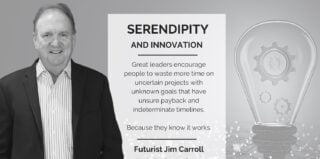

“Don’t be someone who asks “what happened?” — make things happen. Change your attitude, and you’ll find that things really can improve. The next year is full of opportunity, and it’s yours if you want it!
”
A quick little video from a keynote in which I outline what organizations often do — with good intentions that go horribly wrong.
Think about what happens — suddenly, a message is established that only ‘special people’ on the ‘special team’ are responsible for innovation.
Here’s what I wrote in What I Learned From Frogs in Texas — which, by the way, you can now buy for your Kindle from Amazon or for your iPhone/IPad on iTunes.
Three Simple Ideas
The essence of innovation is really quite simple. It is all about coming up with new ideas that help you to run the business better, grow the business and transform the business. But it isn’t just about idea generation—innovative companies excel at implementing these ideas and making them work.
Let’s examine each of these areas.
Run the Business Better
There is plenty of opportunity in every organization for operational innovation; that is, doing what you can to “run the business better.” This type of innovation involves a continuous effort to change, improve and redefine business processes, whether they involve customer service, HR practices, logistics and shipping methodologies, purchasing processes or just about anything else.
Never think there isn’t huge room for improvement—most organizations are inherently inefficient, with outdated or illogical processes in place. There is countless potential for improving the way organizations work, and plenty of opportunities for innovative thinking with respect to the way things are done.
Add it up and look at the benefits from doing things smarter or more effectively and there can be a huge return.
Grow the Business
Second, make sure you understand the opportunities from “growing the business,” or what might also be called “revenue-focused innovation.”
Most often, new revenue comes from new products and the ability to enter a new marketplace. Yet that isn’t the only way to enhance revenue. Think about business model innovation, for example: new business ideas involving expansion in existing markets or new ways of reaching the customer that weren’t previously possible (or that no one had thought of before).
Revenue enhancement can also come from changing the nature of existing products, such as adding a service component to a product that can bring in additional revenue. It might involve enhancing the perceived image of a product so it is more valuable to the customer, resulting in the customer being willing to pay more for it.
The key is, don’t think about “growing the business” and revenue enhancement as simply coming from new products or new markets; there are plenty of other methods for innovative thinking that can lead to revenue enhancement.
Transform the Business
Last but not least, always keep in mind the concept of “transformational innovation.”
Transformational innovation involves taking a look at the way the organization is structured, and thinking how it might be able to work smarter, more efficiently and with better results by changing the skills makeup of the organization. It involves constant, probing questions that continually assess the organization and its skills, such as:
Do we have the people we need in the right places/positions?
Do we have the right people with the right skills available at the right time?
If we are suddenly faced with rapid market change, do we know how to access specialized skills and talent we might need?
With the global connectivity that has emerged over the last few decades, there is plenty of opportunity to do today what couldn’t have been done even five years ago, in terms of how an organization accesses the skills, resources, talents and capabilities that it needs to get the job done..
Organizational transformation also recognizes the concept of “partnership” as a key corporate structure for the future. In a world of mammoth complexity and constant change, organizations must focus on their core competencies and partner with others to accomplish the things they cannot or should not do. In essence, they must recognize that the path to the future is to concentrate on what they do well and on what is critical to their central mission, and to seek partners to help out with everything else.
It was a busy September, with keynotes and leadership events for the likes of PPG, the Utah League of Cities and Towns, St. Joseph’s Health Center, Transcontinental Media, the Ohio League of Bankers, the Illinois League of Financial Institutions, the Minnesota Hospital Association CEO Summit, Allied Solutions and many other events.
A common theme for many of the keynotes I’ve given for senior executive events at these groups has been the focus on ‘what do world class innovators do that others don’t do?” In that context, there are several key themes I’ve been relentless on:
fast beats big: we have never lived in a period of time that has involved such rapid change with business models, competitive landscapes, product and service innovation, challenging consumers, a new political dynamic, and countless other new realities. World class innovators are those who move fast, get things done, and keep getting things done.
bold beats old: all around you right now, there are countless numbers of people and organizations who are out to mess up your business model. They’re making bold steps, aggressive moves, and big decisions. This is not a time for timidity; it’s a time for BIG ideas and the pursuit of the offbeat
velocity trumps strategy: careful strategic planning can be a critical step in adapting to the future, but in some areas, things are happening so fast that you can’t take the time to strategize: you just need to jump in and go. That’s experiential capital it’s one of the most important investments that you need to be making now. Understand what it is, and why you need to be investing in it NOW.
flexibility beats structure: successful innovators have mastered the ability to form fast teams: they know their that their ability to quickly scale resources to tackle fast emerging opportunities or challenges are the only way that they can win in the future. They avoid the organizational sclerosis that bogs too many organizations down
disruptors destroy laggards: step into any industry, and there are people who are busy messing about the fundamental business models which have long existed. Start your own disruption before you find yourself disrupted
connectivity is the new loyalty: with the forthcoming dominance of mobile technology in everyday lives, everything you know about customer relationships is dead. Right now, it’s all about exploring and building new relationships throughout the mobile data cloud in which the customer lives. If you don’t get that, your brand is dead.
location is the new intelligence: withconnectivity comes location, which results in new applications, business models, methods of customer interaction, and just about everything. If you don’t have a location strategy for your business, you really don’t understand how quickly your world is changing around you
For more on this thinking, check out the ‘innovation’ tag on my blog.
Welcome to the folks from FarmSecure – Great to see you here!
Over the last fifteen years as a futurist and innovation expert, I’ve spoken to a tremendous number of agricultural groups. This has often included large groups of farmers, attending an event where I’ve been asked to speak at a community economic development event.
These talks have long involved a lot of research into key agricultural trends. And one thing I’ve come to appreciate is that farmers can be some of the most innovative people on the planet. Here’s a video clip from a keynote to a US Military conference in Dallas — yes, the military — and I’m describing to them the unique innovation insight that can be learned from farmers.
I’m now into a bit of a slow stretch for some summer; postings here will be slow for a time.
Years ago, inspired by similar times, I wrote about how innovation thrives in the building of sandcastles. It was a great post — and it made it into BusinessWeek. I thought it a fitting post to leave here while I’m busy doing other things — such as building sandcastles.
With that line of thinking,. here’s my list of “10 Reasons Why Innovation Thrives in the Building of Sandcastles: and What We Can Learn From Such Creativity.”
Hierarchy has disappeared: In most cases, there isn’t a boss, a reporting structure, or anything else that can cause organizational sclerosis. People just pitch in and do what needs to be done. The lack of a hierarchy is implicit to most successful teams.
Creativity is implicit: Anyone can build a sandcastle. There are no rules or preconceived notions, other than some sand and water. The same thinking should drive corporate innovation efforts. Make do with what you’ve got and what you can find, and use creativity as your main asset.
If it doesn’t work the first time, do it again: It’s inevitable that a rogue wave will destroy your work. This only encourages you to fix the design, or rebuild it altogether. Setbacks are meaningless, and indeed, are part of the plan.
Experience doesn’t cloud insight: Parents listen to kids, kids get bored and move on to another rampart and do something awesome. The key to sandcastle building is the combined insight of several different generations: likely one of the most important foundations for success in corporate innovation today. (See my 10 Ideas post for more on this theme.)
Everyone picks up on the passion: People just join in and help to build. Eventually beach-neighbors join in, and the growing castle becomes a big collaborative effort. Organizations that can build similar levels of interest in the concept of innovation don’t simply succeed: they exceed!
Feedback is instant: You know right away how well your design works, particularly if it is at the waters edge, since everyone will make a comment on it as they walk by. That parallels’ the instantaneity of today’s markets: things are changing so fast, that you must have a constant ear tuned in to understand what your customers are telling you.
Competition is easily scoped: Need new ideas? Want to learn from the competition? Spend a few minutes walking up and down the beach and check out the other sandcastles. Study their design, their assumptions, and see how you can improve upon them. Do the same in the corporate world: develop a finely tuned radar that signals to you how and where your world is changing.
No idea is too dumb: There’s not a lot of criticism and bias in the building of sandcastles. Any idea is welcomed. People can contribute the skills they have. Everyone is a designer, a builder and an owner. Somehow the combination just works.
The reward is clear: At the end of the day, a great sandcastle provides a sense of accomplishment. Photos are taken, and the team talks about the experience. That’s why every innovation effort needs to be celebrated, highlighted, and championed into the corporate record.
It’s fun: Enough said. If an organization approaches a problem the same way, innovation and creativity can thrive.
With all the keynotes I do, I spend a huge amount of time on airplanes — and often end up going through a lot of video. As of late, I’ve seen a number of rock documentaries, and was struck by some of the unique innovation stories in these films. And so I’ve put this list together!
Start with the slide show on the image below: use the right arrow key to advance through the list! (SLIDESHOW)
You can also continue reading the list below.
#10 Woodstock: 3 days of peace, music …and love
They figured out the HP InkJet business model, long before we even had personal computers
Innovation is all about risk, and Woodstock Ventures Inc. was all about risk. Everything went wrong — problems with ticket sales, the decision that the concert would have to be free, last minute problems that forced a change in concert location which drove up costs. They lost a ton of money on the concert — but made it up in spades with the film and album. Which is an innovation model that many would follow years later, with companies giving away printers for free, and making gazillions off the ink they would later sell you!
Key innovation lessons:
Not every business model is certain: and sometimes, the success you achieve won’t be from what you anticipated
Stephen Stills on fear: “This is the second time we’ve ever played in front of people, man, we’re scared shitless.” Most innovators are!
#9 The Sex Pistols: The Great Rock & Roll Swindle
Innovators often achieve massive brand success by being at the right place at the right time
Love them or hate them, they were certainly one of the most innovative rock bands of all time. They didn’t respect convention: they tore it up. They didn’t do PR — they redefined PR through their television appearances. They didn’t shy away from controversy — they created it. In a world of massive competition where brands are trying to stand out, maybe there’s a little bit of PR that everyone can learn from the Pistols.
Key innovation lessons:
In today’s business social networked world, controversy stands out. I better the Pistols would have more Twitter followers than anyone on the Planet. Then again, maybe the social universe would just look at them as a bunch of wankers
#8 Wayne’s World
Innovation means dreaming big, trying hard, and if at the end of the day it didn’t work out, it will still be worth the effort!
Ok, so they weren’t a real band, and it’s not really a rock documentary, but it had to go on the list! Did you live the Wayne’s World experience? I did, as a part time roadie for two Kiss concerts during the 70’s. I crack up every time I see the Alice Cooper scene: that was me with the ‘backstage pass.’ Wayne’s World is an innovation inspiration simply because of the enthusiasm and inspiration that these two misfits carry about with them as they pursue their mission. of achieving great success!
Key innovation lessons:
Goal oriented: “Let me bring you up to speed. My name is Wayne Campbell. I live in Aurora, Illinois, which is a suburb of Chicago — excellent. I’ve had plenty of joe-jobs, nothing I’d call a career. …… OK, so I still live with my parents, which I admit is both bogus and sad. But at least I have an amazing cable access show and I still know how to party! But what I’d really love is to do “Wayne’s World” for a living. It might happen, tsshyeah, and monkeys might fly out of my butt.”
#7 The Clash Live: Revolution Rock
Innovators constantly mix it up, change, evolve their product and style, and never go stale.
If a band can go from punk to reggae-oriented punk with a touch of Spanish flamenco, it’s certainly a leader in innovation. And Clash excelled as an innovative band because it’s music and lyrics also tied into the rage of the region: “Guns of Brixton” will always be a classic commentary on the mood of Britain during the race-infused riots of 1979. They came to influence everyone from the Beastie Boys to U2 to Green Day. This documentary shows them during their early years, full of energy, drive and innovative attitudes!
Key innovation lessons:
Each and every transition the band made involved a huge leap in musical style and focus – they were naturals at innovation
“Their music is an influential now as when it hit the scene some thirty years ago”
#6 Rush: Beyond the Lighted Stage
Real innovators stick with what they believe in, despite what they are told by others
When Rush first appeared on the scenes in the 70’s, they were told by lots of folks that their music — cerebral, deep, and complex — would never appeal to a big audience. They went on to record 2112 and instantly endeared themselves to an audience of hundreds of millions, becoming one of the biggest rock bands of all time.
Key innovation lessons:
Don’t always listen to the experts:
There always exists a market for a product that is unique, complex and unlike anything else out there! Product differentiation is a core innovation capability!
#5 Metal: A Headbangers’ Journey
Exploring and understanding the unique motivations of niche markets
The world today doesn’t consist of one generic, homogenous customer base. Nor does it exist in the world of heavy metal. In this documentary, you catch a fascinating glimpse of the many different genres and sub-genres, each with their own unique style, founding principles (or lack thereof), and unique audience value proposition. A must for those who want to understand how micro-markets are a significant driving force in customer innovation!
Key innovation lessons:
From the Web site: “Sam Dunn is a lifelong Metalhead and anthropologist. In Metal: A Headbanger’s Journey, after years of studying diverse cultures, Sam turns his academic eye a little closer to home and embarks on an epic journey into the heart and soul of heavy metal music.” In other words, when it comes to innovation, research into niche markets still matters!
#4 End of the Century: The Story of the Ramones
They defined punk, before punk even knew it existed.
The most remarkable thing about this documentary is that the Ramones were clearly leaders at innovation. They defined the unique musical style that defined a generation of music; they defined the look; they defined the attitude. So much so that their style and attitude came to epitomize what it meant to be different! They weren’t afraid to experiment, even during their ill-fated sessions with Phil Spector.
Key innovation lessons:
being innovative doesn’t necessarily mean huge success: maybe it is more important to influence and change the entire course of history instead. That’s what the Ramones did from a musical genre perspective
despite setbacks, maybe innovators do get the respect they deserve in the end — which came true for the Ramones when they were inducted into the Rock ‘n Roll Hall of Fame
#3 This is Spinal Tap
“It goes to 11”
That’s a massive innovation that few other bands have managed to accomplish (let alone say with a straight face.)
Although a fake documentary, the lessons on innovation are countless. Don’t be afraid to try new things. Always be mixing up the stage performance with dramatic new initiatives. Don’t fear failure, but learn from it. And remember — keeping an innovation partnership together can be one of the most important things you can do.
Key innovation lessons:
success doesn’t come all at once: it can take a long time. Be relentless in your efforts!
Key line in the movie: David St. Hubbins: “It’s such a fine line between stupid, and clever.” That’s innovative thinking!
Motivational moment: Ian Faith (head roadie:)
“For one thing that goes wrong… one… one single thing that goes wrong, a hundred things go right”
#2 Iron Maiden – Flight 666
If the business model isn’t working, change the business model!
The business model for concert touring has changed in massive ways; it’s more difficult for bands to launch a successful, sellout regional tours. So when the business model changes, make up your own!
That’s what Iron Maiden did — they had their lead singer — a pilot — fly a chartered 757 to stadium shows in 22 countries in 35 days, putting on a tour that might have been logistically impossible in the old business model of rock tours.
Key innovation lessons:
when your business model changes — get ahead of it and define your own!
innovation can be all about logistics — you can get out and do things you haven’t done before
don’t wait for others to fix your “problems” — fix them yourself!
#1 Anvil – The Story of Anvil
Innovators sometimes take a long time before they achieve success
Anvil is a Toronto based band that toured with heavy-metal monsters such as Metallica during the 80’s. They never made it big. But they never gave up. This movie is their story — the story of true innovation heroes, who somehow succeeded to find success in the end — even if it more than thirty years!
Key innovation lessons:
never give up
be relentless in your focus
don’t let the down moments get you down
don’t do it their way – do it your own way
Notice of potential conflict: I was transitting through Toronto airport a few months ago, and saw Anvil at the gate for a Los Angeles flight. Turns out they were on their way to a series of concerts in Australia. I had to go up and get a picture, and told them, “I found your story to be one of the most compelling innovation stories of all time.” That’s where I got the idea for this blog post, and maybe I’m a bit biased in my choice for number 1!
What do you think? What other rock documentaries should be on the list?
With a lot of university graduations and commencements, it might be a good moment and pause to think about a degree that colleges and universities should be offering their students. That’s why I opined a number of years ago that we needed to prepare people for a fast paced future by letting them enroll in a Masters of Business Imagination Degree.
MBI PDF
Grab the PDF to the right, and share it around. Here’s how it reads.
“In a time of rapid, disruptive change can be a death sentence – not only for organizations, but for the careers and skills of those who work there! It’s time to abandon the thinking that has had you anchored firmly to the past – and to shift your focus to the future, with enthusiasm, motivation and imagination.
You can do this by abandoning any pretense that the skills of yesterday will be important tomorrow. Figuratively and literally, it is time to move beyond the thinking that has led us to a world of MBA’s – Masters of Business Administration – and focus upon the critical skill that will take you into tomorrow. The world doesn’t need more administrators. It needs more MBI’s – Masters of Business Imagination!
What do innovative organizations do? They re-orient themselves for an economy in which their ability to react to fast paced change will increasingly define their success.
In this clip, Jim Carroll outlines for an audience of several thousand the key attributes of today’s innovation heroes:
In essence, these organizations concentrate upon:
an accelerated innovation cycle
the rapid ingestion of new technologies / methodologies
faster time to market
rapid re-focusing of resources to deal with new opportunity or threat
a rabid focus on operational excellence
a rapid response to volatility
and a re-orientation to fast paced consumer and brand perception
Jim has studied the innovation attitudes of hundreds of global organizations, and has carefully come to define what it is that allows some organizations to achieve stunning levels of innovation success, while others become innovation laggards. These attributes are a good part of the defining characteristics for success.
I’ll often be lined up for a conversation with the CEO of a client organization when I’m preparing for a private client CEO leadership/innovation keynote.
It’s part of a careful diplomatic dance. They want to ensure that the framework of my keynote addresses the key issues and challenges that they need to address to ensure that they can become a high velocity innovation hero. I often work with them to help them understand the unique innovation perspective I am bringing into the room.
During the conversation, I often prepare a summary list of the issues that they put on the table that I’ll use in preparing my talk.
I’ve got dozens of scribbled notes from such conversations. Here’s one that I just came across for an event over a year ago; the CEO of this Fortune 1000 organization (obviously, not named) outlined some of the key themes that I needed to address. As he put it, “we need to:”
increase our bench strength. We don’t seem to have the right skills and the right capabilities at the right time for the right purpose. We need to get better at our skills mix and agility if we are to max out our creative capabilities.
institutionalize learning. We tend to fall behind and miss opportunities because our people don’t know enough about what is going on “out there”
grow high value customer relationships. We could get much better in solving customers problems before they know they have a problem. If we could do that, we could extend existing revenue faster.
accelerate product innovation. We’re slow. By the time we get to market, our competitor has already been there. We need to speed things up.
have a better talent pipeline. We’ve got a lot of “dead wood” lying around, performing a lot of tactical, non-strategic work. We need to ensure that we are developing/ingesting new talent faster, for the faster emergence of new issues.
reduce our structural costs through collaboration. Simply put, there is simply too much duplication of effort. It’s the era of social networks; why can’t we be “social” internally?
suck less. There’s still huge opportunity to reduce product costs through process innovation and better project execution. (Yes, he did use this phrase)
scale faster. We really, really need to get better at identifying and capturing growth markets.
plug knowledge gaps. There’s lots to learn about things we don’t know about. We need to invest more in risk oriented projects. We have to fail faster.
What’s fascinating about these conversations is that the CEO knows the challenges that need to be addressed, and is confiding in me those concerns; my role is helping to build a message for the team as to what they really need to do to become high velocity innovation hero’s.
The simple list above — and this is but one of dozens of such summaries — gives a bit of insight into how you can take innovation beyond simple product oriented innovation.
Remember – innovation is all about answering the questions: “What can I do to run this business better? What can I do to grow this business? And what can I do to transform the business!”
I’ve been quite priviliged through the years to be able to observe, within my global blue chip client base (which includes clients such as the National Australian Bank; Diners Club; HJ Heinz, General Dynamics / Northrop Grumman Nestle), some of the fascinating innovation strategies that market leaders have pursued.
What is it they do? Many of them make big, bold decisions that help to frame their innovative thinking and hence, their active strategies. For example, they:
make big bets. In many industries, there are big market and industry transformations that are underway. For example, there’s no doubt that mobile banking is going to be huge, and its going to happen fast with a lot of business model disruption. Innovative financial organizations are willing to make a big bet as to its scope and size, and are innovating at a furious pace to keep up with fast changing technology and even faster evolving customer expectations
make big transformations: I’m dealing with several organizations who realize that structured operational activities that are based on a centuries old style of thinking no longer can take them into a future that will demand more agility, flexibility and ability to react in real time to shifting demand. They’re pursuing such strategies as building to demand, rather than building to inventory; or pursuing mass customization projects so that they don’t have to compete in markets based on price.
undertake big brand reinforcement: one client, realizing the vast scope and impact of social networking on their brand image, made an across the board decision to boost their overall advertising and marketing spend by 20%, with much of the increase going to online advertising. In addition, a good chunk of existing spending is being diverted as well. Clearly, the organization believes that they need to make bi broad, sweeping moves to keep up to date with the big branding and marketing change that is now underway worldwide.
anticipate big changes: there’s a lot of innovative thinking going on with energy, the environment and health care. Most of the organizations that have had me in for a keynote on the trends that are providing for growth opportunities have a razor sharp focus on these three areas, anticipating the rapid emergence of big opportunities at a very rapid pace.
pursue big math: quite a few financial clients are looking at the opportunities for innovation that come from “competing with analytics,” which offers new ways of examining risk, understanding markets, and drilling down into customer opportunity in new and different ways.
focus on big loyalty: one client stated their key strategic goal during the downturn this way: “we’re going to nail the issue of customer retention, by visiting every single one in the next three months to make sure that they are happy and that their needs are being met.” Being big on loyalty means working hard to ensure that existing revenue streams stay intact, and are continually enhanced.
focus on big innovation: one client stated their innovation plan in a simple yet highly motivating phrase: “think big, start small, scale fast.” Their key goal is to build up their experiential capital in new areas by working on more innovation projects than ever before. They want to identify big business opportunities, test their potential, and then learn how to roll out new solutions on a tighter, more compact schedule than ever before.
thinking big change in scope. One client became obsessed with the innovation strategy of going “upside down” when it came to product development. Rather than pursuing all ideas in house, they opened up their innovation engine to outsiders, looking for more partnership oriented innovation (with suppliers and retailers, for example); open innovation opportunities, and customer-sourced innovation. This lit a fuse under both their speed for innovation as well as their creativity engine
innovate in a big way locally: we’re in a big, global world, but that doesn’t mean that you can’t innovate locally. One client in the retail space pursues an innovation strategy that allows for national, coordinated efforts in terms of logistics, merchandising and operations, yet also allows a big degree of freedom when it comes to local advertising, marketing and branding.
share big ideas. One association client pursued an innovation that was relentless on community knowledge sharing. They knew if they could build an association culture in which people shared and swapped insight on a regular basis on how to deal with fast changing markets and customers, that they could ensure their members had a leg up and could stay ahead of trends. Collaborative knowledge is a key asset going forward into the future, and there’s a lot of opportunity for creative, innovative thinking here.
be big on solving customers problems. Several clients have adopted an innovation strategy that is based on the theme, “we’re busy solving customers problems before they know they have a problem,” or conversely, “we’re providing the customer with a key solution, before the customer knows that they need such a solution.” That’s anticipatory innovation, and it’s a great strategy to pursue.
align strategies to the big bets. There’s a lot of organizations out there who are making “big bets” and link innovation strategies to those bets. WalMart has bold goals for the elimination of all packaging by a certain date; this is forcing a stunning amount of innovation within the packaging sector. Some restaurants aim to reduce food and packaging waste by a factor of dozens; this is requiring stunning levels of creativity in the kitchen.
These are but a few examples and the list could go on; the essence of the thinking is that we are in a period of big change, and big opportunity comes from bold thinking and big creativity!
A key innovation message that I spend time with my clients focusing upon involves the concept of “thinking big, starting small, and scaling fast.”
(With all due respect, the thought process comes from a customer-service oriented strategy at McDonald’s many years ago, but it is easily extended to encompass innovation in general.)
What does the message imply:
think big: identify the long term transformative trends that will impact you. These could include significant industry change, business model disruption, the emergence of new competitors, product or service transformation; anything. Essentially, you need to get a good grounding in the “big changes” that will impact your future over a five or ten year period
start small: from those trends, identify where you might weaknesses in skills, products, structure, capabilities, or depth of team. Pick a number of small, experiential orientated projects to begin to fill in your weak points, and learn about what it is you don’t know. This will give you better depth of insight into what you need to do in order to deal with the transformative trends identified above
scale fast: from those small scale projects, determine which areas need to be tackled first in terms of moving forward more aggressively with the future. Develop the ability to take your ‘prototyping’ of skills enhancement from the small scale projects into full fledged operations
It sounds simple, but its’ extraordinarily complex. Having said that, it does give you and your team a good conceptual framework for innovation, and orienting yourself to the trends which will provide you with the greatest opportunities and challenges in the years to come.
How might a company use such thinking? Let’s say you are in the banking industry. You know that mobile, text message, and location-sensitive banking trends are going to have a big impact on you. You know little about what is going. Think about how you might have redefined your customer service out on a ten year basis; where you might see new competitors emerge; and what you need to do to ensure that you stay on top of changing consumer demands. Then start small — take on a number of projects that build up the experience of your team with specific mobile technologies: how quickly can we get financial apps developed? From those ongoing efforts, build up the capability to scale — that is, separating the successes from the failures with these smaller projects, and learning how to quickly roll them out on a national or international basis.
Leave a comment : let me know what you think, suggest or ideas where you’ve seen the concept work!
I’ve been doing a tremendous number of small, intimate CEO level leadership meetings; I’ll work with the CEO or other senior management team member to pull together a talk that will highlight the key opportunities for growth through innovation within an industry.
I often point out that there are significant innovation and revenue growth opportunities when an organization concentrates on mastering the rapid emergence of new knowledge within a specific sector.
Take the world of construction; I’ve recently spoken at quite a few building management, construction and real estate conferences, and have focused on the fact that we are now witnessing very fast knowledge exponentiation with “green” design concepts.
What’s happening is that we are seeing:
the rapid emergence of new building methodologies, design concepts, materials, eco-design principles, all of which have the goal of reducing the overall energy footprint of the building, or reducing its environmental impact
the result is that green building methodology is continuing to evolve at a furious pace
there is so much new knowledge emerging that a new profession of “energy engineers” is beginning to emerge
their skill and role is simply to keep on top of furious rates of change in terms of new energy management solutions within the building and construction sector
developments are occurring so quickly that these individuals possess three key skills: how to rapidly ingest new knowledge and new ideas; awareness of where this new knowledge is emerging; and the ability to tap into other specialized skill sets and form rapid skills partnerships in order to tackle growth opportunities
The result is the emergence of a new career of “green engineers” who simply know where to find all the new knowledge and expertise that is appearing out there!
This is pretty significant stuff: after all, some 40% of total US energy consumption can be attributed to operating buildings: the heat, light, cooling, hot water and other systems. Another 8% of energy use is related to the materials used. All the SUV’s in North America? Three percent!
Clearly, there are BIG opportunities for growth through innovation, through the mastery of fast knowledge.
That’s why I always challenge a CEO and senior management team to challenge themselves with workforce innovation.
That involves innovation with different workplace policies, career paths, workforce structure, experiential oriented job descriptions, skills banks for specialized skills, and a rapid focus on growth through the rapid emergence of new knowledge within that workforce.
I was in Chicago earlier this week; I had a keynote for the leadership team of a company that’s involved in a sector of the construction industry.
They’ve had some challenges with the economic downturn; they’re also likely to see a resurgence as infrastructure spending kicks in.
But they’re thinking beyond what happens after that — they’re positioning themselves for long term growth — and so they brought me in to stir up some creative thinking as to what they need to do.
The focus of my keynote was the theme: “What is it that world class innovators do that other organizations don’t do?” Here’s some of the insight that I covered.
World class innovators possess a relentless focus on growth: I deal with a lot of CEO’s at a lot of organizations, and in almost every instance, they’ve engaged me because my message of future growth opportunities resonates with their own attitude. In my view, there are unprecedented opportunities for growth in almost every industry. Spend some time on this blog; read my Where’s the Growth overview and other information, and you’ll come away convinced we live in transformative times that offer tremendous opportunities for growth through innovation.
World class innovators continually transition their revenue source: they’re focused on ‘chameleon revenue‘. They know that they have to evolve from being a commodity product competing on price, to one that offers a more complex, revenue rich solution. They’re aware that they need to have continuous, relentless product innovation in order to keep their new revenue pipeline full.
World class innovators solve customers problems – before the customer knows it’s a problem: They excel at anticipatory thinking: where do we need to go with our customers to ensure that we continue to have a strong revenue relationship? What key trends can we ride to maximum advantage that will allow us to provide a constant flood of new, irresistible innovations for our customer base?
World class innovators source innovation ideas through their customers.: Simply put, they derive new innovation ideas by observing what their customers are doing with their products or services. They know that they aren’t fully in control of the innovation agenda anymore, and that some of the most brilliant ideas are coming from a new source. Notes John Hanks, vice-president, industrial and embedded products for National Instruments: “We have the advantage of working with some of the most innovative people in the world. For example, we could find a customer who is using one of our products in an unexpected and innovative way. It’s then possible for us to take that and add value for another customer, which is one of the ways we can help the innovation process as a whole.”
World class innovators focus on ingesting fast ideas: there are new technologies, business models, customer trends, product developments, scientific advances and countless other things that are increasing the pace of change. Innovators know that if they plug into the global idea machine, they can constantly discover a tremendous number of insights that help them to move forward.
Innovators check their speed and focus on corporate agility: they know that to keep up with fast paced trends, it’s their ability to quickly act, react and do that will allow their future success. There’s not a lot of time for debate, studying; inertia is abhorred. They simply DO.
World class innovators focus on long term wins through constant incremental improvements: they know that some pretty big growth can come from continual small wins and improvement on margins. For example, 7% of power on transmission and distribution lines are lost as heat. Reduce that loss by 10% – and that would equal all the new wind power installed in the US in 2006. That’s why ‘smart grids’ are such a hot topic. Take the auto industry: todays’ typical automotive system uses only 25% of the energy in the tank — the balance is lost to waste, heat, inefficiency. Work on increasing that on a year over year basis, and there are some pretty solid gains through innovation.
World class innovators focus on skills partnerships as a key success factor: they know that with rapid change, knowledge is becoming an ever more precious commodity, particularly niche oriented knowledge. If they are entering a fascinating new, fast paced market, they realize that there might be but a few individuals or organizations in the world who could help them tackle that new market. They focus on forming fast teams and fast partnerships, drawing a lot of innovation oxygen from that external insight.
World class innovators focus on pervasive connectivity for next generation product: they know that one of the key trends out to 2020 is that everything around us is plugging together. Soon, every device on the planet will have an IP address on the Internet; we’ll be able to access it’s status and its location. This is transformative stuff, and is one of the primary sources for the next new billions of dollars of revenue in countless industries. Consider the world of HVAC — industrial heating, ventilation and air conditioning equipment: as it is transitioned to the world of “HVAC 2.0″, an intelligent, interlinked, fascinating new world of massive connectivity.
World class innovators aren’t afraid to back away from big ideas: they know that right now it’s a great time to made bold decisions, and take decisive advantage to forge aggressive new paths against their competitors. While everyone else wallows in aggressive indecision and organizational sclerosis, world class innovators know that it is a great time to do great things.
You know what?
World class innovators win!
Did my keynote go well? Here’s what the client had to say: “Thanks again for your first class presentation! It really hit home and was right on the money!”
How do you master innovation? Through the powerful story in this video clip, I point out the challenges that organizations face with the different generations in the workplace — and introduce the concept of “generational collaborative capability” as being a key component of succcesful innovation.
Innovative organizations focus upon the concept of agility: they can manage fast change, new risk, business market turmoil, staffing challenges, and market commoditization. They can do this because they are relentless focused on the future and the trends that will impact them.
They ensure that they innovate and adapt based on rapidly changing circumstances, on a continuous basis. Innovation isn’t just about new product; it’s an inclusive mindset, in which everyone knows that they must stay relentlessly focused on the religion of innovation: how do we do things differently to run the business better, grow the business and transform the business.
How do they do this? By adopting several key guiding principles that form the basis for all corporate strategy and activities going forward:
plan for short term longevity: No one can presume that markets, products, customers and assumptions will remain static: everything is changing instantly. Business strategies and activities must increasingly become short term oriented while fulfilling a long term mission.
presume lack of rigidity: Many organizations undertake plans based on key assumptions. Agile organizations do so by presuming that those key assumptions are going to change regularly over time, and so build into their plans a degree of ongoing flexibility.
design for flexibility : In a world of constant change, products or services must be designed in such a way that they can be quickly redesigned without massive cost and effort. Think like Google: every product and service should be a beta, with the inherent foundation being one of flexibility for future change.
build with extensibility: Apple understood the potential for rapid change by building into the iPod architecture the fundamental capability for other companies to develop add-on products. Think the same way : tap into the world. Let the customer, supplier, partners and others innovate on your behalf!
harness external creativity: In a world in which knowledge is evolving at a furious pace, no one organization can do everything. Recogize your limits, and tap into the skills, insight and capabilities of those who can do things better.
plan for supportability: Customers today measure you by a bar that is raised extremely high — they expect you to deliver the same degree of high-quality that they get from the best companies on the planet. They expect instant support, rapid service, and constant innovation. If you don’t provide this, they’ll simply move on to an alternative.
revisit with regularity: Banish complacency. Focus on change. Continually revisit your plans, assumptions, models and strategies, because the world next week is going to be different than that of today.
Is it time for an innovation audit within your organization? Maybe so!
After all, 2010 is likely going to continue to be a challenging year for many. With ongoing economic challenges, rapid business model change, competitive disruption, fast paced technological developments, rapid and new branding challenges, customer churn, social networks and all kinds of other challenges! Right now, you need to make sure that you have an organization that is open to new ideas, and is thinking about innovative ways of turning challenge into opportunity.
Where do you start? Take the time to do this simple to test to determine if your organization is in the right frame of mind for remarkably new and innovative things, or whether you are stuck in a rut, unable to respond and deal with the change that is swirling around you.
Here are the signs I would watch for. If you are guilty of more than a couple of these indicators, then you’ve got an organization that has a significant change anti-virus in place:
people laugh at new ideas
someone who identifies a problem is shunned
innovation is the privileged practice of a special group
the phrase, “you can’t do that because we’ve always done it this way”is used for every new idea
no one can remember the last time anyone did anything really cool
people think innovation is just about R&D, and forget that it’s also
about the way things are done, and about deliverables
the organization is focused more on process than success
there are lots of baby boomers about, and few people younger than 30
after any type of surprise — product, market, industry or
organizational change — everyone sits back and asks, “wow, where did that come from?”
Innovative companies act differently. In these organizations:
ideas flow freely throughout the organization
subversion is a virtue
success and failure are championed
there are many, many leaders who encourage innovative thinking, rather than managers who run a bureaucracy
there are creative champions throughout the organization — people who thrive on thinking about how to do things differently
ideas get approval and endorsement
rather than stating “it can’t be done,” people ask, “how could we do
this?”
people know that in addition to R&D, innovation is also about ideas about how to “run the business better, grow the business and transform the business,” an attitude that is equally applicable to associations
the word “innovation” is found in most job descriptions as a primary area of responsibility, and a percentage of annual remuneration is based upon achievement of explicitly defined innovation goals
Every organization should work to develop innovation as a core virtue — if they don’t, they certainly won’t survive the rapid rate of change that envelops us today.
How can you do this? With some 80 keynotes under my belt through the last year, many of which have focused on instilling an innovative culture, I’ve seen some of the best and worst approaches to innovation and creativity. Analyzing what I’ve seen, I’ve come up with a quick list of 10 more things that smart, innovative organizations do to create an overall sense of innovation-purpose.
Heighten the importance of innovation. One major client with several billon in revenue has 8 senior VP’s who are responsible for innovation. And the fact is, they don’t just walk the talk — they do it. The message to the rest of the company? Innovation is critical — get involved. You can do the same thing by elevating specific responsibility to various committee or executive members.
Create a compelling sense of urgency. With product lifecycles compressing, markets witnessing fierce competition, and entire skills and professions changing overnight, now is not the time for studies, committee meetings and reports. It’s time for action.
Simply do things. Now. Get it done. Analyze it later to figure out how to do it better next time.
Ignite each spark. Innovative leaders know that everyone in the organization has some type of unique creativity and talent. They know how to find it, harness it, and use it to advantage.
Re-evaluate the mission. You might have been selling widgets five years ago, but the market doesn’t want widgets anymore. If the world has moved on, and you haven’t, it is time to re-evaluate your purpose, goals and strategies. Rethink the fundamentals in light of changing circumstances. This is particularly important for associations in fast- moving industries.
Build up experiential capital. Innovation comes from risk, and risk comes from experience. The most important asset today isn’t found on your balance sheet — it is found in the accumulated wisdom from the many risks that you’ve taken. The more experiential capital you have, the more you’ll succeed.
Shift from threat to opportunity. Innovative organizations don’t have management and staff who quiver at the thought of what might be coming next. Instead, they’re alive from breathing the oxygen of opportunity.
Banish complacency and skepticism. It’s all too easy for an organization, bound by a history of inaction, to develop a defeatist culture. Innovative leaders turn this around by motivating everyone to realize that in an era of rapid change, anything is possible.
Innovation osmosis. If you don’t have it, get it — that’s a good rule of thumb for innovation culture. One client lit a fuse in their innovation culture by buying up small, aggressive, young innovative companies in their industry. They then spent the time to carefully nurture their ideas and harness their creativity. You might be able to do the same type of thing with a merger with a similar, smaller and more innovative organization, or by seeking out some new, creative talent for your executive ranks.
Create excitement. I don’t know how many surveys I saw this year which indicated that the majority of most people in most jobs are bored, unhappy, and ready to bolt. Not at innovative organizations! The opportunity for creativity, initiative and purpose results in a different attitude. Where might your organization be on a “corporate happiness index?” If it’s low, then you don’t have the right environment. Fix that problem — and fix it quick.
You need to do this soon. Sit back and think about how different the world is going to be five years from now — in a world of hyper-change, it will be very, very different.
Is your organization in the right frame of mind to do what needs to be done to get there?
One year ago today, I was on stage in Sydney, Australia, opening the 2008 Toshiba Mobility Exchange Conference.
Part of my talk focused on the issue of “innovation in the high velocity economy.”
Looking back at a clip from the talk, one year after the global economic meltdown, some key points continue to remain extremely valid going forward as the economic recovery begins.
In a summary, my point then, and my point now, is that innovative organizations concentrate on:
an accelerated innovation cycle
rapid ingestion of new technologies / methodologies
faster time to market
rapid re-focusing of resources for opportunity or threat
rabid focus on operational excellence
innovating for rapid customer change
nomadic workforce
rapid response to volatility
If you can nail those things, you are well positioned to deal with what the global economy tosses your way.
Looking back at my slide deck, I concluded with the observation that high-velocity innovators concentrate on “global scalability, rapid assembly of teams, and hierarchy destroyed, because of a relentless focus on fast, emerging opportunity.”
I don’t think any of that has changed despite everything that has gone in the last year, and it still provides a good framework for innovative thinking.
Please consider supporting me with a small donation for this epic fundraising event - I will be riding 200 km / 150 miles over two days with thousands of other riders in support of cancer research. Click the image below for more information.
"An outstanding presentation for an industry and association that falls on its traditions so often. We learned that our tradition should not be something that holds us back, but rather the launching pad for innovation for the future. Thanks Jim for your thought provoking presentation!"
- 94th PGA of America Annual General Meeting
"We were extremely pleased with Jim’s presentation... the content was bang-on and would hopefully prompt people to think about the rapidity of change going on in our world!. Jim’s storytelling approach really helps to get his points across! He did a great job!"
- Walt Disney Company
"We thought Jim was amazing - just the positive message we wanted to leave folks with.
- T. Rowe Price
"Jim Carroll recently presented at Lockheed Martin’s Executive HR Leadership conference. His content was very provocative, fascinating, and relevant. I’ve embedded a couple of his nuggets into my operating model
- Lockheed Martin
"Many thanks for your presentation, “7 Things You Need to Do Right Now: Aligning the Fast Future to Your Current Strategy” It couldn't have been more energy filled and dynamic to start the conference out on the right foot. It was exactly what the audience wanted and needed to hear. The feedback from all attendees was excellent."
- VIBE Conference 2010, Las Vegas
"Bringing Jim into our MLC Sales Conference in Sydney through a fibre optic line was truly incredible. The key note session Jim delivered was on the money, he exceeded my expectations."
- MLC National Australia Bank
"Jim is one of the best speakers we had. He had excellent information that our attendees could take home and incorporate it into their plans immediately. He also incorporated our messages into his presentation that helped localize the information for our group. Highly recommended!"
- Illinois Bureau of Tourism.
"After seeing Jim speak at another conference, I was so motivated by his presentation, I invited Jim to speak at a conference for my organization. Another home run! Powerful, articulate, thought provoking and energetic! Jim's delivery on the importance of staying abreast of rapidly changing trends truly can assist in changing the way we do business!"
- US Navy, Air Force, Marine Child Youth Program Conference
"... your talk hit just the right note.....I did have several people ask me if they could get a copy of your presentation as well as many who noted that the programming was fantastic and gave them a lot to think about."
-Consumer Electronics Association 2010 CEO Summit
"Thank you for an outstanding opening keynote for the 10th Anniversary Opportunities Conference: you received a 100% approval rating which has only been achieved 2 other times in our 10 year history!"
-Opportunities 2009 Conference Organizer
“We were extremely pleased with Jim’s presentation….. the content was great and would hopefully prompt people to think about the rapidity of change going on in our world!”
You were superb! As we make changes your message could not have come at a better time. This group likes tradition but unfortunately that often gets in the way of moving forward. Thank you again for reminding us that our greater responsibility is to the future!"
- US National Recreation and Parks Association
“I have been working with Jim for the past four years, and, without question, he is one of the most dynamic speakers and professional partners I’ve ever come across. Our audiences (internal and external) love him, and he works wonderfully with our customers. ….I’m willing to bet your first experience will lead to many, many more, as it has with SAP. I wish you the best with him….book him before someone else does!”
- SAP
Great presentation by Jim! Key words and explanations were enlightening and relevant to us all!
- International Society of Medical Publication Professionals
Healthcare in 2021? What will we be doing in 10 years time? Well, according to Jim Carroll, keynote speaker for the opening session, definitely not what we're doing today! He presented an invigorating view of what our healthcare systems could be looking like and it's up to us to decide how we get there. We'll be accepting his challenge to take three scary ideas away and think about how we can make them work, rather than the reasons why they won't. The poll4 system was fun and it was definitely the first time we'd been asked to turn our phones on during a presentation!
- International Society of Medical Publication Professionals
Sample of recent and upcoming speaking engagements
PGA - Professional Golf Association
94th Annual General Meeting
Boston, Massachusetts
Terrapin Conference Group
World Pharma Innovation Congress
London, England
Computer Science Corporation
CSC Executive Exchange
St Andrews, Scotland
Southern Gas Association
2012 Executive Conference
Austin, Texas
Accenture
2012 Worldwide International Energy Conference
San Francisco, California
T. Rowe Price
2011 Investment Symposium
Baltimore, Maryland
International Dairy, Deli & Bakery Association
2012 Global Global Conference
New Orleans, Louisiana
Talent Management Magazine
2012 International Talent Management Conference
New Orleans, Louisiana
Visa
2012 Global Payments Conference
Phoenix, Arizona
Texas Municipal League
100th Annual Conference and Exhibition!
Gaylord, Texas