The total mobile location intelligence market will grow to US$70 billion by 2014

Home > Archives

Industry

Without question, he is one of the most dynamic speakers and professional partners I've ever come across. Our audiences love him. He hits a home run every time.You will not be sorry if you use him. In fact, I'm willing to bet your first experience will lead to many, many more, as it has with SAP


Pex2013

Read my Foreword for this report on the new era of customer interaction

Next week in Orlando, I’m set to be the opening speaker for the 14th Annual Process Excellence Week 2013 in Orlando – with folks from most global Fortune 1,000 organizations in the room.

The focus – aligning fast paced change to a customer centric world, and the need to align business process to market, customer, technology, business model change.

There’s a lot to cover and a lot to talk about — and I’ve got 45 minutes to get these folks fired up about the fascinating opportunities unfolding in their future as we devolve to a world in which the future belongs to those who are fast!

The folks at PEX have just released their seminal 2013 white paper, “Transforming customer feedback into opportunity.”

And they were kind enough to ask me to consider writing a Foreword for the report — to which I responded with an unequivocal yes. I pride myself as a speaker on the obvious need to go above and beyond client expectations — it’s not just about the keynote, it’s about an opportunity for transformation of a profession! And turning customer feedback into opportunity!

You can read my Foreword from the report by hitting the image.

You can also request a full copy of the report here — you will need to register.

Three of my favorite comments from my Foreword:

Fix things fast
When things go wrong with a customer relationship fix them fast. Have a communications plan.Be prepared to reassure the customer quickly. In this new era of hyper-information feedback, don’t let the customer sit and stew for a moment — proactive information and proactive action is the only weapon you have, and you have to use it.

Admit that mistakes will happen

It’s ok. It’s the 21st century. Bad things go wrong all the time. Accept that, and use that as a go- forward strategy.

“Things will go wrong and we will work to fix them fast” is a better strategy than “we plan on rolling it out and holding our breath that things don’t get messed up.”

Empower people with niceness

Customer-centricity and the instant-age demands that the customer be made happy — quickly.

Give staff who have not previously had the authority, the authority to do things to the customer that are nice. That will help to ease the early part of the “pain process.”

Every company in every industry is in a situation in which the customer is more empowered than ever before. Accept that — work with it — learn from it — and use it as the base for innovation!


In May, I was the opening keynote speaker for Manufacturing Innovation 2012, held in Orlando, California. In the room were a thousand or so folks from throughout the manufacturing sector throughout the US. This is one of MANY manufacturing conferences that I’ve opened — I’ve developed a reputation in the sector for what is really going on, without any political spin.

Here I am speaking about the next generation -today’s uber-connected generation –  and how their attitudes towards careers and new business models — are coming to reshape the world of business startups and manufacturing.

From my keynote for the Manufacturing Innovation 2012 conference held in Orlando, Florida. I’m speaking about how manufacturing companies can add value to their product through intelligence and connectivity – one of the leading trends which will define products through the next ten years.

The Canadian Society of Association Executives “Association Magazine” has just released their latest edition, which included my article with the title above.

"We will see massive business model disruption as new, faster, more nimble competitors who understand technology based disruption cast aside their slower, ingrained counterparts who are stuck with old, ingrained ideas."

You can grab the PDF of the article at the right on the image. Note that it is English and French.

The article is based on the blog post I wrote back in November last year, shortly after my keynote for the 2011 T. Rowe Price Investment Symposium, where I played into the theme in a big way.

You can read that post here, although the PDF of the article expands on the concepts in a bit more detail.

I’m finding a huge degree of interest in this theme as a speaking topic; actually, quite a few recent keynotes are being entirely built around the theme, since it is such a significant transformative trend.

Essentially, industries used to control their destiny. They could drive the pace of innovation.

That’s not true anymore, and as I have described on stage in the last few weeks to companies in the insurance, banking, credit union, agricultural and other industries — “What happens to you when the pace of innovation begins to occur at the same speed that Apple innovates. Because that is pretty well what is beginning to happen now.”

Read the article. Think about what is happening here.

The future belongs to those who are fast!


“There are people who are making big bold bets, big bold decisions, we are going to change the world and we are going to do things differently.” From my opening keynote for the 2012 Accenture International Utilities and Energy Conference last week in San Francisco.

Where do you stand? In a company that is focused on small, incremental nothingness, or one that is set out to change the world?

I found myself in Sonoma County, California earlier this week; I was the opening speaker for a small corporate conference that featured what were probably the top 100 cattle, stockyard and feedlot operators in the US.

This was a pretty heavy duty event, so to speak, with some individuals representing ranches with upwards of 30,000 to 50,000 head of cattle. We’re talking billion-dollar operations here. A very exclusive group – as noted in the invitation, the sponsors ” have partnered to create an advanced leadership development curriculum entitled the 4C Summit – an experience that will be unlike any other ever offered in animal agriculture.”

My role? To encourage this group to think about future trends in the world of agriculture and food production; opportunities for innovation; and how to live out on the edge in terms of thinking about big ideas.

What the client DIDN’t want was what he found  from a lot of other innovation speakers he spoke to, who seemed to offer up the same refrain: “Plug into Twitter, get onto Facebook, get social, and you’ve mastered innovation!”

Uggh. Yah, right! Real innovation comes from studying obvious future trends, and aligning yourself to those trends to seize opportunity and achieve growth.

So it was a thrill to speak to such an exclusive group — and I had a lot of ground to cover! First off, recognizing that this could be a dispirited crowd given past trends — they could be in a mindset that might not encourage innovative thinking.

After all, as I pointed out, they’ve suffered from:

  • stagnant growth (6.4% over 25 years) while imports have tripled
  • a continuing drop in the number of feedlots
  • consolidation of buyers (top 4 meatpackers control 80% of market from 36% in 1980), which give them fewer options
  • an overall decline in consumption in the US (94.3 lbs per capita to 59.1lbs from 1976 to today….)

What’s the result of these trends, and the impact of the recent recession? Aggressive indecision — a mindset that I’ve talked about on this blog for a long time.

“Many ranchers are wary of investing in expanding their herds, even with exports rising and prices climbing, because “they’re uncertain about the future,” said Gregg Doud, chief economist at the National Cattlemen’s Beef Association, which represents ranchers and feedlots.” Where’s the Beef: Food Inflation Fears, Wall Street Journal, August 2010

Yet given this uncertainty, what are the trends that drive the opportunity for innovation? I covered many; here’s a few.

1. There is massive, significant opportunity for global growth.

The statistics are simple and clear:

  • the world’s population will increase 47%, to 8.9 billion, by 2050
  • a simple fact: global agriculture production must double to sustain growth
  • a stark reality: little new arable land will come to play a role in that production

In other words, existing producers will have to double production to keep up with global demand.

Clearly, a substantial number of people are entering the global middle class through the next decade; as noted by McKinsey: “Almost a billion new consumers will enter the global marketplace in the next decade …. with an income level that allows spending on discretionary goods.

As this transition to middle class occurs, entire societies will transition to a diet that involves more consumption of meat. In India, the #1 “aspirational purchase” is a television. What do you think is #2? If you said a car, you are wrong — it’s a refrigerator! And right now, refrigerators have only a 13% market penetration! Talk about opportunities for growth.

The opportunity is clear – per capita meat consumption growth from 2000 to 2030 will be 49% in China, 79% in India, and 22% in Brazil.

2. There are significant long term trends that will drive global agricultural innovation and opportunity, if approached from the right perspective

I also covered four key trends that will have a huge impact on agriculture from every single perspective:

  • food security becomes a foremost “national interest” agenda
  • significant international agricultural investments
  • sustainability practices moves to the forefront of customer agenda
  • food quality and safety ratings become commonplace

On the first issue — we are going to witness many nation states work fast to ensure the security of their food supply. We are seeing it happen now with China, in order that it can ensure a sustainable reliable supply of food for its population in the future. How big an issue this is this?

“Food security will be the greatest challenge to civilization this century, with shortages leading to higher prices, political instability and mass migration, warn scientists, farmers and academics.” Looming food crisis showing on our shelves Sunday Age, April 2011

The issue of food security leads to the second big trend, and that is significant international agricultural investments. Quite simply, there’s a lot of investment money sloshing around involving agriculture.

“The World Bank reported this month that the number of large-scale farmland deals in 2009 amounted to about 45 million hectares, compared with an average of less than 4 million hectares each year from 1998 through 2008.” Investors bet the farm, Los Angeles Times, September 2010

Even Harvard University is getting into the act,  with a significant investment into one of the biggest ranches in New Zealand — the Big Sky Dairy Farm in Central Otago. (New Zealand Herald, June 2010)
These two trends are unfolding at the same time that sustainability practices moves to the forefront of customer agenda. Consider a very unique partnership between some “unlikely allies” that involve sustainable business practices in agriculture. This is going to affect EVERYONE in the industry:

“Food manufacturers, retailers and WWF are joining forces to address how to feed the world’s population, writes Paul Myers. When the World Wildlife Fund engages the ideologically distant interests of the cattle industry, Coca-Cola and McDonald’s to discuss global food production, it’s clear something is cooking…..Unlikely alliance, Sydney Morning Herald, February 2011

What is cooking is an effort by these organizations to move to sustainability practices to the forefront, in order to respond to consumer demand. And what the sustainability trend leads to is a world in which food quality and safety ratings become commonplace.

Wal-Mart, which sells more than 20 per cent of all US groceries, is developing an eco-labelling program that will give a green rating to all items sold in its 7500 stores worldwide…. Unlikely alliance, Sydney Morning Herald, February 2011

This will trickle right down to the farm and the ranch: agriculture is going to have to demonstrate sustainability at a micro-level:

“A group of cattle producers in Gippsland, Victoria, is marketing beef sourced from properties with independently audited environmental management systems that comply with the international ISO 14001 standard. Their “enviromeat beef”, sourced from 15 suppliers, is thought to be the first labelled food product backed by an environmental management system in Australia.” Unlikely alliance, Sydney Morning Herald, February 2011

Many farmers and ranchers might view these issues as a challenge, and a threat. But as I emphasized in my keynote, “Some people see a trend and see a threat. Others see opportunity!” The key innovation opportunity is now to work within these new realities in order to stay ahead of what the customer demands!

3. Ranchers need to think big! There are huge transformative opportunities!

In my keynotes, I always try and challenge the team to adapt to the mindset of Bill Gates, who observed that “we always overestimate the change that will occur in the next two years and underestimate the change that will occur in the next ten.”

I always pull out a number of examples of some of the big, bold, whacky innovative thinking that is occurring in any particular industry.

I’ve long observed that one of the key global economic drivers is that a lot of people are spending a lot of time solving the big problems faced by the industrialized world. In my “Where’s the Growth” trends document, I make the observation:  ”What’s likely to lead us out of this recession? A combination of bold goals on energy and the environment, significant investment in health care to fix a system that is set for absolutely massive challenges, combined with high-velocity innovation in all three sectors.”

In the spirit of that observation, think about this report!

America’s dairy farmers could soon find themselves in the computer business, with the manure from their cows possibly powering the vast data centers of companies like Google and Microsoft…..With the right skills, a dairy farmer could rent out land and power to technology companies and recoup an investment in the waste-to-fuel systems within two years, Hewlett-Packard engineers say in a research paper to be made public on Wednesday…According to H.P.’s calculations, 10,000 cows could fuel a one-megawatt data center, which would be the equivalent of a small computing center used by a bank.

”The cows will never replace the hydroelectric power used by a lot of these data centers,” Mr. Kanellos said. ”But there is interest in biogas, and this presents another way to make manure pay.”“One Moos and One Hums, But the Could Help Power Google”, New York Times, May 2010

Whacky? Crazy? Who is to say! I actually wrote about this opportunity back in 2004 when I penned my “I found the future in manure” article!

4. Innovators concentrate on all kinds of innovation opportunities

I’ve always stressed that people can challenge themselves to innovate by focusing on 3 key questions; what can we do to run the business better, grow the business, and transform the business.

In that context, for these ranchers, there’s plenty of innovation opportunity. When it comes to running the business better, there is a massive opportunity for the continued deployment of technology to better manage the herrd, deal with food safety and tracability issues, manage the health of the herd; the list is endless! Growth of the business? Consider the opportunities that come about with direct-to-consumer relationships as our world of connectivity continues to expand. Transform the business?  Change the business model! One Australian group was faced with the challenge of getting fresh meat to Indonesia — and so they built the MC Becrux — basically a floating stockyard for thousands of head of cattle! (I admit, to go forward this will have to be done to fit into the sustainability model….)

5. Innovators ride accelarating rates of change

Quite simply, there’s a lot of scientific driven innovation in the agricultural sector. One conference I spoke at noted that we are seeing a lot of “advances in genomics, combinatorial chemistry, high throughput screening, advanced formulation, environmental science and toxicology, precision breeding, crop transformation, nanotechnology, synthetic biology and bio-informatics are tools that will transform the industry.”

It couldn’t be said better. Even the field of animal genomics is evolving at a furious pace — the same trend in which Moore’s law is driving down the cost of sequencing the human gene, so too it is with animal genetics, which has a big potential impact on the quality of future production.

6. Innovators adapt to accelerating generational change

Perhaps the biggest trend occurring in agriculture today is that we are seeing a generational turnover. As the family farm and industrial ranch transition from the baby boomer to today’s 25-30 year, there will be more rapid ingestion of new technologies. Quite simply, we are going to witness more change on the farm and ranch in the next ten years than we have seen in the last 50! That’s providing even yet more opportunity for innovation.

—-

As always, I had a lot of interaction with the audience through Q&A, and live text message polling. I walked through the innovation killer attitudes that I often talk about, and asked the audience what they thought they were most guilty of. Here’s what they had to say!

Overall, it was a great day, a great keynote, with a lot of the unique research and background that I take on for this type of assignment!


What happens when the world goes “real time?” When we’ve got the capability to process vast amounts of information to see what is really going on, and we can make decisions based on what we see?

"Competing with analytics - the next billion dollar industry"

We witness the birth of new billion dollar industries. Massive business model disruption. The rapid emergence of fascinating new solutions to complex problems. We get some pretty BIG and exciting stuff!

Back in December, I was invited to be the opening keynote speaker for the annual users group conference for Siemens XHQ in Orlando.

XHQ is a specialized division of the company that focuses on the provision of specialized software that helps organizations to manage their business in “real time.”  In other words, tools and insight that let you drill down into vast quantities of real time information in order to make better operational decisions, whether in manufacturing, the utilities sector, energy companies or elsewhere.

It was exciting to be a part of this, since I have been predicting for years that one of the biggest trends in the future is that organizations would find their operations, business models, and opportunities for innovation explode as the field of ‘real time analytics’ matures.

For example, I wrote one blog post a few years, back — “Competing with analytics – the next billion dollar industry” — which itself was based on my “What Comes Next?” trends document, which suggests that “aanalytics is hot….it’s where the next-billion dollar industries will be born!”

Take a look at that document – and the section “Revenge of the Math Geeks”, where I make the comment, “Remember those kids in school who were really good at math? They own the future!”

I speak about analytics in a wide variety of industries. In the world of health care, I’ve been speaking about the potential for analytics as a disease / condition predictive management tool for almost a decade. Take a look at my document, “It’s January 15, 2020: Do You Know Where Your Healthcare System Is?” for some insight into the role of analytics in that field.

And in another previous blog post about future trends, I wrote that “the future is owned by the math geeks. We’re entering an era in which extremely intelligent people who know a lot about how to throw a bunch of computers at a complex problem in order to come up with interesting solutions.”

So it fascinating to see an article appear in Network World (“Health provider wants algorithm that can predict illness, Network World, March 29, 2011″) covered the looming role of analytical, real time data mining in the world of health care.

The article covered the plans of a health provider, Health Provider Network, “to do for healthcare what technology in the film “Minority Report” did for police work” — and that is, real time aanalytics to predict emerging health conditions:

“it wants to use technology to pre-emptively predict when illness is likely to strike and take measures to prevent costly hospitalizations. This week Heritage announced that it was offering a prize of $3 million for any developer who successfully created a “breakthrough algorithm that uses available patient data, including health records and claims data, to predict and prevent unnecessary hospitalizations.”

Exactly! Back in 2008, I keynoted the Institute of Actuaries, and noted that we were entering a world in which we would see fascinating new developments in the world of health care with predictive aanalytics. There’s a blog post, ‘Computational Plastics is another new plastic“, that is well worth a read.

This is but one small example of where analytics is emerging as a force to reckon with. If you want to ride a trend, this is a big one.

Analytics is hot, and getting hotter!


Two years ago, I was the opening keynote speaker for the 14th Annual Portfolio Management for New Products & Services Conference in Fort Lauderdale, an event sponsored by the Product Development and Management Association.

In the blog entry I wrote at the time (The Hollowing Out of Big Corporate R&D), I noted that “I spoke to the broad theme of  ’innovating faster,’ but also challenged the crowd to think about how the “source of innovative ideas” has changed.”

It was a pretty interesting conference — it was right after the financial crisis of 2008, and there were quite a few folks in the room — long time R&D professionals — who had just been let go. Others were seeing their budgets cutback; many more were in a state of absolute shock and uncertainty as the economy was still contracting. It seemed as if the entire room was in a state of shock. I spent a good part of my time working to help them understand there were deep, transformative changes occuring in how “big” R&D was conducted, and if they were to survive, they would have to adapt to these realities. Those point are covered in the blog post.

While undertaking some research in the last few weeks for upcoming keynotes, I’ve come across a few interesting articles that have an R&D spin, and which can help to put into perspective the many ways in which R&D is evolving:

Two sides to nanotechnology – huge opportunities, but all offshore?

From the article Nanontechnology: We can rebuild matter atom by atom, The Observer, 2 January 2011

  • New ways of making solar cells very cheaply on a very large scale offer us the best hope we have for providing low-carbon energy on a big enough scale to satisfy the needs of a growing world population aspiring to the prosperity we’re used to in the developed world.”
  • “Given the huge resources being directed towards nanotechnology in China and its neighbours, this may also be the first major technology of the modern era that is predominantly developed outside the US and Europe.”

Nanotechnology is clearly going to change our world and is probably the hottest area in R&D right now (aside from genomics). And yet, many of the solutions that emerge might not emerge within traditional first-world countries!

America universities continue to lead in patents over India

The title of the article says it all, but read the details (“Less than 1% of India’s GDP goes into scientific R&D, 19 December 2010, The Economic Times”)

  • Every year, American universities obtain an average of 4,000 patents, whereas Indian institutions fail to get past even the 100 mark

Why is this so? Because the R&D communityn in India is so small! Consider this quote from the same article:

  • “TC James, a former official of the department of industrial policy & promotion in the Union Industries ministry. James says that the “cutting-edge” researches in our country are restricted largely to IITs, IIMs, AIIMS and Tata Institute of Fundamental Research. “But these institutions cater to merely one percent of our student population.”

Clearly, the momentum must be on the Indian side, would it not, as more of the population modernizes and gets involved in R&D activities?

R&D Momentum in China continues

An interesting article , “China’s hi-tech industrial zones take lead in industrial innovation, 3 January 2011, Xinhua’s China Economic Information Service

  • China’s 56 leading hi-tech industrial zones have led the country’s industrial innovation, playing an important role in the nation’s social and economic development, a government statement said Saturday. The statement came from the Ministry of Science and Technology’s Torch High Technology Industrial Development Center.”
  • “The statement summarized the achievements of the 56 state-level hi-tech industrial zones, which are home to over 50 percent of China’s hi-tech firms and provide employment to over 8 million people. With over 700 research centers and laboratories, research and development expenditure was more than one-third of the national R&D budgets at the zones.”

The kicker?

  • Some 16,020 patents were granted to zone-based firms, accounting for nearly 50 percent of all patents registered to enterprises in 2009.”

Another kicker:

  • Half a tonne of standard coal energy-equivalent was consumed for every 10,000 yuan of GDP output in the zones, less than half the national level. Numbers for land-use efficiency, investment density and input-output ratios were also high in the zones.”

So the trends at work here? Clearly China has a lot of room to grow with pure R&D, just as with India. And not only that, there’s not just pure R&D innovation, but also innovation in other critical areas involving energy and community.

The trend of taking on an even bigger role in pure R&D is confirmed by the Monitor group (China entices scientists to return, 18 November 2010, The Wall Street Journal Asia)

  • “After eight years working in the U.S. at the National Institutes of Health, a major federal research center, cell biologist Li Yu decided in 2008 it was time to return to his native China and became a professor here at Tsinghua University.
  • Dr. Yu is one of some 80,000 Western-trained Chinese scientists who have returned to China to work in academia or industry since the mid-1980s. In a report published Wednesday, the Monitor Group, a consultancy, predicts the return will accelerate over the next decade, and says the trend, coupled with an outpouring of investment by the Chinese government and private industry, will help China become a leader in research discovery in the pharmaceutical and health-care industry by 2020.
  • China is already the third-largest pharmaceutical market and is expected to grow by 25% to more than $50 billion in sales in 2011, according to drug-industry tracker IMS Health. But until recently, the West was the source of innovation in the industry.
  • I think the big call to arms . . . is that the world is going to change, and China is going to be on many levels the leader, including life science innovation,” says George Baeder, head of Monitor Group’s life sciences practice in Asia and an author of the report.

But new business models will quickly change R&D

But don’t write off the industrialized world, yet, though, since the essence of the business model for R&D is quickly changing. Everyone has heard of Kickstart, right? If you haven’t, you’d better check it out.

  • “One year in, Kickstarter has already raised between $15 million and $20 million for projects, according to Chen. The recipients range from the prosaic (start-up costs to product a camera mount for iPhones) to the semiabsurd (funding a life-sized “Mouse Trap” game on a tour across the United States).” Creative idea? Kickstarter connects artists with online funding, 15 December 2010, The Christian Science Monitor

I recently participated in the funding of the TikTok watch kit ; the initiative raised almost $1 million in an extremely short period of time. Global cooperative R&D conduits could be a big thing into the future….

GE continues to invest heavily in innovation – maybe others will follow

Even as new business models are pursued, some research power-houses are renewing their focus on real R&D to generate profit, rather than through the manipulation of funny money. Here’s an article that talks about the role of GE’s Global Research center in Niskayuna, New York (from GE relies on its ‘geeks’ to drive innovate and generate profits, 13 December 2010, Daily Telegraph)

  • “The worst financial crisis since the Great Depression increased the stakes for a centre that, though it has changed location once since it began life in 1900, was America’s first and remains its biggest industrial research laboratory. During the recent boom, GE Capital, the company’s financial division, gorged itself on consumer lending and real-estate assets, taking centre stage in a company whose early years were built around the guiding light of Thomas Edison.”
  • “GE wants the division, whose woes cost GE its AAA rating, eventually to account for just 30pc of revenue. “The one piece of good news from the downturn for GE is that it was a bit of shock treatment,” said Shannon O’Callaghan, an analyst at Nomura. “It allowed them to reset.” If the crisis helped give GE a renewed focus on high-quality innovation and product development, experts say that has useful echoes for the whole of America.

What’s encouraging is the broad base of research that is being conducted

  • “Deng’s and Gerdes’s are a snapshot of the dizzying range of research pursued. There’s a team working on software designed to allow pilots to land using 10pc less fuel; a few corridors away there’s a lab dedicated to the development of so-called “smart” appliances that consumers can programme to come on only when energy is at its cheapest.”

Maybe other global powerhouses will get back to a commitment to pure innovation.

Accelerating innovation

And maybe it’s not just new business models and a refocusing on pure innovation that will “bring innovation back,” but a recognition that it needs to be done faster. In the article Hiring seen in NASA hookup Partnership could bring thousands of jobs to Colorado, 14 December 2010, Denver Post, it is noted that a joint project between NASA and the Colorado Association for Manufacturing and Technology:

  • This program seeks to engage Coloradans to work together to accelerate bringing new technologies to market in 18 months rather than the current norm of five or more years and to create 10,000 new jobs in the next five years,’ said Elaine Thorndike, chief executive of the manufacturing association.”

Agility, flexibility, and a change to how things are done – that’s innovation, and so there is innovation occurring with the process of innovation.

Clearly there continues to be a lot of rapid change and upheaval in the world of R&D that is having a big impact in the innovation engines of organizations around the world. Keep on top of this rapid change and learn from it in order to stay ahead!

Well, the headline caught your attention, didn’t it?

So what gives? How could “golf” possibly be the most important word in a year which promises ongoing economic volatility, potential signs of a recovery, restless consumers, potential challenges with the housing market, extremely fast paced business model change driven by technology — and countless other opportunities and worries?

Because the game of golf is probably one of the best barometers for the pace of the economic recovery. And in and of itself, the fact that the game is examining its future is probably the best sign that innovation and change has risen to the top of the leadership agenda.

Consider the first issue: golf and the economy. When the economy is hot, and companies are secure in their belief in economic growth, there are a lot of leadership events in which strategies are discussed, customers are engaged, and new business ideas are launched.

Corporate off-sites. Leadership meetings. Customer events. CEO-led strategy sessions. All the things that organizations do to ensure that they can focus on opportunity and growth. When the economy is in a good way, we see a lot of these events, and inevitably, they’re held at a resort, conference center or hotel that includes some great opportunities for golf, because that’s where a lot of the real business gets done.

Two years ago, many of these events disappeared or were scaled back in a significant way, as many organizations were focused on survival rather than growth. In the darkest days of the economic downturn and the subsequent era of gloom, customer and leadership events were small, low key, local, and didn’t have an element of golf.

But these events are back in a big way, and they’re being done in such a way that “golf” is most definitely back on the agenda. Only it’s not labelled “golf” on the agenda anymore – instead, you’ll see something like : “1:00PM – Private meetings”. In the last while, I’ve been doing or having been booked for a significant number of leadership, CEO and customer-oriented events at golf-oriented conference centers and locations all over North America.

Smart Meetings Magazine, a US publication, covered my thoughts in the January 2011 issue this way:

“Jim Carroll, a futurist, trend and innovation expert who has written and spoken about the economic horizon, often quotes the American Chamber of Commerce when discussing what lies ahead: “We’re going from a really bad economy to a new economy.” Here’s a rundown of what that will look like. … While Carroll says he’s seen a dip in association bookings, “corporate leadership events are way up.” In this sector of the industry, 2011 bodes well for the amount of meetings held and the funds devoted to them. …. With the economy in ascent, planners should see more hefty budgets allocated for meetings (or, as Carroll puts it, “There will be more golf this year.”)

Here’s the second reason why the world “golf” is so important — because the game itself know that innovation and change has become absolutely critical to provide opportunities for growth.

Read about the PGA of America's reaction to Jim Carroll's keynote

Last November, I was invited to be the opening speaker for the 94th Annual General Meeting of the PGA of America.

It’s the first time they have EVER had an external speaker open their event.

When I first got the call, I was a little bit stunned. This was THE PGA.

But then I began to think about my conversation with their senior management. Everyone knows that growth of the game is challenged by a variety of issues, including demographics, the collapse of attention spans, time availability, and a host of other issues. The PGA knows this, and they know that focusing on innovation and change — and confronting these trends — has become one of the most important things they needed to do.

And so they found me — and invited me in to challenge their members to begin just such a dialogue.

I’m seeing many such events. Heck, just over a month ago, NASA — yes, that NASA — had me down to Texas to speak to a senior leadership team on the issue of “Transformational Leadership”. I had in the room with me a very fascinating audience — astronauts, program directors, launch controllers. What was the real issue on the table? NASA’s world is changing fast, and the need for innovative thinking has become critical.

If organizations like the PGA and NASA are putting innovation at the top of their agenda, and innovation is the driver of economic growth — then clearly, golf has to be most important word in indicating where we are going with the economy in 2011.

We are in the era of big thinking, yet a lot of people have a small outlook.

Consider what leading edge innovation organizations are doing today; they’re prepared to:

  • make big transformations: I’m dealing with several organizations who realize that structured operational activities that are based on a centuries old style of thinking no longer can take them into a future that will demand more agility, flexibility and ability to react in real time to shifting demand. They’re pursuing such strategies as building to demand, rather than building to inventory; or pursuing mass customization projects so that they don’t have to compete in markets based on price.
  • undertake big brand reinforcement: one client, realizing the vast scope and impact of social networking on their brand image, made an across the board decision to boost their overall advertising and marketing spend by 20%, with much of the increase going to online advertising. In addition, a good chunk of existing spending is being diverted as well. Clearly, the organization believes that they need to make bi broad, sweeping moves to keep up to date with the big branding and marketing change that is now underway worldwide.
  • anticipate big changes: there’s a lot of innovative thinking going on with energy, the environment and health care. Most of the organizations that have had me in for a keynote on the trends that are providing for growth opportunities have a razor sharp focus on these three areas, anticipating the rapid emergence of big opportunities at a very rapid pace.
  • pursue big math: quite a few financial clients are looking at the opportunities for innovation that come from “competing with analytics,” which offers new ways of examining risk, understanding markets, and drilling down into customer opportunity in new and different ways.
  • focus on big loyalty: one client stated their key strategic goal during the downturn this way: “we’re going to nail the issue of customer retention, by visiting every single one in the next three months to make sure that they are happy and that their needs are being met.” Being big on loyalty means working hard to ensure that existing revenue streams stay intact, and are continually enhanced.
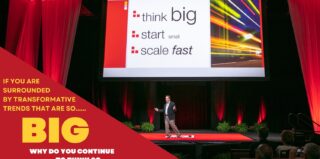
  • focus on big innovation: one client stated their innovation plan in a simple yet highly motivating phrase: “think big, start small, scale fast.” Their key goal is to build up their experiential capital in new areas by working on more innovation projects than ever before. They want to identify big business opportunities, test their potential, and then learn how to roll out new solutions on a tighter, more compact schedule than ever before.
  • thinking big change in scope. One client became obsessed with the innovation strategy of going “upside down” when it came to product development. Rather than pursuing all ideas in house, they opened up their innovation engine to outsiders, looking for more partnership oriented innovation (with suppliers and retailers, for example); open innovation opportunities, and customer-sourced innovation. This lit a fuse under both their speed for innovation as well as their creativity engine
  • innovate in a big way locally: we’re in a big, global world, but that doesn’t mean that you can’t innovate locally. One client in the retail space pursues an innovation strategy that allows for national, coordinated efforts in terms of logistics, merchandising and operations, yet also allows a big degree of freedom when it comes to local advertising, marketing and branding.
  • share big ideas. One association client pursued an innovation that was relentless on community knowledge sharing. They knew if they could build an association culture in which people shared and swapped insight on a regular basis on how to deal with fast changing markets and customers, that they could ensure their members had a leg up and could stay ahead of trends. Collaborative knowledge is a key asset going forward into the future, and there’s a lot of opportunity for creative, innovative thinking here.
  • be big on solving customers problems. Several clients have adopted an innovation strategy that is based on the theme, “we’re busy solving customers problems before they know they have a problem,” or conversely, “we’re providing the customer with a key solution, before the customer knows that they need such a solution.” That’s anticipatory innovation, and it’s a great strategy to pursue.
  • align strategies to the big bets. There’s a lot of organizations out there who are making “big bets” and link innovation strategies to those bets. WalMart has bold goals for the elimination of all packaging by a certain date; this is forcing a stunning amount of innovation within the packaging sector. Some restaurants aim to reduce food and packaging waste by a factor of dozens; this is requiring stunning levels of creativity in the kitchen


Hundreds of thousands have seen Jim Carroll on stage with a keynote focused on future trends, innovation & creativity….with a focus on the trends that will drive their future.

What are the major trends that will shape our world in the future? Here’s what you need to be thinking about now!

How SMALL is your world? Are you thinking BIG enough in terms of just how many big trends are going to impact your future?

Many people ask me how I spend my time in nailing many of the trends that will redefine society, industries, markets and nations into the future….

It involves a lot of research and a great deal of listening to other experts. But it also comes from the fact that I spend my time as a speaker at corporate meetings, massive association events and board retreats, with the resultant opportunity of seeing what many of the most innovative organizations in the world are focused upon. Just take a look at my client list, and you’ll get a sense that I have a constant stream of global executive level insight that drives my view of the future. Take a look at the track record of what I’ve been up to. There’s some pretty solid and significant insight happening here. Take a look at what world class innovators do that others don’t do.

My trending observations also involves a lot of common sense. Take the “expectation gap” which I outline below. This is a pretty significant trend, and it’s pretty well blindingly obvious when you think about it,

So what comes next? Here’s a quick list of 10 trends that you could be thinking about as we go into 2011. I’ve got dozens — no, hundreds — more. Hang out on this blog, track my thoughts, jump in, and let’s continue to innovate our way into the future!

  • the expectation gap: it’s one of the most obvious, most significant, and most challenging trends going forward into the future. Quite simply, Western society is defined by an increasing divergence between what people expect, and what they will get. People expect the world’s greatest health care services; with the aging of society, it is dramatically clear that the system won’t be able to deliver what they expect. Boomers expect that they will have a comfortable retirement pensions; the economic reset and collapsing home values have made it increasingly clear that their hopes will likely have been dashed. People expect that they can live longer, but the increasing prevalence of lifestyle diseases due to obesity and other factors means that in some areas of the Western world, 60 is the new 70. People expect that they can reduce the size of “big government” but have no sense of just how to go about doing this without a great deal of pain. Whatever the case may be, our future is increasingly defined by this gap, and it is going to have huge ramifications for just about everything around us. And here’s the reality: a lot of organizations are going to make a lot of money in helping to close the gap! Take health care and what is really going to happen in terms of future trends. Huge opportunities for growth!
  • industries blur: In the past, we’ve have “industries” which have focused on particular products and markets. Increasingly, the concept of an “industry” is going to blur as fascinating new trends provide interesting new opportunities. Consider this: the world of fashion and healthcare are going to merge. We are going to see an increasing number of bio-connectivity health care devices that will be used for the remote monitoring of health care conditions. Quite simply, people will increasingly wear small “smart appliances” that will monitor their compliance with exercise programs or that will keep their doctors up to date with key health indicators. But people won’t want to wear medical appliances though: they’ll want to wear fashion! Health-care jewelry anyone?
  • energy gets smart: Clearly we’re going to see continued high-speed innovation with renewable energy sources, and velocity with grid-parity: the point in time at which the cost of producing renewable energy equals that of carbon based sources. Much of this is coming about as Silicon Valley gets aggressively involved in the energy sector Taiwan Semiconductor, one of the largest chip manufacturers in the world, has invested $193 million in solar-cell maker Motech Industries. That’s but a small example of a major trend in which hi-tech companies are getting aggressively involved in every single aspect of the renewable energy marketplace. Just look at what Google is up to with wind-farms off the Eastern Seaboard!
  • the collapse of attention spans: Everything changes when people lose their ability to focus: sports, shopping, living…..the numbers with the next generation of consumers are simply staggering. The average teen sent 435 text messages per month in 2007; it’s now 2899! That’s 97 messages per day, an increase of 566% in just a few years. It’s estimated that they now spend 7.5 hours a day engaged with some type of media screen; if you add in the fact they are multitasking, it comes out to 11 hours of screen time per day — or 53 hours a week. Thats’ more time than involved in a full time job, and more time than their parents spend at work. What’s the impact? Continued hyper-speed in the evolution of branding and advertising; surreal rates of change involving products and services; unbelievable rates of change in how decisions are made and people are influenced. If you don’t know how to think, market and promote at nano-speeds, you’re not ready for the future!
  • faster market evolution: If we’re thinking faster, than we are innovating faster! New products flood the market at ever increasing speeds, and fast-consumers snap them up in a moment and evolve their lifestyles quicker. We’re all going to begin moving at Apple-speed as Silicon Valley increasingly comes to control the pace of innovation in many industries. Put it this way: it took two years for Apple to sell two million iPhones, but only 2 months for them to sell 2 million iPads! And just about a month to sell 1 million iPhone 4′s! We’re seeing the same trend in many other industries and product lines: the business of outsourcing the manufacturing LCD TV’s exploded from $9.4 billion in 2009 to over $21 billion in 2010, and an estimated $30 billion in 2011. Some products are obsolete before they are released: Lenovo learned this fact when they cancelled their planned “tablet computer” this June due to the unbelievably fast success of the iPod with market domination.
  • innovation partnerships. Given this rate of change, companies are quickly learning that in this fast paced world, they can’t innovate on their own; it is simply too difficult to keep up. And they’ve realized that they can enjoy greater success through open innovation and other external innovation partnerships. A great example of what happens when innovation “opens up” is seen with the partnership between consumer appliance maker Phillips and Sarah Lee on the single-serving coffee machines. It’s a market that grew from nothing to 12 million machines and 7 billion coffee “pods” in just 5 short years! Everywhere I go, I see organizations focused on challenging the core concepts of how they do “new things.” There’s a new mindset, and this is going to drive a big part of the growth for organizations going into the future.
  • the fight against workplace boredom. When there’s so much fun and fast change in the world, a job can be a mind-numbing experience. That’s why one survey suggested that 67% of Gen-Y admitted on their very first day on a new job, they were already thinking about another job. Organizations are fighting back against boredom by trying to keep staff engaged. At IBM’s Bromont Canada plant, the “3×10″ program aims to combat workplace boredom by changing employees full set of responsibilities 3 times every 10 years. The program is managed by someone who has worked in 10 different jobs within the plant over the last 28 years. Expect within a few years the likelihood that a 3×10 program will have shifted to a 2×1 program….
  • American-Idolatry : People love competition, they love winners, and they relish the battle! Everyone is learning that if they are to succeed in the future, they have to appeal to the new base of hero-worship that comes from our new awards driven society. Everywhere I go, I see companies who are far more willing to celebrate and elevate heroes. DHL holds an annual innovation day which includes an award ceremony with partners who have worked with them on innovative ideas. Deloitte South Africa hosts an annual “Best Company To Work For’ survey and combines into it an elaborate awards ceremony. The future of workplace and partner renumeration is all about the red-carpet, the spotlight, and the celebration of success!
  • the big impact of small incrementalism. Everyone is learning that one way to win the future is by having a lot of small wins that add up to big gains. The oil industry currently retrieves only 1 out of 3 barrels per well on average, yet a 1% improvement represents huge revenue gains! 7% of power on transmission and distribution lines are lost as heat, yet reduce that loss by 10% – and that would equal all the new wind power installed in the US in 2006. Todays’ typical automotive system uses only 25% of the energy in the tank — the balance is lost to waste, heat, inefficiency. Work on increasing that on a year over year basis, and there are some pretty solid gains through innovation. .At DuPont, the savings add up: globally, they now produce 40% more material as a global company using the same amount of energy they used in 1990. Up to 30% of the energy used in a typical industrial or commercial building today is wasted, but new, incremental improvements in green building design and other eco-principles are fixing this fast. Every industry I am dealing with sees small marginal wins adding up to huge tactical advantage! Small is the new winner…
  • communities redefined: there were 37 million senior citizens in the US in 2006, or about 12% of the population. By 2030, there will be 71.5 million of them, representing 20% of the population. Other nations in the Western world are seeing the same trend: we’re all about to become like Japan! And the reality of funding issues means it will be impossible to have the same seniors-housing or assisted living type of infrastructure that we’ve had in the past. The next generation of retirees are going to live at home longer; they’ll live with each other more; the hippies of the 60′s are going to find themselves in the seniors communes of 2015! Community-bliss: far out, man! What does it mean? Communities are going to have to be rethought, re-designed and reconstructed – community ergonomics is going to be a massive growth industry! Overall, we’ll see a lot more growth in high density, compact, mixed-use communities – and a lot of innovative thinking as to just what the concept of ‘community’ means.

These are but a few trends that I’m thinking about. I’ve got HUNDREDS more.

Think about these trends from this perspective: there is a lot of transformative change that is underway.

This is no time to think “small.” This is the time in which you need to be thinking “big.” How “small” is your world: do you have a narrow view of opportunity? The reality is that right now, thinking BIG in terms of opportunity and the future will be crucial to your future success.

What does that does it mean for your future? In the old days, companies had “industries” that they worked within, “markets” that they sold into, and “business models” that they pursued. Assumptions that drove their decisions.

Every single assumption that you might have about your future could be wrong. Challenge those assumptions, think about the rapidity of future trends, innovate — and you’ll find the growth opportunities that seem to elude so many others.

A new keynote topic was put to my many speakers bureaus partners today, based on some of the recent work that I’ve been doing.

What is clear to me from a  number of recent keynotes for health care executives is that they all know that some pretty major change is needed, and it goes well beyond health care reform. There are a number of huge trends coming together which I cover in my It’s January 15, 2020: What Have We Learned About the Healthcare in the Last Decade trends summary.

Here’s the keynote topic which has gone out, which already generated some pretty substantial interest from healthcare executives interested in getting ahead of the trends through innovation.

Healthcare 2020: The Transformative Trends That Will REALLY Define Our Future

When Jim Carroll began a recent keynote talk for the Minnesota Hospital Association CEO Summit, he announced that he wouldn’t even mention health care reform — and the audience of 300 senior executives cheered! Instead, he told the audience that he would take them on a voyage to the world of healthcare in the year of 2020, and provide them the insight they really need to deal with the challenges and opportunity of the future.

Everyone in a leadership position in the US health care system knows that even with health care reform, the challenges facing the US health care system are substantial and immense. That’s why innovation has quickly come to be one of the top issues that senior healthcare executives and medical professionals are thinking about. There is a realization that there is an urgent need to challenge the very philosophies upon which the system is built. They’re seeking insight into the major scientific, technological, consumer and social trends that will, by the year 2020, allow for some very dramatic change in the concept of health care delivery.

Where will we by the year 2020? We will have successfully transitioned the system from one which “fixes people after they’re sick” to one of preventative, diagnostic genomic-based medicine. Treating patients for the conditions we know they are likely to develop, and re-architechting the system around that reality. A system which will provide for virtual care through bio-connectivity, and extension of the hospital into a community-care oriented structure. A consumer driven, retail oriented health care environment for non-critical care treatment that provides significant opportunities for cost reduction. Real time analytics and location-intelligence capabilities which provide for community-wide monitoring of emerging health care challenges. “Just-in-time” knowledge concepts which will help to deal with a profession in which the volume of knowledge doubles every six years. That and much, much more.

The fact is, we are going to witness more change in the world of health care in the next ten years than we have seen in the last 200. And that’s why organizations have been engaging Jim Carroll. For the last fifteen years, Jim has been providing his guidance into future trends to a wide range of global Fortune 1000 companies, associations, and other groups. In his Healthcare 2020 keynote, Jim puts into perspective why innovation is no longer just a fashionable phrase — it’s the critical new leadership focus for executives in the health care sector. Jim has captivated management teams and health care professionals in keynotes for major US health groups as the St. Joseph’s Health System, Blue Cross Blue Shield of North Carolina, Cardinal Health Care, Providence Health, Harvard Pilgrim Health Care, the Association of Organ Procurement Organizations, and the American Society for Health Care Risk Management to name but a few. He was the closing keynote speaker for the 4th annual World HealthCare Innovation and Technology Congress in Washington DC, which featured a virtual who’s who of the health care scene in the US today.

At the recent Consumer Electronics Association CEO summit in Ojai, CA, I focused on how social networks are coming to have a huge impact on brand perception.

But aside from that main thread, I also concentrated on my message of innovation in an era in which “faster is the new fast.” Here’s an older clip that looks at what’s happening in the world of product innovation.

I pointed out to the crowd – which included the CEO’s of some of the largest digital technology companies in the world — that some product lifecycles are collpasing to ZERO. Case in point — Lenovo announced a tablet computer at the CES show in January. They dropped it after the iPad came to market, perhaps because it was bound to be a dud compared to the feature set of the iPad.

But maybe if they got it out sooner, it could have established a beachhead.

What do you do in a world in which a product is dead before you can get it to market? Innovate faster. Focus on fast. Do fast. Be fast. In the high velocity economy, speed and agility are everything.

What happens when Silicon Valley takes over the innovation agenda within an industry? In this video clip from a recent keynote, Jim challenges his audience to think about what happens in the world of banking, particularly with the likely fast paced emergence of contact-less payment technology based on mobile devices.

Innovative organizations need to make sure that they understand the external factors that will influence their future, and need to react appropriately. And as we enter the era of hyper-connected intelligent devices, with the impact of location-intelligence technology and the rapid adoption of mobile technologies, we’re likely to see every industry — even beyond financial services — impacted.

New business models, disruptive competition, a shift in control, customer churn — everything is up for grabs once Silicon Valley seizes control and defines your future!

I was in Billings, Montana last week, speaking at the annual meeting of a financial group.  The audience included a large cross section of business executives from throughout the Midwest. My talk centred around the trends that might provide for sustainable economic growth. Here’s what I focused on:

  • a significant and lasting change in perspective. I spend a lot of time with major international organizations, either in strategic leadership meetings or at various association events or conferences. I often run a text message poll at the start of such sessions to gauge the audience perspective of the current rate of economic growth. As I noted in this post, I’ve seen quite a change in attitude and perspective in the last few months.
  • significant growth is emerging from “solving the big problems.” I am a big believer that the efforts to solve the big challenges with respect to energy, the environment and health care will provide the momentum to kickstart the economy once again. I spend a lot of time examining signs of innovation and growth; and there is a tremendous amount of mind share being devoted to each of these areas.
  • fundamental and long lasting growth trends in global markets. Before the economy went sour in 2008, McKinsey was extremely bullish on the prospects for economic growth driven by the rapid industrialization of emerging economies, noting that “almost a billion new consumers will enter the global marketplace in the next decade …. with an income level that allows spending on discretionary goods,” and that “the ranks of the middle class will swell by 1.8 billion to become 52% of total population, up from 30% today.” I think on a long term basis, those trends are still valid and will provide for tremendous economic growth.
  • rapid response of organizations to the fast emergence of new markets and opportunities. I am seeing a significant number of organizations focused at the top on “revenue innovation” — that is, generating revenue by entering new markets or through new products and solutions. One CEO of a major global organization put it to me this way: “traditional markets are declining … we’re going other places that have better growth opportunities.” This is the concept of chameleon revenue, which you should read about here.
  • signs of various industries reinventing themselves. China and India and Brazil are cleaning our clocks when it comes to manufacturing, with sheer brainpower and design capabilities; the period from 1990 to 2010 saw the decline of the North American manufacturing industry with the resultant massive economic shock. But what I’m seeing out there tells me that North American companies will learn to compete again by challenging old assumptions, and by challenging themselves to do things differently this time around; for example, with mass customization, and through the reinvention of traditional manufacturing processes.
  • the emergence of intelligent infrastructure. Quite simply, every device around us is going to gain intelligence in the next decade. We’ll have awareness of their status, location, and address; this leads to the birth of countless new products, companies and industries. There is real transformative industry growth will come when everything plugs into the cloud, and as location intelligence becomes a significant transformative trend.
  • the impact of the next generation. While many people bemoan the ‘work ethic’ of Gen-Y, I think they are likely the most entrepreneurial generation ever. They collaborate, think, and generate ideas in exciting and different ways, and I think that provides them with a motivation to “do their own thing” unlike any other generation in history. And that is a significant driver for economic growth. During the recession of 2001, 569,750 new companies were created in North America – mostly small businesses. And companies with less than 20 employees accounted for 100% of the new job growth from 1990 to 2000. Global experience shows similar trends. That’s the context of what this ‘next generation’ will do.

As a futurist, I’m optimistic and bullish on the future. (I have to be; I can’t quite go on stage and say to people — “guess what — your future sucks!”)

I don’t think there is any wishful thinking behind this sentiment ; it comes from the discussions and observations I get from going out and speaking to tens of thousands of people at various conferences and events through the last several months.

In a whirlwind of activity over the last ten days, I’ve been the keynote speaker for conferences that probably represents the vast majority of global Fortune 1000 organizations, speaking to the trends that will impact the future of ‘corporate facilities.’

These have included keynotes for the  Professional Retail Store Maintenance Association annual conference in Orlando; the CoreNet Global Summit in New Orleans, and the International Asset Management Council Spring Summit in Colorado Springs. With these groups, we’ve got the folks who manage facilities for a good chunk of the world’s biggest retailers (including Apple, the Gap, Costco and others); commercial real estate executives for Fortune 1000 and government; and the senior executives who manage the same for large industrial and manufacturing organizations (Alcoa, Caterpillar, Whirlpool).

What are they thinking about? Adjusting to an economy that is more and more turning to growth. And to do that, I covered a wide variety of trends:

  • they need to actively shift their role from tactical (managing costs in a downtown) to strategic (‘how do I help my organization to scale and support growth strategies?’
  • ensure that the organization has the flexibility in terms of facilities and workforce to adjust to more rapid market and product innovation, faster competition, and more rapid change in consumer demand and choice
  • take advantage of emerging opportunities with intelligent building management infrastructure
  • be willing to challenge process and assumptions as to operations. I consistently used my story of broken business models, vs. business models built on rapid change – my Honda vs. Chrysler story
  • adapt to a reality in which skills flexibility and innovation will be a key success factor. These folks need to access a lot of unique skills that are in short supply (i.e. green engineers), and so increasingly their success will come from their ability to access the right skills at the right time for the right purpose

Are people really thinking about growth? Here are the live results from a text message poll that I ran from the stage at the IAMC conference in Colorado Springs yesterday:

More information

  • Innovation and the concept of ‘chameleon revenue’
  • Riding fast paced trends in the consumer / retail sector 
  • Finding growth with knowledge exponentiation (construction trends)  

jim-carroll-238x300.jpgHere’s a blog post that ran over at the Chicago Hospitality Insider blog with a report on my keynote last week.”

—-

Moving Beyond The Meltdown” with Jim Carroll
Posted on February 18th, 2010 by Jody Robbins

How is the tourism business impacted by a world where information is passed feverishly around the globe? Immediately and directly; that’s how, says Jim Carroll (Futurist and Trends & Innovation Expert!), today’s lunch-time speaker at the 2010 Illinois Governor’s Conference on Tourism.

“The future happens faster than you think,” said Carroll. “The likelihood is that seven out of ten kindergartners today will work in jobs that don’t exist today.

“[It's also] estimated that half of what college students learn in their first year is obsolete by the time you graduate,” he continued. “The typical digital camera today has a shelf life of three to four months before it’s behind current technology.”

How can a company or a government entity make that change happen? Look for experienced people that know what they’re doing; i.e. build experiential capital and stay nimble.

“It’s not necessarily big corporations that will own the market, but those who innovate — try things they haven’t done before in order to stay in front of a very fast pace.”

How? Accelerate your innovation cycle, Carroll says. “It’s not, ‘We’ll get you in our brochure next year; it’s what can we do to partner with you right now?’

Other important factors: faster time to market and continuous reinvention to meet rapid consumer preference shifts. Again, how to do this? Go online, go mobile and use your staff and outside resources to find your customer and sell them your product when and where they want it.

Carroll’s Pertinent Points:

  • *1/3 of all leisure travel is booked last-minute
  • * Average planning time down to 15 days
  • * 36% of last-minute vacations 3-4 nights in duration
  • * 30% are 1-2 nights
  • *”More than 147-million people interact globally on social networks via their mobile phones – expect one-billion (!!!) within five years,” says Carroll.

In other words, to use a cliche, THE TIME IS NOW!

—–
It was a great talk, and I’ll have more to post on some of the observations from my keynote in the weeks to come!

energyindustry.jpgI spent a half day last week with the CEO and senior management team of a large global energy company.

They engaged me to provide them with insight on the trends which will impact the global oil, natural gas, energy and distribution sectors in the years to come.

It was a small, intimate get-together with about 40 senior executives; I provided my insight into the trends that I believe will have the most impact. That was followed by about an hour of very intense, deep probing discussion; I obviously stirred up some creative thinking within the group.

While not going into the specifics, the broad brush strokes of what I covered off included my observations that they should be thinking about these issues.

  • presume massive market disruption: Think GoogleCar: don’t limit your view of the future as to what might transpire. The future of any industry will likely bear no resemblance to the industry structure of today. Future competitors will probably come from completely outside of an existing industry. Challenge every assumption that you have about the future.
  • prepare for significant transformation: realize that existing insurmountable challenges are simply a big opportunity to someone else. Someone, somewhere, is going to figure out how to plug hundreds of thousands if not millions of small, local, home based renewable energy sources into the energy grid. It’s mostly a computation/mathematical issue: the energy grid was not designed for two way electricity transmission, and so there will have to be an intense amount of computational dynamics to structure a solution. Result? An organization that is a master of massive computational capabilities — and hence, grid management — might very well be the new energy company of the future.
  • find opportunity in scientific rapidity: we’re in the era of global collaborative knowledge generation, and R&D is rapidly externalizing. The infinite global idea loop means that scientific discovery is now happening faster than ever before, which provides for more product and market opportunity. Innovative organizations plug in, ensuring that all staff are in tune with the rapid rate of scientific advance that surrounds them, and are prepared to ride new emerging ideas as soon as they begin to emerge.
  • capitalize on skills fragmentation: the war for talent will define future success. We’re entering a time of massive skills specialization and ever smaller knowledge niches. As I covered off in my keynote to a global financial audience in the Cayman’s, it’s the organizations that can build a culture, structure and flexibility to attract and retain skills that will find the key to success in the high velocity economy.
  • structure for volatility: extreme volatility is the ‘new normal.’ If you have the capability to quickly adjust strategy, structure, plans, skills, projects and teams, you’ve got the right stuff for the new world of constant change.
  • prepare for business intensity: innovative organizations plan for more rapid entrance and exits from new markets. They do so through flexible structure. Partnership takes on new role in era of exponentiating, fast complexity and the rapid emergence of new opportunities: if you can scale up, you can win big.

The Economist Intelligence Unit recently noted that “the ability to swiftly adapt to change represents the greatest challenge manufacturers face in creating long-term value.” That’s the bottom line for innovating in the high velocity energy industry.

Related posts:

  • The Google Car and massive market disruption
  • Global infinite idea loop
  • Talent, not money, is the new corporate battlefront adobe.gif

Performance Optimization WordPress Plugins by W3 EDGE