The solar thermal industry employs at least 624,000 people worldwide

Home > Archives

Associations

"Your future members will work in industries, businesses and organizations that evolve faster in terms of their focus, products, services and mandates" -- Jim Carroll

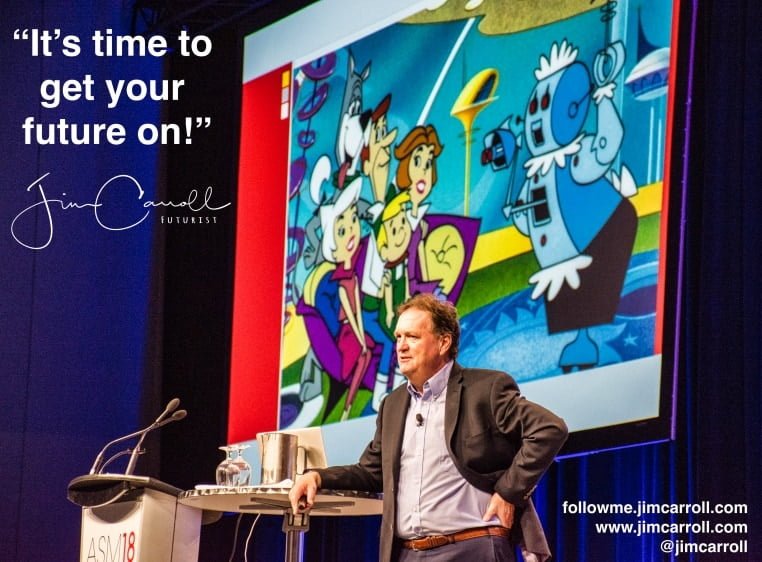
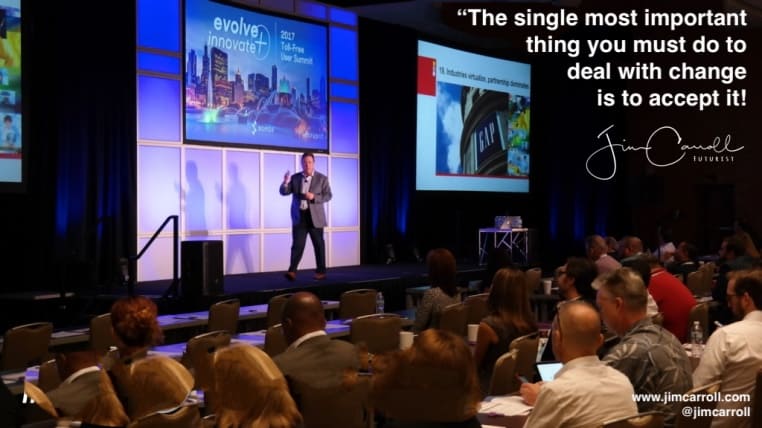
Over the last 15 years, Jim Carroll has keynoted the annual meetings and conferences for hundreds of associations, with audiences of up to 4,000 people. Some of his clients include • American Marketing Association • Association of Land Surveyors • Association of Petroleum Landmen • Association of Professional Executives • Canadian Broadcast Association • Confectionery Manufacturers Association • Crop Protection Association • Equipment Leasing Association • International Newspaper Marketing Association • Mechanical Contractors Association • National Association of Fleet Administrators • National Rural Electrical Cooperative • National Rural Telecom Association • Professional Marketing Research Society • Propane Gas Association • Purchasing Management Association • Western Retail Lumbermen's Association • World Congress of Association Executives • Young Presidents Organization

I was in Baltimore last week, where I was the opening keynote speaker for the 2010 Passkey Corporate Housing Forum.

Passkey is a company that provides software for the corporate and association event management industry; in attendance were meeting planners, executive who manage corporate functions for hotels, and a lot of folks from various convention and visitors bureaus. My goal was to speak about the trends impacting the meetings and events industry, such as found in  my recent article, Does Your Future Suck?

I ran a quick text message poll at the start to find out what these folks see as the big challenges they are faced with.

There are some obvious issues : budget cutbacks, organizations beginning to explore more virtual event technologies, or challenges with delegates bypassing conference facilities and booking on their own (‘booking outside the room block’).

But what is most fascinating is that fully 1/3 of those in the room felt that the biggest challenge / trend that they are seeing is that more organizations — particularly corporations — are organizing more strategic meetings at the last moment, of a smaller scale than before.

That’s certainly what I’ve been seeing: I continue to get bookings for a significant number of small, CEO or senior management level strategic planning meetings. These folks want to bring their team together to discuss innovation, future trends and key strategies for exploring growth opportunities.

I’ve framed many of these talks around the theme of What Do World Class Innovators Do That Other Organizations Don’t Do?, which is a theme that has been quite popular since January of this year.

In my talk for PassKey, I noted two key statistics from Dana Communications, a company that specializes in the events industry:

  • only 17% of meeting planners have “meeting planner” in their job titles
  • less than 20% of meeting planners spend over 50% of their work time planning meetings

This echoes my experience: many of the calls that I get exploring my services are from a senior executive, or the executive assistant to an executive.

Clearly, organizations are of a mindset that is focused on taking them out of a recession, and into a world of exploring future opportunities. The fact that event planners, CVB’s and hotel event managers are seeing the same trend is a significant sign that the economy continues to bounce back.

by Jim Carroll
From: The Boardroom, a publication for Association Executives

Every association executive is regularly inundated with information on the leadership skills they must need to properly guide their association into the future. As someone who spends a lot of time talking, writing and speaking about trends and innovation, and who is constantly taking a look at where we are going in the future, I have my own list that might be rather different from some of the others that you’ve heard.

Here’s what I think you should do to ensure you know the issues that will affect your association.

1. Listen to the grassroots

With the rapid rate of change within every industry, trade and profession, it can be extremely difficult to keep up with what’s important and what’s not, not to mention keeping on top of the trends, challenges and opportunities that should be guiding your activities and strategies. There might be plenty going on within your member organizations, as they wrestle with new business strategies, rapidly evolving business models, heightened market competition, ever growing volumes of research and knowledge, and countless other challenges.

To be effective at what you do, you must keep on top of these trends, and determine how to adjust your activities and strategies accordingly so you are continually meeting your members’ needs. That’s why 21st century association executives should focus on building a strong collaborative culture with their membership base, using both leading edge tools and technology as well as ensuring they have a heightened degree of informal, personal contact.

Take the time to engender and build an informal, “open-door” culture that promotes regular and ongoing contact by your membership base, whether that be by e-mail, telephone or in person. Encourage feedback, complaints and observations, as well as a culture that provides for sharing of leading edge trends, challenges and opportunities.

Continue Reading

nl-header.png

Does your future suck?

by Jim Carroll

Written for “Content Matters Newsletter, March 2010″, Content Management Corporation

So the big question, of course, is this: is there a future for the meetings and conference industry?

What a silly question!

Of course there is: the fundamental trends that are shaping our future demand that organizations continually deliver regular, short sharp shocks of updated knowledge, and despite all the new fangled technology that surrounds us, many will demand that we continue to do so in human-to-humanget-togethers.

Continue Reading

2010Globalevents.jpgHere’s an article that just ran that offers some of my thoughts on what’s up with the global meeting and events industry.

———

Convene Magazine, January 2010
by Maureen Littlejohn

During 2009, many organizations battened down the hatches and waited for the recession to pass. As we enter the new year – and a new decade – the time for waiting is over. It’s the organizations that keep their eyes peeled for budding opportunities – and are prepared to pounce on them – that will succeed. Convene asked futurist and trends and innovation expert Jim Carroll to identify five emerging megatrends of particular interest to the meetings industry.

Continue Reading

Screen shot 2009-12-15 at 7.27.06 AM.pngConvene Magazine is the official publication of the Professional Convention Management Association.

In their December 2009 issue, they have part 2 of their annual technology forecast : how will technology continue to shake up the meetings and convention industry.

My prediction focuses on the impact of location intelligence on the industry; here’s what I wrote:

With the meeting and convention industry still all abuzz about the impact of Twitter, a far more dramatic and far-reaching trend is soon upon us, with the impact of what has come to be known as location intelligence.

Continue Reading

2009NRPA.jpgI head to Salt Lake City next week; I’ll be the opening keynote speaker for the annual conference of the National Recreation and Parks Association.

GovPro News recently ran a press release on my keynote, commenting:

The recession has created an atmosphere of anxiety and uncertainty for many, and those who work in the parks and recreation field are not immune. With so many forces – the economy, politics, and social and leisure trends, for example – out of the control of parks and recreation professionals, thinking about the future could cause a few sleepless nights.

Futurist Jim Carroll has helped hundreds of organizations minimize their sleepless nights when preparing for the future, and he will discuss some of the upcoming challenges and opportunities in the field of parks and recreation when he delivers the keynote address at the National Recreation and Parks Association’s (NRPA) annual Congress and Exposition in Salt Lake City.

Continue Reading

CSAEJimC01-300.jpgI’m keynoting a lunch tomorrow for a group of about 400 medical professionals. Their executive director saw me keynote a national conference of association executives two months ago.

That particular keynote was on a Friday in late September — and the executives in the audience had just been pounded by a week of bad economic news. Since then, the drumbeat of negativity has become only more intense.

I got up that morning two months ago, took a look at the news headlines, and went out and did a barnburner of a speech for an audience of 500+, on the theme, “where’s the growth, and how do we innovate for the future?” I was hugely upbeat, carried a positive message, and spoke to the audience at a very personal level about the necessity of having a strong personal compass to get through “this thing.” I remember coming off stage, and thinking to myself, “wow, that was one helluva talk.” As someone who earns a living on stage, you constantly self-assess as to how you’ve done.

Continue Reading

AssociationSummer08.jpgAssociation Magazine has published my article, Metamorphosis: A Defining Success Factor for Associations.

A huge number of my keynote presentations are for professional, industry, trade or other associations. All of them are faced with some serious challenges — a decline in membership, an inability to maintain their relevance, or a lack of capability to innovate in terms of program delivery.

The article takes a look at the obvious trends which are to impact associations in the years to come. I don’t hold back any punches, opening with these words:

We know we live in a world in which new trends change everything we know at a furious pace. Rapid change envelopes us, consumes us, and pounds us with its reminders of its urgency every single day. There are many obvious trends that impact us; we often refuse or are incapable of assessing their impact.

Continue Reading

GetFested.jpgI’ve had a new article published for Association Executives for the CSAE, about how you can innovate and jazz-up your annual meeting or conference.

Here’s an extract:

Does your conference marketing suck? Maybe it does, and you don’t know it.

People today don’t want to go to an “annual conference” and attend “plenary sessions.” Kids (and today’s 30-40 somethings — the demographic you increasingly want to get to attend!) go to FESTIVALS.

I think they’re expecting the same brand image velocity for the conferences or events that they might attend. Would you rather go to the “121st Annual Tree Farmers Association Annual Meeting and Trade
Show
?”

Or would you rather go to “TreeFest 2009 – The Place Where Tree People Rock!”

Me, I’m all for idea of TreeFest!

  • Read the article Get Fest-ed! adobe.gif
The future of associations
January 28th, 2008

arrow.jpgA few years ago, I wrote regularly for The Boardroom, a publication for association executives, on how trends are impacting professional and other associations. I covered workplace issues — such as integrating Gen-Y into the workplace — as well as rapid career, knowledge and skills change. The articles still generate a lot of traffic as people find them through search engines; and continue to bear relevance today.

Why are associations finding things so challenging? According to a recent study out of the University of California (Berkeley,) we now produce as much new information every six months as was produced in the first 300,000 years of human existence. That type of rapid knowledge growth changes careers faster than ever before, and the associations who represent these career areas must relentlessly focus upon innovation within the areas of professional education, strategic direction and the nature of member services.

These articles were often reprinted in various state and national “associations of associations”, and still bear relevance today, so they might be worth a read.

b>More information

  • Read the association executive articles
  • Details on Jim’s keynotes in the association sector adobe.gif

assoc.jpgAn “association of association executives” has just printed my article that takes a look at how the role of associations will change in the future — with the major focus being on the need for “just in time knowledge,” a phrase I’ve been using for over a decade.

From the intro: “If you want to understand the future role of your association, you might want to spend some time staring at an iPod Nano.

Arguably the hottest consumer technology in a marketplace that astounds everyone with a furious rate of technological innovation, it’s more than just a cool piece of electronic hardware that plays music. It’s a good barometer of the fact that we live and work in a world in which massive, sudden, wrenching change will become the norm, not the exception.

And it will be by helping your members cope with, adjust to, and prepare for this rate of change that you will find the evolution of your new role.

Read the full article adobe.gif

I’ve carefully been watching the crowds in my keynote presentations over the years, and have come to realize that there is a direct relationship between the nature of the audience, and the way that they react to my observations on the future.

Call it Carroll’s law, because what I’ve learned is this — those doomed to extinction and other severe career implications as a result of rapid change, are usually the least receptive to a message as to the reality of their impending doom. They would prefer to escape rather than adapt to reality.

Looking out into the audience, it sometimes seems like I’ve got a bunch of deer in the headlights — they seem so shocked by the change that is occurring around them that they don’t know how to take the next steps of figuring out what to do about it. This is particularly true when I discuss the reality of outsourcing/offshoring, or when I focus in on how rapid innovation, fuelled by scientific advance, will continue to cause havoc and turmoil in every industry.

I wrote an article yesterday, How Science Will Change Careers — And Associations — that looks at the theme of impending, rapid career extinction. Read the article (PDF)

Association related articles
November 14th, 2003

I’ve been writing a bi-weekly column for executive directors of associations. The articles are being printed or are carried online by a number of North American Society of Association Executives. Permission is granted to any association to reprint these articles — contact me for details.

The first three include, “10 Things My Kids Think Are From the Olden Days“, “What’s happening to our careers?” and “What’s your tin can?”

UA-117171-1

Powered by Web Design Company Plugins