The USPTO receives 55 patent applications every hour

Home > Archives

Consumer & food

It's all about velocity! In the food industry - it's all faster. A faster focus on 'fresh' food. New taste trends happen faster. There's faster innovation with ethical packaging.

When the Walt Disney Corporation went looking for an expert on the topic of innovation and creativity, they went with Jim Carroll! When the Readers Digest Food & Entertainment Division, the publisher of such innovative magazines as Everyday with Rachel Ray, went looking for a keynote speaker for a New York City based symposium on marketing and advertising trends, they went with Jim Carroll. Some of Jim's consumer product and food clients include • HJ Heinz • VIBE 2010 Beverage Conference • Silgan Corporation • Walt Disney Corporation • Nestle • FMC BioPolymer • Canadian Council of Grocery Distributors • ConvenienceU (National Association of Convenience Stores) • Point of Purchase Advertising International • Packaging Machinery Manufacturers Insititute • FMC FoodTechnologies •

I just came from giving a keynote for the annual conference of a major customer loyalty organization, with the talk focused on some of key trends impacting the world of retail today.

There’s certainly a lot going on and a lot to think about. Extremely rapid business model change, the emergence of new competitors, ongoing consumer confidence volatility, rapid product turnover and faster product life-cycles.

So what are they really, really worried about? Let’s put in context the people I had in the room — senior VP’s and managers in major retailers representing several billions in revenue in a wide variety of markets, including pharmaceutical, grocery, consumer goods and electronics. Not to mention quite a few bankers, responsible for credit card portfolio’s, loyalty programs and other customer oriented programs and infrastructure.

Given all that, the top of mind issue is — new methods of customer interaction.

Look at the poll results below. The issue stands out far and away as the most important concern of the day!

Hence, my keynote was bang-on. I didn’t touch too much on the social networking phenomena, as this type of crowd has been drowning in social-networking Powerpoints.

My focus was on interactivity, location, and intelligence,, and the extremely rapid emergence of new forms of in-store interaction and product sales uplift. Things like digital signage, in-store electronic promotional displays, iPod based coups. A flood of new stuff and new ideas that promote new ways of

Listen folks, I know I’ve said it here before, but I’ll say it again.

2010 is the year of location, combined with mobility, and it’s happening faster than you think.

I’m pumped about this topic and the reaction, so I’ve rolled this into a new keynote description:

Location is the New Intelligence: Customer Interaction in the Era of Pervasive Mobile

We’re at the leading edge of the merger of three perfect trends: the rapid and massive emergence of a massive mobile infrastructure with increasingly intelligent devices. Pervasive location awareness as a results of GPS and location intelligence/mapping trends in those very same tools. And a consumer mindset that is increasingly open to new forms of interaction. The result is massive business model disruption, absolutely transformative market change, and complete obliteration of old assumptions as to the nature of the customer relationship. Smart, innovative super-heroes know that this is an unprecedented time to jump on the emergence of location as the new intelligence, in order to provide for new ways of product uplift in the retail space, changing the very nature of customer loyalty through new forms of interaction, and enhancing existing one-to-0ne conversations through a more direct, distinct and fascinating new form of location based relationships. Futurist, Trends & Innovation Expert Jim Carroll is setting the retail, marketing and advertising world on fire with his fast paced insight into one of the most important trends to shape the customer-business relationship in the last few decades. Move over social networking — location is the new intelligence!

Read more: Location is the new intelligence

Here’s a summary of my observations from a keynote I did in New York City for retailers, agencies, marketing organizations, food and CPG companies, on some of the trends that are sweeping their industries today.

The summary is courtesy of the event sponsor, the Readers Digest Food & Entertainment Group.

1. The New Consumer Is Shifting Their Attention Faster than Ever

Consumers suffer from “continuous partial attention” with more stimuli around them than ever before:

  • The number of text messages sent each day exceeds the population of the earth
  • There are 62.6 million videogame households (up 11.4%) and the average age of a video game consumer is 41
  • consumers spend about 10 hours per day and $1,000 per year with various media – primarily wireless devices, iPods, in store displays, in-auto media content and the Internet
  • 93% of American teens are online, proving that the Internet will become ubiquitous

Consumers across demographic segments are immersed in this new interactive world forcing brands to engage them across all mediums to stay connected.

Continue Reading

2010PRSM.jpgAt many of my keynotes, I focus on some of the most successful creativity and innovation attributes that I see within organizations. Here’s a list of guidance from a recent keynote for a group of executives in the consumer goods sector:

  • Adapt to more challenging customers: customers expectations and needs are changing rapidly, and yet they are more demanding than ever before. Loyalty disappears….at the same time they expect creative perfection from you, they are more fickle, and far less loyal …. I’m not even sure the concept of loyalty exists any more for many brands! Continue Reading

fm-web_logo.gif
Here’s an article that I wrote for Food Manufacturing on trends in the consumer, food and packaging sector.

I spend a huge amount of my time as a keynote speaker at countless conferences and events, many of them within and to the food, packaging, retail and restaurant sector. I also spend quite a bit of time with smaller, strategy-oriented leadership session designed around the theme of ‘how to innovate in a high velocity economy.’

And I do know that while volatility rocks the economy, some fundamental truths about that velocity remain: the food, packaging and retail industries continue to be subject to dramatic rates of change–and innovative organizations succeed by mastering the pace of this new high-velocity economy.

Continue Reading

In the food industry — it’s all faster.

A faster focus on ‘fresh’ food. New taste trends happen faster. There’s faster innovation with ethical packaging.

And so it’s all about time to market. Challenge yourself to think and act differently, when the food industry continues to speed up, and the process of innovation undergoes a deep transformational change.

“Do you we truly appreciate just how quickly things are going to evolve?”

What should brand leaders be thinking about in terms of the velocity of change with customers and branding.

This clip takes a look at the trends impacting brands….

2009LeadershipGrowth.jpgI was interviewed some time last month by FoodProcessing.com – this was related to their discovery of the keynote I did for the Readers Digest / EveryDay with Rachel Ray team food industry summit in New York last fall.

They ran a short article, “March of the New Machines: The Future of Food Processing” — and ran my comment on what I’ve seen in terms of CEO’s who have relentless focus on growth. Many of my recent keynotes — several in Las Vegas, Austin, Miami and New York — have been focused on how to maintain  growth strategies during an economic contraction.

Here’s an extract from the interview. Some good food for thought on the need to be RELENTLESS on the future and opportunities.

Continue Reading

2009BurgerKing.jpg
There are two types of organizations in the world today: those that have retrenched, shut down their idea machines, and are trying to coast through the recession. Then there are those who are making sure that they keep their team focused on the future, opportunities, and the need for innovative thinking.

I’ve been confirmed to be the opening keynote speaker for the next global leadership/franchise conference for Burger King, one of the largest QSR chains in the world.

This is really quite an honor, and I think is indicative that my theme that “organizations need to stay on the innovative edge despite the recession” resonates strongly.

Continue Reading

In February, I was the closing keynote speaker for the American Nursery and Landscape Association. This was a second booking by this group; they had me in previously for a leadership meeting in Vail.

Here’s a clip in which I’m setting the stage for the rapid changes occuring in their industry: in the context of how quickly basic knowledge is evolving, suggesting that “learning is what most adults will do for a living in the twenty first century.”

Does this line of thinking apply to garden store managers/owners? You bet — individuals in the nursery and gardening industry indeed have to be masters of fast knowledge. There is a regular and ongoing release of new products; new store formats; new retail and branding methodologies; not to mention the need to have a lot of innovative strategies as to growing the business during a recession, or managing costs to survive challenging times. It’s all about learning, sharing ideas, and gaining new insight. Continually learning.

If you’ve been reading the press, you know that recently, many meetings and events have been under attack, driven by what has come to be known as the “AIG effect.” Quite a few organizations have cancelled leadership meeting, fearing that it might look bad. Yet any politician or journalist continuing to beat up on the meetings industry should watch the video that “Today’s Garden Center” magazine has put online; it’s a video called “What I Learned at ANLA Management Clinic 2009.”

In it, we’ve got nursery, garden and landscape managers from across the US — small business owners — talking about the things they’ve learned at the conference; the ideas they’re taking away; the specific actions they’re going to pursue from what they’ve learned.

It’s a pretty compelling video, and if anything, it really puts into perspective what these events are all about.

More information

  • Watch: What I Learned at ANLA Management Clinic 2009

2009PACA.jpgBack in November, I had the honor of providing the opening keynote address for the Picture Archive Council of America, at the 13th Annual PACA conference, in New York City.

This organization represents stock photographers : the folks who supply the amazing shots and footage used by advertising agencies, publishers, magazines and countless other groups in need of great creativity. A vastly diverse group, ranging from global powerhouses like Getty Images and Corbis, to small boutique specialty photographers. They’ve had a bit of a struggle as of late: advertising is down with the recession; they’re impacted by the emergence of new cost competitors; and ongoing challenges with copyright infringement.

I did a tremendous amount of research into their industry, and really walked off stage thinking I hit a home run. That’s why it’s nice to find this feedback from one of their recent newsletters:

Jim Carroll describes himself as an ‘International futurist, trends and innovation expert’ (and nice guy) and works with a number of large corporations here in the US and in the UK commenting on media trends and advising organizations on coping with rapid changes in the market place.

Continue Reading

Here’s a clip from a recent keynote in Las Vegas.

I’m challenging the audience to think about the issue of maintaining brand relevance, in the era in which customers increasingly influence the perception of brands through social networking tools.

The key challenge today is preventing a brand from becoming “from the olden days.” I emphasize this with a quote from Multichannel Marketing, April 2008.

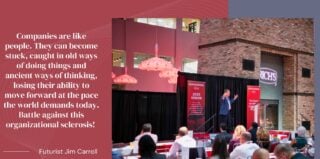
In some ways, brands are like people. They get stuck. They have habits that are hard to break. They don’t always see their blind spots, and they lost touch with their core essence. They resist change. They become irrelevant

Innovative organizations realize that they need to continuously address the issue of the relevance of their brands, and must work harder than before to keep them “fresh.”

2009Yum.jpgI was thrilled to be the opening keynote speaker for Yum! Brands 2009 Global Leadership Meeting. It’s the world’s largest restaurant company.

The organization, the owner of such iconic brands such as KFC, Taco Bell and Pizza Hut, certainly finds itself in the midst of high-velocity change. There are fast paced trends in terms of new branding challenges and marketing methodologies (think Web 2.0), consumer behavior, and many other issues. Yet, there are tremendous opportunities for growth through innovation.

My keynote addressed a variety of trends which are impacting the QSR (quick service restaurant) industry today:

  • opportunities for global growth. Chain restaurants account for but 1% of China’s commercial food service sales, and in Europe, it is but 2%. (Compare that to the US, which is at 50%.) Clearly, growth will come from continued expansion into global markets.

Continue Reading

There are a lot of hits coming into my web site searching for “food industry trends 2009″ or “2009 food trends.”

I’ve spent a fair amount of time through the last few years, focused on trends in the consumer, food and retail sector, talking about some of the unique trends which influence shopping behavior.

Here’s a clip from a major food symposium I keynoted in New York City in September 2008; I spoke to a wide variety of trends impacting the industry. In this short clip, I’m speaking to the issue of market fragmentation, and the need for ever more small niche markets:

The key point: while economic trends are impacting consumer choice, there are still many other trends at play. At the conference, I spoke about a variety of other the “new influencers,” rapid product innovation, fast-paced consumer choice change, and the impact of brand interactivity.

RDA-08-KLJ.jpgA few weeks ago, I keynoted an event for the Readers Digest Food & Entertainment group (who publish Everyday with Rachel Ray, and own and manage the popular online social network recipe site, AllRecipes.com) in New York City. The audience consisted of executives and creative types from Madison Ave advertising agencies, food and packaging companies and other organizations.

They’ve released a summary of the overall day; in addition to my own insight, participants included Katie Lee Joel (pictured on the right), author of the Comfort Table; as well as “supermarket guru” Phil Lampert.

I spoke to a variety of trends that are impacting retail and food markets; for example, the trend in which in store display technology — a “new influencer” — will come to influence how shoppers shop, faster than we think:

This new shopper is not only more scattered and more connected, but also faster — scanning 12 feet of shelf space on average per second.

In-store influencers will now evolve at the pace of the iPhone and the Blackberry, challenging marketers to keep up with the pace. Faster is the new innovation and innovation isn’t just about new product design – it’s about responding to fast-paced consumer change.

Marketing Implication: Marketers must work harder than ever to capture the attention of the consumer and make a connection. Brands must keep up with the pace of consumer change in order to stay relevant.

More information:

Read the RDA Food & Entertainings Consumer Food Symposium summary (PDF)

Here’s another video clip from the New York keynote — actually, this is from the Readers Digest Food & Entertainment (publishers of Everyday with Rachel Ray) keynote.

At this event, I was speaking to an audience of advertising executives, food companies, packaging companies and others about how innovation models are shifting. Today, innovation is much more:

  • partnership oriented – think Disney!
  • flexible in terms of solutions – think tin-cans!
  • faster in terms of market response to rapidly changing consumer demand

The section closes with an overview comparing Honda’s capability for rapid change to those of traditional US automakers.

The key point : faster is the new fast — because consumer choice changes faster than ever before.

RDA-2008.jpgWhen the Readers Digest Food & Entertainment Division, based in New York, went looking for a keynote speaker on marketing and advertising trends within the consumer goods sector, they went with Jim Carroll.

In an event co-sponsored with Advertising Age, the publisher of such innovative titles as Everyday with Rachel Ray wanted to provide a concise, inspirational but challenging overview of the trends impacting innovation, marketing and advertising within the food sector … and decided that Jim’s message on how to innovate at high-velocity was the ideal fit for their symposium.

Ironically, the event fell smack-dab in the middle of one of the wildest economic corrections that we’ve ever seen, and much of the discussion through the day focused on how to innovate in a fast-paced, ever more challenging economic environment.

I outlined how innovation-oriented organizations will use the economic challenges as an opportunity — they’ll examine the emergence of fast-paced trends, and will adjust their actions, products, services, and brand message accordingly.

Continue Reading

I’m in Manhattan tomorrow, speaking at an event for food, advertising and packaging companies on behalf of Readers Digest Food & Entertaining Division. 2008-RDA.jpg

I’ll be offering a late morning wrap up of observations about the high-velocity change that continues to envelop the sector, particularly the following trends. Dig through the blog — particularly, the retail or consumer product categories — and you’ll find a little bit more insight about each of them.

  • the new consumer is faster — and innovation isn’t just about new product design — it’s about reaching and interacting with the consumer in new and different ways
  • the new consumer is connected — and interactivity is the new brand foundation
  • the new consumer is no longer nuclear — and hyper-nicheing is the new brand reality
  • the new consumer is influenced differently — and social-networks are the new brand influencers
  • the new consumer is shifting their focus faster — and faster paced preference change is the new reality
  • the new product is rapidly re-defined — and time to market and corporate agility are the new corporate capabilities
  • the new product is up-side down as innovation changes — and partnership is the key method to speed things up

Continue Reading

RD2008Food.jpg

We’re witnessing hyper-innovation with packaging, design, in-store promotion, new product introductions, rapid change with branding, and perhaps most important, a massive and permanent shift of advertising and influence dollars from traditional media to the online world.

These are all themes that I will be exploring later in the month, when I provide my insight for the Food & Entertaining Division of Readers Digest, the group behind AllRecipes.com, and the magazine Every Day with Rachel Ray, among other properties, at an invitation only event in New York City.

Also sharing their insight during the Symposium will be Phil Lempert, who specializes in providing deep insight into supermarket trends, and Katie-Lee Joel, Top Chef judge and author of the book The Comfort Table.

Continue Reading

I just returned from a keynote for the Direct Seller Association; the industry dedicated to selling products to individuals in their homes. One might think in the Internet era that such an industry is on the skids; yet organizations like Avon, Mary Kay, and new direct selling companies continue on a growth trajectory; through innovation in traditional markets, and through fascinating growth in the Asia Pacific region.

My keynote focused on two primary trends: how the customer of today is changing; and how marketing and advertising are changing. I then spoke about how these organizations need to continue to keep up with the rate of change that is occurring around them.

So what’s with the picture? One of the trends I covered was that today’s consumer is influenced differently when it comes to their purchasing activities. It used to be all word of mouth; it still is, but WOM has changed to a significant degree: it’s widened to include the world of social networking.

Continue Reading

The media is all abuzz with the concept of “user oriented innovation,” and that is certainly an important innovation trend. But it’s not the only trend. Innovators would do well to recognize that there are many, many other concepts that can help to focus and refocus their innovation efforts.

While everyone focuses on having “customers” modify and design their next product, there is an even more powerful and important trend underway. I call it “upside down innovation,” and it involves new levels of innovation partnership between organizations.

It’s when packaging companies, retailers, and food producers get together to examine new markets and branding opportunities through powerful new ideas. Or when a retailer works with its suppliers to come up with “pre-packaged lifestyle solutions” that offer time starved consumers a neat-solution or new idea. It’s when organizations in a supply chain or industry learn to innovate together — and that can be more powerful than when customers innovate.

Continue Reading

UA-117171-1

Powered by Web Design Company Plugins