People search Google 3 billion times a day

Home > Archives

Human Capital

In the high velocity economy, talent, not money, will be the new corporate battlefront. Your ability to deploy the right skills at the right time for the right purpose will define your future success!


My blog back engine pointed out to me this morning that a few articles that I posted to the blog some years back had disappeared. So with that in mind, I’ll repost a few of them in the next few days.

Read Jim's other post - "What do you do after the world get's flat? Put a ripple in it!' Click on the image!

This one is from my June / July 2008 CAMagazine column. It’s still and even more relevant today. Have a good read!

Advice for a flat world

by Jim Carroll, CAMagazine, July 2008

A few years back, I posted an entry to my weblog titled, “What do you do after the world gets flat? Put a ripple in it!”My post came in response to the buzz surrounding the bestselling book The World is Flat by Thomas Friedman.

Executives everywhere were scrambling to understand the impact of a massive global economy; the impact of offshoring and outsourcing; and how business models would be forever changed with increased global competition.

To me, the answer was obvious — innovative organizations should avoid the product commoditization that comes with the flat world. CEOs have two choices: move forward into a world where you are competing on price, or innovate, change and adapt so you are playing in a different, higher-value market.

Of course, not only products have to innovate in a flat world, so do professional skills. There’s no doubt we will continue to see a number of organizations outsource their financial, legal and other backroom functions. Just witness the growth in business process outsourcing or recruitment process outsourcing. Accountants, human resource professionals, legal experts — almost anyone with a professional skill is impacted, unless they move into a higher-tier marketplace.

Given this reality, it might be a good time to assess your career, skills and future options and determine if you want to continue going forward in a commodity market or if you want to up the value of your brand. The obvious answer is to take the latter route. We’re seeing this trend within the profession to a massive degree today: those who develop unique knowledge niches and concentrate on the delivery of very specialized services find themselves in great demand, while those with commodity skills are likely worried about the potential impact of a recession upon their career prospects.

If you focus on career specialization, the flat world is not a threat but an opportunity. It’s become a cliché, but in the much-hyped knowledge economy, those who have special capabilities often truly do have a global marketplace. Today, it is easier than ever to market your skills to that worldwide audience.

With that perspective in mind, I have three pieces of advice. First, it pays to have a blog. I’ve been posting to mine for more than 6 years and discovered that by regularly placing relevant, useful observations online, my position in Google for various topics and phrases has consistently increased. I seem to be in a sellers’ market: I just turned down a request to go to Shanghai to speak on the topic of global trends after a global CFO found my flat-world article online.

Second, invest in online search engine advertising. I’m a big fan of Google AdWords, despite the fact that the media seems to have soured on Google lately. Third, relentlessly track how people are finding your unique skills. I regularly use Google Analytics to examine how other people manage to find me online. By drilling down and seeing what people are searching for, I can adapt and change my areas of focus and expertise.

The same experience could hold true for anyone with unique professional skills. If your focus has been the de- sign and implementation of sophisticated ERP systems, why not reach out to a global audience? If you have mastered certain forensic investigation skills, realize that your market isn’t restricted to a small, local geographic world. In the flat world, the opportunities are wide open.

What happens when you ask 200 high school students to do EXACTLY what they’ve always been told to NEVER do — take out their cellphones and start texting!

You get some fascinating insight…. from the instant text message polling system that I use in all my keynote presentations.

Such was the scene the other day when I ended up doing a rather unusual kind of keynote — a talk about the future of careers for my son’s grade 12 Science & Technology program. I normally find myself on stage in front of senior level business executives in Las Vegas, Orlando .. and just previously this week,the CEO’s of a few global organizations with two events in Washington, DC.

My son asked if I could speak to his group, and we picked a date in the schedule. The theme? How would future trends impact their career – and what should they be thinking about in terms of future career and skills flexibility.

What a wonderful session! There was absolute shock in the room when I asked the students right at the start, seconds in, to take out their phones. We were going to do a live text message poll, I told them — and there were absolute murmurs of excitement.

My first question to them? The poll put to them asked if they had any degree of certainty on “what they wanted to be” when they grew up. The results weren’t unsurprising.

You can watch this section from the keynote in the video clip below; it is quite fascinating to watch the mechanics of the poll as it unfolded.

Later during the session, I asked them how many careers they thought they might have throughout their lifetime

This generation gets it — by far the vast majority knows that they will have multiple different careers throughout their lifetime.

Next up? How many jobs might they have?

Bingo! They definitely know that they are going into a workforce that will demand a lot of change and flexibility!

Last but not least, we spent some time looking into the concept of innovation. Check out what they think are some of the attitudes that most often hold them back from exploring new ideas:

Which begs the question: do their older peers discount their ideas and insight all too readily? There’s lots more to explore from this unique day, but I thought the results of the text message polls were particularly enlightening.

Watch the clip and see the fun unfold… (you might need to turn up the volume; we’ve got to adjust the audio a bit and are working on that!)


Here’s a clip from my 2010 keynote in Tucson, Arizona on the future of the workforce. It covers everything from generations in the workplace, the future of outsourcing, and the impact of specialized skills.

The best part? The story of a snowboarding kid who turned down a job because it messed with his time in the powder!

It’s a true story, and tells you much of what you need to know about the future of the workforce. Make sure you read the PDF story, “Don’t mess with my powder, dude!

In the 20th century, financial capital was the resource of choice.

Read more - click the picture for Jim's "10 Unique Characteristics of 21st Century Skills"

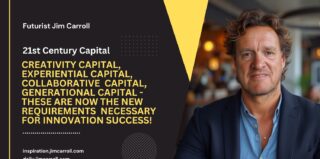
In the 21st century, given the high velocity economy and the need for agility, organizations will need many different, nontraditional types of capital:

  • Experiential Capital. In a world in which Apple generates 60% of its revenue from products that didn’t exist four years ago, it’s critically important that an organization constantly enhance the skill, capabilities and insight of their people. They do this by constantly working on projects that might have an uncertain return and payback – but which will provide in-depth experience and insight into change. It’s by understanding change that opportunity is defined, and that’s what experiential capital happens to be. In the future, it will be one of the most important assets you can possess.
  • Skills Accessibility Capital. Talent, not money, will be the new corporate battlefront. Simply put, there is so much happening that no one person or organization can know everything there is to know. With ongoing rapid knowledge growth, instant market change, fast-paced scientific discovery and constant skills evolution, getting the right people at the right time for the right purpose will be the key to successful change.
  • Creativity Capital. It is the ability to see the world differently, and the skill to imagine how to do things differently, that will be more important than any other skill. This will bring the needed forward oriented depth that organizations require. When product lifecycles are disappearing, and market longevity is measured in weeks and months, the ability to think, adapt, and imagine will be the foundation to provide for necessary change.
  • Generational Capital. We are set to see the emergence of the most unique workforce in history, with the widest age-span ever. Boomers won’t retire, and kids won’t want to get hired. The result will be a workforce that is transient, temporary, shifting and flexible. It will be those organizations who can match up the experience and wisdom of the aging baby boomers with the insight, enthusiasm and change-adept younger generation who will find the most powerful force to be found in business – an organization that is fuelled by the pure energy of change-oxygen.
  • Collaborative Capital. Forget the idea of having a strategic planning department, and think collaborative culture instead. Take a look around you, and ask yourself, who is succeeding today? It is those organizations who are plugged into the infinite idea loop that surrounds us. They’ve dropped any pretense that they can create the future, and instead realize that the future is being devel-oped by everyone all around them. They have come to learn that their role isn’t to plan for that future, but simply to listen to it, plug into it, and plug their growth-engine into it.
  • Complexity Partnership Capital. In the 20th century, organizations focused on hiring the skills that they needed to get the job done. You simply can’t do that today – skills are too fragmented and too specialized. That’s why successful organizations have mastered the art of complexity supply and demand. They provide their own unique complex skills to those of their partners who need such skills. And when they are short on other skills, they tap into the skills bank of their partners. By selling and buying skills with a broad partnership base, they’ve managed to become complexity partners – organizations that spend most of their time focusing on their core mission, and spend less time worrying about how they are going to do what they need to do.
  • Innovation Capital. Companies that understand that all future innovation comes from the ability to tap into the global innovation loop will thrive; those that follow traditional innovation models, self-centered and insular, will find that their creativity and uniqueness has been smothered.

Enhancing your real world balance sheet with these new elements of capital will prove to increase your innovation capability to a great degree.

What’s the depth of all the different types of capital outlined above? Do you have the depth of investment necessary to get you through the future? If not, start to think about how you can start to get some major investment happening!

A clip from a conference for hundreds of health care executives in Orlando in December 2010 – I’m speaking to the issue of the rapid emergence of new careers – including the “location intelligence professional.”

Stretch your mind a little – location aware dashboards, health care alerts as to looming health care issues, and new forms of business analytics all of which provide real time insight based on location sensitive knowledge. This is a huge trend unfolding before our very eyes!

For more insight, read my post “Location is the new intelligence” which I wrote last April.

Each year, Deloitte South Africa presents their annual “Best Companies to Work For In South Africa” survey, and coincident with that, they honour companies that show the best talent management practices. The companies are selected through a diligent process ; the entire event is built around the theme of world class HR and talent management practices.

This year, Deloitte engaged me to provide a “video keynote” that would touch upon the key themes from this years research into the best practices around talent management. The result is the video that you see below. It captures the essence of what makes for successful innovation in todays’ global high velocity economy.

The video was an international effort, with film production /editing done by David Mitchell of RiverBank Pictures of Canada and  further editing/production by FogHound Studios of Johannesburg. It was a true international project. Filmed on location in Toronto, Mississauga, Collingwood, Craigleith and Thornbury, Canada

This is a long post.

Way back in 1997, I wrote a book called “Surviving the Information Age.” It’s now out of print, but a few copies are still at Amazon.

The book took a long look at the trends that would impact our future. I dug it out again today when CNN ran an article, “Say goodbye to full time jobs without benefits“, decrying the fact that with the recession coming to an end, we were seeing more jobs that were contract oriented rather than full time. Reading the article, it seems they see this as a shocking new trend.

D’uh! What planet are these people on. Countless people have been talking and writing about the significant structural change occurring in hiring practices. I’ve been speaking about it since 1987 when the New York Times wrote an editorial entitled “Tomorrow’s company won’t have walls.”

So in the spirit of going back in time, I offer up an extract from my Surviving the Information Age book, in which I wrote at length about the trend.

I think I’ll re-release the book as an e-Book. It’s uncanny how right it was.

Chapter 5 : From Surviving the Information Age, Jim Carroll, 1997

The world of business is going to be changed by computer technology, not only as a result of the interlinking of business computer systems – but through the emergence of brand new forms of corporate organization that are fuelled by the connections that computers permit between companies and people.

My own career experiences are similar to what many people went through with the recession and business upheaval of the 1980s and 1990s. A lot of people found themselves in circumstances that forced them to re-examine their lives and make some decisions with regard to their careers. Some responded marvelously and others did not.

In my case, I’ve discovered a new flexibility in my attitude towards work: I find that my attitude now is that I have to continually change myself and skills in order to keep one step ahead in the game. Since I don’t have a job, I have to constantly invent one – and make myself available as a temporary worker to any business on the planet.

* * * *

By understanding in general terms what is going to happen in the future in terms of new forms of business organization, you can prepare yourself to maintain your career — and hence your income — through a period of unprecedented change.

One of the most significant changes that is occurring is that the emergence of the wired world will result in a significant change in the relationship between a business organization and its employees.

In the good old days, there was a simple rule that the world of business operated by: people lived close to the place where they worked. Having a job meant that you got up every morning, went to work, put in your seven or eight hours and went back home.

With the wired world, of course, this is no longer true: the matter of location is quickly becoming irrelevant. With the explosion of telecommunication networks, fax machines, voice mail, e-mail and other methods of communication, the fact is that the work that people do is increasingly becoming accessible to the world of business from anywhere. You can expect this trend to continue. For all the hype and hyperbole, business is truly going global and will come to rely on the skills of people wherever they might be on the planet.

* * * *

Back in June of 1989, I read an article in the New York Times entitled “Tomorrow’s Company Won’t Have Walls.” The author did a wonderful job of putting into perspective the fact that traditional forms of business were coming to an end, primarily because of the expansion of global communication capabilities. The author foresaw that the world was already becoming one in which companies were more likely to hire expertise on a part-time, as-needed basis.

His prediction? In the future, because of increasing complexity in the business world, companies would find that they would need a lot of specialized expertise. And with ever-increasing sophistication in communication capabilities, they would find that they would be able to obtain this expertise not by hiring more employees, but by accessing that expertise from contract workers or consultants who happened to make their skills available through sophisticated telecommunications technologies wherever they might be.

Two years after I read that article, which caused me to begin to think about what was happening around me with the recession of 1990–1991, Fortune magazine ran a cover story called “The End of the Job.” The article predicted that we were entering an economy in which “jobs” are disappearing and in which people would make themselves available to companies for short-term assignments.

And by 1996, The End of Work, a book that focuses on the dramatic change occurring in our economy, rocketed to the top of the international best-seller lists. One of the key premises of the book? The economy of the temporary workforce is upon us.

In his book Job Shift, William Bridges (1994) coined the phrase “dejobbing” to describe this trend to non-standard employment. He says that workers are going to be more like independent business people (or one-person businesses) than conventional employees. They are likely to work for more than one client at a time and to move back and forth across organizational boundaries — being employed full-time for a period of time, then hired to do contract work, then hired to consult, and then brought back in-house (perhaps part-time this time) on a long-term assignment. He concludes that, although there will always be enormous amounts of work to do in our economy, the work will not be contained in that old familiar employment form of standard full-time, full-year jobs.

All these articles and books centre on two themes: the ever-increasing reliance on the temporary “workforce for hire” and a reduction in the duplication of skills throughout an organization.

Over time, companies will become leaner and meaner than they are today. They will be built around a small, core group of staff responsible for keeping the business running and will obtain the rest of their needed expertise through an ongoing and ever-growing reliance on contract workers. And specialized expertise need not be duplicated. In the old days, companies may have had a human resource expert for every division and every office location. Today, they can rely on one expert, or perhaps two or three, and make that talent available to the rest of the organization through e-mail and other methods.

These changes are real and aren’t science fiction. Take a look around your world, and I’m sure you can see the signs that it is beginning to happen. Fortune 500 organizations continue to shed staff at alarming rates, as the era of downsizing and rationalization continues unabated. You’ve either been directly affected or will be in the future.

* * * *

If you think about it, the wired world is the grease that is fueling this new type of corporate organization. The reason? With the explosion of communication capabilities, organizations can go out and access the expertise and talent of any number of people around the planet. Why hire staff when you can hire a temp? If you spend a bit of time thinking about the implications of this change, you will see that through the next decade some rather remarkable changes are in store.

  • The Number of Full-time Jobs Will Begin to Shrink Dramatically

The era of the job for life has clearly come to an end, and the concept of the job is becoming irrelevant as well. A new way of thinking is emerging in the corporate world, built upon a reluctance to increase staff levels, with the result that we are becoming an economy of consultants who sell their skills and talents to business on an as-needed basis.

It used to be that companies entered into an employer–employee relationship in order to obtain access to some type of specialized skill or knowledge. If the company needed a new marketing specialist, it went out and hired a marketing specialist. Then came the recession of the early 1990s. With the onslaught of restructuring that occurred, companies came to appreciate that it cost a heck of a lot of money to fire people, since severance packages had become quite expensive.

A new way of thinking began to occur in the corporate world, built on this logic: if we hire staff, we might have to fire them some day, particularly if we have another recession. It costs a lot of money to fire people. So why not hire people, not as staff, but on contract or as temporary workers? The role of the wired world? Guess what. A lot of those contract and temporary workers are found on the end of a telecommunications line.

  • Companies Will Hire the Best Talent They Can, Regardless of Where That Person Might Be

In the wired world, the only thing that counts is knowledge. If the knowledge is accessible from anywhere in the world, then companies will find themselves in the position of being able to choose the best talent and expertise they need to do a particular job from a group of global, skilled consultants.

The impact? A new era of career competitiveness is about to unfold as a number of highly skilled workers sell their capabilities and talents to a global audience of business organizations. The result? Marginal performance is no longer going to be good enough: in the new dog-eat-dog world of networked business, the old rule that those with the best skills and capabilities will be in the greatest demand will be even more true than it is today.

  • Lifestyle Choice Will Come to Dominate Career Decisions

Because they can supply their skills from anywhere through the tools of the wired world, this elite group of individuals will call the shots. They will make lifestyle decisions that will let them service their national and global client base from a rural electronic cottage, thus enjoying the fruits of the wired economy, at the same time watching their children grow up. A new era of career decisions based upon lifestyle choices is upon us. As we enter an economy in which location doesn’t matter, the natural result is that more people will choose to work from the places they want to, rather than where they have to.

  • Our Actual Work Location Won’t Matter

You can enhance your future career and job opportunities by adapting your skills so that they are marketable and accessible via the wired world. That simple rule, people lived close to the place where they worked, that I mentioned earlier is clearly and unequivocally changing as a result of the wired world, since you don’t need to be near your job in order to do the work!

On the other hand, we might consider that the rule hasn’t changed: people who have mastered the technology that lets them provide their skills to others, wherever they might be, live close to the place where they work — online!

The matter of location is quickly becoming irrelevant, with the explosion of telecommunication networks, fax machines, voice mail, e-mail and other methods of communication. The office of the future will look like your bedroom — because it will be.

As companies begin to rely more and more on outside expertise, the number of core employees required will continue to decrease. The impact on downtown urban areas will be dramatic. There will be fewer people working in office towers. The real estate industry has a phrase for this: “see through buildings.” That’s because they will be.

Guess what — the work force of the twenty-first century wears sweatpants, not suits, since they shop at WalMart, not Hugo Boss, for their day-to-day work attire. And while downtown real estate will suffer, the home improvements industry will expand, as people build a more comfortable home office environment.

If you really want to know what is happening in the world around us, talk to your letter carrier. She will tell you that her pack is getting heavier, year after year, because of the number of people working at home. Visit a local photocopy or office supply store at 10 in the morning, and you’ll find a variety of semi-scruffy professionals loading up on supplies or getting some copies made.

Today, 41% of Canadians have home computers, according to Statistics Canada. Not all of them are used solely for games and homework; an increasing number sit in the home office, tools with which the new home-based workforce is meeting the challenge of the changing business world.

You can ensure you are a survivor by understanding what it takes to build, manage and work in a home office and by getting into the wired state of mind.

  • A Generational Battle For Economic Control and Survival Is Upon Us

It won’t be easy. Our economic systems are increasingly characterized by baby boomers and the older generation, comfortable in their unchanging ways and who are now faced with a new, wired and technically sophisticated Generation-X. Increasingly, economic survival is dependent upon mastery of technology, and it should be obvious who has the upper hand in this game!

2010GreenEnergy.jpg
I’ve been doing a tremendous number of small, intimate CEO level leadership meetings; I’ll work with the CEO or other senior management team member to pull together a talk that will highlight the key opportunities for growth through innovation within an industry.

I often point out that there are significant innovation and revenue growth opportunities when an organization concentrates on mastering the rapid emergence of new knowledge within a specific sector.

Take the world of construction; I’ve recently spoken at quite a few building management, construction and real estate conferences, and have focused on the fact that we are now witnessing very fast knowledge exponentiation with “green” design concepts.

What’s happening is that we are seeing:

  • the rapid emergence of new building methodologies, design concepts, materials, eco-design principles, all of which have the goal of reducing the overall energy footprint of the building, or reducing its environmental impact
  • the result is that green building methodology is continuing to evolve at a furious pace
  • there is so much new knowledge emerging that a new profession of “energy engineers” is beginning to emerge
  • their skill and role is simply to keep on top of furious rates of change in terms of new energy management solutions within the building and construction sector
  • developments are occurring so quickly that these individuals possess three key skills: how to rapidly ingest new knowledge and new ideas; awareness of where this new knowledge is emerging; and the ability to tap into other specialized skill sets and form rapid skills partnerships in order to tackle growth opportunities

The result is the emergence of a new career of “green engineers” who simply know where to find all the new knowledge and expertise that is appearing out there!

This is pretty significant stuff: after all, some 40% of total US energy consumption can be attributed to operating buildings: the heat, light, cooling, hot water and other systems. Another 8% of energy use is related to the materials used. All the SUV’s in North America? Three percent!

Clearly, there are BIG opportunities for growth through innovation, through the mastery of fast knowledge.

That’s why I always challenge a CEO and senior management team to challenge themselves with workforce innovation.

That involves innovation with different workplace policies, career paths, workforce structure, experiential oriented job descriptions, skills banks for specialized skills, and a rapid focus on growth through the rapid emergence of new knowledge within that workforce.

2010Nomadic.jpgEarly in December, I was contacted by an AP reporter who was doing a story on the key trends that would impact the economy into the future.

A brief part of my comments appeared in an article, “Crystal ball for 2010 sees changes in work, home“, that appears to have run in several hundred newspapers and Web sites over the last few weeks.

The key trend they used in this article was this:

Further adding to a nomadic work force: Many companies will look to hire employees on a contract basis, avoiding the risks and costs of full-time staff, said Jim Carroll, futurist, trends and innovations expert and author of “Ready, Set, Done: How to Innovate When Faster is the New Fast “.

I’m a big believer that one of the key trends going forward is that we are entering the era of the permamently contracted employee. Let’s expand on that thinking a bit: here’s what the AP was originally going to run:

THE TREND: A nomadic workforce. Many people will discover that the “new economy” is going to require them to think differently about their careers, said Carroll, who predicts that people will have four or five different careers throughout their lifetime.

A lot of companies won’t be willing to hire new full-time staff, given that the cost of future severance packages and benefits can be high. But they will hire someone on a contract basis.

“So the secret to success for many people in the year to come will be shifting their mindset from ‘how do I find a job’ to ‘how do I remake myself so I can find a few good contracts,’” he said.


THE IMPACT: More people will position themselves as consultants, he said. They will abandon dead careers and pursue new ones, heading to community colleges for fast hits of knowledge, skills and career training.

This is a trend that I’ve been speaking about over the last fifteen years. This particular recession has caused it to pick up more steam than ever before — even though the recession of 2001-2002 gave it some pretty good momentum.

As more people establish careers based on a constant stream of new contracts, they’ll realize that they’ve become a personal brand. And as they get into the contract game, they’ll learn that they don’t need a resume; they need a Web site that positions their personal brand.

But wait! Personal Brand Web sites are already passe; with the explosion in mobile usage, more and more of the fast-paced organizations that are looking to hire short, sharp shocks of creative staff are likely to be searching for them on their mobile device.

How do you get a leg up in this game?

You develop an App. If you think about it, an App is a simple recognition of the fact that the iPhone Safari browser simply doesn’t work well. Make it easy for the client to find you, and you’re ahead of the game.
Appicon

That’s what I’ve done with the new Jim Carroll App. I’ve been a nomadic worker for almost twenty years. I like to joke that I work really hard to not have to go and get a job. I seem to have some unique insight, and the ability to deliver that insight in a compelling fashion, such that world class organizations like the Washington Speakers Bureau and Harry Walker Agency introduce me to their clients. I’m a unique brand, and I’m continually working to evolve my brand so that it keeps up with the fast paced future. That includes making my insight and knowledge — the essence of my personal brand — easily accessible to potential clients.

The big question for you as you find yourself living an increasingly nomadic career existence is this: how do you keep your personal brand up to date, relevant, and accessible to your audience?

Welcome to the era that involves the End of the Resume, and the Rise of the Personal Brand App!

For those who have asked, my App was designed by the fine folks at iEveryWare.com. They’ve got an interesting product. Check it out!

Related posts:

  • Article: Crystal ball for 2010 sees changes in work, home
  • Video: The new workforce
  • Blog entry Today’s jobless recovery was predicted in 1987
  • Blog entry Advice for a flat world: take your skills to a global audience
  • Blog entry 10 Unique Characteristics of 21st Century Skills by Jim Carroll
  • Book: The Rise of the Project Workforce
  • iEveryWare
The New Workforce!
December 14th, 2009

A brief video clip on just how different our workforce is set to become ; from a keynote in Salt Lake City in the autumn.

I’ve been speaking about the new challenges of the new workforce for some time; some previous blog posts and articles are below.

  • Blog post: Here We are Now, Entertain Us
  • Related article: Don’t Mess with My Powder, Dude!
  • Keynote topic: What’s Happening with Our Workforce: Achieving Competitive Advantage Through Skills Agility
  • Critical Trends Analysis: 10 Unique Characteristics of 21st Century Skills

2009BoardingNRPA.jpgThe feedback on my Salt Lake City keynote for the National Recreation and Parks Association continues; earlier in this story, I had a blog entry from a message from someone at the event thanking me for “changing lives.”

The Past President of the NRPA has weighed in with an editorial in Perspectives, the NRPA’s national magazine. Headlined “Anticipating the Future,” Jodie Adams has this to say (excerpted).

Last month I saw the future, and it was exciting. Granted, it was one person’s version of what parks and recreation may look like a decade from now, but the view is compelling. At NRPA’s Congress last month in Salt Lake City, renowned futurist Jim Carroll outlined key areas where professionals and citizen advocates can expect to see major changes in the field. We chose Carroll as keynote speaker for our opening session as a way to crystallize the conference theme, “Prepare for the Future Today.” Virtually each of his points held importance for our field. Even the best speakers quote others, and Carroll’s quote by media magnate Rupert Murdoch spoke volumes about how we pursue our mission.

“The future will not be about big beating small, but fast beating slow.”

And nowhere is this message more applicable than to the young people entering our field. Considering that they are in large part a product of the Internet Age- infinite choices at lightning speed in interconnected ways- it’s no wonder they view work differently today. Carroll’s statistics point this out- 65 percent of preschoolers today will pursue careers that do not exist today. For those entering the held today, two to five years is a long-term career. When you’re interviewing them today, realize that they are looking right through you. two thirds of them say they are actually thinking about their next job and not the one for which you are interviewing them.

Because young professionals are increasingly more demanding in terms of flexibility, recognition, and loyalty, senior administrators must also think in these terms. It’s a sure bet they reflect the views and values of the citizens they will eventually be serving. As Carroll pointed out, we can expect entirely new sports and activities to come at us faster and faster, while “old” sports will evolve in similar ways. Characteristic of a generation fully wired with itself, Carroll only half kiddingly pictured snowboards with embedded chips and webcams that communicate a good run down a mountain to the friends and family of its user.

As Carroll explained, if you are not preparing for the “next economy,” you’re way too late.

More information:

  • Video: Location intelligence and the future of recreation
  • Blog entry “Thanks for changing lives! A note from the NRPA Congress…” by Jim Carroll
  • Blog entry The future of snowboarding and skiing by Jim Carroll

CareersEnd.jpgWay back in 1987, I was immersed in many of the early networking technologies which would one day form the Internet. I was convinced that we were at the edge of a transformative time, and that the emerging global network would have a profound impact on our world — politics, the structure of organizations and jobs.

I remember being stunned when I read an editorial in the New York Times that October, which forever shaped my view of the future.

The article essentially predicted a future in which organizations would become smaller, grow and contract as needs arise, and become something fundamentally different.

That one article forever shaped my view of the future, and has formed the basis of much of what I focus upon today in terms of the transformative trends that surround us.

Fast forward to today’s economy. With this recovery, as with all others before, organizations are increasingly reluctant to hire staff as they continue to shed even more staff. Organizations are going to go forward with a smaller employee footprint. They’re expanding and contracting as necessary. It’s all about contract work, part time relationships, and external partnerships.

This is not a new trend; indeed, back in the mid-90′s, I wrote a variety of articles and chapters in various of my books that touched on this theme in a variety of ways. I’ve put online a chapter from my 1997 book, Surviving the Information Age, which took a look at this trend. Read it now, and it was stunningly accurate. (The link is below).

For now, this editorial from 1987 makes for a great read.

“Tomorrow’s Company Won’t Have Walls”, New York Times, October 1987

The hub of the network organization will be small, centralized and
local. At the same time, it will be connected to an extended network
that is big, decentralized and global. People from the network and
from outside the company will join the group at the hub for periods
of time and then leave it.

But the network organization will also present its own set of
paradoxes. For instance, how will these new organizations be able to
manage the often conflicting interests of the centralized hub and the
decentralized network? And how can a system that is both centralized
and decentralized be unified and coordinated and quick to respond to
changes in the market place?

For the global organization of the future, the ability to acquire new
products, services, technologies and capital will not be the problem.
The marketplace is crowded with each of these as never before.

But for exactly this reason, the challenge for each company will be
to nurture its own unique culture and develop the quality of its
human resources. That is because competitive advantage will rest
increasingly in the way each network organization gathers and
assesses information, makes its decisions and then carries out those
decisions.

The 21st-century will be full of organizational surprises. The
challenge of arranging cooperative efforts between companies to
achieve strategic gains is beginning to emerge. Changes in the
marketplace have given companies from around the world the
opportunity to develop these new linkages. Advances in
telecommunications technology also enable companies to bring people
together for competitive advantage. The time has now come to form
new global collections of companies, and to fully utilize human
relationships.

12 years ago, in Surviving the Information Age, I wrote about what this 1987 New York Times article really meant. The predictions were pretty bang on.

Today? We’re in the midst of the jobless recovery – exactly what was predicted. Companies aren’t hiring back staff but they will be hiring back lots of people through contracts and partnerships!

benchstrength.jpgI’m in Vancouver, about to deliver a keynote to a global professional services firm, with the working title, “Extreme Skills Specialization: What Comes Next with Global Talent, Global Organizations?

The working description goes like this: “The future of every career is either extremely specialized, or
massively general. Most professions are fragmenting into dozens, if not hundreds or thousands of specialities. Someone needs to understand all this, and help organizations tap into narrow bands of knowledge.

This is a major trend, and perhaps one of the defining trends of the next 10 years. Here’s how I’m presenting the challenges to my audience today:

  • the ability to assist your clients with high-velocity change will be a key success factor
  • because of this, the ability to find, attract utilize and retain ever more narrow niche skills will be critical, for both your clients, and yourself.
  • the ability to scale up and scale down your resource base will define your clients success, and your own.
  • our ability to access and deploy unique skills at high velocity, globally, forming project oriented teams that last but a short time, will be key.

Think about these challenges in the context of your own organization. Ask your this questions: “what’s the depth of your bench strength?”

Then ask this question: “what do you need to do, from a unique structural perspective, to increase and improve your bench strength, particularly as skills become more specialized, scarce and hard to access.” There’s probable room for lots of innovative thinking there!

upcomingevents.jpgMy June is shaping up to be a tremendously busy month. Based on the bookings that are in, it’s clear that innovation continues to be at the top of the CEO agenda, despite some economic challenges.

In most of my upcoming keynotes, I’ll be spending time putting into perspective how executives should be thinking about future trends within their industry, and will take a look at the innovative strategies they might pursue.

Each of these talks is pretty tightly focused; I’ll be zipping from the insurance industry to optometry; from the future of global wealth management to high-velocity innovation in the banking sector; from opportunities in dealing with the new consumer 2.0 mindset, to how massive skills specialization will affect the world economy in the future. There’s been a tremendous amount of research underway as I prepare for each session; most of these talks get pretty darned specific in terms of industry issues.

Some of the unique topics that are unfolding include:

  • the new risk” : a keynote for the US Association of Actuaries that will take a look at how the insurance industry will the rapid emergence of new risk, and the impact of the “new analytics” on the global economy.
  • the new market” : how can a leading manufacturer transition to a market where it is not competing on price, but on brand, quality, image and value : in other words, “what do they do after the world is flat?”
  • the new customer” — how do we sell to the new 2.0 consumer, in this era of the wired-up-no-attention-span Gen-Connect demographic? The average consumer scans 12 feet of shelf space per second. What innovations do we need to think about when it comes to selling today?
  • the new investor“: Dubai and Singapore have “money-velocity.” Where is the investment world going, and how does a wealth management firm innovate to stay at the leading edge?
  • the new workforce” : how does a major global professional services firm transition into a new world of micro-skills and knowledge niches?
  • the new agent” : what comes next for the insurance industry? This one is a a keynote and a workshop for about 200 senior executives from the insurance industry, on behalf of LOMA, a major global insurance group.
  • the new collaborative team“: how can a leading bank outpace, outlast and outperform the competition?

I’ll be posting observations from the road, as there are powerful innovation lessons to be learned and shared from each situation.

dazedandconfused.jpgAt a particular keynote last week, I met a number of senior executives who certainly agreed with my message – we need to constantly realign our company to the reality of change that surrounds it. That’s where innovation comes from. But they also also indicated that they found it increasingly difficult to keep up with the rapid change occurring all around them.

There’s been an increasing number of these individuals, and I’ve come to call them the Led Zeppelin refugees: they’re simply dazed by the changes occuring in the high velocty economy, and are confused about what to do next.

That’s why there’s such a good question that flows from this: just how do you become an organization that is focused on innovation?

One of the easiest methods is simply by identifying the obvious and the not-so-obvious trends that will impact your business or organization — and then taking the time to figure out what actions you must undertake to deal with those trends.

Ask yourself this question: are you prepared for what comes next in terms of your business? The likely answer is no: my experience is that many organizations still have a very short-term minded outlook. They’re caught in an innovation rut, simply doing day by day the same old things they’ve always been doing, day in day out. And they don’t really think about how their world is going to change.

That’s why you should undertake a “trend-and-innovation” audit of your organization: quite simply, figuring out what comes next, and what you need to do about it.

How can you do this? By asking yourself a series of questions:

  • How quickly is our marketplace changing? How quickly might it change in the future? What’s the impact on what I sell, and how I sell it?
  • How are our products changing? Willl they change faster in terms of features? Will support become easier, or more complex? Can we manage to operate in a faster market?
  • Are our products moving upscale, or are they becoming commodities,such that you’ll be forced to compete on price? Can we do something so that there is more of a service element to our product?
  • What new competitors are appearing, or might emerge in the future? Is the basic business model threatened? Is there more likelihood of direct outreach to the consumer rather than through an existing distributor/wholesaler network?
  • What moves could we make to make sure we can remain competitive? You really must ask yourself some probing questions as you go through this process. You need to challenge yourself and think what might really be different in five years, in terms of what you sell, who you sell to, how you sell it, and who you are selling against.

What you need to do is ask yourself these tough questions, so that you’re thinking about where there might be new problems and new opportunities that will impact your business in the future, not just in terms of what you sell, but in terms of the structure that you use to get things done.

And therein lies the rub: I think a lot of organizations fail to do this type of simple analysis. There are too many who sit back and react to change instead of thinking: “ok we know some big change is coming what the heck are we going to do about it?” Think of it as forward-oriented innovation: it’s a simple concept, and one of the most important things you should be doing.

sixtyfivepercent.jpgCareer issues are hot! And one of my favorite ways to open a keynote or executive session is by quoting from an Australian study, which indicated that sixty-five percent of the kids who are in preschool today will work in jobs or careers that don’t yet exist.

I passionately believe this to be true: and I’ve seen the trend occurring in countless professions and industries.

This week, I keynoted a Career Day event at Capitol One in Richmond, Virginia ; the focus was on the rapid emergence of new careers, and the rapid evolution of existing skills. My message, in looking at the future career opportunities, was that there’s nothing but upside, as long as people keep reinventing their skill set.

The topic of the future of careers is a big one these days; I’m being called into many organizations and events to talk about the issue, particularly in the context of recent economic trends. Some of these events have been local economic development conferences. In one talk in January, I spoke to an audience of executives and educators in an auto-sector city ; a group of people caught up in the throes of economic restructuring and turmoil.

Talk about an audience in the midst of challenge! Yet when you are in that type of economic bubble, it can be hard to see the future career opportunities that do exist. That’s why I didn’t focus on the short term economic turmoil, but instead, on the real, practical trends that are defining the careers of tomorrow.

Many sectors of the global economy: and in particular, the manufacturing and financial sectors, are being hit hardest by the US recession, the sub-prime meltdown, and global competition.

The auto-town event got covered in the local paper: and the story ended up being reprinted throughout the Canadian press, including in Vancouver, Calgary, Ottawa and Montreal. One of the key observations I made in the article: “We have to figure out how we can continue to move up the knowledge ladder because there’s going to be a massive shortfall in specialized skills because of the rapid growth of knowledge.

That’s an important issue to think about, and the article is well worth a read.

More information:

  • Read Knowledge Explosion Key to the Future
  • Read Global Economic Trends: An Interview with Jim Carroll
  • The reality of future trends: grab the What Comes Next trends overview

gen-connect2.jpgOne of my latest columns focuses on what will likely be the corporate issue of 2008 – managing generational challenges in the workplace.

In the column, “Here we are now, entertain us,” I take a look at the unique attitudes that Gen-Connect is now starting to bring in to the workplace. There are several key observations from the article that are critical to understanding the future of the workforce:

  • What is clear is that we are witnessing the death of the long-term career and corporate loyalty, which will soon be but a quaint memory from the previous century.
  • I often tell the story of a young engineering graduate who turned down a job with an architectural firm because its 9 a.m. to 5 p.m. work hours conflicted with the time he expected to be carving arcs into deep powder in the mountains. It’s a real attitude, and it’s already happening around us. The challenge, when such trends are so patently obvious, is trying to figure out what to do about it. And a good part of the solution will come through the transformation of rewards and remuneration.
  • Gen-connect has very little patience, particularly when it comes to being rewarded for good work or significant effort. These youngsters are used to instant rewards: their Xbox/Wii video-game-oriented world has them accomplishing a goal, moving up a level, and earning some points or other valuable form of currency that helps them accumulate additional armour, weapons or whatever else is needed to accomplish the game’s next challenge.
  • That’s why, at a recent conference, I framed the issue of rewards transformation to an audience of financial professionals this way: “Organizations that can attract, engage, retain and amuse an increasingly complex workforce will be the ones who find success in the rapidly evolving global economy.”
  • Put the emphasis on the word amuse. Today’s Gen Y doesn’t, and tomorrow’s Gen-connect certainly won’t, have any patience whatsoever for slow and steady career paths.

Related postings:

  • Article: Here We are Now, Entertain Us
  • Related article: Don’t Mess with My Powder, Dude!
  • Keynote topic: What’s Happening with Our Workforce: Achieving Competitive Advantage Through Skills Agility
  • Critical Trends Analysis: 10 Unique Characteristics of 21st Century Skills
  • powerdude.jpg
    Earlier this year, I wrote the Foreword for the book, The Rise of the Project Workforce: Managing People and Projects in a Flat World.

    It was titled, “Don’t Mess with My Powder, Dude“, and tells the unique attitude towards work and life of a snowboarder.

    The foreword, now available online, puts in perspective the unique and often challenging workplace changes now underway, which are often driven by unique and different attitudes towards careers and work with the younger generation.

    It’s worth a read; you can grab a copy below. You might also want to look at Rudolf’s book.

    • read Don’t Mess with My Powder, Dude!
    • Book: The Rise of the Project Workforce

    gen-connect.jpgTake a look at this kid.

    He’s your next employee. How are you going to recruit, retain, manage, interest and amuse this fellow? What’s your workforce going to look like in 2012, 2020, or beyond?

    There’s quite a bit of focus on trends relating to the future of the organization — and organizations are seeing innovative strategies to cope with the world of high velocity change that we find ourselves in.

    Last week I was the opening keynote speaker, and a panelist later in the day, for an offsite of one of the world’s largest professional services firms. Tomorrow, I keynote a get-together of key clients of a multi-billion insurance/financial services company. A few months ago, I ran a Board of Directors/CEO level meeting on the issue for a major industrial company.

    If you don’t have this issue figured out yet, you’d better start thinking about it in a hurry.

    There are certain things we know for a fact that relate to the future of the organization.

    • there is a huge amount of expertise walking out of the economy. In 2010, 3 people will leave the economy for every person that enters it; by 2012, 4. By 2016, 6 people will leave for every new worker that joins. Those are staggering realities.
    • the current generation entering the workforce is completely rejecting the concept of a traditional career. More than 50% of young people in a US survey indicated they believe self-employment to be more secure than a full time job. They don’t want to work for big organizations. They’ll be nomadic, contingent workers, entrepreneurial and global.
    • skills are fragmenting and specializing at a furious pace. Knowledge half-lives in most industries are compressing to a matter of just a few years. Knowledge extinction is real, and massive skills fragmentation is occurring at an extreme velocity. The result is that most organizations will find future failure will come from an inability to get specialized skills. A strategy that is focused on global access to extremely specialized skills will be a transformative factor for winning.

    The whole issue is massive, and is one of the areas in which innovative thinking is needed now. It’s a CEO / Board level issue. It’s transformative. It’s urgent.

    More information

    • What’s Happening with Our Workforce: Achieving Competitive Advantage Through Skills
    • Critical Trends: 10 Unique Characteristics of 21st Century Skills

    powerdude.jpgTenrox, a company that provides companies an intgelligent infrastructure for rapid workforce management, has invited me to keynote their September 2007 user group conference in Bloomingdale, Illinois.

    The title we’ve worked out, based on a story I often tell on stage: “Don’t Mess with My Powder, Dude: Managing People and Projects in the Flat World.” It’s related to the number of talks I’ve been doing within the overall theme of “What’s Happening with Our Workforce.”

    • read the Tenrox press release
    • previous blog post, “What’s happening with our workforce?”
    • Critical Trends: 10 Unique Characteristics of 21st Century Skills here

    Organizations are coming to realize that talent management is going to be a critical issue, and I have a wonderful track record in positioning this on stage.

    Performance Optimization WordPress Plugins by W3 EDGE