24 hours of video are uploaded to YouTube every minute

Home > Archives

Manufacturing

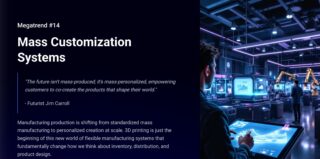
We’re moving from a world of mass production to mass customization, or what I call agility-based manufacturing

Some of the largest manufacturing and industrial organizations in the world have engaged Jim to help them think about opportunities for innovation. DaimlerChrysler arranged for his participation in a two day global strategy summit in Stuttgart, Germany, in order to provide insight on trends in the automotive industry. He recently keynoted the 2011 IMX - Interactive Manufacturing Exchange Congress in Las Vegas. Jim's other manufacturing and industrial clients include • Genesis Systems Robotics Conference • Siemens • PPG • Chrysler • Satisloh North America • FMC Lithium • Motorola • The World Congress on Quality • Caterpillar • FMC Food Products • Techsolve Ohio • Parker Hannifin • Methanex • Packaging Machinery Manufacturers Association • Materials Handling Association of America • Silgan Corporation • FMC BioPolymer and many more.

I’ve just had an article published in STOrai Magazine. This is the monthly magazine for the Retail Association of India, one of the largest such groups in the world.

The article takes a look at the trends which will define the world of retail through the next 1, 2, 5 to 10 years.

You can grab a PDF version of the file — it’s 2 pages long.   

Grab the PDF of the article above! “…most retail experts believe that retail stores will evolve, so that they simply become showrooms for a massive backend logistics system that is their e-commerce system.”

I’ve been doing quite a few keynotes in the world of retail for quite some time, with clients that including for The GAP, the Walt Disney Company, Loblaw and global conferences for both Yum! Brands and Burger King. There’s a lot more information in the Retail Trends section of my blog.

These have ranged from speaking for small groups around a boardroom table (with the CEO and senior management team of several major retailers) to 7,000 person events in Las Vegas.

While dong my research for a recent event, I came across a great quote from Cyriac Roeding, CEO of Shopkick (which develops location- based shopping apps available for Macy’s, Target and other top retailers) ….. “The next five years will bring more change to retail than the last 100 years.”

I certainly believe that to be true.

I also believe that there are quite a few retailers who aren’t quite ready for the scope, speed and breadth of the change that is underway.

The article does a good job of putting into perspective just a few of the trends that are sweeping the world of retail. Much of it is being driven by mobile technology — which is coming to influence not just purchasing behavior, but the entire checkout process.

And think about how quickly dramatic change is occurring in the world of retail – by simply visiting an Apple Store – which is redefining the layout and purpose of a retail store, as well as causing significant upheaval in the entire retail process.

Consider this fact: Apple Stores devote at least 50% of their retail process to what they call “ownership experiences”. The Genius Bar, training, and exploring. That in itself is a fascinating statistic.

And then there’s process: the Apple checkout process, for example. All of a sudden, cash registers seem obsolete! They’ve had such an impact that countless other retailers are now scrambling to put the same type of process flow in place, trying to link themselves to the coolness of the Apple cachet.

That’s the new reality in the world of retail today — pacesetters can swiftly and suddenly change the pace and structure of an industry, and other competitors have to scramble to keep up.

Here’s the article in it’s entirety – and remember, you can grab the PDF from the image above!

Logistics, E-commerce and Attention Spans!

Perhaps the most fascinating thing about the future of retail is that e-commerce, or virtual commerce – which was so hyped in the late 90′s and then came into it’s stride in the last decade -will probably come to define the future of the physical retail experience. Jim Carroll, a futurist trends and innovation experts with clients such as The Gap, the Walt Disney Company, the Professional Retail Store Maintenance Association, Loblaw and other, has an interesting take to share on the future of retail.

 Isn’t that the obvious conclusion in a world in which, in the US at least, Amazon.com is now promising same day delivery?

Buy online, get it delivered, all in an instant. So imagine that you go into a store, see something you like, buy it and the same e-commerce system kicks in to deliver it to you later in the day!

Why? Well, why carry inventory if you don’t have to if you’ve built a big e-commerce infrastructure for your brand, you might as well use it!

This is the obvious conclusion  in a world in which the customer in the typical retail store probably spends more time looking at the screen on their smartphone than looking at store shelves. So why not adapt to that reality?

Certainly it is becoming more difficult for retailers to keep the attention of their customers. It is said that the average consumer scans some 12 feet of shelf space per second – because they are spending a lot of other time looking at their phones.

In a recent keynote with a world-leading retailer, I made the observation that most retail experts believe that over time, retail stores will evolve, so that they simply become showrooms for a massive backend logistics system that is their e-commerce system. Stores won’t carry much inventory anymore, and instead will become integrated into the sophisticated e-commerce systems which they have built for the online shopping experience.

Anne Zybowski, an analyst at Kantar Retail, stated this possibility perfectly: “A few years ago retailers spent a ton of time trying to make their online stores look and act like their physical stores. Now they’ve sort of reversed course, and the challenge is how to take that online shopping experience that’s so personalized, socially connected and heavily layered with data, and essentially bring it into a physical environment.

And it is for reasons like that, that we have Ron Boire, the chief marketing officer at Sears (and former chief executive of Brookstone Inc.), commenting that his focus is about “creating more and better theater in the stores.”

In other words, pump up the in store experience to grab the attention of the customer. Send promo codes to their smartphones, interact with them heavily through technology, give them the excitement of shopping and deliver the product to them the same day through the logistics system that you have already put in place.

Continual re-invention

Of course, if the consumer is losing their attention, then retail needs to ensure it can do the right thing to stay relevant.

We are seeing this as many retailers invest heavily in the in-store experience. In the UK, Marks & Spencer is spending $600 million revamp of its High Street Kensington store! And Macy’s in New York is spending $400 million on flagship store.

But it’s not just big global mega-stores, mega brands that are reinventing. Trends involving everything from safety to energy to health are causing retail chains to reformulate their stores at a fast pace.

Consider Fresh-Stop, a chain in South Africa that is own owned by Chevron. With the push to healthier diets in the country, the gas-bar chain is now moving away from a mix of unhealthy snack foods, to shelves that offer  fresh produce, meat, fish, a delicatessen and even up-market meals!  And they are converting stores at a furious pace with results. Converted stores have recorded a 12 per cent footfall increase and a 40 per cent sales increase in 2010 against the background of a convenience store sector where sales fell 6 per cent.

What’s most fascinating about this is the fact that they are learning how to change an entire store extremely fast. They can convert an entire store in just two weeks so the future belongs to those who are fast!

And then the credit card disappears

The biggest change to the world of retail comes about as credit cards disappear – because our cell phones become the credit card!

This is a huge trend in North America, it is estimated that payments using digital wallets will grow from $4 billion in 2012 to $191 billion in 2017, breaking $100 billion in 2016.

We’re already seeing the signs of this change consider the Silicon valley upstart Square. Plug the little (square device) into your iPhone, and all of a sudden, you can accept credit card payments.

The service is growing at a furious pace with over 2 million users in just 2 years. They’re doing $8 billion in payments, and just had equity investment by VISA. Even more momentum Starbucks planning a massive rollout to 8,000 stores throughout the US. Square has an unmitigated cool factor!

Yet, despite the excitement of such initiatives, it will take some time for the ‘digital wallet’, or mobile commerce, to become real. Even Google admits this their VP of Wallet and Payment Systems, Osama Bedier, commented that “there’s a lot of ideas and not a lot of problems being solved.”

That’s because there are a lot of BIG problems that need to be solved concerning credit card infrastructure. The New York Times noted this, commenting that “one of the bigger problems that has to be overcome is that mobile payments involve deals between companies that aren’t used to working together like wireless carriers and banks.” (Mobile Payments Slow to Catch On, New York Times, March 2012).

Certainly smartphones are everywhere but retail stores and credit card companies are going to have to invest a HUGE amount of money to put in place the technology that will support near-field-communications.

How much work? “Yankee Group analyst Nick Holland estimates it will cost $15 billion to deploy the technology that will make mobile payments ubiquitous.” Wall Street Journal, November 2011.

In May, I was the opening keynote speaker for Manufacturing Innovation 2012, held in Orlando, California. In the room were a thousand or so folks from throughout the manufacturing sector throughout the US. This is one of MANY manufacturing conferences that I’ve opened — I’ve developed a reputation in the sector for what is really going on, without any political spin.

Here I am speaking about the next generation -today’s uber-connected generation –  and how their attitudes towards careers and new business models — are coming to reshape the world of business startups and manufacturing.

As I wrote in one of my columns last year (“Smartphones are changing everything,” August 2011), when I give a keynote I like to use a service called Poll Everywhere — the same technology at the heart of the American Idol voting process. I put a poll on the front screen and audience members can reply by text or online with their smartphones, laptops or tablets. The results start to appear on the screen instantly — it’s a very powerful tool.

American manufacturing executives have proven to the most optimistic group of audiences I have been dealing with through the last two years.

There’s one question I pose at the start of every talk: “when do you think we will see an economic recovery?” After running more than 200 polls over four years based on this question, I can tell you the majority of North Americans and Europeans I’ve encountered think the economic recovery is at least six months to two years away, or more than two years away. Few offer up the answer “It’s happening right now.” (And of course, I always have a few who go for the option, “Run for the hills! It’s all over!” I figure they might have been up late at the bar the night before.)

So the majority of my audiences — which represent virtually every type of industry and region from the heartland of the US to major global cities — are still skeptical about the future and economic recovery.

Except for one distinct group: North American manufacturers.

In the past year I’ve addressed 1,000 manufactures at major conferences in Orlando and Las Vegas, and at both events an overwhelming 70% indicated the recovery is happening now. At a February 2011 event in Ohio, 200 executives in the sector — one of the hardest hit during the downturn — indicated a similar positive outlook. As did executives at advanced robotics manufacturer Genesis Systems in Davenport, Iowa, where I spoke in April.

What’s driving this optimism? Manufacturers have been innovating like mad for the past decade, and are more likely than any other sector to bring the North American economy roaring back. We’ve seen them focus on agility-based manufacturing, which allows them to change their product faster so they can deal with a higher rate of change at the consumer level. They’ve completely automated the design process with powerful tools such as AutoCAD (which now even runs on an iPad) to such a degree that they’ve mastered the skills of rapid concept generation, rapid concept development and rapid prototyping. They’ve become experts at mass customization and rapid time to market. Not to mention learning to win the battle against offshore competition by mastering the one key advantage they have: time.

The sophistication of the machinery North American manufacturers use places them ahead of the pack. As one executive told me, “The education level of our workforce has increased so much — the machinists in this industry do trigonometry in their heads.”

That’s why a comment in the San Francisco Herald in July 2009 was so bang on: “We don’t have to give up on manufacturing — it will be a different type of manufacturing.”

That’s what’s happening now. There’s also a lot of experimentation with new manufacturing business models. One of the most fascinating involves micro-factories, where the average Joe can design a product and have it built to spec.

Take a look at Ponoko for some fascinating insight on the future of manufacturing, where the average Joe can design a product and have it built to spec. And then think about the rapidly emerging concept of 3D printing, 3D printers and the inevitable shift to “additive manufacturing” (laying down additional quantities of material to create a product) from “subtractive manufacturing” (based on cutting, drilling and bashing metal) which has been used for more than 100 years

Who’d a thunk it? While most people are still skeptical about the pace of the future, it’s the manufacturing folks who are most positive of all.

From my keynote for the Manufacturing Innovation 2012 conference held in Orlando, Florida. I’m speaking about how manufacturing companies can add value to their product through intelligence and connectivity – one of the leading trends which will define products through the next ten years.

In April, I’ll be a dinner speaker for Genesis Systems Group annual Robotic Automation conference.

It’s one of quite a few keynotes I’m doing in the manufacturing sector. I’ll be in Phoenix the week after this one for a corporate meeting for a major manufacturing group; in May, I headline “Manufacturing Innovation 2012” in Orlando, which will feature representation of over 700 manufacturing organizations, as well as representative from most US states Manufacturing Extension Partnerships.

This follows up some pretty high profile events last year, including the Interactive Manufacturing Exchange in Las Vegas as well as several other events.

What’s the draw? Why so many bookings in this sector, usually left for dead by so many?

Because my key message is one that folks in the manufacturing industry already know: something big is going on. There are huge opportunities for innovation, a change in the way things are done, opportunities for reinvention, and fascinating new technologies, processes and methodologies that helps manufacturers to do things they haven’t done previously.

There’s also a recognition in the sector that to take advantage of these trends, people really need to challenge their thinking. A sense of ongoing doom can kill innovation; a focus on the challenges of the past rather than the opportunities of the future can blind people to what they should be doing, rather than thinking about what they have been doing.

And that’s what I’ve been doing in my keynotes.

It seems to be striking a chord!


A report from T. Rowe Price on my recent keynote for the 2011 Investment Symposium follows, where I was one of three keynote speakers (the other two being Colin Powell and Charlie Cook). You can find some blog links to each of the three key themes in the article at the end of the article below.

""We thought Jim was amazing - just the positive message we wanted to leave folks with"

It was a fabulous event, and a great opportunity to get a pretty impressive audience — investment managers for a broad range of investment managers for a broad range of Fortune 1000 organizations, pension funds and government agencies.

Summary:

Futurist Jim Carroll, one of the world’s leading experts in global trends and innovation, described how advances in technology and human innovation will combine to create positive change in the future. He explained how businesses can be held back by what he calls “aggressive indecision”— postponing action because they are constantly waiting for economic conditions to improve. Carroll noted that as the pace of change accelerates, the companies that prosper will be those that can adapt and innovate most quickly.

Key Points

  • Long-term trends that will lead us into the future. Silicon Valley is redefining everything—industries that get involved with Silicon Valley will be brought up to their speed. One powerful trend is pervasive interconnectivity—the fact that electronic devices are connected and can communicate with each other—as a driving force. For example, a staid industry such as air conditioning and heating benefits when people can control their entire home environment remotely through a cell phone. On the health care front, sensors can monitor the activities of seniors and report any changes in behavior, allowing people to live independently longer. On a more dramatic note, he believes advances in exploring the human genome will change medicine’s focus from reactively treating disease to proactively searching for potential health problems before they occur.
  • The paradox of pessimism and reality. While many business people are pessimistic about the future and believe economic recovery is at least two years away, technological advances are creating the potential for greater productivity and efficiency. For example, the auto industry now has the flexibility to produce in response to demand instead of building huge inventories that may go unsold. Products can also be brought to market much faster to take advantage of changes in consumer tastes.
  • The next generation. The next generation has grown up with rapid advances in technology, so they are at home with change. This familiarity means young people will greatly increase the rate of innovation as they enter the workforce. This group is not afraid to take independent action—50% believe self employment offers more job security than working for a company. The next generation will receive $12 billion to $18 billion in intergenerational wealth transfers in the next 12 years alone, which could help fund their ambition.

More information:

  • Major 10 year trend: The future of every industry to be controlled by Silicon Valley Innovation  
  • The new face of manufacturing: agility, insight and execution 
  • Creativity and the new workforce 


One thing I love to do when I’m working with an audience is to build a totally interactive keynote with them.

Jim Carroll has set the conference world on fire with his live, interactive text message / mobile phone polling from the stage.

It doesn’t matter if I’ve got 40 people in the room and I do some simple Q&A, or if I’ve got 2,000 in a cavernous Las Vegas conference hall.

In the latter case, I do a series of live text message polls – people use their cell phones and other mobile devices to give me a sense as to what they are thinking about the issues I’ve built into my talk.

Manufacturing Engineering Magazine just ran an article commenting on the live text message poll that I did during my keynote at the IMX 2011 – Interactive Manufacturing Exchange Conference – in Las Vegas last month.

This type of interaction matters — it helps me to shape my comments and the direction of my remarks to the mindset that exists in the room. Consider the comments, because this is significant:

Up Front – Your Opinion Matters
1 October 2011, Manufacturing Engineering

Anyone who can text can take part in a real-time opinion poll. This was demonstrated at the imX keynote address of Jim Carroll, global futurist and trends and innovation expert (his billing). Carroll asked a basic question about how optimistic/pessimistic the authence was about the future of the economy, Authence response through texting was displayed on monitors in real-time as they “voted” with their fingers. The audience of manufacturers, their suppliers, and technologists who shape the future of manufacturing was more optimistic about the future than the headlines in any of our major media would lead one to believe they would be.

It goes without saying that that same manufacturing authence and our readers would have the best opinions about how to ensure that public policy- too often heid hostage by politicians- could best serve the interests of manufacturing. Policy should support and not hinder manufacturers in the successful use of all the resources available to them.

There’s a key issue that I’ve observed with manufacturing audiences through this type of live interaction that is quite worth mentioning — and that is that North American manufacturing executives tend to be far more optimistic about the state of the economic recovery then any other industry group I deal with.

This, despite the drumbeat of news negativity that continues around the sector. I asked the audience about this issue — whether the reality they saw matched what they saw in the media. The response was pretty overwhelming:

And there’s the paradox: everyone is convinced that manufacturing in America is dead – except for those who actually work within the sector.

I’ve never encountered a sector with such a degree of optimism about the future. And believe me, I deal with virtually every type of industry out there, and have been doing this type of live interactive polling on stage for over four years. I ask every single audience what they think is going on with the global economy. (You can watch me doing this when I opened the PGA – Professional Golfers Association of America — conference last year in Boston.)

At the IMX conference and at a previous keynote for a manufacturing group in Ohio, I was floored by the optimism in the room. I don’t see this mindset to exist anywhere else, to be quite honest, regardless of where I’m speaking in the world

And this mindset in manufacturing is confirmed by the number of forward looking inquiries and bookings that I have with various manufacturing groups and conferences going forward from here.

There’s a variety of attitudes at work, some of which I spoke at IMX in Las Vegas:

  • the industry has seen tremendous opportunities for innovation through advanced technology and changes within the manufacturing process
  • manufacturers are learning quickly how to streamline the process, such that they can focus more on agility and such capabilities as mass customization
  • the rapid emergence of new methodologies such as 3D printing is providing new opportunities for transformation in process
  • the arrival of the ‘digital natives’ is accelerating the rate of adoption of new ways of doing things

What it is really leading to is a fascinating new trend that I think is just bubbling below the surface, but that I suspect will be mainstream within the year — “Build America.”

There’s a realization and a push within the manufacturing sector that given this new mindset and the capabilities that emerged, with the emergence of challenges within the global supply chain (i.e. Japan and the tsunami), the impact of increasing Asian wage inflation (the Chinese cost advantage beings to erode); and the eventual arrival of reskilled, retained American workers who can work within the new sophistication of American manufacturing — that the time has come for the sector to grab the reins once again and show the world what can be done with American ingenuity and innovation.

It’s there — I can see it with my audiences — and it’s my projection that there is a real and significant mindset and trend here.

You saw it here first, folks: Build America.

More information:

  • Jim Carroll’s “Manufacturing Trends” page  
  • The Future of North American Manufacturing? Brighter Than You Think 
  • Report from the Heartland: Is there life in manufacturing in Ohio? You Bet! 


Many people don’t know how to think big — how to envision bold news ideas. In this clip from Las Vegas, Jim talks on stage in Las Vegas at a major manufacturing conference, about he challenged an auto company to think bigger by thinking about Google as a potential competitor. He uses this as opportunity to talk about the impact of future trends — particularly 3D manufacturing — upon industry and manufacturing.

The world of manufacturing is in the midst of a huge trend — we will witness the emergence of 3D printing and an inevitable shift to “additive manufacturing” from subtractive manufacturing based on “cutting, drilling and bashing metal…”

Last week, I spoke to several hundred manufacturing executives from throughout North America, at IMX Las Vegas — the Interactive Manufacturing Exchange!

Here’s a key clip from the start of the keynote. Watch it, and ask yourself — are you guilty of focusing on short term volatility — or are focused on opportunity of the long term?

I’ve just returned from Las Vegas, where I was the keynote speaker for a new manufacturing conference that has attracted quite a bit of attention – IMX 2011 – “The Interactive Manufacturing Experience.”

Seen on Twitter: "@imXevent this morning's speaker Jim Carroll was amazing and insightful! had powerful information! #imXevent"

I was in esteemed company on the stage; the other two keynote speakers were Peter Schutz, author and retired CEO of Porsche AG, and President Barack Obama’s new “Chief Manufacturing Officer, Michael Molnar, who chose this conference to deliver his first public address.

I actually had two keynotes, starting out with a quick 20 minute talk at the Gala celebration dinner on the second day of the conference, an invitation only event with the CEO’s and senior management of some of the largest manufacturing based organizations worldwide. The next morning featured an opening keynote for Day 3, for about 400 manufacturing executives.

Let’s turn to the Gala. It was a celebratory dinner — and my goal came to be one of highlighing the transformative trends that are driving the manufacturing industry in North America forward and providing for future opportunity and potential rebirth of the sector.

Wait a moment, you might think! Isn’t this an industry that is dying by degrees? Certainly the media spin is that manufacturing in North America might be all but over!

Consider, for example, a headline that ran in the Huffington Post just a few days before my talk:

The article goes on to note that August saw a net loss of “3,000 jobs” — and that perhaps this is a sign of the yet continuing decline of the industry.

My first bit of advice to the audience. Knowing that economic volatility is the new normal, they should tune out the day to day media noise, and focus on the fact that there is a significant reinvention and transformation of the manufacturing sector that is well underway!

Given that, what’s the mindset of some of the leading manufacturing based organizations from throughout North America. On the stage, i summoned up a quick text message poll: and in a matter of two minutes, had a good summary of the belief in the room that an economic recovery was well underway:

This echoes the experience I had earlier this year when I keynoted Techsolve 2011, a meeting of leading manufacturers in the state of Ohio (Read: “Report from the Heartland: Is There Life in Manufacturing in Ohio?” You Bet!“) — who also responded in resounding fashion that they believe the economic recovery is happening now.

So what’s going on in the world of manufacturing that’s “right” and that will allow organizations to seize advantage of opportunity in the future.

Many things which I began to cover off in my keynote. Read these points and check the related posts, since it will help to clarify each point where necessary.

Agility: I wrote a story into an article a few years back — actually, about 2004. It’s self explanatory on the agility theme:

I recently spent time with the CIO of a US-based patio furniture manufacturer. His organization was hammered in the last decade by countless factors, including the fact that a Chinese manufacturer could provide a similar product for a much lower price.

He convinced his leadership team that it needed a financial management system that would permit it to run leaner, faster and with more insight into operations. The company spent a whack of money on it and suffered greatly with the challenges that came with implementation.

Then one day, it reaped the rewards of a financial management insight system. Last winter, it had a call from Wal-Mart, asking if it might supply 110,000 patio swings; Wal-Mart was unable to source the product from its usual Chinese supplier. With the analytical tools the organization had put in place it was able to look up and down the supply chain to ensure supplies could be immediately sourced. In an instant, it was able to analyse the numbers and determine a price bid it could live with. It examined its resources and changed the production schedule to fit things in. The company was able to go to production two weeks later, delivering the product in advance of the order date, and on budget.

The company had the agility necessary to respond to a world of rapid change — and serve as a perfect case study of what we can really do when we focus on the benefits that sophisticated accounting insight can bring.

There’s a tremendous amount of focus on agility today, and it is one of the key trends that is driving the transformation of the sector.

Flexibility: I often compare the “old” business model of “building to inventory” to the new business model of building to demand. Read my blog post, in which I compared the approach of Ford, vs that of Honda. (“The new face of manufacturing: agility, insight and execution“. ) There’s also YouTube video you can watch – “Innovators focus on corporate agility.” I’m that video I’m actually on stage for 3,000 people for a global food company — in the exact same conference room at the Bellagio hotel a few years previous to the IMX event! Another key concept is that of “chameleon revenue” — success comes from the ability to generate new streams of revenue that haven’t existed before. Read “Innovation and the concept of chameleon revenue” for insight into what is happening here.

Post-flat strategies: smart companies avoid the complications of the “flat-world” by changing the rules of the game. Take a look at “What do you do after the world gets flat? Put a ripple in it!” in which I outline the attributes that I’ve seen successful manufacturing organizations make. And for more enthusiasm, read a 2008 post, “Is there hope for manufacturing?” which continues with the theme.

Faster time to market: tools have emerged that permit rapid industrial design: rapid concept generation, rapid concept development, and rapid prototyping.  We’ve got the capable for physical plant modelling, virtual commissioning, process simulation, analysis of factory flow in a virtual tool pre-design — all kinds of new capabilities. Quite simply, organizations that upgrade their skills and capabilities with these new tools are discovering the very real pathway to agility and flexibility.

Arrival of the digital natives: The speed with which the new methodologies is being adopted is increasing due to the arrival of a new generation of tech-savvy, innovation-oriented, open-minded individuals who are fully ready and willing to exploit and take advantage of every digital tool, methodology and capability to expand the capabilities of the manufacturing sector to respond to the demands of todays new, fast paced world.

The tinkering economy. Spend some time at MakerBot, Ponoko (which bills itself as “your personal factory….” or similar sites, and you’ll discover an entire global collaborative culture that is sharing ideas and insight on how to “build the next thing.” This “tinkering mindset” is going to influence manufacturing, for it is drawing in the skills and interest of this next generation, and also their unique way of thinking about the world. Read the article “Tinkering Makes a Comeback Amid Crisis” and you’ll get a sense of the fascinating things that are underway — and project this trend into its impact on manufacturing.

The inevitability of mass customization: Of course, one way of avoiding a “flat-world” is by premium pricing your product — and you can do that by establishing a market of one. Mass customization has been around a long time, and there are a number of successful examples. Yet the arrival of the digital natives is going to speed up this trend, helping to lead to a  resurgence of manufacturing.

New business model exploration: at the same time, they’re also busy exploring new methods of reaching out to consumers, raising equity funds, or collaborating on fascinating new projects. Sites like KickStarter.com are going to have a profound impact on manufacturing — for a really innovative story, take a look at the TikTok and LunaTik Multi Touch Watch Kits and the story behind their development.

Pervasive connectivity and intelligent assembly: the definitive trend for the next decade, in which “everything plugs into everything else.” Quite simply, we have a lot of opportunity to reinvent the future with transformative technology, because we will know three things about every device on the planet — including those that include the manufacturing process — their location, their status, and their Internet address. This is going to permit a STUNNING level of rethinking of assembly lines, manufacturing process and methodology, cost efficiency, and all kinds of other fascinating new opportunities. Not only that, but it leads to the opportunity to manufacture new intelligent devices for use in the areas of energy, health care, or just about anything else.

Transformation change: I’ve barely scratched the surface of what is yet to come. One of the most fascinating developments, well underway in the move from the conceptual to the practical stage, involves the use of “3D printers” and the inevitable shift to “additive manufacturing” from “subtractive manufacturing based on cutting, drilling and bashing metal…” There’s a good article on recent developments at MIT . Noted the Observer newspaper in a recent article: “Just as Bill Gates wanted to put a computer in every home …. all of us will eventually own a 3D printer. The key will be making them affordable.”

Here’s what it comes down to : there are a lot of negative trends happening with North American manufacturing. But as shown at IMX, there are also a lot of trends that are providing for transformative change and opportunity.

I closed my keynote with the observation that “some people see a trend and see a threat. Innovators see the same trend and see nothing but opportunity.” So it is in the world of manufacturing.

From my CAMagazine column….

—-

Can you keep reinventing your business at the speed demanded?

I am not alone in thinking we’re in the midst of a significant economic transformation. As Mick Fleming, president of the American Chamber of Commerce Executives, said recently, “It’s going to be a move from a bad economy to the next economy.”

What is the shape of the next economy? In many cases, it will involve structural change based on an acceleration of business cycles. Consider manufacturing, for example. We’re moving from a world of mass production to mass customization, or what I call agility-based manufacturing. I often cite the case of Honda, as noted in a 2008 article on the financial website Bloomberg: “Honda’s assembly lines can switch models in as little as 10 days.” By contrast, the article suggests, it could take months for most rivals to make the same change.

Companies such as Honda can see what’s selling strongly and quickly reorient their production to fit that demand. In the meantime, its competitors are busy cranking out 700,000 versions of the same old car, hoping to sell it to consumers who have already moved on to something different. It’s no wonder Detroit is being killed off by its long-term reliance on gas-guzzlers.

Everyone now understands that the old Detroit-based manufacturing business model was deeply flawed. The newer model, based on agility and flexibility, is the model of the future. If an organization can rapidly change its production to accommodate what consumers are willing to buy, it has a good chance of future success.

This ability to respond quickly to change is a corner-stone of opportunity. Competitors will emerge, particularly as the new connected generation rejects existing business models and innovative people continue to shake up the fundamentals. Take the business model of Wizzit, a South African cellphone-based banking system, which could cause upheaval throughout the banking sector as mobile technology garners more of our attention.

Furthermore, the nano-cannibalization of markets is becoming a business trend rather than an aberration. For example, Apple broke new ground years ago by tossing out an entire iPod Nano product line worth billions of dollars of revenue, replacing it with a newer, up-to-date product. Imagine even considering that. How could it cannibalize its own product revenue?

I recently spoke at a leadership meeting for a global organization, where the CEO spoke of a future in which the company’s success would come from what he called “chameleon revenue” — the sales derived from entirely new product lines. The chart he presented said it all: the organization’s future consisted of a steady decrease in baseline revenue and accelerating revenue streams from markets it currently does not participate in.

I think this will become the norm for most organizations. The ability to rapidly enter and exit markets will define future success. The ability to sustain multiple, short-term product life cycles, each perhaps no more than 36 to 48 months long, will be a critical success factor. Agility at discovering, producing and capitalizing on new revenue sources will be a fundamental necessity. In other words, your ability to change your spots and your colour on a dime will be the key driver for your potential.

Which begs the question: does your financial system have the capability to provide information on your chameleon revenue streams? Does it provide the insight and analytical tools to tackle product life-cycle revenue so the organization can assess how quickly its chameleon revenue streams are evolving? If it doesn’t, what do you need to do to adapt?

What happens when the world goes “real time?” When we’ve got the capability to process vast amounts of information to see what is really going on, and we can make decisions based on what we see?

"Competing with analytics - the next billion dollar industry"

We witness the birth of new billion dollar industries. Massive business model disruption. The rapid emergence of fascinating new solutions to complex problems. We get some pretty BIG and exciting stuff!

Back in December, I was invited to be the opening keynote speaker for the annual users group conference for Siemens XHQ in Orlando.

XHQ is a specialized division of the company that focuses on the provision of specialized software that helps organizations to manage their business in “real time.”  In other words, tools and insight that let you drill down into vast quantities of real time information in order to make better operational decisions, whether in manufacturing, the utilities sector, energy companies or elsewhere.

It was exciting to be a part of this, since I have been predicting for years that one of the biggest trends in the future is that organizations would find their operations, business models, and opportunities for innovation explode as the field of ‘real time analytics’ matures.

For example, I wrote one blog post a few years, back — “Competing with analytics – the next billion dollar industry” — which itself was based on my “What Comes Next?” trends document, which suggests that “aanalytics is hot….it’s where the next-billion dollar industries will be born!”

Take a look at that document – and the section “Revenge of the Math Geeks”, where I make the comment, “Remember those kids in school who were really good at math? They own the future!”

I speak about analytics in a wide variety of industries. In the world of health care, I’ve been speaking about the potential for analytics as a disease / condition predictive management tool for almost a decade. Take a look at my document, “It’s January 15, 2020: Do You Know Where Your Healthcare System Is?” for some insight into the role of analytics in that field.

And in another previous blog post about future trends, I wrote that “the future is owned by the math geeks. We’re entering an era in which extremely intelligent people who know a lot about how to throw a bunch of computers at a complex problem in order to come up with interesting solutions.”

So it fascinating to see an article appear in Network World (“Health provider wants algorithm that can predict illness, Network World, March 29, 2011″) covered the looming role of analytical, real time data mining in the world of health care.

The article covered the plans of a health provider, Health Provider Network, “to do for healthcare what technology in the film “Minority Report” did for police work” — and that is, real time aanalytics to predict emerging health conditions:

“it wants to use technology to pre-emptively predict when illness is likely to strike and take measures to prevent costly hospitalizations. This week Heritage announced that it was offering a prize of $3 million for any developer who successfully created a “breakthrough algorithm that uses available patient data, including health records and claims data, to predict and prevent unnecessary hospitalizations.”

Exactly! Back in 2008, I keynoted the Institute of Actuaries, and noted that we were entering a world in which we would see fascinating new developments in the world of health care with predictive aanalytics. There’s a blog post, ‘Computational Plastics is another new plastic“, that is well worth a read.

This is but one small example of where analytics is emerging as a force to reckon with. If you want to ride a trend, this is a big one.

Analytics is hot, and getting hotter!


Last week I was invited to speak in Cincinnati, Ohio by Techsolve, an organization that provides assistance to the manufacturing sector in Ohio

It was a tremendously fun keynote, because my talk was being transmitted — with both video and slides being shown — to remote locations in Cleveland, Dayton, Akron and elsewhere. Overall, we had about 350 people participating, representing a good cross-section of small and medium sized manufacturers from throughout the state.

My theme was “What do world class innovators do that others don’t do,” with a sub-theme of “Manufacturing 2.0″ – what is it that leading manufacturers are doing to ensure they can thrive despite challenging economic times?

As with many of my keynotes, I used a series of text-message based polls to interact with the audience. It’s a very effective way of delivering a keynote in which the audience is fully engaged and active throughout my talk.

And as with most keynotes, I led with an opening survey in the first few minutes, to gauge the attitude in the room, in which I asked, “When do you think we’ll see an economic recovery. In moments, I had close to 100 responses.

And I must admit, the majority response surprised me. I do these text messages across North America to a huge range of organizations, and for the last two years, the consensus answer everywhere has been “2 to 4 years.”

Not in Ohio — almost half the respondents see that they see a global economic recovery happening now! That’s a lot of optimism!

They're more optimistic in Ohio than you think!

To be fair though, half the respondents also believe that the recession is still hanging on and that we won’t see progress for at least six months or more.

Which gave me a chance to hammer home a key point I often use with my audiences — and that comes from a study by GE which found that organizations who chose to innovate during a recession often emerged as breakthrough performers “on the other side.” In other words, the time to focus on innovation is now!

On to the next issue — I often frame innovation for the audience as pursuing a wide variety of opportunities to “run the business better, grow the business, and transform the business.”

What’s the priority in Ohio? Again, the results might surprise you!

Focused on growth and transformation!

Innovation aimed at “running the business better” is often the major focus for organizations in a recession – it involves cost cutting, and often major steps to save money for mere survival.

Clearly a good part of my audience had moved beyond that, and were thinking about growth and transformative opportunities!

This is great stuff, since it shows a real mind-set of innovation in the state of Ohio.

I was feeling playful by this point — and zipped in another text message poll further into my talk. Given their mindset, I asked the room, was there a fair picture being portrayed in the media about the state of manufacturing in Ohio? Not at all!

What do they think about the media?

Fascinating stuff. Overall, it was a great day, and I will post a longer blog about the manufacturing trends I focused on. Did it go well? I put up a slide part way through, to see how I was doing with the audience. The results came flying in:

Reaction to Jim Carroll's keynote

I received quite a few email messages, including this one from particular fellow — so it’s great to have an impact and provide some encouragement!

I wanted to drop you a quick line and thank you for a great morning this past Wednesday when you spoke at theTechsolve/Magnet Ohio simulcast.

Your presentation was outstanding and really validated much of what I am trying to do at my company. I am the General Manager at a company that has been very out of touch with innovation and has been a sleeping giant. Our new team is driving significant change. I needed a dose of motivation and your presentation certainly provided it to me!

Thanks for taking the time to share your exciting views and vision with us, Ohio companies certainly need it!

Is there a manufacturing sector in Ohio! You bet!

Here’s a clip from my keynote for the Human Capital Institute Summit in Tucson, Arizona.

In the clip, I speak about the issue of innovation in the context of increasing business velocity – with examples from the automotive, food and retail, and travel industries.

A key question that every innovative organization must address is how do we prepare, position and organize ourselves to deal with increasingly fast rates of change.

In a whirlwind of activity over the last ten days, I’ve been the keynote speaker for conferences that probably represents the vast majority of global Fortune 1000 organizations, speaking to the trends that will impact the future of ‘corporate facilities.’

These have included keynotes for the  Professional Retail Store Maintenance Association annual conference in Orlando; the CoreNet Global Summit in New Orleans, and the International Asset Management Council Spring Summit in Colorado Springs. With these groups, we’ve got the folks who manage facilities for a good chunk of the world’s biggest retailers (including Apple, the Gap, Costco and others); commercial real estate executives for Fortune 1000 and government; and the senior executives who manage the same for large industrial and manufacturing organizations (Alcoa, Caterpillar, Whirlpool).

What are they thinking about? Adjusting to an economy that is more and more turning to growth. And to do that, I covered a wide variety of trends:

  • they need to actively shift their role from tactical (managing costs in a downtown) to strategic (‘how do I help my organization to scale and support growth strategies?’
  • ensure that the organization has the flexibility in terms of facilities and workforce to adjust to more rapid market and product innovation, faster competition, and more rapid change in consumer demand and choice
  • take advantage of emerging opportunities with intelligent building management infrastructure
  • be willing to challenge process and assumptions as to operations. I consistently used my story of broken business models, vs. business models built on rapid change – my Honda vs. Chrysler story
  • adapt to a reality in which skills flexibility and innovation will be a key success factor. These folks need to access a lot of unique skills that are in short supply (i.e. green engineers), and so increasingly their success will come from their ability to access the right skills at the right time for the right purpose

Are people really thinking about growth? Here are the live results from a text message poll that I ran from the stage at the IAMC conference in Colorado Springs yesterday:

More information

  • Innovation and the concept of ‘chameleon revenue’
  • Riding fast paced trends in the consumer / retail sector 
  • Finding growth with knowledge exponentiation (construction trends)  

09Chameleon.jpgI am not alone in thinking we’re in the midst of a significant economic transformation. As Mick Fleming, president of the American Chamber of Commerce Executives, said recently, “It’s going to be a move from a bad economy to the next economy.”

What is the shape of the next economy? In many cases, it will involve structural change based on an acceleration of business cycles. Consider manufacturing, for example. We’re moving from a world of mass production to mass customization, or what I call agility-based manufacturing. I often cite the case of Honda, as noted in a 2008 article on the financial website Bloomberg: “Honda’s assembly lines can switch models in as little as 10 days.” By contrast, the article suggests, it could take months for most rivals to make the same change.

Companies such as Honda can see what’s selling strongly and quickly reorient their production to fit that demand. In the meantime, its competitors are busy cranking out 700,000 versions of the same old car, hoping to sell it to consumers who have already moved on to something different. It’s no wonder Detroit is being killed off by its long-term reliance on gas-guzzlers.

Everyone now understands that the old Detroit-based manufacturing business model was deeply flawed. The newer model, based on agility and flexibility, is the model of the future. If an organization can rapidly change its production to accommodate what consumers are willing to buy, it has a good chance of future success.

This ability to respond quickly to change is a corner-stone of opportunity. Competitors will emerge, particularly as the new connected generation rejects existing business models and innovative people continue to shake up the fundamentals. Take the business model of Wizzit, a South African cellphone-based banking system, which could cause upheaval throughout the banking sector as mobile technology garners more of our attention.

Furthermore, the nano-cannibalization of markets is becoming a business trend rather than an aberration. For example, Apple broke new ground years ago by tossing out an entire iPod Nano product line worth billions of dollars of revenue, replacing it with a newer, up-to-date product. Imagine even considering that. How could it cannibalize its own product revenue?

I recently spoke at a leadership meeting for a global organization, where the CEO spoke of a future in which the company’s success would come from what he called “chameleon revenue” – the sales derived from entirely new product lines. The chart he presented said it all: the organization’s future consisted of a steady decrease in baseline revenue and accelerating revenue streams from markets it currently does not participate in.

I think this will become the norm for most organizations. The ability to rapidly enter and exit markets will define future success. The ability to sustain multiple, short-term product life cycles, each perhaps no more than 36 to 48 months long, will be a critical success factor. Agility at discovering, producing and capitalizing on new revenue sources will be a fundamental necessity. In other words, your ability to change your spots and your colour on a dime will be the key driver for your potential.

Which begs the question: does your financial system have the capability to provide information on your chameleon revenue streams? Does it provide the insight and analytical tools to tackle product life-cycle revenue so the organization can assess how quickly its chameleon revenue streams are evolving? If it doesn’t, what do you need to do to adapt?

From Jim Carroll’s CAMagazine December column

09Tech.jpgOver the next several weeks, I will be speaking at a series of events sponsored by Microsoft related to their Windows 7 launch. The audience includes key executives (CIO’s, CFO’s, CTO’s and IT managers) from a wide variety of industries.

While much of the news coverage of Microsoft focuses around the “consumer” side of the Windows 7 launch, of equal significance is the release of several new server infrastructure upgrades that permit large and small business to take their business into the next level of operational innovation.

In Toronto the other day, Steve Ballmer was speaking to this aspect of innovation. I find that some media gave the message short shift, because their planned story spin didn’t fit his message.

That’s too bad, because the reality is that having an infrastructure that provides for a lot of business flexibility is going to be critical as we transition into the “next economy.” Clearly, there’s a lot of business turmoil out there, and organizations need to be able to change quickly to deal with new circumstances.

Given that, part of my message at these events will focus on what I’ve come to call the “new rules for the next economy.” What are those rules?

  • structure for growth: In many industries, the painful process of contraction is either over, or coming to an end. Once you’ve done the cost cutting, you only grow the profit line through new revenue. New revenue means new products and services; that comes from insight, collaboration, and thinking. Smart companies are ensuring they have a razor-sharp growth oriented culture, and technology enablers that help them get there.
  • focus on “chameleon revenue”: in many industries, the revenue stream five years from now won’t come from the products or services offered today. You have to keep a product/service innovation pipeline full in order to generate these new revenue sources — and do it faster and better than before. Crayola has two supply chains: one for existing revenue, and one for innovation-based revenue. Interesting concept!
  • speed up: I spoke at a global travel conference a few weeks ago, and noted that 1/3 of all leisure travel is now last-minute; the average time frame for planning now down to just 15 days; 36% of last minute vacations are 3-4 nights; and 30% are 1-2 nights. Smart travel companies have in place an infrastructure that allows them to rapidly change their product lineup, marketing message, brand image, and the flexibility to communicate a new message to a massive client base quickly.
  • ingest new technology faster. There’s going to be a huge amount of business model change as the tsunami of technology continues unabated. Anyone in retail will be hammered by the rapid transition to cellphone based payment technology. Winners will be able to transition at the speed of Silicon Valley — with the result that leaders are those who will continue to find operational innovation in ways they hadn’t thought of before
  • shake up methodology: think Manufacturing 2.0, and a blog post I wrote here some time ago. The future is all about Honda’s thinking: “how quickly can I change” is the defining question in terms of market flexibility. Manufacturing models are undergoing a huge shakeup, and those who transition them for maximum agility and flexibility will dominate the next marketplace.
  • be offensively defensive: no matter what industry you are in, there is someone out there who wants to mess up your business model. Before that happens, you should mess it up yourself, so that you better control the end game. Technology has and will play a huge role in business model transformation, and your infrastructure has to be up to the task.

Bottom line: business will continue to get faster, more complicated, and far more challenging.

Will you be able to ahead with a creaky, finger-in-the-dyke infrastructure?

2009MHIA.pngNext week, I’ll be in Jacksonville, as the lunch time keynote speaker for the annual meeting of the Materials Handling Association of America. We’ll have about 300 executives in the room, from a broad cross section of North American industry.

My topic? “Moving Beyond the Meltdown: Aligning Yourself for Growth Through Innovation“.

In the last twelve months, I’ve had a unique first hand opportunity to witness what’s happening on the ground throughout corporate North America as companies have grappled with the recession. Throughout this time, I’ve been fortunate enough to speak at a wide variety of leadership meetings, management get-togethers and other corporate events for a fascinating list of Fortune 500 organizations, as well as many prestigious national associations.

And in my own small way, I’ve been busy helping people to understand what they need to do to innovate their way into the “next economy.” That’s because there are an increasing number of CEO’s or other members of senior management who are bringing me in, in order to help place emphasis on their message of the urgency of change.

What’s clear is that we are in the midst of a pretty significant economic transformation. As Mick Fleming at the American Chamber of Commerce put it recently: “It’s going to be this move from a bad economy, to the next economy.”

What is the shape of that next economy? The scope of the change can be seen in the types of deep, transformational change that is underway in many an industry. Consider manufacturing – clearly, we’re moving from a world of mass production, to mass customization and agility-based manufacturing. I often use the example of Honda, as noted in a Bloomberg news article back in 2008:


“Honda’s assembly lines can switch models in as little as 10 days ….. by contrast, it could take months for most rivals to make the same change.”

Clearly, the Detroit based old manufacturing business model was seriously and deeply flawed. The newer model, based on agility and flexibility is the model that will take may manufacturers into the future.

There’s a similar fundamental transformation underway in many other industries — and to understand the link between future trends and innovation, you must get into that mindset. Take health care — 20 years from now, it will look nothing like it does today, as we move to a world of preventative medicine.

And what’s really happening with the global economy are a number of trends that point to growth:

  • There are a tremendous number of new companies and new industries being built around the high velocity of ideas that surround us – which is increasing the pace of business startups;
  • New ideas continue to be explored, markets grow, and industries emerge as rapid innovation occurs in health care, agriculture and countless other fields. It’s all about rapid science today — and exponential knowledge growth leading to faster discovery of the “next thing”
  • Business model innovation continues unabated : I’m seeing revolutionary trends with mobile text message based banking systems, for example
  • Small organizations continue to have the advantage of capitalizing on opportunity quicker; today, it’s all about speed, and these are the innovators who often win in big markets. Just look at what’s going on in pharmaceutical research, where the majority of new discoveries are happening in small labs

It’s easy during a time of economic volatility to lose sight of where the global economy is really headed. Yet while stock markets might rock, innovation thrives.

What’s my role? In each and every case, the individuals who have engaged me know that their industry and the world they live in is set for deep, systemic, transformational change. They have a compelling sense of urgency. They know that maybe the rest of their team does not share the sentiment; they’re suffering from organizational sclerosis; their ability to understand the future is clogged up by todays’ short term focus.

Leaders today know that they need to wake their people up, shake them out of their complacency, and give them a clear understanding that they had better start thinking about the future — and fast — in order to keep up with high velocity change.

And perhaps, if they are lucky, stay one step ahead of everyone else.

More information:

  • Material Handling Association of America – 2009 annual conference
  • Blog post: Are you watching the major transformations, or just the piddly stuff?

I was the opening keynote speaker yesterday for Opportunities 2009, a conference in Ontario, Canada, that was focused on workplace trends to 2015.

Opportunities2009.png

The keynote description went like this:

What Comes Next: And What Should We Do About It?

Is there a future out there? Definitely yes, but a constant drumbeat of negative news can cause people and organizations to lose sight of what will happen with careers and jobs in the future. That’s where Jim Carroll comes in — this noted international futurist, trends & innovation expert spends his time with globally innovative leaders. He’s gained keen insight into some of the key trends which will impact industries, organizations and careers in the next few years to come, in a wide variety of industries from health care, to technology and manufacturing, to the skilled trades. Jim is a passionate believer in the reality that every career and profession is in the midst of a transition, and that additional, new careers are being born before our very eyes.

Jim Carroll will challenge you to focus on the opportunities of today and tomorrow, rather than the challenges of the past. Jim will provide an outline of how the economy will evolve from this point out — and how we should be planning and acting in order to innovate in career development ahead of fast-paced events. He’ll provide us a look at “what comes next, and what we should do about it.

In the coming weeks and days, I’ve got a lot to blog about this keynote: I took a good hard look at emerging careers, transitioning careers, and how existing careers are changing as a result of ever-increasing velocity.

The talk was extremely well received — probably because I focused the 700+ people in the room on the opportunities of the future rather than the current economic muck of today.


GoodJobsBadTimes.pngWKSU, the PBS affiliate in Cleveland, Ohio, has been running a series this week titled “Good Jobs in Bad Times.” It’s a serious look at current and future job and career trends. Topics include “high-paying tech jobs, careers that don’t need a four-year degree, the re-growth of agriculture as industry, working part-time full-time, career makeovers, the truth about healthcare, bridge jobs after graduation and the future of the NE Ohio employment outlook.”

I’m interviewed in the final segment, “What’s next:Jobs of the future will likely refine the jobs of today.”

Here’s an extract: you can visit the site and listen to the series at the links below. I’m on at 2:58 on the timeline.

Jim Carroll of Toronto is a futurist who studies trends and tries to predict what lies ahead. He believes the growing interest in alternative energy and “green” products will generate new jobs in coming years, but not just in obvious ways such as building wind turbines and solar panels.

For example, “there’s a lot of very unique research and development occurring out there having to do with packaging,” Carroll said. “And what that leads to is new products coming to market. It involves new companies, it involves new growth industries. …So, what you’re going to have is the emergence of new companies with a new mind set developing these new products to meet new societal demands. And when you look at that, that’s where some of the job growth is going to occur.”

Carroll said companies must closely watch for trends that can be turned into new jobs. But, not everyone has the resources of a big company to find and capitalize on the next big thing. For individuals planning to train for new careers, Carroll advises they pursue jobs that are evolving in areas like health care. “Patient navigators,” for example, are increasing in demand.

“It’s a doctor or a nurse or a medical professional or someone with specific training who simply steers the patient through the complexity of the increasingly complex health care system,” Carroll said. “It’s estimated there’s about 18,000 of these people in the US health care system today. It’s estimated that number will grow to about 180,000 by the year 2015. That’s the emergence of a new career.

“And if you’re thinking, ‘Where are the jobs going to be in the future?’ It’s in things like that.”

It’s a time series and interview, because on Monday I do a keynote for a group of HR professionals, community leaders, social innovators, career development and employment preparation practitioners, labour market experts and employers, on the theme of “Careers 2015.” It will be a real, practical look at what we can expect in terms of career transitions, new careers and job opportunities a half decade out.

Think growth!

More information:

  • Go to the Good Jobs in Bad Times site
  • Go to the What’s next:Jobs of the future will likely refine the jobs of today section
Performance Optimization WordPress Plugins by W3 EDGE