
Global energy demand will be double that of today – by 2050!

Home > Archives

Social networking


My recent post about using a live text message poll while speaking to a group of high school students drew a fair bit of attention as an example of the novel use of a social networking tool.

This isn’t the first time I’ve been using this type of tool on stage — I’ve been doing this for close to four years, and it always provides for an amazing amount of interaction with the audience.

Here I am opening the 94th Annual General Meeting of the Professional Golfers Association of America, immediately diving into a poll with the audience in order to gauge their thoughts on when we would see an economic recovery. While running the poll, I challenge the PGA to think about the impact of mobile technology out on the golf course!


Pretty darned effective, isn’t it!

Here’s an article from my September 2010 CAMagazine column:

Jim Carroll was the opening keynote for the 2010 Consumer Electronic Association CEO Summit, speaking to the theme of "Brand Innovation At the Speed of Twitter: How to Innovate in the Era of Hyperconnectivity." Click the image for more on this keynote topic.

It’s no secret that social networks are booming. But let’s put into perspective how quickly they are growing. It took radio 38 years to hit 50 million users. Television took 13 years, the Internet four years and the iPhone three years. In that context, now consider that Facebook is adding 20 million users a month and Twitter reports more than 300,000 people are signing up every day. These statistics are mind-boggling, even to someone like me who has been online since 1981.

Much of this rapid growth is driven by the younger generation: 50% of the global population is less than 25 — and in North America, 96% of them use Facebook. That’s a pretty astonishing percentage. Social networking is also increasing as people use their mobile devices to continually share their thoughts, access social media content and see what their friends are up to. Software such as Tweetdeck lets people access and filter the flood of information that flows through Twitter, whether it is related to the friends and people they follow or to track information posted about breaking news.

But social networks aren’t just inane thoughts people post to their Facebook and Twitter accounts; it’s the flood of video and pictures that people place online. YouTube reports that some 24 hours of video are uploaded to the service every minute — and when the iPhone was released, YouTube traffic rose by 1,700%.

What is perhaps most significant is that social networks are changing the very nature of how people search for information. At this point, Facebook is used for more searches than Google. And at 600 million queries a day, Twitter is now the largest search engine in the world.

What does it all mean? The key point here is that when people search for information on goods and services, they turn to other people on social networks for advice and guidance more often than they consult producers of the product or service itself. At this point, one out of four online searches for the top 20 global brands end up with user generated content, such as information on blogs, as well as what people post to Twitter and Facebook.

The result is that organizations are having to think about advertising and branding in completely different ways. In the olden days a company could figure out an advertising and marketing strategy, build a campaign and put it out to the public. Today, lots of people are having lots of “conversations” about many topics, including the products and services that they use on a daily basis. They’re placing online both positive and negative insight. And increasingly, when we search for information about a product or service, we’re accessing that insight, in addition to — or sometimes in place of — a company’s carefully crafted message.

That’s why organizations are scrambling to change their approach to marketing and advertising.

Last year, I had the opportunity to speak at the annual Consumer Electronics Association CEO Summit in California. It was a pretty fascinating crowd, with senior executives from a variety of global entertainment and technology companies, as well as major global retailers that sell their products. The rapid pace of change in the online world, particularly with respect to social networks, is coming to influence these markets. It’s been reported, for example, that IBM has combined some of its marketing and PR staff to deal with the impact of social networking. And Pepsi now devotes one-third of its advertising budget to interactive and social media.

The bottom line? Companies must think about how to reach their customers in new and different ways.

In a clip from his keynote for the 94th Annual General Meeting of the PGA, Jim takes a look at the challenges the profession and industry must face in trying to reach out to the new demographic — the socially networked generation, and what Jim calls “Mom 3.0″.

It’s a good look at trends with member-based organizations, and the impact of social networking in general.

I just came from giving a keynote for the annual conference of a major customer loyalty organization, with the talk focused on some of key trends impacting the world of retail today.

There’s certainly a lot going on and a lot to think about. Extremely rapid business model change, the emergence of new competitors, ongoing consumer confidence volatility, rapid product turnover and faster product life-cycles.

So what are they really, really worried about? Let’s put in context the people I had in the room — senior VP’s and managers in major retailers representing several billions in revenue in a wide variety of markets, including pharmaceutical, grocery, consumer goods and electronics. Not to mention quite a few bankers, responsible for credit card portfolio’s, loyalty programs and other customer oriented programs and infrastructure.

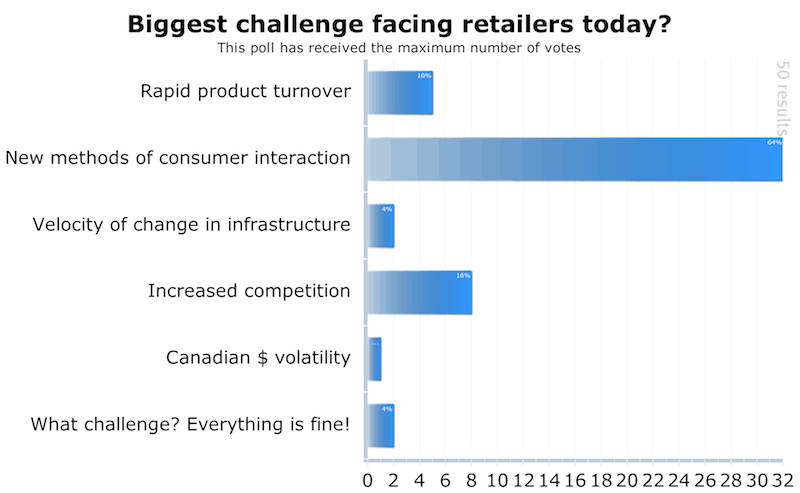
Given all that, the top of mind issue is — new methods of customer interaction.

Look at the poll results below. The issue stands out far and away as the most important concern of the day!

Hence, my keynote was bang-on. I didn’t touch too much on the social networking phenomena, as this type of crowd has been drowning in social-networking Powerpoints.

My focus was on interactivity, location, and intelligence,, and the extremely rapid emergence of new forms of in-store interaction and product sales uplift. Things like digital signage, in-store electronic promotional displays, iPod based coups. A flood of new stuff and new ideas that promote new ways of

Listen folks, I know I’ve said it here before, but I’ll say it again.

2010 is the year of location, combined with mobility, and it’s happening faster than you think.

I’m pumped about this topic and the reaction, so I’ve rolled this into a new keynote description:

Location is the New Intelligence: Customer Interaction in the Era of Pervasive Mobile

We’re at the leading edge of the merger of three perfect trends: the rapid and massive emergence of a massive mobile infrastructure with increasingly intelligent devices. Pervasive location awareness as a results of GPS and location intelligence/mapping trends in those very same tools. And a consumer mindset that is increasingly open to new forms of interaction. The result is massive business model disruption, absolutely transformative market change, and complete obliteration of old assumptions as to the nature of the customer relationship. Smart, innovative super-heroes know that this is an unprecedented time to jump on the emergence of location as the new intelligence, in order to provide for new ways of product uplift in the retail space, changing the very nature of customer loyalty through new forms of interaction, and enhancing existing one-to-0ne conversations through a more direct, distinct and fascinating new form of location based relationships. Futurist, Trends & Innovation Expert Jim Carroll is setting the retail, marketing and advertising world on fire with his fast paced insight into one of the most important trends to shape the customer-business relationship in the last few decades. Move over social networking — location is the new intelligence!

Read more: Location is the new intelligence

Here’s a summary of my observations from a keynote I did in New York City for retailers, agencies, marketing organizations, food and CPG companies, on some of the trends that are sweeping their industries today.

The summary is courtesy of the event sponsor, the Readers Digest Food & Entertainment Group.

1. The New Consumer Is Shifting Their Attention Faster than Ever

Consumers suffer from “continuous partial attention” with more stimuli around them than ever before:

  • The number of text messages sent each day exceeds the population of the earth
  • There are 62.6 million videogame households (up 11.4%) and the average age of a video game consumer is 41
  • consumers spend about 10 hours per day and $1,000 per year with various media – primarily wireless devices, iPods, in store displays, in-auto media content and the Internet
  • 93% of American teens are online, proving that the Internet will become ubiquitous

Consumers across demographic segments are immersed in this new interactive world forcing brands to engage them across all mediums to stay connected.

This new shopper is not only more scattered and more connected, but also faster – scanning 12 feet of shelf space on average per second. In-store influencers will now evolve at the pace of the iPhone and the Blackberry, challenging marketers to keep up with the pace. Faster is the new innovation and innovation isn’t just about new product design – it’s about responding to fast-paced consumer change.

Marketing Implication: Marketers must work harder than ever to capture the attention of the consumer and make a connection. Brands must keep up with the pace of consumer change in order to stay relevant.

2. The New Consumer Is No Longer Nuclear

The nuclear family is no longer the norm as Americans find new definitions for ‘family’ in today’s world. The following headlines touch on the variety of different ways families are structured today:

  • “….only 1 in 4 of the population live in heterosexual, two-parent families… one in three people now live alone….” – ABC
  • “….urban Americans remain single for more than half of their adult lives, a radical shift…..” – NBC
  • “Between the ages of 18 and 59…. Chicagoans spend… 18 years married.. 4 years co-habitating….19 years alone or casually dating” – Associated Press
  • “LAT tourism …. living apart together ….two out of five marriages end in divorce” – Reuters

Brands must acknowledge these new trends as they develop products and create marketing messages to resonate with today’s consumer.

Marketing Implication: Hyper-nicheing is the new brand reality as the market becomes more specialized and fragmented. Marketers can no longer rely on preconceived segmentation strategies, but rather need to think differently about who they are trying to reach and how to reach them.

3. The New Consumer Is Influenced Differently

We’re in the era of the “Celebrity Baby Blog” where purchases are influenced heavily by what others are doing. And it is not just celebrities that consumers are watching – they are also looking to their peers for advice and brand recommendations. For example, in travel, 79% of travellers trust peer reviews more than ads.

The same thing is happening with consumer products – peer reviews are the new influencers, with 83% trusting the opinion of a friend or acquaintance who has used the product or service.

Marketing Implication: Social networks are the new brand influencers and marketers must find ways to connect with consumers who are highly influential in their peer groups.

4. The New Consumer Is Shifting Their Focus

Socio-economic shifts are affecting consumer behavior at an increasingly fast pace.

For example, the downturn in the economy has quickly had a significant impact on consumers’ eating habits. 71% of consumers are choosing to prepare meals at home instead of eating out and restaurant trips have decreased from 1.5 times a week in 2006, to 1.2 times today. (Food Marketing Institute US Grocery Shopper Trends)

Another prime example of trends reaching mainstream quickly is the health trend. Even the most active consumers shopping at delis are health-conscious. 80% of deli-buyers are making changes to their diets and 90% are now reading deli labels (International Dairy-Deli-Bakery Association)

New markets are constantly emerging, whether it’s fresh-cut snack food, growing from a $6.8 billion industry to $10.5 billion (International Fresh-Cut Produce Association) or rapidly changing tastes – flavors are now moving from upscale kitchens to chain restaurants in 12 months, compared to 36 months 5 years ago.

Marketing Implication: Faster-paced preference change is the new reality and brands must be nimble to keep up with consumer demand.

5. The New Product Is Rapidly Redefined

New products are brought to market faster, redefining the industry quickly and forcing products to keep up.

As scientific knowledge is being shared in real time, ethical packaging innovations are emerging and driving product design.

For example, wax paper infused with cinnamon oil (antibacterial) inhibits 96% of mold for up to 10 days (Investor’s Business Daily). This new discovery allows CPG companies to produce new products with a naturally longer shelf life. Major manufacturers and retailers must respond to these new trends, especially as consumers jump onboard and demand these innovations. Most notably, Walmart has vowed to have zero private label packaging waste by 2010, and to eliminate all packaging waste by 2025 (Modern Plastics Worldwide)

Another example of a new product being redefined at a rapid pace is the “nutri-cosmetic” market – already at $1.5 billion worldwide (only 3% of that is in the U.S.) and predicted to grow at 4.7% a year in the U.S. to $10.6 billion by 2012 (Household & Personal Products Industry). Consumers are embracing new products that can offer positive effects on their appearance, while easily being integrated into their lifestyle.

Marketing Implication: Time to market and corporate agility are the new capabilities to focus on.

6. The New Product Is Upside Down

The way companies are innovating is also changing. The process used to be to get the assortment right, figure out the merchandising, go to stores and create a marketing campaign around it all.

The new innovation model turns that upside down: as large companies are more connected to consumer demand, they can use that insight to come up with the marketing, then determine the merchandising and get the assortment right.

Partnership with retailers and packaging companies in the design of the product is the key trend because these partners are closer to consumer demands and can often guide development of new products through their unique insight. Smart manufacturers are turning to packaging designers to ask for help lowering expenses as oil and raw material prices rise. (Bangkok Post). 73% of packaging machine builders collaborate with customer-packaging engineers. (Control Engineering).

Marketing Implication: Partnership with retailers and packaging companies is the key method to speed up product innovation and efficiently introduce new products to the marketplace.

7. The New Marketing Is Shifting

Consumers are being increasingly influenced by their time spent online. Therefore, online advertising spending is increasing and is predicted to rise to $51 billion in 2012 – up from $21 billion in 2007.

Consumers are looking across all media and being influenced by different sources of inspiration. Different media serves different purposes for consumers and reaches them in different mindsets. For example, certain magazines are set aside for leisure comfort reading, while online media can quickly provide relevant information at the touch of a button.

Marketing Implication: A “healthy mix” is the new advertising recipe for success reaching consumers at different touch-points.

Here’s a short video clip of Jim’s keynote, in which he speaks about the increasing velocity of change in retail.

Here’s an article that I wrote for the spring issue of Marketline, for the BCAMA. Some good food for thought on the future of branding, and how all this social networking might really evolve.

Key point: “The concept of branding is being re-energized. People care again

Pat Boone Has an App
by Jim Carroll, Marketline, Spring 2010

Does that blow your mind? It should. After all, for some people, Pat Boone could be the most uncool guy around, and yet he has an App with a pretty good rating in the Apple App Store. I think that’s pretty cool.

If it doesn’t blow your mind because you don’t know who he is, then here’s the deal: he’s a singer who sold some 50 million albums during the 50s and 60s. Think Justin Bieber if he was around in 1956.

I learned about Pat Boone’s App when I set out to get my own. Given the nature of my business, I’m a brand, and I’m a big believer that we are rapidly entering the era of the personal brand App. And in fact, the same folks who developed Pat’s App pulled mine together and had it available in the App store within just eight weeks.

What does this have to do with the future of marketing? Probably everything and anything, in that we are in the very early stages of what is likely to be a very significant transformation in the energy that people have towards the concept of a brand.

Bill Gates once observed that “most people overestimate the amount of change that will occur in two years, and underestimate the change that will occur over 10 years”.

Think about that statement in the context of the current impact of social networking on brands and marketing.

Certainly, everyone knows that carefully orchestrated Twitter, Facebook and YouTube-centric marketing campaigns can provide a substantial uplift in sales and that, to a large degree, successful brands are focused on building relationships by having conversations with their customers. It’s all too obvious to everyone that if a brand doesn’t respect the fascinating power possessed by the new collective consciousness, things can go to hell in a handbasket in a hurry. And we all know that, increasingly, a brand is no longer what you say it is it’s what ‘they’ say it is.

Yet, these are early days. Where will we be 10 years out? How will the art of marketing have changed? What will a brand be in 10 years’ time? Will we even find it necessary to market a brand? Or will brands become such a part of our lives that we won’t even think it necessary to market them, because each of us will essentially own those brands? How do you market a product to someone who already owns the brand for that product?

Certainly there has been a tsunami of change in the marketing and creative world over the last few years with the explosion of social networking. But do we know where this change is going to take us? I’m not certain we do know. When the Internet first appeared on the scene, who could have imagined Twitter, or YouTube or cyber-battles between China and a company that didn’t exist less than a decade ago?

Much can happen in a two-year time span. Much more can happen in 10 years. The difficulty is in figuring out how to steer to wherever we might be in a decade. These are the early days and the pace of change is still accelerating. Brands are learning to adapt to fascinating new realities, and marketing skills are transitioning at lightning speed.

Customers are toying with their vast new powers, learning to use them in new and fascinating and sometimes scary and dangerous ways. Brands can go from hero to zero in a matter of moments. Marketing campaigns that one day seemed edgy and leading-edge can suddenly fall off a cliff, looking dull and out of date as a new brand comes along to displace them. And it all occurs at blinding speed.

Maybe in a decade some brands will have transitioned further into our lives through even more connectivity than we can currently imagine. Perhaps one day the packaging for a medication that I will be using will “talk” via a subterranean Twitter-like stream to a sensor embedded in my mobile device, updating my medical profile and adjusting my dosage based on up-to-the-second medical tests. When a brand becomes a part of my being, does that mean that the new brand relationship of today looks ancient?

I don’t think anyone has figured everything out yet with social media. There are certainly a lot of people talking about it, and I spend a fair amount speaking to the trend myself. But I think we are in the midst of something unique, special and awe-inspiring. I am convinced that in 10 years’ time, we will look back and think, “wow, that was an amazing time to take part in something big”.

What is that “something big”? Perhaps a period of time in which everyone customers and brand owners alike are becoming re-energized about the concept of a brand, as a brand truly become part of one’s existence.

Yes, Pat Boone has an App. He’s proud of his brand he put out good work, even if it is niche-oriented. And yes, maybe his market is declining. But here he is, an icon of the birth of the boomer era, and he’s got enough passion and enthusiasm for his brand to reach out to his brand participants using these fascinating new and powerful tools.

Pat Boone has had his passion for his brand restored. And maybe that is the most important thing that is happening right now. The concept of branding is being re-energized. People care again. We’re out of the era of robots building TV commercials that didn’t resonate, and brand images that didn’t create a sense of awe, and brand images that were simply stuck because of creative failure.

Perhaps that’s the real magic everyone is acquiring a new enthusiasm to do something with brands. If they own a brand, they can be inspired to do something great with it. If they are a customer of a brand, they can be inspired to help to shape the future of the brand more to their own liking through the collective consciousness that is social networking.

The energy and creativity around us is staggering. Continue to jump in, explore, try, do, fail and retry and remember that there is lots yet to learn, since these are early days.

Grab the original article at Scribd!

It’s big, and its’ getting bigger!

That’s the location intelligence industry, which is resulting from the rapid dominance of location-aware mobile devices, the rapid emergence of massive sources of spatial (geographic oriented information, i.e. Google Maps), the rapid user adoption of location-based applications (i.e. iPhone Apps), and a significant amount of innovative thinking as to how to capitalize on these very fast paced trends.

There’s a lot of people building a lot of new businesses around these trends. And it’s happening extremely quickly:

  • in a just-announced test of location based advertising in Finland, MacDonalds’ has reported that location-relevant mobile ads resulted in a 7.0% click-through rate. Of those who clicked through, 39% then used the click-to-navigate option to find the closest restaurant. These are significant numbers
  • one if 4 American’s uses location based mobile services, and half of those who noticed an ad while using such services too some action
  • there has been a 68% increase in the use of mobile mapping and direction services in Europe in ONE YEAR according to comScore
  • MarketResearch.com predicts increases of 37% compound annual growth for mobile advertising and 65% for mobile commerce, influenced by the speed of adoption of location-based services
  • Juniper Research suggests that location based service revenues will top $12.7 billion by 2014, up from $3 billion last year
  • another survey by RCNOS suggested that the mobile locations technologies market will grow at annual compound rates of 20%, reaching $70 billion by 2013, which includes both consumer and business intelligence/application (survey, mapping etc) applications
  • it’s estimated that 1 billion people will access social networks by 2014. Most of them will use some form of location based application as they do so.
  • GPS-enabled mobile phone devices will dominate the technology space, comprising 66% of all GPS devices by 2013

This is pretty significant stuff. Actually, its more than significant – it’s huge. Location is set to lead to significant industry transformation; some pretty dramatic business model disruption (think real estate); changes in consumer behaviour (product promotion and uplift); new business models (mobile, text message based banking which starts out via a proximity relationship.). There’s a huge amount of velocity out there!

There are two angles to the emerging market: consumer (i.e. iPhone) driven applications which will involve marketing, branding, product promotion, customer loyalty, point-of-purchase and a huge variety of other opportunities. The second involves corporate applications such as risk-minimization (i.e. mortgage risk analysis based on spatial data).

Regardless of how you look at, the overall impact of location intelligence is going to be dramatic.

It’s even going to come to impact sports. Here’s a clip from a keynote I gave for 4,000 individuals as the recent National Recreation & Parks Association: “Location intelligence and the future of recreation,” and spoke about the concept of a location intelligence professional.

Last week, I did a keynote for DMTI Spatial, a leader in this emerging space, particularly in the corporate application world. He has an interesting blog post that summarizes some of the unique issues that go with this fast emerging trend.

Location is the new intelligence. And its’ happening faster than you think!

And an increasing number of my keynotes and clients are asking me to focus upon the business opportunities that are emerging in this world. Stay tuned.

Related posts:

  • Location intelligence, financial industries and business model change 
  • Location intelligence and the conference industry
  • Extract from Jim’s book, Ready, Set, Done: How to Innovate When Faster is the New Fast 

I used this a lot in the past, but it’s probably good to repeat it here; maybe there is a little too much hype around social networking, particularly around the context of marketing.

Given that’ it’s probably a good time to have a little bit of fun with the issue.

  • no one is sure what it is, but they hear that its great
  • everyone thinks that everyone else is doing it
  • those who say they are doing it are probably lying
  • the few who are doing it aren’t doing it very well
  • everyone hopes it will be great when they finally do it
  • once they start doing it, they’ll discover that it is going to take a while to figure out how to get really good at it
  • and they’ll realize that they’ll have to try to discover a whole bunch of new methods of doing it to really figure it all out

2010PRSM.jpgAt many of my keynotes, I focus on some of the most successful creativity and innovation attributes that I see within organizations. Here’s a list of guidance from a recent keynote for a group of executives in the consumer goods sector:

  • Adapt to more challenging customers: customers expectations and needs are changing rapidly, and yet they are more demanding than ever before. Loyalty disappears….at the same time they expect creative perfection from you, they are more fickle, and far less loyal …. I’m not even sure the concept of loyalty exists any more for many brands!
  • Costs increase: all this is happening in a world in which producers and retailers are faced with a rapid increase in uncontrollable costs…energy, plastics, you name it! Margins are being squeezed and pressured as a result. Operational excellence is no longer optional!
  • Focus on collaborative relationships: The key to innovation in retail today can be found in collaborative relationships and partnerships between packaging companies, consumer products and brands, and retailers. ! Noted Paul Moss, British Bakeries Divisional Marketing Director, “We have more to talk about than price.” No one wants to fight in a brand sector that is involved in a race to the bottom, but that’s what happens when everyone focuses on price. Shift the equation with your partners, and you’ll find a way out.
  • Remember — the package is the brand: Heinz, StarKist and other industry leaders have learned that packaging innovation, driven by new methodologies, ideas and technologies, has become the secret to brand image in many sectors, because it permits a shift of value and customer perception in ways that haven’t previously been seen. Think upside-down-Ketchup. If you aren’t innovating with packaging, you aren’t in the game
  • Hyper-innovation is key: Throughout the consumer products world, we are witnessing faster time to market in every single sector. The concept of a product lifecycle is disappearing as products come to market and thrive for but short micro-bursts of time. Make sure you’ve got the agility on your team you need to cope with this reality, and you might survive
  • Get used to rapid change. Consumer desires, needs and demands will continue change at an ever more furious pace, often in ways that won’t make sense, particularly with the impact of social networks. Don’t despair from it: learn from it. Take the recent race to value-oriented products as a result of the recession. Did you act fast enough? What organizations sclerosis blocked your ability for quick change? And what should you do to fix it?
  • Capture the insight of creatively new competitors – constantly: Admit this: there are likely going to be a lot of folks out there who are a lot more creative than you are. They’ll beat the pants off you all the time with quick short bursts of tactical success, while you are still busy marshalling your forces. Rather than losing sleep over their success, study them! Learn from them! And then capitalize by doing what they do – and do it better. Rapid creativity in a time of constant change is the name of the game, and you’d do best to work to obtain the same skills and insight that your best competitors have developed.
  • Ride the wave of continuous business model innovation: If someone is reinventing your business model, reinvent it faster! In retail, we are seeing constant experimentation with store formats, brand partnering, in-store displays, logistics and tracking studies, and countless other new ways of doing things. Get on board the tornado of change in retail and ride it for all it is worth. You should develop a team that has a finely-tuned radar for unique trends, experiments, success stories and innovations. They’re swirling around you continuously, they are constantly reinventing the world of retail on a minute by minute basis – and you’ve got to understand them and capitalize upon them.

I’ve got quite a few keynotes coming up with the consumer, food, packaged goods and retail sectors in the next several months, one of them being the Professional Retail Store Maintenance Association in Orlando, Florida next month.

The topic for that keynote will be: Where Do We Go From Here? Why Innovators Will Rule in the Post-Recession Economy – And How You Can Join Them.

Here’s an extract from the keynote description:

Jim Carroll has carefully studied what it is that organizations are doing to position themselves for post-recession growth.

One thing they are certainly doing is positioning themselves for innovative solutions to complex problems. When it comes to retail store maintenance there is no doubt that we are in the era of fast-paced solutions, whether its related to intelligent building management solutions, the rapid evolution of in-store layout and design principles; innovative environmental and green technology solutions; or new in-store
customer engagement methodologies, all of which impact in-store maintenance professionals in new and dramatic ways.

In his keynote, Jim will share his insight into the key trends impacting the retail sector, and how maintenance professionals can take a seat at the “strategy table,” providing unique solutions and guidance to the management team by adapting to fast paced trends.

jim-carroll-238x300.jpgHere’s a blog post that ran over at the Chicago Hospitality Insider blog with a report on my keynote last week.”

—-

Moving Beyond The Meltdown” with Jim Carroll
Posted on February 18th, 2010 by Jody Robbins

How is the tourism business impacted by a world where information is passed feverishly around the globe? Immediately and directly; that’s how, says Jim Carroll (Futurist and Trends & Innovation Expert!), today’s lunch-time speaker at the 2010 Illinois Governor’s Conference on Tourism.

“The future happens faster than you think,” said Carroll. “The likelihood is that seven out of ten kindergartners today will work in jobs that don’t exist today.

“[It's also] estimated that half of what college students learn in their first year is obsolete by the time you graduate,” he continued. “The typical digital camera today has a shelf life of three to four months before it’s behind current technology.”

How can a company or a government entity make that change happen? Look for experienced people that know what they’re doing; i.e. build experiential capital and stay nimble.

“It’s not necessarily big corporations that will own the market, but those who innovate — try things they haven’t done before in order to stay in front of a very fast pace.”

How? Accelerate your innovation cycle, Carroll says. “It’s not, ‘We’ll get you in our brochure next year; it’s what can we do to partner with you right now?’

Other important factors: faster time to market and continuous reinvention to meet rapid consumer preference shifts. Again, how to do this? Go online, go mobile and use your staff and outside resources to find your customer and sell them your product when and where they want it.

Carroll’s Pertinent Points:

  • *1/3 of all leisure travel is booked last-minute
  • * Average planning time down to 15 days
  • * 36% of last-minute vacations 3-4 nights in duration
  • * 30% are 1-2 nights
  • *”More than 147-million people interact globally on social networks via their mobile phones – expect one-billion (!!!) within five years,” says Carroll.

In other words, to use a cliche, THE TIME IS NOW!

—–
It was a great talk, and I’ll have more to post on some of the observations from my keynote in the weeks to come!

fm-web_logo.gif
Here’s an article that I wrote for Food Manufacturing on trends in the consumer, food and packaging sector.

I spend a huge amount of my time as a keynote speaker at countless conferences and events, many of them within and to the food, packaging, retail and restaurant sector. I also spend quite a bit of time with smaller, strategy-oriented leadership session designed around the theme of ‘how to innovate in a high velocity economy.’

And I do know that while volatility rocks the economy, some fundamental truths about that velocity remain: the food, packaging and retail industries continue to be subject to dramatic rates of change–and innovative organizations succeed by mastering the pace of this new high-velocity economy.

Think about what is going on out there: customer mindset has become increasingly difficult to capture as we become a society with massive attention deficits–the Twitter era is having a profound impact on brand image. Marketing and advertising dollars are fleeing traditional media and moving online at a pace that surprises even the more hard-core technology-evangelists. Faster innovation means faster in-store format change. New digital signage technologies and other innovations march forward at a furious pace, providing yet another new influencer in the retail space.

And in the midst of all this change, business models are subject to upheaval due to economic turmoil, commoditization of product and the rapid emergence of new competitors.

It’s a fast paced world–and that’s why cutting-edge organizations are focused on key leadership strategies that provide for a fast-paced future. So what should you do to confront the “big trends” that have so much velocity–and what you should be doing right now?

I approached this very question as the opening keynote speaker for an audience of 5,000 at a recent Las Vegas event. The client organization certainly finds itself in the midst of high-velocity change. There are fast paced trends in terms of new branding challenges and marketing methodologies (think Web 2.0), consumer behavior, and many other issues. Yet, there are tremendous opportunities for growth through innovation.

My keynote addressed a variety of trends that impact every aspect of the food, packaging and retail sector today. For example, to be a leading edge innovator, you must confront and have a strategy that deals with a variety of fast-paced trends:

  • Rapid emergence of new methods of customer interaction. For example, in the next few years, we will likely see the emergence of contact-less payment technology, as our credit card infrastructure migrates to Blackberry, iPhone, and smart phones. This presents new opportunities in terms of customer contact.
  • New methods of brand and product promotion. Organizations must be able to scale to meet the demands of new intelligent infrastructure, and that will require a tremendous amount of innovation. Consider text messaging: technologies that provide for the remote retrieval of mobile coupon offers will define the future of brand interaction. With 147 million people already interacting globally on social networks via their mobile phone–and up to 1 billion in but five years–there are tremendous opportunities for new methods of achieving brand and product awareness.
  • Rapid change in consumer choice. Take the issue of health concerns and balanced diet. Fresh-cut snack foods grew from $6.8 billion in to $10.5 billion in a short time, according to the International Fresh-Cut Produce Association. Innovation comes from changing product mix to keep up with fast-changing consumers.
  • Rapidly emerging new menus and taste trends. It’s estimated that new flavors now move from upscale kitchens to chain restaurants in 12 months, compared to 36 months 5 years ago. This means that faster innovation is not a luxury–it’s a necessity. Change faster, and you’ll yeild new growth-based products.
  • Fast emerging issues involving green strategies. The Grille Zone, a restaurant chain in Boston, generates about 15 pounds of waste per restaurant, compared to an industry average of 275 pounds. The Green Restaurant Association took 14 years to go to 90 restaurants; it’s now at close to 1,000, with thousands more going through the certification program. Growth can come from evolving a brand so that it matches the social desires of the customer base.

What I stress at events like this is that organizations need to realize that innovation isn’t just about “big innovation”–the launch of new products and services. There’s also the issue of “fast innovation”–in which success is defined by the ability of the organization to respond to rapidly changing products, markets, business models, economic trends, competitive moves, consumer trends and just about everything else.

Innovation today is moving from more than just “products” to process, structure, capability, and speed.

Here’s the thing: in my keynotes, I focus on growth opportunities. There are enough people out there who are so focused on the doom and gloom of the economy, that they lose sight of the fact that if they focus on fast innovation–and keeping up with rapid trends–they can discover all kinds of new ways to grow the business.

Faster is the new fast. Think growth. Think innovation.

How is social networking impacting brands? Take a look!

2010FinancialAdvisor.jpgI spend a lot of time speaking to global financial organizations — some of the world’s largest institutions — helping them understand what they need to do from an innovation perspective to stay ahead of fast paced change.

These talks are often aimed at the idea of “how do we need to transition our advisory services — financial planners, investment advisors, insurance agents and brokers — to keep up with fast paced change?”

Here’s a laundry list of some of the strategies that I’ve been talking about:

  1. Focus on growth:With so much volatility in the financial sector, it’s all too easy to take your eye off of the opportunity ball. As I noted in my remarks for a recent keynote to a group of senior bankers:

    Never before has the need for financial advice for Australians been greater; only 20% of Australians are currently getting professional advice.”

    That means there are tremendous opportunities for growth! For many, access to financial advice is still too hard and complicated – that’s why it’s a great time to innovate, in order to build market share!!!!

  2. Structure for fast paced change: There are several certainties in the financial sector:
    • more business model change
    • more sophisticated competition
    • continuous business model disruption with new, young upstarts
    • continual shifts in consumer behaviour
    • technology-driven fast change, such as with the impact of mobile technologies

    Quite simply, an innovative financial organization concentrates on aligning its structure and capabilities so that it can change quickly

  3. Reshape brand messages faster:
    Clearly there’s a lot of fast-paced change in financial services with the rapid economic pullback, and it’s critical that financial institutions continue to reshape their brand at the pace of rapidly changing consumer perception.

    Noted Jim Buchanan, Senior VP of Consumer Marketing at the Bank of America in an article in Advertising Age, October 2009:

    Six months ago, we were trying to re-assure the market and consumers that we are safe and secure….now consumers are telling us they’re not worried about those things anymore…..What they are interested in is ‘How can you help me manage my finances?‘”

    Innovative organizations ensure that the brand message evolves at the pace of a world in which volatility is the new normal.

  4. Adapt to momentum of financial consumer change: Quite simply, the new financial client is online in a big way, and smart financial organizations will evolve their service and support message to these platforms. The numbers are staggering; in the case of my Australian keynote, I emphasized that:
    • 147 million people interact globally on social networks via their mobile phones – we can expect 1 billion within five years!
    • there are 1.6 million Twitter users in Australia – up 1,000% from last year
    • Australian’s now spend 16.1 hours a week on the Internet, compared to 12.9 hours watching TV
    • 25% of that time is spent on Facebook

    The impact is clear: as noted by Mondaq Business Briefing in November 2009: “Australians visit social networking sites more often than financial services sites.”

    The bottom line for financial and investment advisors is that social networks are an extremely effective tool to keep core clients in the loop; as an outreach tool, they’re fast, effective, unique, quirky, and certainly the story of the day. The bottom line is that financial advisors have to go where the client is going, and should be thinking about how to become socially-networked oriented advisors.

  5. Adjust platforms to this changing behaviour: I continue to emphasize with my global financial clients that the impact of mobile technologies on financial services is absolutely massive. Think about Wizzit, a South African service that is essentially a text message based banking system.The reality is that the new financial consumer expects to be served on new platforms: as noted by Thomas Kunz, Senior VP at PNC Financial:

    Gen-Y doesn’t reconcile checkbooks, and they don’t believe in float. For them, their balance is their balance.”

    That’s why PNC has released a “virtual wallet app” available for iPhones. They’re reaching out to this new financial consumer in a big way.

    Aggressive change with business platforms provides big opportunity for business model disruption. A key factor here has to do with new client acquisition: what’s happening is the point of origination of the relationship might change as people transition their banking to mobile devices. Opportunity can come from continuing to build the advisor and distribution channel into these new platforms.

    And that’s not a threat – that’s a huge opportunity!

  6. Leverage off of new peer-to-peer behaviour trends:
    The new financial consumer relies more than ever before for advice from their social networks.Peer-to-peer social driven advice through sites such as TradeKing is coming to the forefront: it’s a service that allows people to share stock tips and research through extended social networks.

    Does this diminish the role of advisory services — not at all, if you dive in and become a part of the peer-to-peer conversation!

  7. Re-orient distribution channels : Here’s another key point: I’ve emphasized to my insurance and other financial clients that the next-generation advisor/broker/agent expects ever more sophisticated technology platforms to help support their role.You’ve got to make sure you are keeping up with their needs. In one survey in the insurance sector, 80% of brokers indicated that the sophistication of the technology platform of the provider would influence who they would choose to do business with.

    According to Kevin Murray, EVP and CIO at New York-based AXA Equitable:

    The younger generation of financial professional will almost demand online self-service….they will want to text any questions they have in to the service centre or self-service from their mobile device. We’re going to have to be able to provide that capability. It’s how they will operate.”

  8. Build your own peer-to-peer collaborative knowledge networks: The new financial advisor is also thinking socially, and is actively looking for peer-to-peer collaborative knowledge.Imagine building a financial advisory team that is collaborative for ideas, shares insight on market wins, constantly leverages insight from new branding campaigns that work in unique ways, and constantly shares great ideas on new methods of converting leads into clients — that’s how this next generation works!

    Back to Kevin Murray:

    “They will also want an online collaboration tool to …find answers concerning product or questions from their customers. The X and Y generations are going to demand a different way of selling and servicing their customers.”

    What’s it really all about? Freeing up their time to build opportunity, make sales, close deals.

  9. Reduce churn through electronic relationships: Here’s something else to think about according to Chief Marketer (October 2009),

    The average brand saw one third of highly loyal consumers in 2007 completely defect to another brand in 2008“.

    People are far less loyal, and far more likely to jump ship at the drop of a hat. That’s why continuous innovation in terms of the relationship is critical — and that’s maybe why continually transitioning to new technology platforms such as an iPhone app might
    reduce that churn

  10. Better, more focused niche marketing: We’re in the new era of analytics and analysis, which provides new opportunities for advisors to reach out to markets previously unattainable. As noted by Money Management Executive in October 2009:

    Financial advisers generally prefer to manage a small number of high-net-worth clients rather than a large number of small accounts, but recent advances in automation technology could change this dynamic.”

  11. Innovate hard with the next generation: one of the biggest trends going forward is that right now, we are witnessing the early stages of a massive transition of wealth from one generation to another. The numbers are staggering: we’ll see $12 to $18 trillion in intergenerational wealth transfer In the next 12 years (US GDP is $12 trillion); and by 2053, some $130 trillion will have moved from one generation to another. That’s a lot of money sloshing around — and much of it is going to this new, tech-savvy financial consumer.
  12. At the same time, rethink importance of boomer market: It’s easy with all of these points to think that new markets will come from new, uber-hip young people and hot new technologies. But don’t stop with innovating with that market — also realize that there continues to be huge growth potential with the boomer market. In Australia, baby boomers will control 51% of the nations wealth. Put that in the context of the reality that there is a huge adoption by Boomers of Facebook. They continue to more aggressively integrate technology into their lives; they’re busy researching health care, insurance, retirement planning and investment advice. Online makes more sense than ever before — get your advisors there!
  13. Evolve the approach: Insurance and financial services are products that are always sold based on fear — they aren’t bought. This reality doesn’t go away because of new technologies. What does change is that technology is a powerful enabler that frees advisors from having to focus on the mundane, routine, time wasting stuff, in order to focus on providing the advice & guidance that advisors can provide. Focus on the core role!
  14. Enact change: Many advisors will be in comfortable, established routines. Change is not easy. That’s why organizations in the financial sector that are trying to be innovative need to help existing advisors focus on the opportunity and the benefits that come with rapid change, rather than being fearful of the change that technology is bringing to the industry.

Bottom line? As I summed up in my talk — “Innovative organizations make bold leaps, in order to keep up — and stay ahead — of a faster future.”

hugh-hefner-jung.jpg>by Jim Carroll, CAMagazine, August 2009

When you travel like I do, you spend a lot of time reading. One ofthe recent books on my list provides a fascinating look back at the 1950s and ’60s: Mr. Playboy: Hugh Hefner and the American Dream. (No, I didn’t buy it for the pictures, because there are very few.)

I was struck by one paragraph about how Hef worked very hard in the early years to get advertisers on side. He was initially met with resistance, for obvious reasons, but he persisted and eventually succeeded at signing up some of the “leading brands of the time.”

Just what were those brands? Crosswinds House beach towels, Scintella Satin BedSheets, the Lektrostat Record Cleaning Kit, Mansfield Holiday II 8-mm cameras, Leslie Record Racks, Electro-Voice Musicaster loudspeakers, the Ronson Electric Shaver, Max Factor crew-cut hair dressing and the Rogers “Rocket Flame” cigarette lighter. And let’s not forget Merrin Gold Jewelry and the Batch Book, “a new and modern address book that lets you list every pertinent detail — the surest way to avoid social errors.”

Those brands aren’t exactly household names today; in fact, very few of them still exist. Some disappeared due to changing societal norms, others due to technological change. Some probably just ran out of steam.

Brands disappear for a variety of reasons: think Enron, E.F. Hutton and Woolco. Brands can also stick around and become tarnished, losing respect in the eyes of the customer because of a series of missteps. My own client list includes organizations such as Chrysler, Motorola and the US Army Corps of Engineers — brands that for a variety of reasons have lost respect in the marketplace.

Is your brand at risk? That’s a key question, because corporate brands today are no longer guaranteed longevity in the marketplace. They can disappear because of obsolescence, competition and business model change, or simply because, as we have seen of late, failure and error.

Brands now also have to contend with the potentially lethal challenge of social networks. Pizza chain Dominoes quickly discovered how much harm social network “terrorism” can do when employees posted a damaging video on YouTube in which they were less than reverent with customers’ food.

It is isn’t just the risk of events like this that can threaten a brand. People are extremely busy chatting online — on Twitter, Facebook and elsewhere– about the brands that they like, and the ones they dislike.
Consider the effort one customer put into a self-created commercial for US based grocery store Trader Joe’s.

All of a sudden, organizations are discovering a reality that I’ve been pointing out for years: a brand is no longer what you say it is — it’s what they say it is.

Think about your brand, whether you are in public practice, consulting or the corporate sector. Does your brand still resonate? I often talk to my clients about the need for constant brand innovation and challenge them days.” Better yet, I ask them if their brand looks tired because it is tired.

Many people don’t spend much time thinking about branding, but it is becoming more important considering how quickly perceptions can change. Here’s how you should challenge your thinking.

  • Recognize that brand longevity is a critical issue.
  • Ensure that everyone in the organization is relentlessly focused on the currency of the brand.
  • Make sure that continuous brand innovation is part of your corporate mantra.
  • Be incessantly focused on the innovations that are most likely to impact your brand.

More information:

  • Video: The impact of social networking on brands
  • How a customer sees Trader Joe’s
  • Blog post: Is your brand from the olden days?

There are 147 million people interacting on social networks through mobile devices today – expect that to grow to 1 billion within 5 years.

A clip from a recent keynote in which I outline the dramatic impact that social networking — Twitter, Facebook, etc — is having on brand image, relevance of brand, and longevity of brand.

Reinventing brand relevance
March 10th, 2009

Here’s a clip from a recent keynote in Las Vegas.

I’m challenging the audience to think about the issue of maintaining brand relevance, in the era in which customers increasingly influence the perception of brands through social networking tools.

The key challenge today is preventing a brand from becoming “from the olden days.” I emphasize this with a quote from Multichannel Marketing, April 2008.

In some ways, brands are like people. They get stuck. They have habits that are hard to break. They don’t always see their blind spots, and they lost touch with their core essence. They resist change. They become irrelevant

Innovative organizations realize that they need to continuously address the issue of the relevance of their brands, and must work harder than before to keep them “fresh.”

2009Yum.jpgI was thrilled to be the opening keynote speaker for Yum! Brands 2009 Global Leadership Meeting. It’s the world’s largest restaurant company.

The organization, the owner of such iconic brands such as KFC, Taco Bell and Pizza Hut, certainly finds itself in the midst of high-velocity change. There are fast paced trends in terms of new branding challenges and marketing methodologies (think Web 2.0), consumer behavior, and many other issues. Yet, there are tremendous opportunities for growth through innovation.

My keynote addressed a variety of trends which are impacting the QSR (quick service restaurant) industry today:

  • opportunities for global growth. Chain restaurants account for but 1% of China’s commercial food service sales, and in Europe, it is but 2%. (Compare that to the US, which is at 50%.) Clearly, growth will come from continued expansion into global markets.
  • rapid emergence of new methods of customer interaction. For example, in the next few years, we will likely see the emergence of contact-less payment technology, as our credit card infrastructure migrates to Blackberry, iPhone, and smart phones. This presents new opportunities in terms of customer contact.
  • new methods of brand and product promotion. Organizations must be able to scale to meet the demands of new intelligent infrastructure, and that will require a tremendous amount of innovation. Consider text messaging: Subway is working with a “pRomo” program that provides for remote retrieval of mobile coupon offers. With 147 million people already interacting globally on social networks via their mobile phones, there are tremendous opportunities for new methods of achieving brand and product awareness.
  • rapid change in consumer choice. Take the issue of health concerns and balanced diet. Fresh-cut snack foods grew from $6.8 billion in to $10.5 billion in a short time, according to the International Fresh-Cut Produce Association. Innovation comes from changing product mix to keep up with fast-changing consumers.
  • rapidly emerging new menus and taste trends. It’s estimated that new flavors now move from upscale kitchens to chain restaurants in 12 months, compared to 36 months 5 years ago. This means that faster innovation is not a luxury – it’s a necessity. Change faster, and you’ve got new growth-based products.
  • fast emerging industry issues. Consider the “greening of the industry.” The Grille Zone, a restaurant chain in Boston, generates about 15 pounds of waste per restaurant, compared to an industry average of 275 pounds. The Green Restaurant Association took 14 years to go to 90 restaurants; it’s now at close to 1,000, with thousands more going through the certification program. Growth can come from evolving a brand so that it matches the social desires of the customer base.

What I stress at events like this is that organizations need to realize that innovation isn’t just about “big innovation” — the launch of new products and services. There’s also the issue of “fast innovation” — in which success is defined by the ability of the organization to respond to rapidly changing products, markets, business models, economic trends, competitive moves, consumer trends and just about everything else. Innovation today is moving from more than just “products” to process, structure, capability, and speed.

Is the industry innovating? You bet: in October 2008, the US QSR market saw the biggest number of “Limited Time Offers,” a unique method of increasing sales, with 547 new menu items (up 40% from the prior year. Noted Obesity, Wellness, Fitness Week magazine in November 2008, “operators appear quite open to partnering with suppliers on new products with shorter lead times.”

Here’s the thing: in my keynotes, I focus on growth opportunities. There are enough people out there who are so focused on the doom and gloom of the economy, that they lose sight of the fact that if they focus on fast innovation — and keeping up with rapid trends — they can discover all kinds of new ways to grow the business.

Faster is the new fast. Think growth. Think innovation.

During a CEO strategy session last week in Miami Beach for a major global publisher, I outlined that one of the key areas of focus for innovative organizations is effective “generational collaboration.”

There’s no doubt that the transformation in politics in the last year is due to the way the “next generation” has utilized the technology tools they know to effectively steamroller the opposition. This is an extremely transformative trend that will impact every industry through the next ten years. It is perhaps the MOST transformative trend.

In how many organizations is senior management being similarly blindsided by rapid developments and a dramatic power shift as the next generation pursues their unique ideas, utilizing the power of social networking and other technologies?

Does your organization leadership team really understand the vast transformation that is underway in the economy as Gen-Connect asserts itself in the workplace, within business models, and within corporate structure?

In my Ready, Set, Done: How to Innovate When Faster is the New Fast book, I opened with a chapter that explored this phenomena in the context of ‘generational dynamics.’ Titled Cardboard People, Plasma People.

It’s well worth a read.

If it strikes a chord with you, pick up a book with the little widget above, and it will be shipped to you within the week.


More information:

  • Read Cardboard People, Plasma People
Reaching the new travel consumer
September 10th, 2008

08cellphone.jpgI’m off to keynote Tourism Alberta — and will speak to some 200+ tourism marketing professionals on trends within the sector.

Alberta, located in Canada, has an extremely hot economy — globally, it stands as the home of the 2nd largest provable oil reserves in the world, just after Saudi Arabia. Most of this is tied up in the ‘tar sands,’ which costs quite a bit more than traditional oil reserves to bring to market. Hence,there is a flood of infrastructure investment and other spending going on.

Needless to say, even thought it’s a hot economy, the economic ‘correction’ (and certainly volatility in the price of oil), as well as other issues, is providing for a bit of a challenge in the tourism sector.

What am I doing at the conference? Notes the brochure: “ Jim will speak to the fact that travel product innovations occur today at such a pace that simply keeping up can be a challenge. A furious pace of technological innovation continues unabated, with the rapid emergence of new technologies that change the way the travel consumer plans theirtravels. The Web continues to make massive inroads into tourism planning and business model change. It’s a fast paced world — and that’s whyleading edge organizations are focused on staying ahead of the trends that are impacting the high-velocity economy of today. Join international futurist, trends and innovation expert Jim Carroll as he puts into perspective how the world of tourism is changing — and how organizations are innovating in order to keep up with it!”


What I am talking about? Quite a few trends:

  • the new tourist is faster: 1/3 of all leisure travel is now last minute, and the average time for planning a trip is down to 15 days
  • the new tourist is connected: 86% of all North American’s now travel with a cell phone. They have expectations of finding data-heavy local tourism portals when they walk off a cruise ship looking for something to do.
  • the new tourist is influenced differently: 79% of travelers trust reviews by other tourists over advertisements. Social network tourism sites and stalwarts like TripAdvisor continue to have the biggest impact on tourism decisions.
  • the new tourism family is no longer nuclear: A grab bag of observations … only 1 in 4 of the population live in heterosexual, two-parent families …. .one in three people now live alone ……urban Americans remain single for more than half of their adult lives, a radical shift…
  • the new tourism product is faster to market: WhereI’veBeen started as a Facebook application that allowed people to post where they’ve travelled to. It exploded to 2 million users in a matter of weeks.
  • the new tourism product is being rapidly redefined: Online tourist mashups that allow people to combine online maps with travel schedules, destination information, and social networks are redefining the concept of trip planning.
  • the new tourism marketing is viral: Budget Rent A Car, Southwest Airlines and Sheraton Hotels are examples of 3 companies that are using blogs and Internet video to establish leading edge marketing campaigns.
  • the new tourist is, well, different a grab bag of trends: we’re seeing a lot more shorter term “pressure relievers,” themed holidays, adventure, health or well-being vacations, “authenticity” as a new trend, and the “unplugged” vacation. Not to mention an “old” trend from 2007 which involves “debaucherism” as the new travel trend.

My key message? As a tourism marketing professional, you must keep ahead of these trends….build your experiential capital by working with new methods of reaching the market ….. understand that the market is becoming faster, more global, and more challenging.

Bottom line — innovate!

I’m about to head out the door to keynote a leadership team, business analysts and IT staff for a leading multinational bank. The theme of my luncheon talk is, of course, innovation in the high velocity financial sector.
There’s been a tremendous amount of new research undertaken in the last day, so that I can add to the insight that I’ve already accumulated through the years as to the innovations occuring in this sector.

There are a couple of key observations that I’ll share with the crowd. I start out with a list of pretty scary headlines. American banks face financial meltdown if their reforms fail. Mortage Meltdown! Bloody and Bowed — Money Managers Remain Badly Shaken by the Meltdown. Market Cap Meltdown — Billions in Blue Chip Stock Values Have Been Blown Away.Congress caught in a bind over bank crisis. Crisis Looming As Realty Slump Becomes Global


Most of these headlines are from 1989-1990.

Key point being, we’ve been here before. Whenever there is market turmoil, there is also opportunity for growth through innovation.

And that’s what I’ll concentrate on the talk. How banks are transitioning staff from tactical to strategic roles so that they can provide the consultative services customers are demanding. How bank branches are becoming the “new Internet” as financial institutions rediscover the power of rejuvenated bricks-and-mortar networks. How the new era of Web 2.0 is going to have to drive a new form of “social wealth management,” particularly as we witness a massive intergenerational transfer of wealth from baby-boomers to the Twitter generation. And how maintaining brand relevance is critical when products and customer service expectations continue to increase at a furious pace.

Several months ago, I wrote a Memo to the CEO of banks worldwide, imploring that they don’t kill innovation it’s tracks as they scramble to deal with the subprime mess. It drew quite a bit of attention: and the comments and sentiment are still critical today. It’s worth a read.


More information

  • Read the Memo to the CEO

    Please consider supporting me with a small donation for this epic fundraising event - I will be riding 200 km / 150 miles over two days with thousands of other riders in support of cancer research. Click the image below for more information.
Performance Optimization WordPress Plugins by W3 EDGE