
By 2015 there will be 59 mega-cities with a population greater than 5 million

Home > Archives

Videos


The future belongs to those who are fast — Jim Carroll, from the opening to a keynote to an audience of thousands in Las Vegas!

Approaching a new year is always a good time to check your mindset. Do you have the right degree of optimism and enthusiasm to tackle the opportunities of the future? Are you spending enough time of thinking about what you can really do if you are innovative? Are you really prepared for how the ‘next generation’ of wired kids is going to change our world? Here’s a few video highlights from various keynotes throughout the year that might get you thinking!

  • Do you really think about the scope of opportunity that is unfolding on a global basis?
  • On stage for the PGA of America, with a message on retaining the concept of innovation – open up your mind as to what it’s really all about!

  • Are you prepared for increasing intensity and velocity of business cycles?
  • What happens when 250 high school kids are TOLD to text in class!.
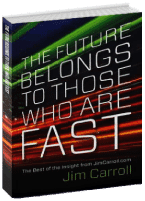
  • Think big, start small, scale fast — the title of the book I’ll release in 2012!
  • What’s the mindset that you’ll carry into 2012?
  • Do you need an MBI degree to take you into the future?
  • Are you really ready for this next generation?
  • Have you stopped innovating because of uncertainty?
  • Are you thinking big enough?
  • Three words – mobility, location, awareness!
  • My personal favourite clip from the year
  • Change – deal with it!
Video: The Innovation Killers
November 30th, 2011

Here’s a clip that I had out on Youtube, but realized that I had never worked it into the blog. It’s a quick clip on the “innovation killers” — the attitudes and actions that some people posses that manage to stifle innovation within an organization.

I’m on stage in New Orleans – it’s 730am, and 4,500 people have showed up for my keynote on Healthcare 2020:

The session description used for the keynote:

Today’s Trends – Tomorrow’s Opportunities
Futurist Jim Carroll will give us a brief overview of the innovations affecting business and what they will mean to our economy and that of the world.  His unique views… will provide a smorgasbord of what businesses will succeed in the coming decades and the types of skills workers will need in the future….no matter what the business.  There is no doubt that the delivery of health care is influenced by the state of our economy .   As Jim takes us on a voyage of what health care will look like in 2020, he won’t even mention the phrase ‘health care reform’.  He’ll address what key innovations will affect health care and health care delivery, as well as how we are going to pay for it.  In doing so, he will challenge the usual assumptions we make as trustees with respect to the future.  There is no doubt that we are transitioning from a system which “fixes people after they’re sick” to one of that is focused on preventative, diagnostic and genomic-based medicine. Join us for this thought provoking and mind expanding presentation.

I’m getting a tremendous number of bookings and inquiries from groups throughout the healthcare, pharmaceutical, medical and other sectors for a keynote that looks at the concept of Healthcare 2020: which takes a look at the real scientific, demographic, social, technological and other trends that are providing for real health care transformation.

People are sick to talking about and listening to others talk about Washington-centric health care reform, and want to know what’s really going to happen. That’s why I come in.

Jim Carroll speaks to 4,500 pharmacists at IdeaShare 2011 in San Francisco, on the theme of "changing opportunities, changing roles." His job was to encourage innovative thinking as to how they can seize opportunities in the health care system, by thinking about the major trends which are changing the system out to the year 2020.

Contact me today — or followup through the speakers bureau that sent you to my Web site — to learn how I can help you with your own transformative thinking. And in addition, check out the Healthcare Trends section of my blog for some fascinating posts regarding what I’ve been doing in this sector.

Last week, I spoke to several hundred manufacturing executives from throughout North America, at IMX Las Vegas — the Interactive Manufacturing Exchange!

Here’s a key clip from the start of the keynote. Watch it, and ask yourself — are you guilty of focusing on short term volatility — or are focused on opportunity of the long term?

I’m finally back in the office full time after a very busy summer with my family.

And what do I return to? A September that seems to feature screaming headlines about a potential recession and some pretty wild economic and market volatility.

If you are thinking about how you are reacting to this fast-paced world in which we find ourselves, then here is a key question: are you going to stay focused on the future, opportunity and innovation – or are you going to allow yourself fall into the trap of aggressive indecision.

Watch this clip from a recent keynote I gave in which I challenge the audience on this very issue:

Here’s a video clip from my opening keynote for the 94th Annual General Meeting of the PGA of America, in which I talk about the necessity of “thinking big, starting small, and scaling fast,” and of the importance of the concept of experiential capital as a foundation for innovation.

I’ve written and spoken about the concept of experiential capital quite a bit through the years – I think in a fast paced economy its one of the most important innovation strategies that we can undertake.

One particularly good post which can help you get thinking about this concept is “Understanding 21st century capital: Why it’s not just financial capital anymore“, in which I wrote”

Experiential Capital. In a world in which Apple generates 60% of its revenue from products that didn’t exist four years ago, it’s critically important that an organization constantly enhance the skill, capabilities and insight of their people. They do this by constantly working on projects that might have an uncertain return and payback – but which will provide in-depth experience and insight into change. It’s by understanding change that opportunity is defined, and that’s what experiential capital happens to be. In the future, it will be one of the most important assets you can possess.

I also write about the idea in my book Ready, Set, Done: How to Innovate When Faster is the New Fast, where I made this observation:

“Innovation comes from risk, and risk comes from experience. The most important asset today isn’t found on your balance sheet – it is found in the accumulated wisdom from the many risks that you’ve taken. The more experiential capital you have, the more you’ll succeed.”

I close with the observation: “Investing in experiential capital is one of the most important things you can do.”

When people ask me about the “secrets” of innovative organizations, this is one of the key attributes I outline. They realize they are immersed in a world of fast-paced ideas — and they take on many different projects, some of which are doomed to fail, in order to build the overall experience of the organization.

Which begs the question: how many experiential oriented projects do you have underway that involves new technological platforms, social network and branding or marketing projects; business model innovation or any other number of ideas?

A clip from a conference for hundreds of health care executives in Orlando in December 2010 – I’m speaking to the issue of the rapid emergence of new careers – including the “location intelligence professional.”

Stretch your mind a little – location aware dashboards, health care alerts as to looming health care issues, and new forms of business analytics all of which provide real time insight based on location sensitive knowledge. This is a huge trend unfolding before our very eyes!

For more insight, read my post “Location is the new intelligence” which I wrote last April.

A clip from my keynote for the PGA, challenging the audience to think about innovation in a different way. Innovation isn’t just about the invention of new products and services — it’s also about focusing as a leader on how to “run the business better, grow the business, and transform the business!

As you can see, I ran a live interactive text message poll in the room — we had responses from 200+ people in a matter of two minutes. I was then able to use the nature of the response through the rest of the talk. For this group, innovation is really about ‘growing and transforming the business’.

A quick video on innovation: how do you achieve breakthrough results?

A quick little video from a keynote in which I outline what organizations often do — with good intentions that go horribly wrong.

Think about what happens — suddenly, a message is established that only ‘special people’ on the ‘special team’ are responsible for innovation.

Here’s what I wrote in What I Learned From Frogs in Texas — which, by the way, you can now buy for your Kindle from Amazon or for your iPhone/IPad on iTunes.

Three Simple Ideas

The essence of innovation is really quite simple. It is all about coming up with new ideas that help you to run the business better, grow the business and transform the business. But it isn’t just about idea generation—innovative companies excel at implementing these ideas and making them work.

Let’s examine each of these areas.

Run the Business Better

There is plenty of opportunity in every organization for operational innovation; that is, doing what you can to “run the business better.” This type of innovation involves a continuous effort to change, improve and redefine business processes, whether they involve customer service, HR practices, logistics and shipping methodologies, purchasing processes or just about anything else.

Never think there isn’t huge room for improvement—most organizations are inherently inefficient, with outdated or illogical processes in place. There is countless potential for improving the way organizations work, and plenty of opportunities for innovative thinking with respect to the way things are done.

Add it up and look at the benefits from doing things smarter or more effectively and there can be a huge return.

Grow the Business

Second, make sure you understand the opportunities from “growing the business,” or what might also be called “revenue-focused innovation.”

Most often, new revenue comes from new products and the ability to enter a new marketplace. Yet that isn’t the only way to enhance revenue. Think about business model innovation, for example: new business ideas involving expansion in existing markets or new ways of reaching the customer that weren’t previously possible (or that no one had thought of before).

Revenue enhancement can also come from changing the nature of existing products, such as adding a service component to a product that can bring in additional revenue. It might involve enhancing the perceived image of a product so it is more valuable to the customer, resulting in the customer being willing to pay more for it.

The key is, don’t think about “growing the business” and revenue enhancement as simply coming from new products or new markets; there are plenty of other methods for innovative thinking that can lead to revenue enhancement.

Transform the Business

Last but not least, always keep in mind the concept of “transformational innovation.”

Transformational innovation involves taking a look at the way the organization is structured, and thinking how it might be able to work smarter, more efficiently and with better results by changing the skills makeup of the organization. It involves constant, probing questions that continually assess the organization and its skills, such as:

Do we have the people we need in the right places/positions?

Do we have the right people with the right skills available at the right time?

If we are suddenly faced with rapid market change, do we know how to access specialized skills and talent we might need?

With the global connectivity that has emerged over the last few decades, there is plenty of opportunity to do today what couldn’t have been done even five years ago, in terms of how an organization accesses the skills, resources, talents and capabilities that it needs to get the job done..

Organizational transformation also recognizes the concept of “partnership” as a key corporate structure for the future. In a world of mammoth complexity and constant change, organizations must focus on their core competencies and partner with others to accomplish the things they cannot or should not do. In essence, they must recognize that the path to the future is to concentrate on what they do well and on what is critical to their central mission, and to seek partners to help out with everything else.

Hundreds of thousands have seen Jim Carroll on stage with a keynote focused on future trends, innovation & creativity....with a focus on the trends that will drive their future.

What are the major trends that will shape our world in the future? Here’s what you need to be thinking about now!

How SMALL is your world? Are you thinking BIG enough in terms of just how many big trends are going to impact your future?

Many people ask me how I spend my time in nailing many of the trends that will redefine society, industries, markets and nations into the future….

It involves a lot of research and a great deal of listening to other experts. But it also comes from the fact that I spend my time as a speaker at corporate meetings, massive association events and board retreats, with the resultant opportunity of seeing what many of the most innovative organizations in the world are focused upon. Just take a look at my client list, and you’ll get a sense that I have a constant stream of global executive level insight that drives my view of the future. Take a look at the track record of what I’ve been up to. There’s some pretty solid and significant insight happening here. Take a look at what world class innovators do that others don’t do.

My trending observations also involves a lot of common sense. Take the “expectation gap” which I outline below. This is a pretty significant trend, and it’s pretty well blindingly obvious when you think about it,

So what comes next? Here’s a quick list of 10 trends that you could be thinking about as we go into 2011. I’ve got dozens — no, hundreds — more. Hang out on this blog, track my thoughts, jump in, and let’s continue to innovate our way into the future!

  • the expectation gap: it’s one of the most obvious, most significant, and most challenging trends going forward into the future. Quite simply, Western society is defined by an increasing divergence between what people expect, and what they will get. People expect the world’s greatest health care services; with the aging of society, it is dramatically clear that the system won’t be able to deliver what they expect. Boomers expect that they will have a comfortable retirement pensions; the economic reset and collapsing home values have made it increasingly clear that their hopes will likely have been dashed. People expect that they can live longer, but the increasing prevalence of lifestyle diseases due to obesity and other factors means that in some areas of the Western world, 60 is the new 70. People expect that they can reduce the size of “big government” but have no sense of just how to go about doing this without a great deal of pain. Whatever the case may be, our future is increasingly defined by this gap, and it is going to have huge ramifications for just about everything around us. And here’s the reality: a lot of organizations are going to make a lot of money in helping to close the gap! Take health care and what is really going to happen in terms of future trends. Huge opportunities for growth!
  • industries blur: In the past, we’ve have “industries” which have focused on particular products and markets. Increasingly, the concept of an “industry” is going to blur as fascinating new trends provide interesting new opportunities. Consider this: the world of fashion and healthcare are going to merge. We are going to see an increasing number of bio-connectivity health care devices that will be used for the remote monitoring of health care conditions. Quite simply, people will increasingly wear small “smart appliances” that will monitor their compliance with exercise programs or that will keep their doctors up to date with key health indicators. But people won’t want to wear medical appliances though: they’ll want to wear fashion! Health-care jewelry anyone?
  • energy gets smart: Clearly we’re going to see continued high-speed innovation with renewable energy sources, and velocity with grid-parity: the point in time at which the cost of producing renewable energy equals that of carbon based sources. Much of this is coming about as Silicon Valley gets aggressively involved in the energy sector Taiwan Semiconductor, one of the largest chip manufacturers in the world, has invested $193 million in solar-cell maker Motech Industries. That’s but a small example of a major trend in which hi-tech companies are getting aggressively involved in every single aspect of the renewable energy marketplace. Just look at what Google is up to with wind-farms off the Eastern Seaboard!
  • the collapse of attention spans: Everything changes when people lose their ability to focus: sports, shopping, living…..the numbers with the next generation of consumers are simply staggering. The average teen sent 435 text messages per month in 2007; it’s now 2899! That’s 97 messages per day, an increase of 566% in just a few years. It’s estimated that they now spend 7.5 hours a day engaged with some type of media screen; if you add in the fact they are multitasking, it comes out to 11 hours of screen time per day — or 53 hours a week. Thats’ more time than involved in a full time job, and more time than their parents spend at work. What’s the impact? Continued hyper-speed in the evolution of branding and advertising; surreal rates of change involving products and services; unbelievable rates of change in how decisions are made and people are influenced. If you don’t know how to think, market and promote at nano-speeds, you’re not ready for the future!
  • faster market evolution: If we’re thinking faster, than we are innovating faster! New products flood the market at ever increasing speeds, and fast-consumers snap them up in a moment and evolve their lifestyles quicker. We’re all going to begin moving at Apple-speed as Silicon Valley increasingly comes to control the pace of innovation in many industries. Put it this way: it took two years for Apple to sell two million iPhones, but only 2 months for them to sell 2 million iPads! And just about a month to sell 1 million iPhone 4′s! We’re seeing the same trend in many other industries and product lines: the business of outsourcing the manufacturing LCD TV’s exploded from $9.4 billion in 2009 to over $21 billion in 2010, and an estimated $30 billion in 2011. Some products are obsolete before they are released: Lenovo learned this fact when they cancelled their planned “tablet computer” this June due to the unbelievably fast success of the iPod with market domination.
  • innovation partnerships. Given this rate of change, companies are quickly learning that in this fast paced world, they can’t innovate on their own; it is simply too difficult to keep up. And they’ve realized that they can enjoy greater success through open innovation and other external innovation partnerships. A great example of what happens when innovation “opens up” is seen with the partnership between consumer appliance maker Phillips and Sarah Lee on the single-serving coffee machines. It’s a market that grew from nothing to 12 million machines and 7 billion coffee “pods” in just 5 short years! Everywhere I go, I see organizations focused on challenging the core concepts of how they do “new things.” There’s a new mindset, and this is going to drive a big part of the growth for organizations going into the future.
  • the fight against workplace boredom. When there’s so much fun and fast change in the world, a job can be a mind-numbing experience. That’s why one survey suggested that 67% of Gen-Y admitted on their very first day on a new job, they were already thinking about another job. Organizations are fighting back against boredom by trying to keep staff engaged. At IBM’s Bromont Canada plant, the “3×10″ program aims to combat workplace boredom by changing employees full set of responsibilities 3 times every 10 years. The program is managed by someone who has worked in 10 different jobs within the plant over the last 28 years. Expect within a few years the likelihood that a 3×10 program will have shifted to a 2×1 program….
  • American-Idolatry : People love competition, they love winners, and they relish the battle! Everyone is learning that if they are to succeed in the future, they have to appeal to the new base of hero-worship that comes from our new awards driven society. Everywhere I go, I see companies who are far more willing to celebrate and elevate heroes. DHL holds an annual innovation day which includes an award ceremony with partners who have worked with them on innovative ideas. Deloitte South Africa hosts an annual “Best Company To Work For’ survey and combines into it an elaborate awards ceremony. The future of workplace and partner renumeration is all about the red-carpet, the spotlight, and the celebration of success!
  • the big impact of small incrementalism. Everyone is learning that one way to win the future is by having a lot of small wins that add up to big gains. The oil industry currently retrieves only 1 out of 3 barrels per well on average, yet a 1% improvement represents huge revenue gains! 7% of power on transmission and distribution lines are lost as heat, yet reduce that loss by 10% – and that would equal all the new wind power installed in the US in 2006. Todays’ typical automotive system uses only 25% of the energy in the tank — the balance is lost to waste, heat, inefficiency. Work on increasing that on a year over year basis, and there are some pretty solid gains through innovation. .At DuPont, the savings add up: globally, they now produce 40% more material as a global company using the same amount of energy they used in 1990. Up to 30% of the energy used in a typical industrial or commercial building today is wasted, but new, incremental improvements in green building design and other eco-principles are fixing this fast. Every industry I am dealing with sees small marginal wins adding up to huge tactical advantage! Small is the new winner…
  • communities redefined: there were 37 million senior citizens in the US in 2006, or about 12% of the population. By 2030, there will be 71.5 million of them, representing 20% of the population. Other nations in the Western world are seeing the same trend: we’re all about to become like Japan! And the reality of funding issues means it will be impossible to have the same seniors-housing or assisted living type of infrastructure that we’ve had in the past. The next generation of retirees are going to live at home longer; they’ll live with each other more; the hippies of the 60′s are going to find themselves in the seniors communes of 2015! Community-bliss: far out, man! What does it mean? Communities are going to have to be rethought, re-designed and reconstructed – community ergonomics is going to be a massive growth industry! Overall, we’ll see a lot more growth in high density, compact, mixed-use communities – and a lot of innovative thinking as to just what the concept of ‘community’ means.

These are but a few trends that I’m thinking about. I’ve got HUNDREDS more.

Think about these trends from this perspective: there is a lot of transformative change that is underway.

This is no time to think “small.” This is the time in which you need to be thinking “big.” How “small” is your world: do you have a narrow view of opportunity? The reality is that right now, thinking BIG in terms of opportunity and the future will be crucial to your future success.

What does that does it mean for your future? In the old days, companies had “industries” that they worked within, “markets” that they sold into, and “business models” that they pursued. Assumptions that drove their decisions.

Every single assumption that you might have about your future could be wrong. Challenge those assumptions, think about the rapidity of future trends, innovate — and you’ll find the growth opportunities that seem to elude so many others.

Each year, Deloitte South Africa presents their annual “Best Companies to Work For In South Africa” survey, and coincident with that, they honour companies that show the best talent management practices. The companies are selected through a diligent process ; the entire event is built around the theme of world class HR and talent management practices.

This year, Deloitte engaged me to provide a “video keynote” that would touch upon the key themes from this years research into the best practices around talent management. The result is the video that you see below. It captures the essence of what makes for successful innovation in todays’ global high velocity economy.

The video was an international effort, with film production /editing done by David Mitchell of RiverBank Pictures of Canada and  further editing/production by FogHound Studios of Johannesburg. It was a true international project. Filmed on location in Toronto, Mississauga, Collingwood, Craigleith and Thornbury, Canada

Over the last fifteen years as a futurist and innovation expert, I’ve spoken to a tremendous number of agricultural groups. This has often included large groups of farmers, attending an event where I’ve been asked to speak at a community economic development event.

These talks have long involved a lot of research into key agricultural trends. And one thing I’ve come to appreciate is that farmers can be some of the most innovative people on the planet. Here’s a video clip from a keynote to a US Military conference in Dallas — yes, the military — and I’m describing to them the unique innovation insight that can be learned from farmers.

What are the trends they are innovating with? Take a look at 10 Key Trends for Agriculture.

A quick little video hit on innovation from Las Vegas.

If you want to innovate, you must take risks!

At the recent Consumer Electronics Association CEO summit in Ojai, CA, I focused on how social networks are coming to have a huge impact on brand perception.

But aside from that main thread, I also concentrated on my message of innovation in an era in which “faster is the new fast.” Here’s an older clip that looks at what’s happening in the world of product innovation.

I pointed out to the crowd – which included the CEO’s of some of the largest digital technology companies in the world — that some product lifecycles are collpasing to ZERO. Case in point — Lenovo announced a tablet computer at the CES show in January. They dropped it after the iPad came to market, perhaps because it was bound to be a dud compared to the feature set of the iPad.

But maybe if they got it out sooner, it could have established a beachhead.

What do you do in a world in which a product is dead before you can get it to market? Innovate faster. Focus on fast. Do fast. Be fast. In the high velocity economy, speed and agility are everything.

Kids today spend some 7.5 hours a day engaged with some type of media; with with multitasking, that’s 11 hours of screen time per day, or almost  53 hours a week, according to the Kaiser Family Foundation!

That’s more than a full time job, and more time than their parents spend at work.

Here’s a video clip where Jim was the opening keynote speaker for the 2010 US Navy, Air Force & Marine Child Youth Program Conference in Dallas, Texas, putting these numbers into perspective and speaking to the new realities in providing support services today.

What do innovative organizations do? They re-orient themselves for an economy in which their ability to react to fast paced change will increasingly define their success.

In this clip, Jim Carroll outlines for an audience of several thousand the key attributes of today’s innovation heroes:

In essence, these organizations concentrate upon:

  • an accelerated innovation cycle
  • the rapid ingestion of new technologies / methodologies
  • faster time to market
  • rapid re-focusing of resources to deal with new opportunity or threat
  • a rabid focus on operational excellence
  • a  rapid response to volatility
  • and a re-orientation to fast paced consumer and brand perception

Jim has studied the innovation attitudes of hundreds of global organizations, and has carefully come to define what it is that allows some organizations to achieve stunning levels of innovation success, while others become innovation laggards. These attributes are a good part of the defining characteristics for success.

What do you think?

Way back from about 1999 to 2005, I would often talk on stage about “things from the olden days.” It was a story that reflected how my young sons, from the ages of 3 & 5, saw certain things around the house as something completely ancient — when just a few years previous, they had been a part of my life.

Earlier this year, I keynoted the joint US Navy, Air Force, & Marine Child Youth Program conference in Dallas, Texas. I had about 1,500 folks in the room who manage social, counselling, day care and recreation programs on military bases worldwide. The focus of the talk was around innovation in delivery of services. In order to get across to this crowd the rate of change, I resurrected my olden days story.

It still makes for good viewing, and can help you to think about the rate of business change that continues to occur out there today. And in fact, if you look around you, you’ll find that an ever greater number of things are becoming things from the olden days, and it’s occurring at a faster rate.

What happens when Silicon Valley takes over the innovation agenda within an industry? In this video clip from a recent keynote, Jim challenges his audience to think about what happens in the world of banking, particularly with the likely fast paced emergence of contact-less payment technology based on mobile devices.

Innovative organizations need to make sure that they understand the external factors that will influence their future, and need to react appropriately. And as we enter the era of hyper-connected intelligent devices, with the impact of location-intelligence technology and the rapid adoption of mobile technologies, we’re likely to see every industry — even beyond financial services — impacted.

New business models, disruptive competition, a shift in control, customer churn — everything is up for grabs once Silicon Valley seizes control and defines your future!

Performance Optimization WordPress Plugins by W3 EDGE