
“Geosocial networking” is one of the fastest growing trends online

Home > Archives

Tagged “business model”


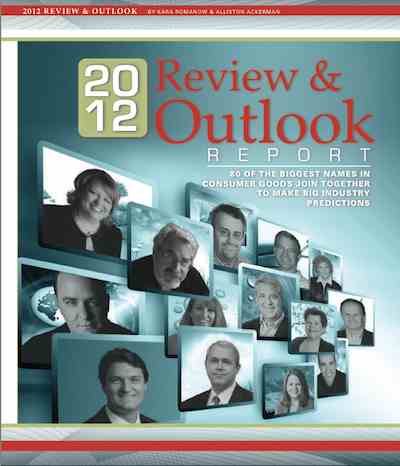
Consumer Goods & Technology Magazine has just released their 2012 Review & Outlook Report – “”80 of the Biggest Names in Consumer Goods Join Together to Make Big Industry Predictions”.

I’m honoured to be one of those 80 contributors.

This year, they were focused on the major trends which would impact the consumer good space in 2012 and years to come. Here’s how I responded:

There’s a tremendous amount going on in the CG space, particularly with mobile, social and location. Packaging is about to become intelligent; the relationship that consumers have with products is becoming more interactive; the retail space is going to change in a huge a way as our cell phones become credit cards.

Put that into perspective, and I believe that the biggest issue that people within the industry need to think about is the speed of change that is occurring. If you think about the context of these trends, what is clearly happening is that CG companies are no longer setting the pace of innovation; it’s being driven at the speed of companies in Silicon valley.

Can they keep up with the blistering rate of innovation that drives high-tech companies? Can they respond fast enough to take advantage of opportunities or at the same time, ward off threats? A key phrase that I’ve been using for years is that “the future belongs to those who are fast.” I think for 2012, this is going to be a defining success factor for every single CG company.”

I think my message is resonating ; a few weeks ago, these folks confirmed me to headline another of their  major conferences in New York City in October 2012.

CGT previously booked me to headline their major conference last year

Press release: ”Consumer Goods Technology Announces Jim Carroll as Keynote Speaker for 2011 Business & Technology Leadership Conference”  

The future belongs to those who are fast!

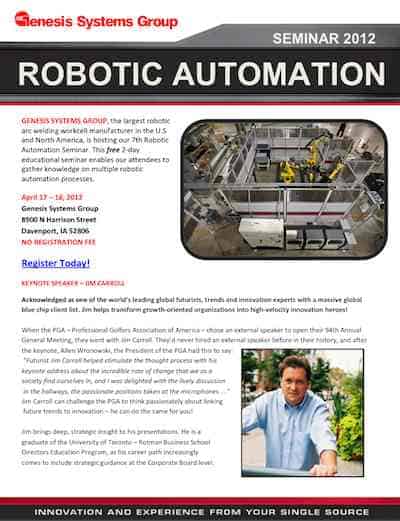
In April, I’ll be a dinner speaker for Genesis Systems Group annual Robotic Automation conference.

It’s one of quite a few keynotes I’m doing in the manufacturing sector. I’ll be in Phoenix the week after this one for a corporate meeting for a major manufacturing group; in May, I headline “Manufacturing Innovation 2012” in Orlando, which will feature representation of over 700 manufacturing organizations, as well as representative from most US states Manufacturing Extension Partnerships.

This follows up some pretty high profile events last year, including the Interactive Manufacturing Exchange in Las Vegas as well as several other events.

What’s the draw? Why so many bookings in this sector, usually left for dead by so many?

Because my key message is one that folks in the manufacturing industry already know: something big is going on. There are huge opportunities for innovation, a change in the way things are done, opportunities for reinvention, and fascinating new technologies, processes and methodologies that helps manufacturers to do things they haven’t done previously.

There’s also a recognition in the sector that to take advantage of these trends, people really need to challenge their thinking. A sense of ongoing doom can kill innovation; a focus on the challenges of the past rather than the opportunities of the future can blind people to what they should be doing, rather than thinking about what they have been doing.

And that’s what I’ve been doing in my keynotes.

It seems to be striking a chord!


The future belongs to those who are fast — Jim Carroll, from the opening to a keynote to an audience of thousands in Las Vegas!

A report from T. Rowe Price on my recent keynote for the 2011 Investment Symposium follows, where I was one of three keynote speakers (the other two being Colin Powell and Charlie Cook). You can find some blog links to each of the three key themes in the article at the end of the article below.

""We thought Jim was amazing - just the positive message we wanted to leave folks with"

It was a fabulous event, and a great opportunity to get a pretty impressive audience — investment managers for a broad range of investment managers for a broad range of Fortune 1000 organizations, pension funds and government agencies.

Summary:

Futurist Jim Carroll, one of the world’s leading experts in global trends and innovation, described how advances in technology and human innovation will combine to create positive change in the future. He explained how businesses can be held back by what he calls “aggressive indecision”— postponing action because they are constantly waiting for economic conditions to improve. Carroll noted that as the pace of change accelerates, the companies that prosper will be those that can adapt and innovate most quickly.

Key Points

  • Long-term trends that will lead us into the future. Silicon Valley is redefining everything—industries that get involved with Silicon Valley will be brought up to their speed. One powerful trend is pervasive interconnectivity—the fact that electronic devices are connected and can communicate with each other—as a driving force. For example, a staid industry such as air conditioning and heating benefits when people can control their entire home environment remotely through a cell phone. On the health care front, sensors can monitor the activities of seniors and report any changes in behavior, allowing people to live independently longer. On a more dramatic note, he believes advances in exploring the human genome will change medicine’s focus from reactively treating disease to proactively searching for potential health problems before they occur.
  • The paradox of pessimism and reality. While many business people are pessimistic about the future and believe economic recovery is at least two years away, technological advances are creating the potential for greater productivity and efficiency. For example, the auto industry now has the flexibility to produce in response to demand instead of building huge inventories that may go unsold. Products can also be brought to market much faster to take advantage of changes in consumer tastes.
  • The next generation. The next generation has grown up with rapid advances in technology, so they are at home with change. This familiarity means young people will greatly increase the rate of innovation as they enter the workforce. This group is not afraid to take independent action—50% believe self employment offers more job security than working for a company. The next generation will receive $12 billion to $18 billion in intergenerational wealth transfers in the next 12 years alone, which could help fund their ambition.

More information:

  • Major 10 year trend: The future of every industry to be controlled by Silicon Valley Innovation  
  • The new face of manufacturing: agility, insight and execution 
  • Creativity and the new workforce 


The phrase is bit of a mouthful, isn’t it?

Get used to the concept. It’s part of an overall massive trend in which computational analytics come to play an increasingly more important role in helping us solve some of the big problems in society, in the fields of health care, energy, the environment and other industries. I wrote about this some time ago in a post, “Computational Analytics is the New Platstic.” It’s one of the next new billion dollar industries and it’s happening now.

Here’s a keynote from a recent keynote in which I’m talking about these “From a recent healthcare keynote, based on my Healthcare 2020″ keynote. The slides are running at the same time that I’m speaking – watch the screen as the data unfolds! Then cast your mind into the future….

At the T. Rowe Price 2011 Investment Symposium in Baltimore on Friday, I listened to the technology panel that preceded my luncheon keynote.

It was a fascinating discussion as a number of their leading analysts spoke of the trends that they saw unfolding with consumer and other digital technology companies, such as Apple, Amazon and Samsung.

Name any industry - auto, health care, manufacturing, energy, banking -- and the big trend over the next five years is that Silicon Valley is coming to control the pace of innovation in the industry. And it's speeding it up!

But I thought that the crowd was hungering for a bit more — where are the next big trends, and the next big transformation opportunities that are going to unfold which are going to provide for the birth of new industries, fast growing companies, and billion-dollar market opportunities?

And so I outlined that reality: the next big areas of growth will come from the transformative change that occurs as Silicon Valley comes to drive the pace of innovation in almost every other industry. As it does so,  it will speed up the rate of innovation.

The impact of this trend is that it will also shift control from any particular industry – insurance, healthcare, banking, auto — to the technology companies. The result will be massive business model disruption as new, faster, more nimble competitors who understand technology based disruption, cast aside their slower, ingrained counterparts.

The future belongs, in other words, to those who are fast. Tech companies and tech based innovators certainly understand this! And the key issue is speed : Apple, for example, could innovate much faster with new credit card financial systems than any bank could. Google and it’s tests of automatic car navigation technology will certainly evolve faster than any auto company in Detroit, Japan or Germany could. Unless leaders in those organizations increasingly learn to focus on speed as a metric, and fast-innovation as a core capability.

Consider just a few of the trends:

  • Banks and credit companies risk losing control of their future as our mobile devices, cell phones and iPhones become credit cards
  • the energy industry and home construction is impacted as a new personal energy infrastructure management, in the form of such devices as the NEST Thermostat, provide for a significant change in the way people use energy
  • health care will be transformed by medical device connectivity and bioconnetivity — allowing hospitals and nursing homes to extend the reach of their medical professionals to an increasing number of remote locations
  • the auto industry will face trendmeondous change as an intelligent highway infrastructure emerges as the same time as intelligent, self-guiding cars and trucks become a regular part of our daily world
  • the world of insurance is upended as we head to a world of predictive insurance modelling through the use of sophisticated technologies such as on-board GPS devices which monitor driver behaviour

These are but just a few examples. I can go into any industry today and point out how Silicon Valley and technology is going to cause significant change and upheaval within the industry. I can spot the smart executives who understand the message and realize that right now is the time for aggressive innovation and big thinking.

And then in other clients, I can see this observation pass right over the heads of some of those in the audience, and realize we’ve got folks who are like deer in the headlights — the trends are blinding in their reality, but they are frozen by their inability to do anything.

I spoke about this trend in a recent keynote.

There are a whole series of related posts in which I’ve commented on the significance of this trend and the speed with which it is occurring. These are just a few.

  • Silicon Valley innovation velocity set to dominate every industry 
  • When Silicon Valley Takes Over Health Care Innovation 
  • This ghost town in New Mexico could turn into one of the most important innovation engines 
  • Reinventing the future with transformative technology
  • Silicon Valley: Is Innovation Dead? 

A few weeks ago, I was the opening keynote speaker for the 2011 Multi-Unit Franchising Conference held at The Venetian in Las Vegas.

The audience were owners and operators of multiple franchise operations, primarily from the restaurant / food sector, but also from other franchise operations in auto, pet care, home supplies and other retail product lines.

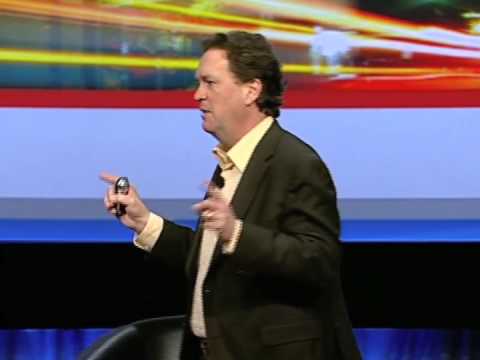
An audience of close to 1,000 listens to Jim Carroll's keynote on fast paced consumer, retail and restaurant industry trends in Las Vegas

My keynote topic was built on the theme “”Where Do We Go From Here? Why Innovators Will Rule in the Post-Recession Economy – And How You Can Join Them!”


What did I take a look at? A wide variety of the fast-paced trends impacting the retail / restaurant sector today. I broke my talk down into 3 key trends, what I might call:

  • Consumer velocity
  • Mobile madness
  • Intelligent infrastructure

1. What We Know: Consumer behaviour shifts faster today than ever before

The average consumer scans 12 feet of shelf space per second.” That’s a stat I’ve long used to emphasize that the attention span of the typical shopper of today is shorter than ever before — and retailers need to innovate to ensure they can keep the attention of today’s consumer.

It’s not just keeping up with fleeting attention spans — it’s about adapting to the fast pace of how quickly consumer choice changes. Consider what is happening with the rapid emergence of revenue in the late night business segment – it was up 12% in 4th quarter 2010, compared to 2-3% for other parts of the day. That’s why major chains have been focusing on new “happy hour” offerings — and so their success increasingly comes from how quickly they can scale and adapt to fast moving trends.

We’ve seen plenty of fast innovation from various organizations in the sector to respond to quick consumer change. Morton’s capitalized on the new consumer sensitivity towards value when it jumped on the trend that involves the “casualization of fine dining” with its’ $6 mini-cheeseburger.

Other fast trends drive the industry. The Sydney Morning Herald ran a great article in April of 2011, noting that “… the world of cooking and restaurants is becoming more like an arm of show business …..” with the result that “everyone wants to see the chef.” That’s why we are seeing many restaurants from fine-dining to fast casual moving the kitchen to the “front of the house,” or in other cases, a lot of TV display technology that provide for video links from tables to the kitchen. The evolution that is occurring is that the chef is becoming the star, and more and more of the staff are becoming ‘performers.’ Innovators in appropriate sectors would see the opportunities and jump on this trend.

Whatever the case may be, the consumer of today changes quickly, and innovators check their speed and agility in being able to respond to this reality.

2. What We Know: Technology – especially mobile – has become the key influencer of today’s consumer decision making.

Simply put, the velocity of mobile adoption, local search and product promotion is evolving at a pace that is beyond furious.

Consider the growth rates underlying today’s technology. It took two years for Apple to sell two million iPhones. It took 2 months for them to sell 2 million iPads! It took 1 month to sell 1 million iPhone 4’s!

The impact of such trends is an explosive rate of growth of wireless Internet usage. Mobile represented but 0.2% of all Web traffic in 2009. That grew to 8% by 2010, and is expected to hit 16% of all traffic this year.

Some suggest that mobile searches now exceed the number of computer based searches. What is also well known is that most mobile searches are for “local content.” Not only that, but Google has found that when someone gets a smartphone, the number of searches they make increases 50 times!

What is clear is that people are using their mobile devices to find nearby – stores, retailers, restaurants and just about everything else. Combine this with the emergence of new promotion opportunities (through apps and other tools) and you’ve got a revolution in the making in terms of local product promotion. That’s why the success of many retailers / restaurants will come from their success with location-sensitive coupon technology.

Bottom line? Innovation is: rethinking in-store uplift in terms of new methods of interaction!

3. What We Know: We will have far more opportunity for operational innovation through the rapid emergence of new technology, infrastructure and other trends

Consider how quickly near-field payment technology is going to steamroller the retail / restaurant sector. Simply put, over the next few years, the credit cards in our wallet will disappear as our iPhones, Blackberries and Android phones become the credit card infrastructure of the future. This is a HUGE trend — it provides countless opportunities for innovation, disruptive business model change, new competitors, and all kinds of other fun opportunities.

The trend has enormous velocity – we can expect $113 billion in transactions by 2016,  with 3.5 billion transactions – and with this comes new opportunities for loyalty and contact followup. From an innovation perspective, the sector will have to ensure they can ingest the new infrastructure quickly enough, and keep on top of the industry change that it will cause to ensure that challenges are turned into opportunity.

There are all kinds of other areas of fast change that present opportunity. Consider the issue fo ‘green buildings’ and sustainability. The West Australian newspaper recently noted that “with the rapid increase in knowledge, skills and availability of materials, costs have fallen. The industry now understands how to build green and building a 5-star Green Star building is now generally cost neutral.”

Some franchisees are taking this to heart, with aggressive plans involving eco-friendly buildings. Chick-fil-A has a  LEED initiative in building a test model restaurant that has water usage down by 40% through rainwater collection; an electricity reduction of 14% through the use of skylights & energy efficient appliances; 20% of the building content is from recycled material; and 30% more fresh air than regular buildings. While the structure is 15% more expensive to build, they expect a fairly quick payback — and will manage to get a branding image to their customer base that they don’t just talk sustainability – they do it!

From this perspective, innovation is keeping ahead of and planning for hyper-innovation with IT, energy, environmental and other infrastructure trends that impact facilities or the nature of the customer interaction.


Innovators get ahead by focusing on bold ideas, and exploring the concept of 'experiential capital' - Jim Carroll

I also emphasized that innovators aren’t afraid to make bold moves. Every franchise and retail organization today is looking for opportunities for cross-promotion, cross-selling and product placement. So consider this observation from the Dallas Morning News in March 2011 in an article titled: Funeral home adds little sip of heaven: Starbucks Coffee.

At McKinney’s Turrentine Jackson Morrow Funeral Home, it’s now possible to pay your respects to the dead or plan your own funeral with a venti Caramel Macchiato in hand

Craziness, or smart niche-marketing? I think it’s innovation!

So what do you do? My message to the folks in Las Vegas was to get involved and explore these fascinating new worlds that surround you!

Many of them might hold themselves back from Facebook advertising, because the concept might simply seem overwhelming for a small to medium sized mulit-unit franchise operation. Yet, today Facebook now accounts for 1 of 3 every online ads. And we are seeing the rapid emergence of new online ‘aggregators’ that are focused on helping small business take advantage of that fact. These organizations — such as Blinq — manage the buying of thousands of individualized ads, based on age, location, interests.

They should simply try the world of mobile promotion. Buffalo Wild Wings gave it a shot for one recent NFL based initiative, and indicated that they tripled the return on their investment.

Think differently in terms of new ways of reaching the consumer. Pizza Pizza, a Canadian chain, recently released a new iPhone App that allows online ordering. Nothing new or special about that – such apps are becoming a dime a dozen, and are quickly becoming de rigueur. What is cool is that the chain has revealed that it is working to link the  app payment system to university meal card plan, in recognition of the fact that many students in the target market might not have credit cards (or “credit worthy” cards.)

Bottom line? One of my key closing messages was that innovators focus on the concept of “experiential capital” -there’s a lot going on, and to figure out, we should just get out and do it! Try new ideas, explore new initiatives, undertake new projects. One of the only ways to get ahead is to work quickly to build up your experience in all the new opportunities that surround you.

As an association executive, are you thinking BIG enough?

That’s the challenge I raise in a forthcoming article for the April / May CSAE Association publication, due out in print any minute.

You can get a sneak preview right now!

How small is your world? Are you thinking BIG enough?

Here’s how I close the article.

There is a lot of transformative change that is underway. This is no time to think “small.” This is the time in which you need to be thinking “big.” How “small” is your world? Do you have a narrow view of opportunity? The reality is that right now, thinking BIG in terms of opportunity and the future will be crucial to your future success.

What does that does it mean for your future? In the old days, companies had “industries” that they worked within, “markets” that they sold into, and “business models” that they pursued. Assumptions that drove their decisions. And associations that represented them in a world that moved relatively slowly.

Every single assumption that you might have about your future could be wrong. Challenge those assumptions, think about the rapidity of future trends, innovate — and you’ll find the growth opportunities that seem to elude so many others.

Think about this NOW!


From my CAMagazine column….

—-

Can you keep reinventing your business at the speed demanded?

I am not alone in thinking we’re in the midst of a significant economic transformation. As Mick Fleming, president of the American Chamber of Commerce Executives, said recently, “It’s going to be a move from a bad economy to the next economy.”

What is the shape of the next economy? In many cases, it will involve structural change based on an acceleration of business cycles. Consider manufacturing, for example. We’re moving from a world of mass production to mass customization, or what I call agility-based manufacturing. I often cite the case of Honda, as noted in a 2008 article on the financial website Bloomberg: “Honda’s assembly lines can switch models in as little as 10 days.” By contrast, the article suggests, it could take months for most rivals to make the same change.

Companies such as Honda can see what’s selling strongly and quickly reorient their production to fit that demand. In the meantime, its competitors are busy cranking out 700,000 versions of the same old car, hoping to sell it to consumers who have already moved on to something different. It’s no wonder Detroit is being killed off by its long-term reliance on gas-guzzlers.

Everyone now understands that the old Detroit-based manufacturing business model was deeply flawed. The newer model, based on agility and flexibility, is the model of the future. If an organization can rapidly change its production to accommodate what consumers are willing to buy, it has a good chance of future success.

This ability to respond quickly to change is a corner-stone of opportunity. Competitors will emerge, particularly as the new connected generation rejects existing business models and innovative people continue to shake up the fundamentals. Take the business model of Wizzit, a South African cellphone-based banking system, which could cause upheaval throughout the banking sector as mobile technology garners more of our attention.

Furthermore, the nano-cannibalization of markets is becoming a business trend rather than an aberration. For example, Apple broke new ground years ago by tossing out an entire iPod Nano product line worth billions of dollars of revenue, replacing it with a newer, up-to-date product. Imagine even considering that. How could it cannibalize its own product revenue?

I recently spoke at a leadership meeting for a global organization, where the CEO spoke of a future in which the company’s success would come from what he called “chameleon revenue” — the sales derived from entirely new product lines. The chart he presented said it all: the organization’s future consisted of a steady decrease in baseline revenue and accelerating revenue streams from markets it currently does not participate in.

I think this will become the norm for most organizations. The ability to rapidly enter and exit markets will define future success. The ability to sustain multiple, short-term product life cycles, each perhaps no more than 36 to 48 months long, will be a critical success factor. Agility at discovering, producing and capitalizing on new revenue sources will be a fundamental necessity. In other words, your ability to change your spots and your colour on a dime will be the key driver for your potential.

Which begs the question: does your financial system have the capability to provide information on your chameleon revenue streams? Does it provide the insight and analytical tools to tackle product life-cycle revenue so the organization can assess how quickly its chameleon revenue streams are evolving? If it doesn’t, what do you need to do to adapt?

(This is a long post!)

Were my comments in the video below — recorded in front of 3,000 people at the annual National Recreation and Parks Association annual conference in Salt Lake City in 2009 — quite possibly the stupidest, dumbest  comments I’ve ever made on stage?

Could we really be headed to a world in which we are going to utilize a lot of technology and innovation to help us deal with a very real and significant challenge – that is, dealing with the tsunami of care-giving that will be required in the world of seniors care?

I’ve been debating this for quite some time, given the confluence of two issues: my wife and I  and sons (and her sister and family) have been quite immersed since December with a family member that has involved the rapid onset of Alzheimer’s and dementia. It is a very sad, intense and emotionally challenging situation; it has revealed to me the personal side of a very complex problem.

And while all this has been going, I had been working on and preparing for my keynote to the DSSI Annual Forum. DSSI is a major supplier within the US seniors care industry, and the conference features the participation of probably the bulk of the seniors care operators in the US.

My keynote was to be focused on innovation in the seniors care sector — where might there be opportunities, and what are the trends that will provide those opportunities.

How did I approach the topic? I truly believe that we live in a period of great transformation, and that people must challenge themselves to think boldly when it comes to innovation. Hence, the innovation opportunity comes from “thinking big.”

So let’s think about the scope of the problem. We all know that in Western nations and mature Asian countries, the seniors care challenge is massive. And with longer life expectancy, we are dealing with a reality in which the challenge of Alzheimer’s care for these seniors will go on for much longer periods of time.

In my keynote, I jumped right into the “scope” issue. Consider the reality:

  • in the US, the number of Alzheimer’s patients is set to triple to 16 million by 2050
  • the typical Alzheimer patient is disabled for 9 to 20 years – and this will increase to 40- to 50 years as medical advances continue and life expectancy continues to grow
  • we are spending $172 billion a year in treatment – and that is set to grow to $1.08 trillion by 2050 given the growth in the number of cases, and the impact of longevity
  • there is a lot of family care giving that is involved; as the St. Louis Dispatch noted, “Boomers may be spending more years caring for an aging parent than a child
  • and the challenge shows no end in sight: “40% of people over the age of 80 are suffering from dementia – there will be a million new cases a year by 2050

Put these facts into the context of the reality of what is occuring in the world of seniors care today:

  • an ongoing massive ramp-up in demand with shortfall in available and planned units
  • a funding crisis with plunging investment / housing values, and state, federal and municipal tax deficits
  • ongoing skills and staffing issues
  • increasing scrutiny in public eye
  • heightened expectations on quality of service from the boomer generation

That’s why one of the first points I emphasized is what I often do in my keynotes: “World class innovators aren’t afraid of thinking boldly!” Simply put, we have a huge problem, and society and government needs some pretty bold thinking when it comes to solutions. How is society going to care for, in a respectful way, an increasing number of seniors living with a very complex disease? How can we help the caregivers to give better care?

Which brings me to the Paro therapeutic robot.

"It's Not a Stuffed Animal, It's a $6,000 Medical Device; Paro the Robo-Seal Aims to Comfort Elderly, but Is It Ethical?" - Wall Street Journal

When I am preparing for a keynote, I often do research that involves reading through several hundred articles on a topic — I access these through an online research service. In this case, while doing my homework, I came across the Paro, as covered in an article in the Wall Street Journal:

It might be the cuddliest medical device ever to cause an ethical quandary. Five years ago, a Japanese robot manufacturer introduced Paro to the world. Built to resemble a baby harp seal—with a plush coat of antibacterial fur—Paro was hailed in Japan as a pioneer among socially interactive robots, one that would help lift the spirits of millions of elderly adults.

It never quite caught on. “It doesn’t do much other than utter weird sounds like ‘heeee’ or ‘huuuu,’” says Tomoko Iimura, whose adult day-care center in Tsukuba City keeps its Paro in a closet.

Now Paro has come to American shores, appearing in a handful of nursing homes and causing a stir in a way that fake seal pups rarely do.

My first reaction was, “that’s the dumbest thing I’ve ever heard.” I was thinking in the context of what my wife was going through; dealing with someone with Alzheimer’s involves a tremendous amount of love, care, time, and emotional commitment.

How, in my mind, could a fake pet ever provide a level of care that would equate to that offered by a loving family member?

And at that point, I had to check myself — after all, I always challenge people to avoid reacting to new ideas with such phrases. It’s a key part of what I often outline on stage — the “innovation killers” that provide such a degree of organizational sclerosis that it clogs up our ability to try to do something new.

So let’s think about the Paro therapeutic robot. It was approved by the FDA as a medical device; the Wall Street Journal had this to say:

“Powering it are two 32-bit processors, three microphones, 12 tactile sensors covering most of its fur, touch-sensitive whiskers and a system of motors that silently move its parts. They allow Paro to recognize voices, track motion and “remember” behaviours that elicit positive responses from patients”

- It’s not a stuffed animal, it’s a $6,000 medical device, WSJ, June 2010

The more I thought about it, I realized that I was probably guilty of the same anti-innovation attitudes that I often talk to my clients about. Who am I to say that such a device might not play a role in helping to provide for bold, transformative solutions to a challenge that is massive in scope?Maybe I’m guilty of the same type of innovation-blockers’s that I speak on stage about! I pondered that thought through the last month during my daily five mile walks….

Read further into the article, and you come across this:

One recent morning, staff at Marian Manor in Pittsburgh, one of Vincentian Collaborative’s homes, circulated three Paros among residents gathered for a sing-a-long. As 77-year-old Anita Biro sat down at a table, she berated two fellow residents and told them to leave, recalls Beth Kuenzi, activities manager for the home’s dementia unit.

But when Ms. Kuenzi put Paro in front of Ms. Biro, her mood changed. As Ms. Biro stroked the robot’s synthetic fur, the machine batted its eyelashes and tracked movement with its head and eyes.

“I love this baby,” Ms. Biro cooed.

Aides also take Paro to residents’ rooms to get them to socialize. At another Vincentian home, Lois Simmeth, 73, doesn’t always participate in group activities, but she ventures into the hall when she hears Paro’s sounds.

“I love animals,” explains Ms. Simmeth. She whispered to the robot in her lap: “I know you’re not real, but somehow, I don’t know, I love you.”

Five years out? 10? 15? Who knows what type of bold, innovative solutions we might see emerging that could help family members who are in a caregiving situation, or which might help to alleviate the huge burden of care within seniors facilities?

Further into my research, I came across the MedCottage. What a unique innovation this was — a small, wired, backyard “cottage” that a family could use to provide independent living for their parents.

It seems to tie into a key trend — at the DSSI event, former Kansas Governor Mark Parkinson (now President of the AHCA / NCAL, the main association representing the seniors care industry in Washington), noted that a survey indicated that 96% of American’s did not want to spend their later retirement years in a nursing home — they wanted to be in a home care environment.

And so could the MedCottage be a fascinating innovation to the trend towards home care?Absolutely — but it too will run into the “innovation blockers.” Such an idea could be doomed because of “NIMBYISM”  - “not in my neighbours backyard!” Yet things are moving fast on that front too:

The State of Virginia has passed a law allowing installation of MEDCottages in residential backyards, over the objections of homeowners who have expressed fears they don’t belong in neighbourhoods.” Checking up on mom from a distance, Toronto Star, September 2010

Telling this story on stage, I reminded my audience that to deal with the really big challenges that we are faced with, we need fundamental shifts in how we approach things, and a lot of bold thinking and big ideas. Certainly the economics for home-care are compelling. I put up these bullets for the audience of seniors care operators:

  • “In Ohio, home care is estimated at $1,400 per month vs $4,300 for nursing care
  • bold goals: plan shift from 42% to 50% within three years
  • the discussion is occurring – you need to be a part of it!

In other words, my challenge to the seniors care industry is this: clearly, there is a massive trend towards home care, which will also involve a lot of family caregiving. Which led to one of the key points in my keynote: “Innovative organizations make bold leaps, in order to keep up — and stay ahead –  of a faster future”, and this point : ““Our innovation mandate won’t involve tinkering around the edges.”

So where does all this lead in terms of the video clip from my NRPA keynote – was this the dumbest thing I ever said on stage? I don’t think so. Clearly, Silicon Valley has health care in its sights — and that will include seniors care, and home care. Noted one researcher at Intel:

We have the potential to aim our innovation engine at the age wave challenge and change the way we do health care from a crisis- driven, assembly-line, hospital approach to a personal-driven approach, with people taking care of themselves with help from family, friends and technologies

This ties into the research that I refer to in my keynote to the NRPA:

Researchers at the University of Missouri are using sensors, computers and communication systems …. to monitor the health of older adults who are living at home.”

“….motion sensor networks installed in seniors homes can detect changes in behavior and physical activity, including walking and sleeping patterns…early identification of changes can prompt health care intervention….

Study the MedCottage web site, and you’ll discover that it involves some monitoring and other technologies that do exactly that.

Clearly, we have some big challenges to solve in the seniors care industry. Clearly, there will be a trend to home care. And clearly, we are witnessing the emergence of new ideas and innovations that will provide for transformative change.

So no, I don’t think I was wrong in my video.

I don’t think that the experience that my family has been through negates the trends. I think as a futurist, sometimes you have to make bold leaps with your imagination, by carefully studying trends and innovations, and putting into perspective what they mean.

The future is coming — and while we might often wonder about the predictions that are made, we must never dare to question the boldness of what might emerge.

Last week I was invited to speak in Cincinnati, Ohio by Techsolve, an organization that provides assistance to the manufacturing sector in Ohio

It was a tremendously fun keynote, because my talk was being transmitted — with both video and slides being shown — to remote locations in Cleveland, Dayton, Akron and elsewhere. Overall, we had about 350 people participating, representing a good cross-section of small and medium sized manufacturers from throughout the state.

My theme was “What do world class innovators do that others don’t do,” with a sub-theme of “Manufacturing 2.0″ – what is it that leading manufacturers are doing to ensure they can thrive despite challenging economic times?

As with many of my keynotes, I used a series of text-message based polls to interact with the audience. It’s a very effective way of delivering a keynote in which the audience is fully engaged and active throughout my talk.

And as with most keynotes, I led with an opening survey in the first few minutes, to gauge the attitude in the room, in which I asked, “When do you think we’ll see an economic recovery. In moments, I had close to 100 responses.

And I must admit, the majority response surprised me. I do these text messages across North America to a huge range of organizations, and for the last two years, the consensus answer everywhere has been “2 to 4 years.”

Not in Ohio — almost half the respondents see that they see a global economic recovery happening now! That’s a lot of optimism!

They're more optimistic in Ohio than you think!

To be fair though, half the respondents also believe that the recession is still hanging on and that we won’t see progress for at least six months or more.

Which gave me a chance to hammer home a key point I often use with my audiences — and that comes from a study by GE which found that organizations who chose to innovate during a recession often emerged as breakthrough performers “on the other side.” In other words, the time to focus on innovation is now!

On to the next issue — I often frame innovation for the audience as pursuing a wide variety of opportunities to “run the business better, grow the business, and transform the business.”

What’s the priority in Ohio? Again, the results might surprise you!

Focused on growth and transformation!

Innovation aimed at “running the business better” is often the major focus for organizations in a recession – it involves cost cutting, and often major steps to save money for mere survival.

Clearly a good part of my audience had moved beyond that, and were thinking about growth and transformative opportunities!

This is great stuff, since it shows a real mind-set of innovation in the state of Ohio.

I was feeling playful by this point — and zipped in another text message poll further into my talk. Given their mindset, I asked the room, was there a fair picture being portrayed in the media about the state of manufacturing in Ohio? Not at all!

What do they think about the media?

Fascinating stuff. Overall, it was a great day, and I will post a longer blog about the manufacturing trends I focused on. Did it go well? I put up a slide part way through, to see how I was doing with the audience. The results came flying in:

Reaction to Jim Carroll's keynote

I received quite a few email messages, including this one from particular fellow — so it’s great to have an impact and provide some encouragement!

I wanted to drop you a quick line and thank you for a great morning this past Wednesday when you spoke at theTechsolve/Magnet Ohio simulcast.

Your presentation was outstanding and really validated much of what I am trying to do at my company. I am the General Manager at a company that has been very out of touch with innovation and has been a sleeping giant. Our new team is driving significant change. I needed a dose of motivation and your presentation certainly provided it to me!

Thanks for taking the time to share your exciting views and vision with us, Ohio companies certainly need it!

Is there a manufacturing sector in Ohio! You bet!

Often, one of the best ways to discover ideas for doing things differently — of fuelling your innovation engine — can come from studying other organizations or industries that are excelling at dealing with fast market, business model, competitive and technological change. There are many organizations out there who aren’t innovative and are stuck in a rut; there are others who are extremely innovative, at the same time that there are a lot of laggards.

Seek ideas for innovation by studying those who excel at dealing with fast-paced change

One of the best ways to discover new and creative innovation ideas is by studying those who are moving forward at a really fast pace. They might be within your own industry; quite often, they will be in a completely different industry.

Organizations or industries that are subject to extremely high velocity are often the most innovative. They are busy working with the challenges that exist, and are being as creative as possible to deal with those challenges in order to turn them into opportunity.

Regardless of who and where they are, they share several things in common: they’re busy experimenting, adapting, evolving and changing. They’re working hard to make sure that the essential concepts of high-velocity innovation – run the business better, grow the business, transform the business – have become an essential part of their lifeblood.

If you can spot these organizations, you can learn from them, and become inspired by them. They can be a wonderful source of creative ideas!

So how do you find them? By looking for the telltale signs of companies or industries who are faced with all the challenges that the high-velocity economy can throw at them. Given the challenges, the organization or industry will tend to have people who are more innovative, realistic, practical, and open to new ways of thinking. They are likely to be more forward oriented and creative. They will be working to rapidly adapt to changing circumstances, and will be collectively seeking complex solutions to unique problems.

Several signs can provide you with insight as to whether the company is dealing with extreme velocity and is therefore a real innovator. Look for these characteristics:

  • They are significantly impacted by faster science. The fundamentals of the science within the industry are evolving at a furious pace as a result of the infinite idea loop. It is evident that the discovery of new knowledge within the industry is occurring at a faster pace than within other industries. Hint: look to genomics companies. Furious rates of scientific change here!
  • More competition. Business models are changing quickly, with a lot of new competition appearing on the scene as the industry begins to blur and change.
  • A faster degree of product/service innovation. The industry is widely known for being innovative, with a constant stream of new products or services coming to market.
  • More operational innovation. There is a lot of fundamental change within the industry in terms of business models, marketing methodologies, customer relationships and other unique changes. Organizations or industries that are subject to extremely high velocity – that is, significant amounts of fundamental change occurring at a rapid pace – are often the most innovative.
  • Shorter product lifecycles. Products are coming to market faster than previously, or faster than within other industries, due to the previous four trends.
  • Rising tides require fast change. Customer expectations are changing quickly in terms of the products or services being offered, because of the furious rates of innovation that are occurring. In addition, there’s heightened customer service due to hyper-competition; people know that they must absolutely excel in service levels.
  • A significant creativity capability. The organization or industry is dominated by creative thinkers; a workforce and management team that is fully focused on doing things differently, in order to respond to the reality of change that engulfs them. Those who kill ideas aren’t the dominant force; those who suggest how things could be done differently are at the forefront of action within the organization.
  • A partnership orientation. The organization or industry is constantly seeking outside expertise in order to help it go forward; it is willing to make use of complexity partners, nomadic workers, skills banks and other partners in order to grab on to ever more important change capabilities. They know they can’t do it all, and so they are willing to do what it takes to get access to what they need to get it done.
  • They’re plugged in. The organization or industry is linked into and is feeding off of the ideas from within the infinite idea loop. They are constantly scanning and sifting through the constantly evolving collective insight of the global discussion that is taking place; they are always eager to spot how innovation is occurring outside of their organization, and are busy interpreting what is being said in order that they can use this insight for their own purposes.

Organizations or industries that are subject to extremely high velocity – that is, significant amounts of fundamental change occurring at a rapid pace – are often the most innovative. They are busy working with the challenges that exist, and are being as creative as possible to deal with those challenges in order to turn them into opportunity.

You want to find these organizations, study them, and learn from them – since that will be one of the best ways to create your own innovation oxygen.

When you are on stage in front of several hundred people, you’ve got to be prepared to be interactive and open to insight.

That’s why I regularly use a text message polling tool on stage — I can quickly get a sense of what people in the room are thinking about.

Here’s the results from a recent poll – at the start of a talk I asked the audience (in this case, a group of professionals from a national organization) when they thought we might see an economic recovery. Within 2 minutes, I had 218 responses, which probably represented 75% of the audience.

Of course, that gave me the opportunity to lead into a very important observation — if the majority of folks in the room think that economic recovery is still some time off, what are they doing now to prepare for the inevitable economic upturn?

This was a great time to hit them with a key observation by GE’s Chief Innovation Consultant — breakthrough performers manage to accomplish great things because of a decision to focus on innovation right in the middle of an economic challenge — rather than waiting till they came  into a recovery phase.

Here’s the bottom line : during the oil shock of 70’s, 80’s and 90’s recession, and the 2000 dot com bust, of those companies surveyed, 70% of companies barely survived, 30% died, and 10% became breakthrough performers.

Noted the GE head of innovation: it was explicitly “…because of choices they made in the recession..”

So it really comes down to this: when do you innovate? Are you going to wait until you are comfortable that we’re in a sustained period of economic recovery? Bad decision — because economic volatility is the new normal. Everything we have learned from past recessions has taught us that the winners were those who decided that it was an important thing to keep moving ahead despite massive amounts of uncertainty.

When do you innovate?

I captured this sentiment on stage in Las Vegas some time back. Maybe it’s worth a watch. Ask yourself the question, and look around at what you are doing right now to prepare for the future. Are you in an innovation frame of mind right now?

Hundreds of thousands have seen Jim Carroll on stage with a keynote focused on future trends, innovation & creativity....with a focus on the trends that will drive their future.

What are the major trends that will shape our world in the future? Here’s what you need to be thinking about now!

How SMALL is your world? Are you thinking BIG enough in terms of just how many big trends are going to impact your future?

Many people ask me how I spend my time in nailing many of the trends that will redefine society, industries, markets and nations into the future….

It involves a lot of research and a great deal of listening to other experts. But it also comes from the fact that I spend my time as a speaker at corporate meetings, massive association events and board retreats, with the resultant opportunity of seeing what many of the most innovative organizations in the world are focused upon. Just take a look at my client list, and you’ll get a sense that I have a constant stream of global executive level insight that drives my view of the future. Take a look at the track record of what I’ve been up to. There’s some pretty solid and significant insight happening here. Take a look at what world class innovators do that others don’t do.

My trending observations also involves a lot of common sense. Take the “expectation gap” which I outline below. This is a pretty significant trend, and it’s pretty well blindingly obvious when you think about it,

So what comes next? Here’s a quick list of 10 trends that you could be thinking about as we go into 2011. I’ve got dozens — no, hundreds — more. Hang out on this blog, track my thoughts, jump in, and let’s continue to innovate our way into the future!

  • the expectation gap: it’s one of the most obvious, most significant, and most challenging trends going forward into the future. Quite simply, Western society is defined by an increasing divergence between what people expect, and what they will get. People expect the world’s greatest health care services; with the aging of society, it is dramatically clear that the system won’t be able to deliver what they expect. Boomers expect that they will have a comfortable retirement pensions; the economic reset and collapsing home values have made it increasingly clear that their hopes will likely have been dashed. People expect that they can live longer, but the increasing prevalence of lifestyle diseases due to obesity and other factors means that in some areas of the Western world, 60 is the new 70. People expect that they can reduce the size of “big government” but have no sense of just how to go about doing this without a great deal of pain. Whatever the case may be, our future is increasingly defined by this gap, and it is going to have huge ramifications for just about everything around us. And here’s the reality: a lot of organizations are going to make a lot of money in helping to close the gap! Take health care and what is really going to happen in terms of future trends. Huge opportunities for growth!
  • industries blur: In the past, we’ve have “industries” which have focused on particular products and markets. Increasingly, the concept of an “industry” is going to blur as fascinating new trends provide interesting new opportunities. Consider this: the world of fashion and healthcare are going to merge. We are going to see an increasing number of bio-connectivity health care devices that will be used for the remote monitoring of health care conditions. Quite simply, people will increasingly wear small “smart appliances” that will monitor their compliance with exercise programs or that will keep their doctors up to date with key health indicators. But people won’t want to wear medical appliances though: they’ll want to wear fashion! Health-care jewelry anyone?
  • energy gets smart: Clearly we’re going to see continued high-speed innovation with renewable energy sources, and velocity with grid-parity: the point in time at which the cost of producing renewable energy equals that of carbon based sources. Much of this is coming about as Silicon Valley gets aggressively involved in the energy sector Taiwan Semiconductor, one of the largest chip manufacturers in the world, has invested $193 million in solar-cell maker Motech Industries. That’s but a small example of a major trend in which hi-tech companies are getting aggressively involved in every single aspect of the renewable energy marketplace. Just look at what Google is up to with wind-farms off the Eastern Seaboard!
  • the collapse of attention spans: Everything changes when people lose their ability to focus: sports, shopping, living…..the numbers with the next generation of consumers are simply staggering. The average teen sent 435 text messages per month in 2007; it’s now 2899! That’s 97 messages per day, an increase of 566% in just a few years. It’s estimated that they now spend 7.5 hours a day engaged with some type of media screen; if you add in the fact they are multitasking, it comes out to 11 hours of screen time per day — or 53 hours a week. Thats’ more time than involved in a full time job, and more time than their parents spend at work. What’s the impact? Continued hyper-speed in the evolution of branding and advertising; surreal rates of change involving products and services; unbelievable rates of change in how decisions are made and people are influenced. If you don’t know how to think, market and promote at nano-speeds, you’re not ready for the future!
  • faster market evolution: If we’re thinking faster, than we are innovating faster! New products flood the market at ever increasing speeds, and fast-consumers snap them up in a moment and evolve their lifestyles quicker. We’re all going to begin moving at Apple-speed as Silicon Valley increasingly comes to control the pace of innovation in many industries. Put it this way: it took two years for Apple to sell two million iPhones, but only 2 months for them to sell 2 million iPads! And just about a month to sell 1 million iPhone 4′s! We’re seeing the same trend in many other industries and product lines: the business of outsourcing the manufacturing LCD TV’s exploded from $9.4 billion in 2009 to over $21 billion in 2010, and an estimated $30 billion in 2011. Some products are obsolete before they are released: Lenovo learned this fact when they cancelled their planned “tablet computer” this June due to the unbelievably fast success of the iPod with market domination.
  • innovation partnerships. Given this rate of change, companies are quickly learning that in this fast paced world, they can’t innovate on their own; it is simply too difficult to keep up. And they’ve realized that they can enjoy greater success through open innovation and other external innovation partnerships. A great example of what happens when innovation “opens up” is seen with the partnership between consumer appliance maker Phillips and Sarah Lee on the single-serving coffee machines. It’s a market that grew from nothing to 12 million machines and 7 billion coffee “pods” in just 5 short years! Everywhere I go, I see organizations focused on challenging the core concepts of how they do “new things.” There’s a new mindset, and this is going to drive a big part of the growth for organizations going into the future.
  • the fight against workplace boredom. When there’s so much fun and fast change in the world, a job can be a mind-numbing experience. That’s why one survey suggested that 67% of Gen-Y admitted on their very first day on a new job, they were already thinking about another job. Organizations are fighting back against boredom by trying to keep staff engaged. At IBM’s Bromont Canada plant, the “3×10″ program aims to combat workplace boredom by changing employees full set of responsibilities 3 times every 10 years. The program is managed by someone who has worked in 10 different jobs within the plant over the last 28 years. Expect within a few years the likelihood that a 3×10 program will have shifted to a 2×1 program….
  • American-Idolatry : People love competition, they love winners, and they relish the battle! Everyone is learning that if they are to succeed in the future, they have to appeal to the new base of hero-worship that comes from our new awards driven society. Everywhere I go, I see companies who are far more willing to celebrate and elevate heroes. DHL holds an annual innovation day which includes an award ceremony with partners who have worked with them on innovative ideas. Deloitte South Africa hosts an annual “Best Company To Work For’ survey and combines into it an elaborate awards ceremony. The future of workplace and partner renumeration is all about the red-carpet, the spotlight, and the celebration of success!
  • the big impact of small incrementalism. Everyone is learning that one way to win the future is by having a lot of small wins that add up to big gains. The oil industry currently retrieves only 1 out of 3 barrels per well on average, yet a 1% improvement represents huge revenue gains! 7% of power on transmission and distribution lines are lost as heat, yet reduce that loss by 10% – and that would equal all the new wind power installed in the US in 2006. Todays’ typical automotive system uses only 25% of the energy in the tank — the balance is lost to waste, heat, inefficiency. Work on increasing that on a year over year basis, and there are some pretty solid gains through innovation. .At DuPont, the savings add up: globally, they now produce 40% more material as a global company using the same amount of energy they used in 1990. Up to 30% of the energy used in a typical industrial or commercial building today is wasted, but new, incremental improvements in green building design and other eco-principles are fixing this fast. Every industry I am dealing with sees small marginal wins adding up to huge tactical advantage! Small is the new winner…
  • communities redefined: there were 37 million senior citizens in the US in 2006, or about 12% of the population. By 2030, there will be 71.5 million of them, representing 20% of the population. Other nations in the Western world are seeing the same trend: we’re all about to become like Japan! And the reality of funding issues means it will be impossible to have the same seniors-housing or assisted living type of infrastructure that we’ve had in the past. The next generation of retirees are going to live at home longer; they’ll live with each other more; the hippies of the 60′s are going to find themselves in the seniors communes of 2015! Community-bliss: far out, man! What does it mean? Communities are going to have to be rethought, re-designed and reconstructed – community ergonomics is going to be a massive growth industry! Overall, we’ll see a lot more growth in high density, compact, mixed-use communities – and a lot of innovative thinking as to just what the concept of ‘community’ means.

These are but a few trends that I’m thinking about. I’ve got HUNDREDS more.

Think about these trends from this perspective: there is a lot of transformative change that is underway.

This is no time to think “small.” This is the time in which you need to be thinking “big.” How “small” is your world: do you have a narrow view of opportunity? The reality is that right now, thinking BIG in terms of opportunity and the future will be crucial to your future success.

What does that does it mean for your future? In the old days, companies had “industries” that they worked within, “markets” that they sold into, and “business models” that they pursued. Assumptions that drove their decisions.

Every single assumption that you might have about your future could be wrong. Challenge those assumptions, think about the rapidity of future trends, innovate — and you’ll find the growth opportunities that seem to elude so many others.

It was a busy September, with keynotes and leadership events for the likes of PPG, the Utah League of Cities and Towns, St. Joseph’s Health Center, Transcontinental Media, the Ohio League of Bankers, the Illinois League of Financial Institutions, the Minnesota Hospital Association CEO Summit, Allied Solutions and many other events.

A common theme for many of the keynotes I’ve given for senior executive events at these groups has been the focus on ‘what do world class innovators do that others don’t do?” In that context, there are several key themes I’ve been relentless on:

  • fast beats big: we have never lived in a period of time that has involved such rapid change with business models, competitive landscapes, product and service innovation, challenging consumers, a new political dynamic, and countless other new realities. World class innovators are those who move fast, get things done, and keep getting things done.
  • bold beats old: all around you right now, there are countless numbers of people and organizations who are out to mess up your business model. They’re making bold steps, aggressive moves, and big decisions. This is not a time for timidity; it’s a time for BIG ideas and the pursuit of the offbeat
  • velocity trumps strategy: careful strategic planning can be a critical step in adapting to the future, but in some areas, things are happening so fast that you can’t take the time to strategize: you just need to jump in and go. That’s experiential capital it’s one of the most important investments that you need to be making now. Understand what it is, and why you need to be investing in it NOW.
  • flexibility beats structure: successful innovators have mastered the ability to form fast teams: they know their that their ability to quickly scale resources to tackle fast emerging opportunities or challenges are the only way that they can win in the future. They avoid the organizational sclerosis that bogs too many organizations down
  • disruptors destroy laggards: step into any industry, and there are people who are busy messing about the fundamental business models which have long existed. Start your own disruption before you find yourself disrupted
  • connectivity is the new loyalty: with the forthcoming dominance of mobile technology in everyday lives, everything you know about customer relationships is dead. Right now, it’s all about exploring and building new relationships throughout the mobile data cloud in which the customer lives. If you don’t get that, your brand is dead.
  • location is the new intelligence: with connectivity comes location, which results in new applications, business models, methods of customer interaction, and just about everything. If you don’t have a location strategy for your business, you really don’t understand how quickly your world is changing around you

For more on this thinking, check out the ‘innovation’ tag on my blog.

I just came from giving a keynote for the annual conference of a major customer loyalty organization, with the talk focused on some of key trends impacting the world of retail today.

There’s certainly a lot going on and a lot to think about. Extremely rapid business model change, the emergence of new competitors, ongoing consumer confidence volatility, rapid product turnover and faster product life-cycles.

So what are they really, really worried about? Let’s put in context the people I had in the room — senior VP’s and managers in major retailers representing several billions in revenue in a wide variety of markets, including pharmaceutical, grocery, consumer goods and electronics. Not to mention quite a few bankers, responsible for credit card portfolio’s, loyalty programs and other customer oriented programs and infrastructure.

Given all that, the top of mind issue is — new methods of customer interaction.

Look at the poll results below. The issue stands out far and away as the most important concern of the day!

Hence, my keynote was bang-on. I didn’t touch too much on the social networking phenomena, as this type of crowd has been drowning in social-networking Powerpoints.

My focus was on interactivity, location, and intelligence,, and the extremely rapid emergence of new forms of in-store interaction and product sales uplift. Things like digital signage, in-store electronic promotional displays, iPod based coups. A flood of new stuff and new ideas that promote new ways of

Listen folks, I know I’ve said it here before, but I’ll say it again.

2010 is the year of location, combined with mobility, and it’s happening faster than you think.

I’m pumped about this topic and the reaction, so I’ve rolled this into a new keynote description:

Location is the New Intelligence: Customer Interaction in the Era of Pervasive Mobile

We’re at the leading edge of the merger of three perfect trends: the rapid and massive emergence of a massive mobile infrastructure with increasingly intelligent devices. Pervasive location awareness as a results of GPS and location intelligence/mapping trends in those very same tools. And a consumer mindset that is increasingly open to new forms of interaction. The result is massive business model disruption, absolutely transformative market change, and complete obliteration of old assumptions as to the nature of the customer relationship. Smart, innovative super-heroes know that this is an unprecedented time to jump on the emergence of location as the new intelligence, in order to provide for new ways of product uplift in the retail space, changing the very nature of customer loyalty through new forms of interaction, and enhancing existing one-to-0ne conversations through a more direct, distinct and fascinating new form of location based relationships. Futurist, Trends & Innovation Expert Jim Carroll is setting the retail, marketing and advertising world on fire with his fast paced insight into one of the most important trends to shape the customer-business relationship in the last few decades. Move over social networking — location is the new intelligence!

Read more: Location is the new intelligence

Ask yourself this question: do you work in an organization that just simply doesn’t get it? Who is oblivious, blind, completely unaware of just how much business model change is occurring out there?

Here’s the thing — there are three types of people in the world:

  • those who make things happen
  • those who watch things happen
  • and those who say, “what happened?”

I’ve often pointed this out on stage, and have emphasized the point, by suggesting that  the folks who find themselves last on the list sit back and say, “whoah, dude, what happened? Where’d that come from?”

In other words, they’ve been completely blind to the trend which would cause massive upheaval within their industry, or refuse to accept the significant business model disruptions which are already occurring.

Guess what — it’s happening right now as a lot of financial institutions don’t realize just how quickly mobile technology is going to change everything in the consumer financial services industry! Or in countless other industries where the blindness of current market leaders is leading them to their own “whoah, dude” moment.

So let’s make it simple: when it comes to innovation, make sure that you are in the first camp!

What should you do if you make that conscious decision, and are trying to steer your organization into the future?

  • turn forward! establish an overall organizational culture in which everyone is firmly focused on the future while managing the present.
  • change the focus: make sure that you link the corporate mission of today to the major trends and developments that will influence the organization through the coming years;
  • pursue speed: use a leadership style that encourages a culture of agility and allows for a rapid response to sudden change in products, markets, competitive challenges and other business, technological and workplace trends;
  • watch more stuff: establish and encourage an organization-wide “trends radar” in which all staff keep a keen eye on the developments that will affect the organization in the future;
  • share more: make sure that you’ve got a culture of collaboration in which everyone is prepared to share their insight, observations and recommendations with respect to future trends, threats and opportunities;
  • change responsibilities: ensure that staff are regularly encouraged to not only deal with the unique and ongoing challenges of today, but are open and responsive to the new challenges yet to come;
  • take risks: you won’t get anywhere if you don’t make sure that are encouraged to turn future challenges into opportunities, rather than viewing change as a threat to be feared.

I continue to be stunned by how many organizations today continue to be caught flat-footed by the pace of rapid trends that impact them. It seems like it should be so simple to avoid this. Yet there likely still lots of “whoah, dude” dudes out there.


I’ve been quite priviliged through the years to be able to observe, within my global blue chip client base (which includes clients such as the National Australian Bank; Diners Club; HJ Heinz, General Dynamics / Northrop Grumman Nestle), some of the fascinating innovation strategies that market leaders have pursued.

What is it they do? Many of them make big, bold decisions that help to frame their innovative thinking and hence, their active strategies. For example, they:

  • make big bets. In many industries, there are big market and industry transformations that are underway. For example, there’s no doubt that mobile banking is going to be huge, and its going to happen fast with a lot of business model disruption. Innovative financial organizations are willing to make a big bet as to its scope and size, and are innovating at a furious pace to keep up with fast changing technology and even faster evolving customer expectations
  • make big transformations: I’m dealing with several organizations who realize that structured operational activities that are based on a centuries old style of thinking no longer can take them into a future that will demand more agility, flexibility and ability to react in real time to shifting demand. They’re pursuing such strategies as building to demand, rather than building to inventory; or pursuing mass customization projects so that they don’t have to compete in markets based on price.
  • undertake big brand reinforcement: one client, realizing the vast scope and impact of social networking on their brand image, made an across the board decision to boost their overall advertising and marketing spend by 20%, with much of the increase going to online advertising. In addition, a good chunk of existing spending is being diverted as well. Clearly, the organization believes that they need to make bi broad, sweeping moves to keep up to date with the big branding and marketing change that is now underway worldwide.
  • anticipate big changes: there’s a lot of innovative thinking going on with energy, the environment and health care. Most of the organizations that have had me in for a keynote on the trends that are providing for growth opportunities have a razor sharp focus on these three areas, anticipating the rapid emergence of big opportunities at a very rapid pace.
  • pursue big math: quite a few financial clients are looking at the opportunities for innovation that come from “competing with analytics,” which offers new ways of examining risk, understanding markets, and drilling down into customer opportunity in new and different ways.
  • focus on big loyalty: one client stated their key strategic goal during the downturn this way: “we’re going to nail the issue of customer retention, by visiting every single one in the next three months to make sure that they are happy and that their needs are being met.” Being big on loyalty means working hard to ensure that existing revenue streams stay intact, and are continually enhanced.
  • focus on big innovation: one client stated their innovation plan in a simple yet highly motivating phrase: “think big, start small, scale fast.” Their key goal is to build up their experiential capital in new areas by working on more innovation projects than ever before. They want to identify big business opportunities, test their potential, and then learn how to roll out new solutions on a tighter, more compact schedule than ever before.
  • thinking big change in scope. One client became obsessed with the innovation strategy of going “upside down” when it came to product development. Rather than pursuing all ideas in house, they opened up their innovation engine to outsiders, looking for more partnership oriented innovation (with suppliers and retailers, for example); open innovation opportunities, and customer-sourced innovation. This lit a fuse under both their speed for innovation as well as their creativity engine
  • innovate in a big way locally: we’re in a big, global world, but that doesn’t mean that you can’t innovate locally. One client in the retail space pursues an innovation strategy that allows for national, coordinated efforts in terms of logistics, merchandising and operations, yet also allows a big degree of freedom when it comes to local advertising, marketing and branding.
  • share big ideas. One association client pursued an innovation that was relentless on community knowledge sharing. They knew if they could build an association culture in which people shared and swapped insight on a regular basis on how to deal with fast changing markets and customers, that they could ensure their members had a leg up and could stay ahead of trends. Collaborative knowledge is a key asset going forward into the future, and there’s a lot of opportunity for creative, innovative thinking here.
  • be big on solving customers problems. Several clients have adopted an innovation strategy that is based on the theme, “we’re busy solving customers problems before they know they have a problem,” or conversely, “we’re providing the customer with a key solution, before the customer knows that they need such a solution.” That’s anticipatory innovation, and it’s a great strategy to pursue.
  • align strategies to the big bets. There’s a lot of organizations out there who are making “big bets” and link innovation strategies to those bets. WalMart has bold goals for the elimination of all packaging by a certain date; this is forcing a stunning amount of innovation within the packaging sector. Some restaurants aim to reduce food and packaging waste by a factor of dozens; this is requiring stunning levels of creativity in the kitchen.

These are but a few examples and the list could go on; the essence of the thinking is that we are in a period of big change, and big opportunity comes from bold thinking and big creativity!

What happens when Silicon Valley takes over the innovation agenda within an industry? In this video clip from a recent keynote, Jim challenges his audience to think about what happens in the world of banking, particularly with the likely fast paced emergence of contact-less payment technology based on mobile devices.

Innovative organizations need to make sure that they understand the external factors that will influence their future, and need to react appropriately. And as we enter the era of hyper-connected intelligent devices, with the impact of location-intelligence technology and the rapid adoption of mobile technologies, we’re likely to see every industry — even beyond financial services — impacted.

New business models, disruptive competition, a shift in control, customer churn — everything is up for grabs once Silicon Valley seizes control and defines your future!

I was in Billings, Montana last week, speaking at the annual meeting of a financial group.  The audience included a large cross section of business executives from throughout the Midwest. My talk centred around the trends that might provide for sustainable economic growth. Here’s what I focused on:

  • a significant and lasting change in perspective. I spend a lot of time with major international organizations, either in strategic leadership meetings or at various association events or conferences. I often run a text message poll at the start of such sessions to gauge the audience perspective of the current rate of economic growth. As I noted in this post, I’ve seen quite a change in attitude and perspective in the last few months.
  • significant growth is emerging from “solving the big problems.” I am a big believer that the efforts to solve the big challenges with respect to energy, the environment and health care will provide the momentum to kickstart the economy once again. I spend a lot of time examining signs of innovation and growth; and there is a tremendous amount of mind share being devoted to each of these areas.
  • fundamental and long lasting growth trends in global markets. Before the economy went sour in 2008, McKinsey was extremely bullish on the prospects for economic growth driven by the rapid industrialization of emerging economies, noting that “almost a billion new consumers will enter the global marketplace in the next decade …. with an income level that allows spending on discretionary goods,” and that “the ranks of the middle class will swell by 1.8 billion to become 52% of total population, up from 30% today.” I think on a long term basis, those trends are still valid and will provide for tremendous economic growth.
  • rapid response of organizations to the fast emergence of new markets and opportunities. I am seeing a significant number of organizations focused at the top on “revenue innovation” — that is, generating revenue by entering new markets or through new products and solutions. One CEO of a major global organization put it to me this way: “traditional markets are declining … we’re going other places that have better growth opportunities.” This is the concept of chameleon revenue, which you should read about here.
  • signs of various industries reinventing themselves. China and India and Brazil are cleaning our clocks when it comes to manufacturing, with sheer brainpower and design capabilities; the period from 1990 to 2010 saw the decline of the North American manufacturing industry with the resultant massive economic shock. But what I’m seeing out there tells me that North American companies will learn to compete again by challenging old assumptions, and by challenging themselves to do things differently this time around; for example, with mass customization, and through the reinvention of traditional manufacturing processes.
  • the emergence of intelligent infrastructure. Quite simply, every device around us is going to gain intelligence in the next decade. We’ll have awareness of their status, location, and address; this leads to the birth of countless new products, companies and industries. There is real transformative industry growth will come when everything plugs into the cloud, and as location intelligence becomes a significant transformative trend.
  • the impact of the next generation. While many people bemoan the ‘work ethic’ of Gen-Y, I think they are likely the most entrepreneurial generation ever. They collaborate, think, and generate ideas in exciting and different ways, and I think that provides them with a motivation to “do their own thing” unlike any other generation in history. And that is a significant driver for economic growth. During the recession of 2001, 569,750 new companies were created in North America – mostly small businesses. And companies with less than 20 employees accounted for 100% of the new job growth from 1990 to 2000. Global experience shows similar trends. That’s the context of what this ‘next generation’ will do.

As a futurist, I’m optimistic and bullish on the future. (I have to be; I can’t quite go on stage and say to people — “guess what — your future sucks!”)

I don’t think there is any wishful thinking behind this sentiment ; it comes from the discussions and observations I get from going out and speaking to tens of thousands of people at various conferences and events through the last several months.

    Please consider supporting me with a small donation for this epic fundraising event - I will be riding 200 km / 150 miles over two days with thousands of other riders in support of cancer research. Click the image below for more information.
Performance Optimization WordPress Plugins by W3 EDGE