65% of the kids in preschool today will work in a job or career that doesn’t yet exist

Home > Archives

Tagged many


My friend, PamelaWallin.ca
June 14th, 2013

Lots of news going on around the world with government, scandals, ethics, and this and that.

Sometimes it strikes close to those you know. It’s staggering to watch the media storm that is today’s news as it unfolds in real time.

So let me tell you a story that involves my good friend, Pamela Wallin.

Twenty years ago, I caught the edge of the Internet explosion, and wrote a few books (actually, about 30) that made their way to the #1 bestseller list in my home country, Canada. Before I knew it, I was in the whirlwind that was media at the time : TV, newspaper, radio interviews, book tours. It’s a time I would much sooner forget. It was pretty bizarre. I don’t do much anymore, since much of it just seemed to be so shallow. (If you look hard enough, you can find a lot of it, such as the time Peter Mansbridge interviewed me in January 2000 for an hour about the future of the Internet — it’s in the CBC archives.)

Along the way, I was interviewed many times by someone who always struck me as someone who was just plain nice. Class. Sincere. Honestly interested in the topic at hand. A real journalist. Someone who didn’t just read the show notes and make shit up. Someone who really got into the story.

That person was Pamela Wallin.

I think I was on her Pamela Wallin Live show at least 5 times during the dot.com era. We covered fascinating topics; the politics of the Internet. The emergence of Mp3 technology and the impact on the music industry. The future of government in an era of global communication. How the world might change when everyone was connected. I have a lot of the show at home on a computer somewhere, and should digitize them one day and put them up. Most of what we spoke about came true. The Arab spring. The surveillance society. The upheaval and change in the global entertainment industry.

Here’s the thing. Somewhere during this time, I realized that Pamela didn’t know that she hadn’t registered the Canadian version of her domain name. She had owned pamelawallin.com, but no one thought to tell her that she should own the Canadian version, pamelawallin.ca.

So I told her I would register it on her behalf. I would take care of it. Make sure that no one used it for a nefarious, slanderous intent. Friends do that type of thing.

And so for about 10 years, each year, my wife and I would pay the bill to renew the domain name, and send her and her office an email. We all lived well in the knowledge that her good name was protected.

Eventually, we transferred all the details of ownership of her domain over to her office. I was always happy I did this. (And I did it for a few other high profile people too. Friends do this…)

Today, my friend Pamela Wallin is under attack. It seems to be a very complicated affair. But I’m with Pamela on this.

When you live a life in the public spotlight, you live a complicated life. I sent her an email the other day and said “there will be better days.”

I’m pretty happy I guarded the Canadian version of her domain name for a decade or more. And I would imagine that there are a lot more of her friends out there who have done things through the years to help her manage a complicated life. With no nefarious intent. With no dastardly scandalous thoughts in mind.

Simply because friends look out for other friends.

So I’m with Pamela on this, and I think all the other folks who know her for who she is should also stand up and say so.

I have a very odd job.

OnStage

Officially, my title is that I’m a ‘futurist, trends & innovation expert.” I must be pretty good at it, judging by my client list.

And it’s always difficult to describe to some people what it is I do for a living.

Most often, I explain, “well, I go out and talk to large groups of hungover people.” To a degree, that’s what I’m doing quite often when I’m keynoting events in Las Vegas, Palm Springs or New Orleans.

Officially, my title is that I’m a ‘futurist, trends & innovation expert.” I must be pretty good at it, judging by my client list. I spend a lot doing extensive original research for my clients, and pull together presentations and workshops that helps align them to fast paced future trends.

But its’ fascinating that when I meet many people for the very first time who have a bit of an idea of what I do (“he’s a speaker”), they always ask “are you a motivational speaker?” This is happening quite a bit with the local golf club I just joined, where every round has me golfing with someone new.

The question quite possibly could drive me nuts, because  I think “motivational speakers” like Tony Robbins and others who encourage people to walk across fire to discover their ‘internal strength’ are just a bunch of crackpots!

That said, I finally give up, and will admit that I am a motivational speaker, and I’m pretty darn good at it.

Here’s why:

  • in many of my keynotes or private corporate leadership events, I cover a lot of very unique trends that will provide both opportunity and challenge in the future
  • when I tie those trends into opportunities for innovation, I’m implicitly encouraging people to position themselves to take advantage of the opportunities that exist, rather than coiling away in fear from the potential threats
  • I usually close every talk with my 10 Great Words, which many people have said provides them with a powerful motivation to adapt quickly to the future — a future that is unfolding around them faster than ever before.

So, sure, I’m a motivational speaker. Through the years, I’ve had thousands of folks contact me, Tweet, post to Facebook, or in the best possible compliment — book me for their own event. Some of these folks tell me I’ve changed their view of the world in a very major way : such as this comment which came after I spoke to over 3,000 people in Salt Lake City at the National Recreation and Parks Association annual conference:

Dear Jim,

I just wanted to let you know that in my 20 years of attending the NRPA Congress, no one has captivated me more than your keynote address. And, all during the week, when we talked about the Keynote, everyone agreed!

In fact, I presented a seminar “Creating the Wow—New Marketing Trends for Everyone”, and mentioned a few of your insightful comments. It was amazing to see how everyone was captivated with your session. In fact, it is the only time I can remember, that people were upset that we were running late and you had to wrap up your talk rather quickly.

In addition, Vendors raved about you pressing attendees to visit the trade show, talk to peers, and see how technology is changing our profession. It was quite a Home Run!

We have a saying in our department, the 2008 NRPA Gold Medal Winner (Class II—100,001 to 250,000), which is, “Engage. Inspire. Change a Life Today!” I wanted to leave you with this… YOU Engaged. YOU Inspired. YOU changed lives that day! Thanks again for sharing your keen insight and talents with all of us!

Respectfully,

Rick Herold

Director of Parks and Recreation

City of Grand Prairie, Texas

www.GrandFunGP.com

So yes, I’m motivational.

There’s a quote I use to close many of my keynotes. “Some people see a trend and see a threat. Real innovators see the same trend, and see an opportunity.”

You want to be the latter type of person. And if somehow through the years I’ve inspired you to think that way, then I’m doing my job as a motivator!

Here’s a great clip to get you start.

Many of my keynotes and leadership meetings in dozens of industries and corporate events involve a good, hard look at serious future trends. It’s a lot of work, takes a lot of research, but is a hugely rewarding “job.”

And then, every once in a while, something completely different comes along. So it was with a major US financial company that was holding the 30th anniversary of their key customer meeting. And since they’re somewhat in the IT business, they wanted a keynote that looked back in time, rather than looking forward. Something fun, engaging, and which would help folks have a good laugh at the unique experiences baby boomers have been through over the last 30 years. As it turns out, they found me, through one of the speakers bureaus that represents me.

The results was a rollicking, hilarious 45 minute keynote based on lots of my material from one of by books from the 1990′s: Surviving the Information Age, but a lot more material that I’ve developed and have used on stage over this 20 year career as a speaker.

Here’s a great clip — where I’m talking about how quickly our world is changing, as things that are a part of our lives have become things from the “olden days” — and it has happened before our very eyes.


The entire keynote was a blast. I’m going to do a few minor edits and will put the entire thing up online over the next few days. Let’s have some fun with it!


Some months back, the folks at DeVry University interviewed me as part of a series of articles they were doing to focus on the new careers of tomorrow.

The future of long-distance trucking might look more like these “road trains,” as Carroll calls them. These are autonomous vehicles that can navigate long distances without direct operation, with a team of skilled technicians operating them from afar

The future of long-distance trucking might look more like these “road trains,” as Carroll calls them. These are autonomous vehicles that can navigate long distances without direct operation, with a team of skilled technicians operating them from afar

Their article arrived online today; you can read the original article here, or below.

Fueling America’s Future: New Energy Solutions, New Careers

As U.S. energy independence looms on the horizon, Americans need to start rethinking and transitioning our own energy usage.

Big changes are afoot for U.S. energy. And when energy changes, we all change with it.

American manufacturing, transportation, and technological infrastructures are all deeply affected by, and entangled with, how smartly we produce and consume energy.

According to the International Energy Association, we’re entering an energy renaissance: Its 2012 World Energy Report concludes that the United States will become self-sustaining, in terms of net energy produced, by 2035.[1] Part of that will mean an emergence of new career opportunities for people in the energy sector.

When we try to imagine what U.S. energy may look like in 2035, Jim Carroll, a futurist and energy expert, points to a few clues from very real energy trends emerging right now, changes which include new ways of transporting goods around the country, and new ways in which we think about energy infrastructure and workforces.

Whether we’re talking about renewable or natural energy, efficiency of use is approaching faster because of the acceleration of science, says Carroll, whose many books on innovation include “The Future Belongs to Those Who Are Fast.”

“Scientific knowledge happens and emerges faster than ever before because all of these scientists are plugged together,” he says. “Which means the new scientific discoveries in all these fields are faster, which again leads to higher levels of production in renewables, natural gas and oils.”

On the Road

The American long haul trucking industry has been dependent on traditional and diesel gasoline for decades. But not for much longer, according to Carroll.

“Energy companies are working to retrofit long-distance trucks for natural gas,” Carroll says. But that might be just an interim step toward a brand new paradigm for this industry. Carroll says that technologists are already asking questions like: “How do we use robotics, radar and GPS to link together seven or 10 trucks in a unit that can self drive down the road in a way that is energy efficient?”

The future of long-distance trucking might look more like these “road trains,” as Carroll calls them. These are autonomous vehicles that can navigate long distances without direct operation, with a team of skilled technicians operating them from afar.

A change like this requires us to think about reskilling the American workforce. Truck-driving jobs could potentially disappear, but the need for skilled technicians is growing considerably.

These emerging jobs will be in the management of what Jim Carroll calls “highly sophisticated highway control infrastructure systems,” which will arise from the need to redesign highways for smarter fueled vehicles with better efficiency.

And with smarter infrastructure for highways, there will be greater opportunities for innovating how personal cars are fueled. Many analysts have decried that the electric car is dead, but perhaps it just needs to be rethought. According to Carroll, the renewable battery model, which could take up to eight hours to charge, is outdated.

“Instead, let’s build a battery station that you drive your car into,” Carroll says. “A hydraulic arm reaches in and opens the underneath of your car, takes your battery and places in a brand new fresh one. Thirty seconds and you’re completely refueled and ready to go.”

Reshaping American Infrastructure

The same development is already occurring in many American industries: Think about how manufacturing jobs have shifted from assembly lines to technologically advanced robotics. Or how advanced oil drilling methodologies—hydraulic fracturing or horizontal drilling—have increased domestic oil production due to the efficiency of the processes. These process shifts require rethinking whole infrastructures, and with that, a need for a workforce with new skills.

These are major shifts, but small changes in energy consumption can also showcase how Americans are rethinking their energy consumption. Carroll mentions the Nest Learning Thermostat—a smart thermostat that adjusts the temperature in your house depending on whether you’re home, the time of day, and the outside weather.

A smart thermostat would just be part of the future of smart and energy-efficient homes, where frozen smoke—an expensive but very efficient form of matter—could be used in home insulation. Or, in a concept by the New York architects Cook + Fox, the walls of the home may be biomorphic—practically lizard-like—and able to better absorb sunlight and retain energy depending on the weather.

But, again, the future of energy depends as much on such refinements as bigger innovations that are already being conceived. Some analysts predict that homes will be equipped with hydrogen fuel cells that will create low-emission electricity via a chemical process that combines hydrogen and oxygen.

While there are many different views on when the United States may achieve energy independence, the prevailing opinion is that it will happen—and soon. But independence depends not only from producing more and consuming less energy: The next round of American energy innovation is also linked to scientific and technological advances as well as perhaps the most important feature—a highly skilled workforce.

I had the honor of being a keynote speaker for the recent Canadian Automotive Dealers Association Summit 2013, sharing the agenda with the legendary Bob Lutz, former Vice Chairman of GM, and Steve Rattner (Obama’s “Car Czar” and the main architect of the 2009 North American auto industry restructuring).

Think forward to how quickly technology and automobiles are going to evolve, particularly with autonomous driving technology. Who will win at this race? Google or Ford? Apple or GM?

Think forward to how quickly technology and automobiles are going to evolve, particularly with autonomous driving technology. Who will win at this race? Google or Ford? Apple or GM?

It’s a fascinating time for the auto industry — in many regions of the world, signs of significant recovery abound, sales are up, and happy days are here again!

On the other hand, there’s still the rest of the future to contend with.

And that was the focus on my keynote. There’s certainly a lot that’s happening, and some pretty big changes. For auto dealers, it will be their ability to innovate in the context of these trends that will define their future success.

So what did I concentrate on? I framed my keynote around 4 major trends, which I called:

  • transformation
  • acceleration
  • interaction
  • generations

Let’s take a look.

1. Transformation

The most significant change to the auto industry is already well underway, and is easily summarized by one of the slides from my deck:

AutomotiveInnovation

Quite simply, the pace, control and speed of innovation is shifting from auto companies in Detroit (and elsewhere) to the technology companies of Silicon Valley. This was the focus an article run in an industry publication before my talk, Detroit isn’t keep pace with innovation, says futurist Jim Carroll.

“Shifting customer expectations are driving part of that change as drivers will now expect their vehicles to be as advanced, easy to use and even as “replaceable” as their smartphones and tablet devices that are so central to their lives.

He says dealers need to ensure their staff is ready to adapt to the change. “A car you sell today might be out of date two years from now,” he says. “How do you keep your salesforce and service force up to date with that speed of change?”

“Some people see a trend and see a threat. Real innovative people see the same trend and they see opportunity. That’s what dealers need to ensure they do when they think about this very fast paced future,” says Carroll.

Mobile will also forever change the retail experience and dealers will need to adjust to provide better customer experiences. “I will talk about the changes going on in retail,” says Carroll. “Mobile is the big story.”

He says social media and mobile shopping is having a huge impact on purchasing decisions. “There is a lot of technology that is coming that will link to mobile.” These new technologies will forever change the customer interaction with retailers. “It’s happening very, very quickly,” says Carroll.

In my keynote, I played into this theme. To start out, I asked the audience how many people in the audience used all the features of their new “Smart TV’s.” Very few hands went up.

Why? Because many people are coming to the conclusion that most smart TV’s are actually pretty dumb! What we’ve seen in the last several years, with most so-called smart TV’s, is a situation in which television manufacturers, who have never been really part of the Silicon Valley technology and design culture, suddenly began throwing all kinds of features onto televisions, such as Facebook, Twitter, Netflix.

The result is, if you pardon the expression, a real barf-bag of clumsy screen navigation, confusing remotes, ill-designed apps, and, well, just a bit of a major FAIL.

Smart TV’s? No one uses smart TV’s because they’re dumb. And that seems to be a message that is resonating on the Internet; such as this article recently featured on Wired.

SmartTVSucks

“People aren’t using their internet-connected smart TVs for anything beyond, well, watching TV. It turns out, nobody wants to tweet from their TV. Or read books. Or do whatever it is people do on LinkedIn. Worse, more than 40 percent of the people who buy a connected TV aren’t even using it for its ostensible primary purpose: getting online video onto the biggest screen in your home. “

Contrast the Smart TV experience to the Apple TV. The latter has a crisp design, clean, simple and intuitive interface. Quite simply, it just works.

Now think about the new car that you might own. It’s got a new, cool GPS navigation system. Perhaps an interface to your iPhone. Some entertainment options. And most likely, it’s probably clunky as heck. Slow. Cumbersome to use. Just difficult to navigate. Noted the New York Times in an article in June 2012: “‘See, you spin this knob here, which moves you through these selections up here. Then you press down on the knob to select something, but don’t forget about the other menus under this button…”

And that where we are in the auto industry today: we have a lot of car companies working to try to figure out how to make technology work. And the fact is, in a world in which the future belongs to those who are fast, they are having a difficult time doing so. They don’t get great, clean design. And they have horrifically long development lead times: PCMagazine observed that “a 2012 car could have a system originally designed in 2006 and put into production in 2008 when that model first hit the streets.”

Maybe what is happening is that car companies are making the same mistakes that TV companies made. They’re making a lot of cars with a lot of cool technology that few people will use, because, well, the interface and design sucks!

Contrast any auto company and their dashboard experience to that of Tesla Motors, the “Silicon Valley” car company! This is a technology company that is figuring out how to make cars, a completely different paradigm. And most people would conclude that they’ve nailed the part of in-car design. The reviews of the in-car dash, with it’s crisp 17″ screen, show a passion and delight within the customer base. It’s like the Mac or OS/X design for automobiles!

Tesla isn’t a car company. It’s a tech company, headquartered in a hive of innovation that helped lure the sharp minds who conceptualized the car from an outsider’s perspective……If Tesla is a technology company, the evidence starts with the car’s innovative infotainment system. The 17-inch touch screen controls nearly everything — including navigation, stereo, climate control and driving settings. As clear and touch-sensitive as an Apple iPad, the huge screen can easily accommodate multiple functions at once.
Although Tesla’s future remains uncertain, its Model S delivers on the firm’s grand ambitions, 9 February 2013, Los Angeles Times

Think forward to how quickly technology and automobiles are going to evolve, particularly with autonomous driving technology. Who will win at this race? Google or Ford? Apple or GM?

I think my answer is probably pretty clear!

2. Acceleration

The second trend I spoke too was the fact that the problem above was coming about because the auto industry was now finding itself subject to the dramatic change that is wrought by Silicon Valley when it starts to take over the rate of innovation in an industry. This is a topic I frequently cover — take a look at my post, “Silicon Valley Innovation Set to Dominate Every Industry.”

Consider the auto industry just over 5 to 6 ago:

  • cars were starting to arrive with built-in GPS!
  • a multi-disc CD changer was a REALLY COOL accessory!
  • auto companies were putting “MP3 plugs” into cars!
  • Bill Gates announced Ford Sync at the Detroit Auto Show!

Now consider what could be really big in the auto industry just five years from now; I suggested that the pace of innovation is such that we could see:

  • autonomous vehicles everywhere
  • a SIRI button in every car
  • augmented reality screens with heads up display in most cars
  • glasses-free 3D dashboards
  • interactive in-car billboards (i.e. a store interacts with you via your social network relationship, and alerts you there’s one nearby. You simply say, “take me there!”)
  • open-platforms for extensibility and customization of the in-board dash!

Of course, many people in the room probably sat back and reacted “that’s the dumbest thing I ever heard!” — which I pointed out, observing that this is one of the key attitudes that holds people back from trying to pursue new ideas!

I suspect we are going to see a tremendous amount of technologiical innovation occuring in the automobile space in the next five years, and most people will simply be floored by the velocity of what occurs.

3. Interaction

The third trend I spoke on was the change that would quickly come to automotive dealers, around the theme of the ‘future of retail.’ I’ve done quite a bit in this space; most recnetly, for example, I spoke at a senior leadership meeting with senior executives of The GAP, the global fashion/clothing brand.

There’s a key quote I found that I think summarizes the reality facing us: ”The next five years will bring more change to retail than the last 100 years” (from Cyriac Roeding, the CEO of Shopkick, a location- based shopping app available at Macy’s, Target and other top retailers)

There is much happening here — I’ve recently been speaking at a variety of retail conferences — and will summarize that into a different post.

4. Generations

The fourth topic on the list? As automobiles become more technologically advanced, there is an increasing amount of generational discomfort with some dealers, particularly with some who are struggling to deal with all this change!

The UK Birmingham Post, reporting on a Ford dealership training session, noted  that….35% of sales staff had little confidence in their own ability to demonstrate hi-tech in-car equipment such as Bluetooth devices and voice control systems”

That’s a pretty staggering observation if true!  And that is happening in the context in which more young people are visiting the same dealers, and participating in the practive of “showrooming.” In an article from the Dow Jones News Service  Dealers Take Notice as More People Use Phones to Buy Cars9 February 2013,, it was said that 

  • “...more than a third used their mobile phone to help research pricing and other factors while on dealer lots. That’s compared to 19% for other age categories.”

And so clearly, we have a really unique generational dynamic happening in auto-showrooms!

—–

Put it all together, and it is clear that the automotive industry, and the dealers who support it, are in a particularly unique period of time that involves a lot of change, transition and tranformation!


In November 2011, I was featured as the opening keynote speaker for the 100th Annual Meeting of the Texas Municipal League.

In the audience of more than 2,500 were many mayors and other elected officials of cities and towns large and small from throughout the state of Texas.

And it’s just a few days after President Obama swept to his second term in office – and so I needed to move these folks into thinking about the opportunities of the future!

Watch this quick 40 second clip and see what you think!


Two years ago, I was the keynote speaker for an annual conference of Consumer Goods and Technology Magazine, and from that a great relationship was born, with a few repeat bookings into other conferences and events that they run.

 pacesetters today can swiftly and suddenly change the pace and structure of an industry, and other competitors have to scramble to keep up

“Pacesetters today can swiftly and suddenly change the pace and structure of an industry, and other competitors have to scramble to keep up” – Grab the full CGT report with the image above!

And for the second year in a row, I’m featured in their 2013 Review & Outlook: The best and brightest minds in consumer goods share predictions and guidance for the coming year publication, with many other luminaries in the industry.

My contribution follows below. You can grab the entire PDF of the report by clicking on the image of the cover. Registration is required.


Jim Carroll, Futurist, Trends & Innovation Expert

The future belongs to those who are fast!

In the world of retail in 2013 and beyond, we will be seeing the more rapid emergence of new ways of doing business, and it’s leading us to a time in which companies have to instantly be able to copy any move made by their competition — or  risk falling behind.

For example, think about what is going on in retail, with one major trend defining the future: the Apple Store checkout process, which involves the elimination of the cash register. Apple has such an impact on retail design and consumer behaviour today that many other retailers are now scrambling to duplicate the process, trying to link themselves to the cool Apple cachet.

That’s the new reality in the world of business — pacesetters today can swiftly and suddenly change the pace and structure of an industry, and other competitors have to scramble to keep up.

Consider this scenario, which recently unfolded: Amazon. com announces a same day delivery in some major centers. Google and Walmart almost immediately jump on board. And in just a short time, retailers in every major city are going to have to be able to play the same game!

Then there is in-store promotion. We’re entering the era of constant video bombardment in the retail space. How fast is the trend toward constant interaction evolving? Consider the comments by Ron Boire, the new chief marketing officer for Sears in the United States (and former chief executive of Brookstone Inc.): ”My focus will really be on creating more and better theater in the stores.”

We are going to see a linking of this “in-store theater” with mobile devices and social networking relationships. Our Facebook app for a store brand (or the fact we’ve ‘”liked” the brand) will know we’re in the store, causing a customized commercial to run, offering us a personalized product promo- tion with a hefty discount. This type of scenario will be here faster than you think!

Fast format change, instant business model implementation, rapid-fire strategic moves — that’s the new reality for retail busi- ness, and it’s the innovators who will adapt.

CGT2013-Jim Carroll

One of my favorite innovation phrases that I always use on stage or in a CEO off-site is “think big, start small, scale fast!”

thinksmall

So I woke up this morning and came into the home office, and was thinking about the “start small’ part of that phrase. And quickly jotted down a list of small ideas.

Here goes!

  •  do small projects: too many innovation efforts get bogged down, bloated, and blow up due to big scope and size!
  • celebrate small wins : not every innovation effort needs to be a home run
  • learn from small failures: I love the phrase fail early, fail often, fail fast; you can do that better if your project is small
  • scatter your team for small exploration: there is so much going on in so many industries that is so tiny but has huge implications, you’ve simply got to let your people explore!
  • reframe the idea of small: put into perspective how small changes can have a big impact
  • look for small winners: for example, there are tremendous innovations in manufacturing concepts with small manufacturers — learn from them!
  • give a small bit: in an era of open collaboration and global insight, giving back some R&D can be a good thing
  • seek small heroes: in the global economy, there is probably a small 1 or 2 person company who is doing exactly the cool, innovate thing you need. Find them!
  • establish small decision groups: destroy committees; if there has to be one to make a decision, limit it to 1 or 2 or 3 people.
  • focus on the power of small: one person can change a company, an industry, a country, a world!

Of course, my ideas aren’t original. The original concept of small perhaps came from the greatest advertising campaign of all time — for the VW Beetle, Think Small.

It’s a powerful concept. And while I was writing this post, I was looking for an image related to that campaign — and came across this ad from a small California design firm — one that extolls the power of their smallness.

It’s right there : “Small teams work best.”

In my case, the entirety of my career as a global keynote speaker, futurist, trends and innovation expert is that it’s me, and my wife, and a small home office that is plugged into a great big world. From here, I serve up insight and guidance to a vast range of global organizations, associations, CEO’s and leadership teams. Thinking big, starting small, scaling fast.

Perhaps the real secret to succeeding in a world where the future belongs to those who are fast!


Back in April, I was the opening keynote speaker for the 2012 Accenture Global International Utilities and Energy Conference, speaking to the future of the energy and utility industry. Accenture’s run a report on the conference, including a synopsis of my talk. You can read their full report here.

“Do organizations envision and plan for what an industry will look like in 2022? Winners are bold and unafraid to push innovations that break ‘the organizational sclerosis’ that often keeps organizations from trying new ideas.”

Rethinking Innovation – Jim Carroll

The message is clear: it’s survival of the fastest. The future depends on how quickly companies adapt to change, according to Jim Carroll, who BusinessWeek named one of the world’s leading sources for insights on innovation.

The only real constant is how quickly knowledge, science, innovation and markets evolve.

With 65 percent of today’s preschoolers expected to work in careers that do not exist yet today, “learning is what most of us must now do for a living,” noted Carroll.

And what is it that world-class innovators do? To start, innovators are relentless in their pursuit of the future, yet many executives have become “aggressively indecisive”, killing their organization’s ability to innovate.
He cited a GE study, which shows only about 10 percent of companies in a market typically position themselves to take advantage of emerging opportunities in times of economic uncertainty. Winners decide “now is the time to innovate, now is the time to invest, and now is the time to experiment,” said Carroll.

World-class innovators also remain relentlessly focused on the big picture, despite failures or regulatory and market pushback. He recalled an observation from Bill Gates that most people overestimate the rate of change on a two-year period,
but underestimate the rate of change for a 10-year period. Do organizations envision and plan for what an industry will look like in 2022?

Winners are bold and unafraid to push innovations that break “the organizational sclerosis” that often keeps organizations from trying new ideas.

And because we are immersed in a world where knowledge is generated faster than ever before, Carroll predicts we will witness “furious rates of innovation” in renewable energy—including geothermal, nuclear, off- grid power and solar. For example, he noted how MIT scientists have figured out how to print solar cells onto paper.

World-class innovators have open minds; they think big, and they take advantage opportunities to connect with everyone and everything— right now.

I had the opportunity to meet, and briefly chat with Steve Wozniak yesterday.

You might understand that in my job, in which I’m opening and closing conferences all over the place, that I meet a lot of people. I certainly do!

But this was a personal thrill. I started out in the world of technology in 1982, with a Radio Shack Model III computer. It had 64k of memory, and a 128K disk drive. The Apple I and the Apple II were still to come a few years later.

I watched it all unfold as I found my life and career immersed into the world of technology. (The astute observers among you will note I am wearing my Slashdot shirt. If you don’t understand that, don’t worry. Others will!)

I must say about what I saw yesterday — Steve Wozniak chatted with as many people as he could. He shook hands. He posed for pictures. He smiled an incessant smile. He just told stories with enthusiasm and passion.

What a wonderful fellow. The world would do well with more like him!

Thanks Steve!

So I was on the phone today with the CEO of a major global organization headquartered in Canada. I’ll be opening a leadership meeting for the company in early 2013, and this was a call to begin planning for the structure of my talk.

During the call, comments by Prime Minister Stephen Harper of Canada about the US economic relationship came up. Clearly, this is a country that is seeing it’s share of challenge due to fast-paced challenges in it’s “special relationship” with the US.

I mentioned to the CEO that  as far back as 2009, I was already predicting that Canada would likely have challenges in selling it’s oil in the future into the US market. And many other challenges! And that it would have to re-orient its economy further away from the US and take on much more of a global view!

This was plainly evident to me back then — and look where things are today. What are serious people and politicians and everyday folk in Canada suddenly talking about that no one really took seriously just a year ago?“…a Pacific energy pipeline….”  “…. aligning more natural resources and commodities with long term Asian contracts….”    “…… a serious free trade relationship with Europe that goes beyond NAFTA.”

With that in mind, I just dug out an old post I wrote way back in 2009 that was written as a bit of a joke at the time — surmising that Canada would see many reasons to reorient it’s global economy in the future. It’s a press release written very much tongue-in-cheek. It was briefly posted to my blog. (I removed it after a short time, since I thought that many people might find it offensive. But back then, it was covered in Bourque.org and a few other breaking-Canadian-news blogs….)

I now find it remarkably prescient, though some of it is still very clearly written for fun. For example, the border wall!


Canada announces end of economic relationship with US, & a bold new strategy to 2020

Ottawa, May 14, 2009

The country of Canada today announced the end of its centuries long relationship with the United States, and a bold new seven-point “Canada Transformed!” strategy that will re-orient its economic, cultural, societal values and innovation engine towards the world economy of 2020.

“It has come to the point that we can no longer rely on the United States as a reliable economic partner,” stated Canada at a news conference. “It is time that we adopt a bold new strategy that will align our economy away from the US, and towards the growth economies of the 21st century in Asia, the Middle East and Africa. As well, we will immediately begin working to enhance our long standing relationships with reliable partner nations in Europe.”

The massive scope of the plan was not lost on Canada in the emotional conference. “We aim to reduce our role of being the largest trading partner with the United States, to becoming a marginal partner at best. We believe that this is the only right way forward.”

Bold new thinking is required Canada spoke bluntly at the news conference of the need for bold new thinking. “Our relationship with the US is one that has become, through no fault of our own, increasingly abusive. We’re honest, faithful, and do our part to provide to the relationship. We have been the largest trading partner to the United States for over a century. And yet, in return, we find ourselves taking on an increasing amount of abuse, neglect, and ever more hostile actions. We’re sad that it must come to an end, but we believe that it is time.”

Canada cited a long list of complaints and grievances, ranging from ongoing trade disputes, “downright hostile treatment” of Canadian citizens by US border guards, and increasingly aggressive use of a “Buy America” policy by state and local governments in the US — despite a promise in Ottawa by President Barak Obama that he did not believe protectionism was the right way forward.

Canada Transformed!

At the press conference, Canada announced a significant 10 year, 7 point plan, branded “Canada Transformed!”, that will re-orient it’s economy away from the United States to the AEA (Asia, Europe and Africa) markets, by the 2020, with a number of key goals:

  •  Energy & oil: Canada will invest in a massive infrastructure project that will allow it to deliver the bulk of it’s significant energy/oil resources to Asia, Europe and Africa within 5-7 years. The infrastructure project will consist of a number of significant pipeline projects that will direct Canadian oil, natural gas and other energy sources to east and west coast ports, as well as shipping and marine infrastructure, that will provide for a “ocean railway of energy” destined to the AEA countries.”Today, Canada is the largest supplier of energy to the United States. By 2020, Canada aims to provide almost no energy to the US,” noted Canada at the news conference. “We wish them well in their efforts to solve their energy crisis. We do not intend to help them any further.”
  • Food & agriculture: Global food production must double to meet world population growth, and Canadian grain, beef, pork and other producers will work to achieve an AEA target market of 90% by 2020. “Quite simply, the rest of the world beyond the US needs a stable, reliable food supplier, and Canada intends to become the leading global brand in that regard.”
  • Resources: Canada will seek investment from major Asian and mid-East sovereign wealth funds in an ambitious effort to re-orient the target markets for at least 80% of Canadian mineral commodities to AEA nations by 2015.”Quite simply, Canada has the natural resources — iron, nickel, copper, uranium and just every other type of metal — that the newly industrialized world in Asia needs. As we witness a continued declined in US economic power, particularly in the manufacturing sector, we must ensure that we pursue growth opportunities elsewhere in the world. As China re-industrializes with the economic recovery, we intend to be their partner of choice.
  • Manufacturing: Since the advent of the US-Canada free-trade agreement in 1994, Canada has shared in one of the modern world’s greatest economic successes — the highly integrated Canadian-US manufacturing network supply chain. However, the collapse of the US manufacturing sector, as well as continuous suffocation of the border flow of goods, it is clear that Canada must re-orient itself to the new realities of the 21st century.”A nation does not move forward suffering from the ongoing implementation of economic choke points,” noted Canada. “We will re-align ourselves to economies that believe the way forward is through intelligent, smart-border policies that encourage the free flow of goods and people; not a nation that has a border policy that is driven by  politics. We will immediately provide strong incentives for Canadian manufacturers to re-focus on Canadian markets, as well as the establishment of significant new markets in AEA countries. There are over 2 billion people in these markets, and but 280 million in the US.”"Clearly, our future lies outside of North America, and we will align our manufacturing sector to this reality.
  • Immigration-based knowledge factories: Canada is the envy of other nations throughout the world for its’ open, welcoming culture towards new immigrants. It plans to build on this reputation by establishing itself as the world’s dominant source for high-level, specialized knowledge expertise in almost every single professional field.”We believe that we are entering the second era of off-shoring,” noted Canada, “with the next wave going far beyond customer support call centers. Nations around the world will need access to high level talent in the fields of medicine and health care, scientific research, agricultural and architectural skills, legal and professional services — and will seek to access that knowledge through the global communications networks that will dominate the economy of the 21st century” said Canada. “We will welcome global knowledge experts in every field of human endeavor to relocate to Canada, enjoy all the attributes that our nation has to offer, and provide their skills to a massive offshore groups of clients in AEA nations. In doing so, we will establish Canada as the global hub for the knowledge economy of the 21st century. Quite simply, Brand Canada will become the most widely recognized phase when it comes to the need for access to knowledge.”
  • Immediate border construction: Finally, Canada announced that it would immediately begin construction of border that would prevent unauthorized entry into Canada by US citizens. “We will immediately begin planning construction of a 4,500 mile physical border along our common frontier with the US,” noted Canada. “We increasingly view the US health care system to be in peril — within a decade, some US states will be devoting more than 60% of their GDP to health care. Clearly, many US citizens will plan to flee to Canada to take advantage of our world-class universal health care system. We must prevent this mass migration of Americans into Canada, and believe that significantly enhanced border structures are the only means of doing so.”

At the close of the news conference, Canada stated that it was taking these actions with reluctance, but with conviction that it was the right thing to do.

Nations have always achieved continued economic success by making bold leaps. We believe, given the continuing deterioration in our relationship with the US, and the ongoing and continued lack of respect that they provide to us, that it is time to move on.

Canada is the most resource rich, tolerant, energy abundant, agriculturally advanced, second largest country in the world, with a massive base of skills, energy, commodities, food, and capabilities. We intend to assert our place in the economy of the 21st century with a sense of pride, purpose, and clear direction,” said Canada at the conclusion of the press conference.

Besides that, we’re just plain nice,” said Canada, blushing, in a closing comment.

We are excited about our future, and believe that we have made the right decision at the right time for the right purpose. Canada Transformed! will see our nation emerge as one of the leading economies on the world stage by 2020, and we embark on this voyage with a sense of courage, enthusiasm, and certainty as to its’ impact.”

The United States was not immediately available for comment.

So I’ve been running around for years, preaching my mantra to many global organizations that a key chance for innovation success will come from the ability to align yourself to fast paced future trends…

We’re in the era of the end of incumbency, in which small dominates big, fast trumps ponderous, and indecision spawns failure.

I’ve even written books on the theme: both The Future Belongs To Those Who Are Fast and Ready, Set, Done: How to Innovate When Faster is the New Fast carry this key message.

So I was thrilled when I was discovered by, and eventually booked, by the Toronto Agile community, for the 2012 Agile Tour Toronto conference, being held next Monday morning in Toronto.

As with all clients, I’ve spent some time to understand who these folks are, what they do, and what they think. One evening, over some refreshments, I had a wonderful discussion with their team that helped me to realize that my theme, and the spirit of Agile (yes, it’s capitalized) are perfectly aligned.

So here’s the thing: if you want to understand how your organization will survive and thrive in a world in the future belongs to those who are fast, you should understand and learn about Agile. It’s pretty darned important. Here’s a good starting point – the session description for my keynote on Monday below. But more important, you want to take a look at the Manifesto for Agile Software Development, and the Principles behind the Agile Manifesto.

And then dig deeper from there. Talk to some of these folks. Discover if you’ve got them on your software team, internally or externally. If you don’t, find out why not — because it’s probably a key indicator that you aren’t positioned to keep up with the change that is occurring with your company and the industry that you compete in.

Oh — and if you want to come on Monday, you can’t. The event sold out months ago. Agile is that important!

Aligning Acceleration and Agility: The Business Case for Fast!

To say that we live in a fast world would be an understatement. Small, quick upstarts like Square are challenging the global credit card industry, at the same that GPS based driver monitoring devices are rewriting the rules of the auto insurance industry. The NEST Learning Thermostat morphs from a quiet startup to a worthy challenger to industrial energy device powerhouses. Autonomous vehicle technology leads us to road trains and a more rapid emergence of intelligent highway infrastructure. We’re in the era of the end of incumbency, in which small dominates big, fast trumps ponderous, and indecision spawns failure. Everywhere we look, we can see acceleration, speed, and velocity: and in times like these, time isn’t a luxury.
For any software professional, these trends matter — because we are at the dawn of a time in which “software is poised to take over the world.” That’s not an understatement – it’s a reality. And with that trend, the role of Agile is shifting, from a means of bringing reproducibility, consistency and sanity to the software development process — to a foundation for “what comes next.” It’s clear that the values and practices behind Agile, such as the focus on testing, tight feedback cycles and accelerated learning, continuous or frequent releases, responding to fast change, serve as the backbone of what you need to be a fast organization.  Today, companies like Google can succeed because of their ability to get new functionality out to end users quickly, in order to test the market, or to respond to accelerating trends.
Agile is a great facilitator to help you be fast. Join us as Jim Carroll takes us on a voyage into how the new rules of business and technology are providing for a reality in which the spirit of agility isn’t just an option – it’s the new normal.

I spend a lot of time speaking to global financial organizations —some of the world’s largest institutions — helping them understand what they need to do from an innovation perspective to stay ahead offast paced change.

These talks are often aimed at the idea of “how do we need to transition our advisory services — as financial planners,investment advisors, wealth managers — to keep up with fast paced change?” No where is that question more important than when thinking about the impact of technology and social networks on investing. Think about the change that the investment industry faces. We are witnessing the early stages of a massive transition of wealth from one generation to another. The numbers are staggering: we’ll see $12 to $18 trillion in intergenerational wealth transfer In the next12 years (US GDP is $12 trillion) in North America; and by 2053, some $130 trillion will have moved from one generation to another.

When it comes to financial services, adopt change as a mantra and prepare yourself to reach, support and interact with Gen-Connect in new and different ways.

That’s a lot of money sloshing around — and much of it is going to a new, tech-savvy financial consumer.

This next generation — I call them Gen-Connect — continue to aggressively integrate technology into their lives; they’re busy researching health care, insurance, retirement planning and investment advice online, on Facebook and through other social channels.

So what do you do? Adopt change as a mantra and prepare yourself to reach, support and interact with Gen-Connect in new and different ways.

Here’s a list of innovation strategies I provided in a recent keynote for a major global financial institution

1. Focus on growth

With so much volatility in the financial sector, it’s all too easy to take your eye off of the “opportunity ball.”

Yet there are huge opportunities that surround us ; probably the biggest is that we are going to witness a massive intergenerational transfer of wealth from the baby boomer generation to their uber-wiredGen-Connect children. In every area of the world this is going to involve a requirement for a lot of financial advice. As I noted in my remarks for a recent keynote to a group of senior bankers: “Never before has the need for financial advice for Australians been greater;only 20% of Australians are currently getting professional advice.”The same holds true for North America.

That means there are tremendous opportunities for growth! For many, access to financial advice is still too hard and complicated – that’s why it’s a great time to innovate, in order to build market share!!!!

2. Structure for fast paced change

There are several certainties in the financial sector as a result of the impact of technology.

We will see more business model change as companies leverage technology to change relationships in the world of wealth management; we will see more sophisticated competition as a result, and continuous business model disruption with new, young upstarts that really know how to leverage technology and social network relationships. Combine this with continual shifts in consumer behaviour as we manage more of our money and investments using online tools — and speed things up with even faster technology-driven fast change, such as with the impact of mobile technologies.

What happens when ‘there’s an App for everything’in wealth management? That’s what you need to keep up with!

3. Reshape brand messages faster

Clearly there’s a lot of fast-paced change in financial services , and it’s critical that financial institutions continue to reshape their brand at the pace of rapidly changing consumer perception.

Part of this has to do with how quickly volatility comes and goes. Noted Jim Buchanan, Senior VP of Consumer Marketing at the Bank of America in an article in Advertising Age, October 2009: “Six months ago, we were trying to re-assure the market and consumers that we are safe and secure….now consumers are telling us they’re not worried about those things anymore…..What they are interested in is ‘How can you help me manage my finances?‘”

Innovative organizations ensure that the brand message evolves at the pace of a world in which volatility is the new normal. As a financial manager, you must make sure that your brand and image are seen to be modern, up to date, and in tune with the brand expectations of Gen-Connect. You can’t be “your grandfathers’ wealth manager” anymore.

4. Adapt to momentum of financial consumer change

Quite simply, the new financial client is online in a big way, and smart financial organizations will evolve their service and support message to these platforms.

The numbers are staggering; in the case one recent keynote I provided for a major financial institution, I emphasized that:

    • 147 million people interact globally on social networks via their mobile phones – we can expect 1 billion within five years!
    • usage of Twitter continues to grow at a staggering pace — and people spend more time on Facebook each week than they do on watching television.
    • they spend far less time reading newspapers and magazines in paper fashion — and in fact, some don’t look at such products at all!

The result of this i that they are increasingly influenced by advertising, marketing and branding messages that they see online. Ifyou are still trying to reach out to them through traditional media,you might be missing them altogether.

It’s not just about marketing — it’s also about customer support. The entire world of customer support has gone online, and you need to be able to support them in the world to which they are accustomed.

The bottom line for financial and investment advisors is that social networks are an extremely effective tool to keep core clients in the loop; as an outreach tool, they’re fast, effective, unique, quirky,and certainly the story of the day. Financial advisors have to go where the client is going, and should be thinking about how to become socially-networked oriented advisers. Given regulatory issues, that can be a big challenge!

5. Adjust platforms to this changing behaviour

I continue to emphasize with my global financial clients that the impact of mobile technologies on financial services is absolutely massive. Think about Wizzit, a South African service that is essentially a text message based banking system.The reality is that the new financial consumer expects to be served on new platforms: as noted by Thomas Kunz, Senior VP at PNC Financial: “Gen-Y does not reconcile checkbooks, and they don’t believe in float. For them, their balance is their balance.”

That’s why PNC has released a “virtual wallet app” available for iPhones. They’re reaching out to this new financial consumer in a big way. That’s why every organization is scrambling to keep up with “Appworld” particularly considering that Apple sold 3 million iPad 3′ within the first 3 days of release.

Aggressive change with business platforms provides big opportunity for business model disruption. A key factor here has to do with new client acquisition: what’s happening is the point of origination of the relationship might change as people transition their banking to mobile devices. Opportunity can come from continuing to build the advisor and distribution channel into these new platforms.

And that’s not a threat – that’s a huge opportunity!

6. Leverage off of new peer-to-peer behaviour trends

The new financial consumer relies more than ever before for advice from their social networks. Peer-to-peer social driven advice through sites such as TradeKing is coming to the forefront: it’s a service that allows people to share stock tips and research through extended social networks.

Does this diminish the role of advisory services — not at all, if you drive in and become a part of the peer-to-peer conversation!

7. Re-orient distribution channels

Here’s another key point: I’ve emphasized to my insurance and other financial clients that the next-generation advisor/broker/agent expects ever more sophisticated technology platforms to help support their role.You’ve got to make sure you are keeping up with their needs.

In one survey in the insurance sector, 80% of brokers indicated that the sophistication of the technology platform of the provider would influence who they would choose to do business with.

According to Kevin Murray, EVP and CIO at New York-based AXA Equitable: “The younger generation of financial professional will almost demand online self-service….they will want to text any questions they have into the service centre or self-service from their mobile device. We’re going to have to be able to provide that capability. It’s how they will operate.”

8. Build your own peer-to-peer collaborative knowledge networks

The new financial advisor is also thinking socially, and is actively looking for peer-to-peer collaborative knowledge. Imagine building a financial advisory team that is collaborative for ideas, share insight on market wins, constantly leverages insight from new branding campaigns that work in unique ways, and constantly shares great idea son new methods of converting leads into clients — that’s how this next generation works!

Back to Kevin Murray: “They will also want an online collaboration tool to …find answers concerning product or questions from their customers. The X and Ygenerations are going to demand a different way of selling and servicing their customers.”

What’s it really all about? Freeing up their time to build opportunity, make sales, close deals.

9. Reduce churn through electronic relationships

Here’s something else to think about according to Chief Marketer (October 2009), “The average brand saw one third of highly loyal consumers in 2007completely defect to another brand in 2008“.

People are far less loyal, and far more likely to jump ship at the drop of a hat. That’s why continuous innovation in terms of the relationship is critical — and that’s maybe why continually transitioning to new technology platforms such as an iPhone app might reduce that churn

10. Better, more focused niche marketing

We’re in the new era  of analytics and analysis, which provides new opportunities for advisors to reach out to markets previously unattainable. As noted by Money Management Executive in October 2009: “Financial advisers generally prefer to manage a small number of high-net-worth clients rather than a large number of small accounts,but recent advances in automation technology could change this dynamic.”

11. Evolve the approach

Insurance and financial advisory services are products that are always sold based on fear — they aren’t bought.

This reality doesn’t go away because of new technologies. What does change is that technology is a powerful enabler that frees advisors forum having to focus on the mundane, routine, time wasting stuff, in order to focus on providing the advice & guidance that advisors can provide. Focus on the core role!

12. Enact change

Many advisors will be in comfortable, established routines. Change is not easy. That’s why organizations in the financial sector that are trying to be innovative need to help existing advisors focus on the opportunity and the benefits that come with rapid change, rather than being fearful of the change that technology is bringing to the industry.

Bottom line? As I sum up in many of my keynotes — “Innovative organizations make bold leaps, in order to keep up — and stay ahead —of a faster future.

In May, I was the opening keynote speaker for Manufacturing Innovation 2012, held in Orlando, California. In the room were a thousand or so folks from throughout the manufacturing sector throughout the US. This is one of MANY manufacturing conferences that I’ve opened — I’ve developed a reputation in the sector for what is really going on, without any political spin.

Here I am speaking about the next generation -today’s uber-connected generation –  and how their attitudes towards careers and new business models — are coming to reshape the world of business startups and manufacturing.

2010Questions.jpg

In fact, the realities are that not only are innovative people unafraid to ask questions, they aren’t afraid to:

  • ask the tough questions
  • act on the answers to those tough questions!
  • ask questions that make people uncomfortable
  • challenge others to ask tough questions
  • ask why it has become acceptable to not ask questions!
  • ask questions that challenge fundamental assumptions
  • ask questions that show their complete lack of knowledge about something — which is ok
  • ask questions that might make their boss unhappy
  • indicate that while they don’t know the answer to the tough questions, they’re prepared to find out
  • suggest that maybe there have now been too many questions, and now something simply must be done in order to move forward

What’s the key to this line of thinking?

Organizations can become too comfortable with routine, and unless this is challenged on a regular basis, complacency becomes a killer.

By constantly putting a whole bunch of tough questions on the table, innovators can ensure that innovation paralysis does not set in.


Next Monday morning, I’ll deliver the opening address for WEFTEC 2012  New Orleans, LA; it will be the kickoff for the  Water Environment Federation’s (WEF) 85th annual technical exhibition and conference, a five-day event that is expected to draw thousands of water quality professionals and exhibitors to the New Orleans Convention Center.

It’s going to be an interesting talk – there’s a tremendous amount of potential for innovation the sector, and I’ll be speaking to the theme of a “new direction.”

Last week, I ran a blog post  for the WEF ; it’s on their site via that link, and also reprinted below!


Water’s Worth It – and So Is Initiative!
by Jim Carroll 

To many, it could seem that the phrase “Water is the oil of the 21st century” is one of the most common phrases in use today. After all, there does seem to be a widespread recognition both in industrialized countries and emerging economies that going forward into the future, water is certainly going to be one of our most important resources.

That’s why, when I walk up on stage to keynote the 2012 Water Environment Federation’s annual conference, I’m hoping to see a sea of faces, each bearing a look of confidence that echoes a bright future for abundant and sustainable water resources worldwide!

After all, if water IS the new oil, then it’s the folks in the room at WEFTEC 2012 who have the potential to take us to a world in which water REALLY is worth it. It is those folks in the room who will play a huge role in pursuing the opportunity for deep transformative change that is possible in the industry. It is the folks in the room who will be able to undertake the big ideas, the big strategies, the big initiatives — and the big risks — to ensure that society can best preserve, protect, recycle, and reuse water.

Should they choose to!

Even with my limited exposure to the industry so far, it is clear that with accelerating science, the rapid emergence of a new slew of water treatment methodologies, potential for chemical and metallurgical extraction and more– that there are all kinds of new opportunities for innovative thinking in the industry of water. That’s what I encounter in many industries today — the world is full of opportunities – if we choose to pursue them.

Yet it can be difficult to do so. An environment of municipal, state and federal government cutbacks makes the pursuit of big ideas ever more difficult. Many days it is simply important to get through with what you have in terms of resources, funding and ideas, rather than taking big, bold steps into the future. Ever increasing complexity of the technology and science around water makes it more difficult to source and access the right skills often necessary to pursue bold new initiatives

It’s easy to fall into a state of inertia when it comes to pursuing the future. Yet water’s worth it now and even more for the future. It’s the folks at WEFTEC 2012 who can and I hope will use the conference as a spark to turn their innovation engines on, and align themselves to the opportunities of the future rather than the challenges of the past.

It’s summertime, and I’m laying pretty low; I’ve only taken on 3 events, and have turned down many others! That’s by choice. It’s summertime!

But there’s lots coming up in the fall – here’s two recent announcements that have come out. I’m sharing some time with some fascinating people!

Click for a larger image –> Jim will be keynoting this September at the Blanchard Summit 2012, one of the most prestigious training and leadership development programs in the world!

Click for a full image —> Jim will keynote the HR Southwest conference this fall in Texas – theme: the future of human resources!

Two days, 215km (145 miles), pounding rain and sweltering heat - but I did it -- my bike and I at the base of Niagara Falls! There is still time to make a donation to this important fundraising cause!

I just successfully finished the 2012 200KM Ride to Conquer Cancer, from Toronto to Niagara Falls. It turned out to be a 109K first day, and 106k on the second day. (For my American friends, that’s about 145 miles … two wheels, two legs, and lots of enthusiasm!)

Yesterday over 4,800 people rode in this groundbreaking fundraiser – through buckets of rain. The first leg took me an unimpressive 5 hours. But today started at 7am, with sweltering heat — but I managed to pull in a pretty impressive 4 hours and 4 minute ride!

Not bad for a 53 year old guy who used to smoke — but quit over 25 years ago at the urging of his wife, Christa. At one poignant moment early in the relationship, she stated: “It’s either me or the cigarettes.” I quit cold turkey. The smartest this I ever did – quitting and choosing her! Otherwise I might just be another grim cancer statistic.

This is a fascinating event in just so many ways. I take tremendous pride in being able to do a ride like this at the age of 53. It is a life-changing experience to ride next to folks — denoted by the yellow flags attached to their bikes – who have survived a bout with cancer.

And it’s timely. Right now, I’m right in the middle of doing a number of keynotes around the theme of ‘the future of wellness, health and fitness.” I’ll be blogging on that this week — but let’s just say, what a way to link what I talk about with what I do! I’ve been on a BIG personal fitness kick through the last year, and I can tell you the ride was a heck of a lot easier this year.

The funds from the Ride to Conquer Cancer go directly to the Princess Margaret Hospital cancer foundation, one of the top 5 cancerresearch centres in the world. There couldn’t’ be a more worthy cause.

My sponsors!

These are the awesome people who  sponsored my ride through a donation to the Princess Margaret Hospital. They are the heroes of the ride. (Presented in order of donation, newest donations first.)

I am still short of my goal, so if you would like to make a donation, visit http://ride.jimcarroll.com.


  • Steve Potocny, a neighbor and great golf buddy!
  • Max Kazman, my very unique brother in law
  • Mark Davis, a ski friend
  • Colin Thompson, another ski friend
  • Keith Croucher — a pal from University over 30 years ago.
  • the good folks at Goodman Speakers Bureau – who had booked me into the series of keynotes on health, wellness and fitness
  • Kevin Campbell, a ski friend
  • John Langhorne and his family – another ski friend
  • Laura Boland and family — yup, ski friends
  • Peter Smith – you guessed it a ski friend
  • Rob Sykes, a friend of 25+ years
  • John Gardner – he visited my Web site, looking for some info. I found it for him, and he made a donation!
  • Mark Jeftovice, CEO of easyDNS and long time friend
  • Greg McKenzie — golf buddy – he put up with my golfing at Troon in Arizona
  • Scott Kress, Mt. Everest climber and very good friend
  • Peter Berczi – another ski buddy, who put up with my skiing while out in Aspen this year
  • Mary Joy Aitken – a donation from a Twitter follower! (who wrote that it was a very important cause.

Thank you to all!

Tomorrow I head to New Orleans, where I will keynote the International Dairy, Deli and Bakery Association. One of the key themes — fitness, health, and wellness!

Paula Dean and Sarah Palin are also speaking at the conference — I think my message will be different from theirs! And here’s lot’s of fun – I’m followed on stage by Terry Bradshaw….

I recently discovered that I was quoted in one of the Phillipines major business journals, BusinessWorld, n an article, “Biggest Business Innovations Engines of Innovation” published back in February.

It’s always great to see the media pick up on a few of the key themes that I am always trying to hammer home to people — there’a s lot of very simple and basic guidance, that often seems so obvious, that can help organizations get on the right path with their innovation efforts.

So it is with the two points that are referred to in this article.

They picked up on two key themes that I often focus on, and it’s worth pointing them out:

Stagnation will also buy a company a quick ticket out of business. According to futurist and innovation speaker Jim Carroll, the most original firms and industries are those that experience very high velocity, or a lot of fundamental change at a fast pace. For them, this is a necessity in the face of various trends and challenges – whether it’s to address shorter product life cycles, to keep up with ever-changing customer expectations, or to collaborate with a partner organization and leverage their skills.

Taking notes from firms that evolve at such a pace is one way to rekindle that creative spark. Curiously, Mr. Carroll has noted that these sources of inspiration are often found in completely different sectors from one’s own.”

I’ve often suggested that companies try to deepen their creative pool, either by studying innovation in completely dissimilar industries, and event o the point of hiring people you don’t like. Otherwise, you can simply get stifled with the sameness that comes with unoriginal thinking. I’ve even suggested to people that rather than going to the same old conferences every year, they should pick one or two events from entirely different industries in order to site their creative juices.

  • 10 great innovation ideas – “hire people you don’t like” 
  • Article – Re-energize your association – Listen beyond the grassroots 

I also find that too many organizations get caught up in fads when trying to innovate. Certainly that is true right now with social networking; while it is certainly important, I think too many are jumping in without a clear idea of what they are trying to do. This was referred to in the article:

On the other hand, Mr. Carroll has warned against blindly pursuing the latest innovation trend, a common trap he has called “bandwagon innovation.” If taking the hip approach ends in failure, it can derail any creative progress the company has made so far.

By then, employees may become too disillusioned and burned out to try out the next “in” strategy. A company’s real free-thinking workers are not compelled by the “slogan-based management” that comes with bandwagon innovation, and will hardly be enthused when they see their execs following the crowd.”

 I’m also referring to situations in which I’ve seen a company or organization form a special innovation team. They start up their project, go into a special room — and everyone wonders, ‘what’s up?” This fails because it makes innovation special; it makes it seem like it is something you do once as a project; it is just wrong on so many different levels. Innovation is a corporate culture — an attitude driven from the leadership that continually challenges everyone to ask themselves, “what can I do to run this better, grow the business, and transform the business.”

  • 10 surefire ways to destroy innovation – Form a secret committee 


I was a keynote speaker in San Diego last week for the PSCU 2012 Senior Leadership & Member Forum. I was honoured to be following Captain Mark Kelly, NASA astronaut, onto the stage.

Need to think a bit more about opportunities from innovation? Read my “Masters in Business Imagination Manifesto!”

The conference is attended by senior executives of credit unions from throughout the US.

My keynote, built in close consultation with the client, focused on key three points related to the overall theme of innovation:

  • it’s urgent that credit unions focus on innovation right now
  • it’s important that as they do so, they re-evaluate the concept of what they believe innovation to be
  • it’s critical that they take on a large number of experimental projects oriented towards innovative thinking, and that they do it now

Putting each of this issues into perspective explains my thinking:

Do it now: The world of financial services is faced with unprecedented change — the impact of mobile banking, the transfer of wealth to a new generation who thinks about financial management in entirely different ways, the emergence of new competitors. The list goes on and on. That’s why it important that credit unions establish a culture in which innovation is a priority, in order to keep up with and take advantage of the trends swirling around them

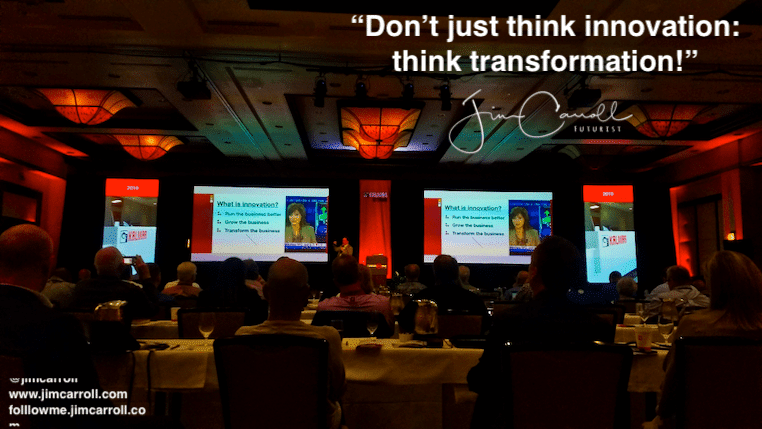
Reframe the concept:  Many organizations fail at innovation because they don’t really understand what it could be. For many people, they think innovation is for cool people who design cool products that change the world: call it the “Apple effect.” But for years, I’ve been reframing innovation from another perspective that helps to open up the minds of people as to its opportunity.

Innovation is a culture in which the leadership and the entire team continually challenges themselves with three questions: what can I do to run the business, grow the business, or transform the business?

There’s a good video clip that you can watch on that theme, “Rethinking Innovation”  

A few years back, I was interviewed at ProfitMagazine, and had this to say about the concept of innovation as I see it:

Profit: So Jim, one of the frustrating things that I find with the term innovation is that people often equate it with only product development.  So what’s your definition of innovation?

Jim Carroll: It’s absolutely true.  I Call it the Steve Jobs iphone innovation problem.  Everybody hears innovation, they think of the iphone, they think about iPod, they think about Apple and they think that’s all that innovation is, you know, coming up with cool products.  To me, it’s about much more.  It starts out with a fundamental presumption, it doesn’t matter what your business is or what industry you compete in, you’re going to be faced with more competition, more challenging customers, your business model is probably going to be subjected to greater changes.  You’ve got issues in terms of cost input, you probably finding your top line, your revenue line is being subject to the pressure.  You’ve got all kinds of challenges being thrown at you.  And from my perspective, innovation is coming up with a lot of unique ideas, whether it’s around your business model, whether it is around the manner by which you compete, whether it’s around your structure, whether it’s around, you know, the methods that you use to compete in your market place, whether, you know, nothing to do with your skills, I mean, it’s everything.  It’s simply, you know, taking the mindset that that my world is going to change on a continuous basis and I am going to make sure that I have a constant stream of ideas as to how I can keep up and how I can deal with those trends.

Experiment – a lot: There is so much changing the world of banking and credit unions. Technology, social networks, new competitors, the emergence of the digital wallet — you name it, and there is an absolute flood of ‘new stuff.’ World class innovators continually establish a regular series of projects by which they can build up their experience with the stuff that comes from the idea-flood. The more experience they build up, the more “experiential capital” they create. I’ve argued that going into the high velocity 21st century economy, “experiential capital” will become as critical if not more important than financial capital.

I actually spoke about the concept of “experiential capital” when I was the opening keynote speaker for the annual general meeting of the PGA of America – it’s worth a watch.  

Suffice it to say, if you rethink innovation in terms of these three basic concepts, it will help you deal with a world in which the future belongs to those who are fast!

Performance Optimization WordPress Plugins by W3 EDGE