
Global energy demand will be double that of today – by 2050!

Home > Archives

Tagged organizations


Here’s the text for a keynote I’m doing in Calgary tomorrow at noon for a group of IT executives.

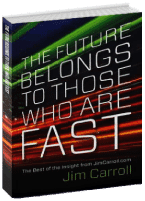
Lots to think about here – the future belongs to those who are fast!

———–

"The new business model for everyone will increasingly use speed as a metric, and fast-innovation is a core capability"

Certainly the last forty years have seen technology play a huge impact on business.

Name any industry – auto, health care, manufacturing, energy, banking — and it’s clear that we are witnessing a fundamental and distinct shift of the innovation agenda to one which is driven by the speed of Silicon Valley, and by a generation of people in the computing world who think fundamentally differently about the source of innovation in an industry.

As this occurs, we will see massive business model disruption as new, faster, more nimble competitors who understand technology based disruption, cast aside their slower, ingrained counterparts who are stuck with old, ingrained ideas.

The future belongs, in other words, to those who are fast. Tech companies and tech based innovators certainly understand that logic. Their entire DNA is bound up in the ability to move fast.

That’s why financial organizations are finding themselves plunged into a whirlwind of change as our mobile devices become our credit cards. As slow-to-change insurance companies find that driver-performance oriented insurance policies, linked to in-dash GPS monitoring technologies, wreak havoc on old-line insurance assumptions. As the world of health care adjusts to the reality of a less than $1,000 genomic sequence machine — something that would have cost over $1 million just ten years ago, leading us much quicker to a world of personalized medicine. And an oil and gas industry which is witnessing hyper-innovation in terms of extraction techniques, driven by deep data analysis and other capabilities, which are leading to year over year yield increases which were unmanageable years ago.

The new business model for everyone will increasingly use speed as a metric, and fast-innovation is a core capability.

That’s why you should join iON Secured Networks and Check Point Security Technologies, as we bring you the unique insight of Jim Carroll, who has emerged as one of the world’s leading international futurists, trends and innovation experts, with a client list that ranges from Northrop Grumman to Rockwell Collins; the SouthWest Gas Association to RGA Reinsurance; the Walt Disney Organization to NASA. Jim has had the opportunity to study what world-class innovators have been doing to keep up with a world in which the future belongs to the fast. He will share with us the new role of leading edge technologies involving cloud networks, agile computing, just-in-time development and other key strategies that will help organizations to deploy the right technologies at the right time for the right purpose — a strategy that will be increasingly important as all industries come to innovate at the speed of Silicon Valley.

I recently discovered that I was quoted in one of the Phillipines major business journals, BusinessWorld, n an article, “Biggest Business Innovations Engines of Innovation” published back in February.

It’s always great to see the media pick up on a few of the key themes that I am always trying to hammer home to people — there’a s lot of very simple and basic guidance, that often seems so obvious, that can help organizations get on the right path with their innovation efforts.

So it is with the two points that are referred to in this article.

They picked up on two key themes that I often focus on, and it’s worth pointing them out:

Stagnation will also buy a company a quick ticket out of business. According to futurist and innovation speaker Jim Carroll, the most original firms and industries are those that experience very high velocity, or a lot of fundamental change at a fast pace. For them, this is a necessity in the face of various trends and challenges – whether it’s to address shorter product life cycles, to keep up with ever-changing customer expectations, or to collaborate with a partner organization and leverage their skills.

Taking notes from firms that evolve at such a pace is one way to rekindle that creative spark. Curiously, Mr. Carroll has noted that these sources of inspiration are often found in completely different sectors from one’s own.”

I’ve often suggested that companies try to deepen their creative pool, either by studying innovation in completely dissimilar industries, and event o the point of hiring people you don’t like. Otherwise, you can simply get stifled with the sameness that comes with unoriginal thinking. I’ve even suggested to people that rather than going to the same old conferences every year, they should pick one or two events from entirely different industries in order to site their creative juices.

  • 10 great innovation ideas – “hire people you don’t like” 
  • Article – Re-energize your association – Listen beyond the grassroots 

I also find that too many organizations get caught up in fads when trying to innovate. Certainly that is true right now with social networking; while it is certainly important, I think too many are jumping in without a clear idea of what they are trying to do. This was referred to in the article:

On the other hand, Mr. Carroll has warned against blindly pursuing the latest innovation trend, a common trap he has called “bandwagon innovation.” If taking the hip approach ends in failure, it can derail any creative progress the company has made so far.

By then, employees may become too disillusioned and burned out to try out the next “in” strategy. A company’s real free-thinking workers are not compelled by the “slogan-based management” that comes with bandwagon innovation, and will hardly be enthused when they see their execs following the crowd.”

 I’m also referring to situations in which I’ve seen a company or organization form a special innovation team. They start up their project, go into a special room — and everyone wonders, ‘what’s up?” This fails because it makes innovation special; it makes it seem like it is something you do once as a project; it is just wrong on so many different levels. Innovation is a corporate culture — an attitude driven from the leadership that continually challenges everyone to ask themselves, “what can I do to run this better, grow the business, and transform the business.”

  • 10 surefire ways to destroy innovation – Form a secret committee 


I was a keynote speaker in San Diego last week for the PSCU 2012 Senior Leadership & Member Forum. I was honoured to be following Captain Mark Kelly, NASA astronaut, onto the stage.

Need to think a bit more about opportunities from innovation? Read my "Masters in Business Imagination Manifesto!"

The conference is attended by senior executives of credit unions from throughout the US.

My keynote, built in close consultation with the client, focused on key three points related to the overall theme of innovation:

  • it’s urgent that credit unions focus on innovation right now
  • it’s important that as they do so, they re-evaluate the concept of what they believe innovation to be
  • it’s critical that they take on a large number of experimental projects oriented towards innovative thinking, and that they do it now

Putting each of this issues into perspective explains my thinking:

Do it now: The world of financial services is faced with unprecedented change — the impact of mobile banking, the transfer of wealth to a new generation who thinks about financial management in entirely different ways, the emergence of new competitors. The list goes on and on. That’s why it important that credit unions establish a culture in which innovation is a priority, in order to keep up with and take advantage of the trends swirling around them

Reframe the concept:  Many organizations fail at innovation because they don’t realize understand what it could be. For many people, they think innovation is for cool people who design cool products that change the world: call it the “Apple effect.” But for years, I’ve been reframing innovation from another perspective that helps to open up the minds of people as to its opportunity.

Innovation is a culture in which the leadership and the entire team continually challenges themselves with three questions: what can I do to run the business, grow the business, or transform the business?

There’s a good video clip that you can watch on that theme, “Rethinking Innovation”  

A few years back, I was interviewed at ProfitMagazine, and had this to say about the concept of innovation as I see it:

Profit: So Jim, one of the frustrating things that I find with the term innovation is that people often equate it with only product development.  So what’s your definition of innovation?

Jim Carroll: It’s absolutely true.  I Call it the Steve Jobs iphone innovation problem.  Everybody hears innovation, they think of the iphone, they think about iPod, they think about Apple and they think that’s all that innovation is, you know, coming up with cool products.  To me, it’s about much more.  It starts out with a fundamental presumption, it doesn’t matter what your business is or what industry you compete in, you’re going to be faced with more competition, more challenging customers, your business model is probably going to be subjected to greater changes.  You’ve got issues in terms of cost input, you probably finding your top line, your revenue line is being subject to the pressure.  You’ve got all kinds of challenges being thrown at you.  And from my perspective, innovation is coming up with a lot of unique ideas, whether it’s around your business model, whether it is around the manner by which you compete, whether it’s around your structure, whether it’s around, you know, the methods that you use to compete in your market place, whether, you know, nothing to do with your skills, I mean, it’s everything.  It’s simply, you know, taking the mindset that that my world is going to change on a continuous basis and I am going to make sure that I have a constant stream of ideas as to how I can keep up and how I can deal with those trends.

Experiment – a lot: There is so much changing the world of banking and credit unions. Technology, social networks, new competitors, the emergence of the digital wallet — you name it, and there is an absolute flood of ‘new stuff.’ World class innovators continually establish a regular series of projects by which they can build up their experience with the stuff that comes from the idea-flood. The more experience they build up, the more “experiential capital” they create. I’ve argued that going into the high velocity 21st century economy, “experiential capital” will become as critical if not more important than financial capital.

I actually spoke about the concept of “experiential capital” when I was the opening keynote speaker for the annual general meeting of the PGA of America – it’s worth a watch.  

Suffice it to say, if you rethink innovation in terms of these three basic concepts, it will help you deal with a world in which the future belongs to those who are fast!

The folks who publish the newsletter The Watercooler: Straight Talk on Strategic Issues” liked a blog post I ran a while back and asked if they could reprint it.

I said sure — in fact, I encourage anyone to reprint materials they find on my site (with permission, of course.)

Click on the PDF and have a read … feel free to share it around.

Jim Carroll: "As I dig into the culture and attitude of a client through interviews with the CEO and other team members, I’m always mystified to find that some organizations just seem to do everything they can to shut down new ideas. Here are some points to consider to find out if your company is on the way to killing innovation."

You can access the full current and back issues of the Watercooler online — it makes for a great read. 

I was recently the keynote speaker at two major corporate events, both of which really have to seem a key theme at the heart of the “big issues” that organizations are faced with — and that is, we are in a period of time in which the very concept of ‘cash’ is being fundamentally changed, due to the impact of mobile technology.

The first event was for Visa’s 2012 Prepaid Forum in Phoenix — at which, in my keynote, I made the observation that “if you think about it, we’ve only redefined cash once in our history — when credit cards were introduced. We’re about to do it a second time as smartphones become the new credit card!”

The second event was in Las Vegas, at GlobalExchange 2012, an event held by Pollard Banknote, one of the largest printers of lottery tickets, with attendance by a large number of senior executives from throughout the global lottery industry. I made the same observation, but in this case challenging the audience to think about how the world of retail, and hence the world of lottery ticket sales, would come to be challenged through this transformation of cash.

Both event featured similar session descriptions in that the issues that both are confronting through strategic thinking are very much the same.

In the case of the VISA event (click to view)….

…and for Pollard Banknote (click to view)

This is a huge trend that is unfolding at lightening speed as a wide variety of Internet companies (Google, Facebook, PayPal and more) all position themselves in terms of the “virtual wallet”, at the same that smartphone makers (Apple, etc) , banks and credit card companies all explore the space.

Yet it is a pretty massive undertaking : as noted in the Wall Street Journal, 
November 2011, “Yankee Group analyst Nick Holland estimates it will cost $15 billion to deploy the technology that will make mobile payments ubiquitous.

As we get the second biggest disruption with cash to occur in our entire history, we can be certain there will be a huge number of business model disruptions, new competitors, existing market turmoil, new customer challenges and opportunities — and just a tremendous amount of change.

One of my observations in both keynotes is that every organization needs to get involved and get their feet wet — fast. There is so much going on so quickly that in this case — the future will truly belong to those who are fast. That means trying out a whole bunch of new ideas and innovating at top speed.

But does that mean that we are going to see someone win in this space in 2012? I doubt it — the scope of the undertaking and the infrastructure is involved is simply too big. That doesn’t mean anyone can avoid it though – because those who are making bold plays now will become big players tomorrow. Noted Thomas Kunz, Senior Vice President,  PNC Financial, when it comes to mobile payments2012 will be about a beta and expanding that beta test. It will take some time for this to become mainstream.

As a result, my key innovation mantra — THINK BIG, START SMALL, SCALE FAST — fit perfectly into the themes and stories I weaved on stage in Phoenix and Las Vegas!


I often wonder if the discussion about health care in many parts of the Western world has come off the rails – with the result that many opportunities for real innovation are not being pursued.

That’s the focus of quite a number of keynotes I’ll be giving in the next few weeks, including for the American Association of Preferred Provider Organizations annual conference in Jacksonville, the 2012 National Pharmacy Forum in Tampa for the Healthcare Supply Chain Association, and a private leadership event for the Mercy healthcare group based in St. Louis.

One of my key messages is that it’s time for bold thinking, big actions, and new ideas in the world of healthcare — and that can only be accomplished if people change the conversation.

What’s the problem? I think that many in the system are stuck in sort of a groundhog day like existence — they get up every morning, and everyone around them keeps talking about the same old thing as the day before — in the US, healthcare reform. In Canada, the discussion is all about wait times. In other countries, the issue of the future of healthcare often swirls around a single issue.

The result is that real healthcare innovation is stifled, smothered, and never given a chance to flourish. Yet there is so much other opportunity if we link ourselves to the major trends that are going to unfold in the future at a furious, blinding velocity.

We need big thinking, because the health care cliff in the Western world is massive. In many countries,  we’ve got a ratio of workers  to retirees of 4 to 1. By 2030, that will decline to 2 to 1. Most of those workers support the health care expenditures of those who place the greatest demands on the health care system. In Canada it’s suggested that as a result, by 2030,  Old Age Security and health care is likely to suffer a $71.2 billion shortfall that will require a GST of 19% and a top tax rate of 71%. In the US, the numbers are even more mind-boggling.

The fact is, we need big, bold thinking, Grand ideas. Dramatic change. Champions with courage to challenge the status quo. The need is desperate.

That’s what I take a look at in my keynotes, by looking at where we will be in the world of health care by 2020. The changes are massive — which implies the opportunities for real innovation are unprecedented. Consider the trends:

  • Preventative: By 2020, if we do the right things, we will have successfully transitioned the system from one which “fixes people after they’re sick” to one of preventative, diagnostic genomic-based medicine. Treating patients for the conditions we know they are likely to develop, and re-architecting the system around that reality.
  • Virtual & Community:  A system which will provide for virtual care through bio-connectivity, and extension of the hospital into a community-care oriented structure. Wireless and mobility health apps that link consumer wellness monitoring to medical professionals.
  • Consumer driven: A consumer driven, retail oriented health care environment for non-critical care treatment that provides significant opportunities for cost reduction.
  • Real time:  Real time analytics and location-intelligence capabilities which provide for community-wide monitoring of emerging health care challenges. “Just-in-time” knowledge concepts which will help to deal with a profession in which the volume of knowledge doubles every six years.

That and much, much more. The fact is, we are going to witness more change in the world of health care in the next ten years than we have seen in the last 200.

That’s the message that has resonated with the global audiences that have been bringing me in to challenge them to think about the real opportunities for innovation in the world of health care. And through that, I’m discovering experts, politicians and people within the health care system who really are thinking big enough about the potential opportunities for real innovation within the system.

Think big. Do great things. Accomplish massive change. The need is dire, the urgency is fast.


Here’s some of the key trends that I see unfolding through 2012 and beyond.

My unique job allows me the opportunity to see and hear what a lot of CEO’s and senior executives in a lot of organizations are thinking about. The  nature of my keynotes and small board / leadership meetings allows me to understand what folks are focused on. The research I do, whether for a major manufacturing conference in Las Vegas or a small corporate meeting with an ice cream company allows me to see the key trends that are unfolding right now.

And so given this unique perch, here’s some of the most important trends which will play out in the year to come.

  •  Biz competes again. North American and Western European companies have lived with constant fear, with the rapid rise of China, the BRIC countries and the N11 on the world  stage. And yet, we’re now witnessing a scene from the movie 2010: “HAL-9000 – ‘What’s going to happen?’ DAVE – ‘Something wonderful.‘ My sense is that a wide variety of industries, from agriculture to manufacturing to industrial design have been going through a renaissance of thinking in the last few years, and have learned what they need to do to re-innovate, grow again, and aggressively return to local and global markets. Read my “Build-America” blog post for some of what I’m thinking here — and stayed tuned!
  • The rise of the tinkering economy. The future is once again being built in the garage next door. But this time, it’s the hyper-connected, innovation oriented tinkering economy which is driving things forward. Get used to phrases like “micro factories,” “hobby designers” and”personal factories.”  The future of design, business and manufacturing is being reinvented at collaborative idea factories such as Ponoko, Etsy and  eMachineShop.com. There’s a revolution underway which is being driven by a globally connected, creatively driven new generation of hobbyists, and the impact is going to be massive!
  • Relationships change. Everywhere around us, the relationship that we have in our lives with the things that surround is, well, changing. Our relationship with food is changing as mobile technologies come to influence what we buy, how we shop,  and how we track our food intake. Our relationship with our body is undergoing a change as we come to use those same mobile technologies to monitor our diet, track our blood pressure another vital signs. Our relationship with clothing is changing as embedded technology becomes a part of what we wear — think about GPS enabled shoes for Alzheimers patients and Zephyr’s smart-clothing — which can be used by athletes to track their performance. When relationships change, everything changes, and opportunities for growth and innovative thinking abound!
  • Generational re-generation: everywhere we look, there’s a massive generational turnover underway, with a change in ownership of organizations from slow moving change adverse baby-boomers to a younger generation that inhales change as a form of innovation oxygen. As family farms and ranches are passed on from father to son and daughter, the rate of adoption of new farming and herd management ideas takes on a greater degree of speed.  As older doctors and nurses who were weaned on the paper-heavy patient file head into retirement, they being replaced by new medical residents who are arriving in the clinic, operating room and by the hospital bed with their iPads, ready to plug in! A shift from change-aversion to change-is-the-greatest-drug is a trend that speeds up our world even more!
  • Revenue reinvention. Every company is coming to face the reality that they have to become just like Apple in order to survive. The fact that Apple generates over 60% of its revenue from products that didn’t exist 4 years ago might today be an aberration, but given the increasing velocity of business cycles, product innovation, the arrival of new business models, changing customer expectations, the impact of social networks and a series of other trends, and soon every organization will find itself in a reality in which constant, relentless reinvention of its product or service line will the crucial to future success.
  • The Dominance of Design. We’re on the edge of a massive new era of creativity, with a trend that we might even call the ‘IPad-ization of Life.’ All one has to do is look at the new Nest thermostat to realize that a new generation of brilliant creativity is about to remake our world. We’re not doomed to a future in which everything around us in the future is going to look just like it did in the past – Apple’s design influence is quickly going to impact everything around us – from the cars we drive to the lamps we use to the fridges we open, to the buses we catch. Clean, simple, easy interfaces and crisp, cool lines, But it’s not just the looks — its the fact that with this new era of design comes intelligence. Our future is going to look great , intelligent and interactive!
  • Chip-velocity! Moore’s law used to apply only to the computer industry. Yet the rule that the processing power of a computer chip doubles every year while its cost cuts in half is taking on new meaning, as your phone becomes a credit card, your car watches how well you drive on behalf of your insurance company, and your clothing talks to your doctor! All of a sudden, in the era of relentless, pervasive connectivity, innovation in every single industry speeds up when Silicon Valley takes over the innovation agenda!
  • Life beyond politics. While the US Presidential election and political turmoil will dominate the headlines for 2012, a new generation of leaders are focused on BIG THINKING, BIG IDEAS, and BOLD MOVES. There’s a realization that political gridlock is the new normal, whether its the Democrats and Republications staring each other down, or France and Germany looking at Italy and Greece with a mystified sense of stunned confusion. So while politicians fail to get things done, innovative organizations are casting their mind to the future trends which will really provide opportunity in the future. It’s fascinating — the future is back in vogue again! And the thinking that is driving it is that we aren’t going to fix the problems of the future by doing what we’ve done in the past. And if we do things differently with those problems – that’s how we’ll discover the next big opportunity. This is the new mindset driving activities in the world of energy, the environment and healthcare!
  • Leading locally. There’s something odd going on — as the world gets global, we’re all going local.  We’re seeing it with sustainability  and local foods; angst and anger at banks and moves to credit unions; and a new volunteerism – as unemployment grew to 7.6%, volunteer service grew by 16%! We’re seeing it with local business – a University of Pennsylvania study found that areas with small, locally owned business (<100 employees) had greater per capita income growth than those with the presence of larger, nonlocal firms! There’s a new focus on local co-ops — with more than 100 million people employed worldwide in some type of local co-op. Thats’ why its fitting that 2012 is the International Year of the Cooperatives, a business model that has stood the test of time for over 150 years. Where-ever you look, while we are thinking global, we’re acting local!
  • Strategy re-dos. The impact of all these trends? Executives quickly coming to realize that what they’ve been doing in the past isn’t to hold them forward into the future. It’s time to throw out all the old assumptions and try things that are new!

Here’s to 2012!

For over 20 years, I’ve been working from my home office, serving a global clientele that includes some of the largest organizations in the world, with unique insight on future trends and innovation. Everyone from the PGA of America to Johnson & Johnson, NASA and the Walt Disney Company. Not unsurprising, this has involved some pretty heavy duty travel – I’ve seen the world!

This week, I’ll have the perhaps dubious distinction of surpassing 1 million miles on one of the airlines that I utilize the most. That’s 1 million miles actually IN THE AIR. (I’m told by the airline that I’ve actually earned over 5 million miles if we add in all the flight, car, hotel, credit card and other bonuses.)

That’s like going to the moon twice and back. At an average speed of 500MPH on a jet, it’s about 2,000 hours spent in the air — more counting taxing and all the other delays. Just over 83 days “up there.”

Out of a sense of curiosity, I did a few calculations, and figure that I’ll pass this milestone somewhere over Lake Michigan on my return to my home airport of Toronto, Canada.

I can’t help but thinking of this scene from the movie Up In The Air, starring George Clooney, in which he surpassed 10 million miles. I couldn’t imagine! So with this dubious distinction in mind, here’s the clip.

Fortunately, unlike the fellow George Clooney portrayed in the movie, I very much have a life beyond flying! Most of my trips are short and to the point ; there is much time in the home office and with my family; and for many of my more exciting international trips, I’ve had the wonderful opportunity of bringing my wife and two sons with me. Just this summer, I was booked to keynote a pretty significant CEO level event in St. Andrews, Scotland — we all went on the voyage, and managed, of course, to get a round of golf in.

Here’s to the next million miles!

At the T. Rowe Price 2011 Investment Symposium in Baltimore on Friday, I listened to the technology panel that preceded my luncheon keynote.

It was a fascinating discussion as a number of their leading analysts spoke of the trends that they saw unfolding with consumer and other digital technology companies, such as Apple, Amazon and Samsung.

Name any industry - auto, health care, manufacturing, energy, banking -- and the big trend over the next five years is that Silicon Valley is coming to control the pace of innovation in the industry. And it's speeding it up!

But I thought that the crowd was hungering for a bit more — where are the next big trends, and the next big transformation opportunities that are going to unfold which are going to provide for the birth of new industries, fast growing companies, and billion-dollar market opportunities?

And so I outlined that reality: the next big areas of growth will come from the transformative change that occurs as Silicon Valley comes to drive the pace of innovation in almost every other industry. As it does so,  it will speed up the rate of innovation.

The impact of this trend is that it will also shift control from any particular industry – insurance, healthcare, banking, auto — to the technology companies. The result will be massive business model disruption as new, faster, more nimble competitors who understand technology based disruption, cast aside their slower, ingrained counterparts.

The future belongs, in other words, to those who are fast. Tech companies and tech based innovators certainly understand this! And the key issue is speed : Apple, for example, could innovate much faster with new credit card financial systems than any bank could. Google and it’s tests of automatic car navigation technology will certainly evolve faster than any auto company in Detroit, Japan or Germany could. Unless leaders in those organizations increasingly learn to focus on speed as a metric, and fast-innovation as a core capability.

Consider just a few of the trends:

  • Banks and credit companies risk losing control of their future as our mobile devices, cell phones and iPhones become credit cards
  • the energy industry and home construction is impacted as a new personal energy infrastructure management, in the form of such devices as the NEST Thermostat, provide for a significant change in the way people use energy
  • health care will be transformed by medical device connectivity and bioconnetivity — allowing hospitals and nursing homes to extend the reach of their medical professionals to an increasing number of remote locations
  • the auto industry will face trendmeondous change as an intelligent highway infrastructure emerges as the same time as intelligent, self-guiding cars and trucks become a regular part of our daily world
  • the world of insurance is upended as we head to a world of predictive insurance modelling through the use of sophisticated technologies such as on-board GPS devices which monitor driver behaviour

These are but just a few examples. I can go into any industry today and point out how Silicon Valley and technology is going to cause significant change and upheaval within the industry. I can spot the smart executives who understand the message and realize that right now is the time for aggressive innovation and big thinking.

And then in other clients, I can see this observation pass right over the heads of some of those in the audience, and realize we’ve got folks who are like deer in the headlights — the trends are blinding in their reality, but they are frozen by their inability to do anything.

I spoke about this trend in a recent keynote.

There are a whole series of related posts in which I’ve commented on the significance of this trend and the speed with which it is occurring. These are just a few.

  • Silicon Valley innovation velocity set to dominate every industry 
  • When Silicon Valley Takes Over Health Care Innovation 
  • This ghost town in New Mexico could turn into one of the most important innovation engines 
  • Reinventing the future with transformative technology
  • Silicon Valley: Is Innovation Dead? 

I haven’t done of these posts in a while — it’s an observation of 10 of the most recent search phrases that resulted in people discovering information in my blog through the last week.

It’s a useful way to see what people around the world might be thinking about, or some of the issues that are top of mind. You can see some other What’s Hot entries here.

I’ve got some fabulous new Web site tracking software — notably Woopra and OpenTracker — both of which give me *real time* insight into what people are discovering on my site, so it’s pretty easy to pull this information together.

Here we go:

  • a search for “food product trends marketing” from Ireland resulted in someone hitting what is currently one of the most heavily visited pages on my Web site — “Food industry trends 2011 – Report from a keynote“. Literally a few hundred hits a day!
  • from Bangalore, India, a search for “healthcare industry trends presentation” led to the page “Healthcare 2020: The Transformative Trends That Will REALLY Define Our Future“, also one of the most popular pages on my site. What is evident is that people find a tremendous amount of value in the detailed trends outlines as found in this type of post and the previous food industry post — there are a lot of these scattered throughout my blog covering a wide range of industries. Try the Trends link for a list by industry.
  • another popular search concerns the future of the meetings and events industry. From San Diego this morning, a search for “event industry 2012 trends” led to the post “Future of the meetings / events industry
  • from Singapore, a search for “characteristics of the 21st century” led to the post “10 Unique Characteristics of 21st Century Skills” which is a useful guide to the key HR issues that you are facing now and into the future
  • on the HR theme, it’s kind of funny that someone in Larisa, Greece, did a search this morning for “Jobs of the future 2015“, which took them to the post “Good jobs in Bad Times – I’m interviewed on PBS on future career trends“. Maybe it will help to inspire someone for post-Greek economic meltdown HR innovation!
  • from Kenya, a search for “importance of innovation to consumers” led to the post “The importance of innovation in the era of the “new normal.” This post is a good summery of the key factors which require fast paced innovation today.
  • from Malaysia, someone searching for “future ready organization” hit the post, “How future ready is your organization?”. I wrote that in 2009 – and write about the velocity ratio, the rate of ‘rising tides’ and other factors that might give you a sense of whether your organization is keeping up with the speed of innovation occurring in your industry.
  • out in Madras, India, a search for the phrase “innovation themes for wealth management technology” led to a post that summarized my 2009 keynote for the National Australia Bank – “14 Key Innovation Strategies for Financial Advisors & Financial Organizations”
  • from North Carolina in the US, a search for “bioengineered body parts” odd to the post from 2006, “Bio-engineered body parts, the Cold Store and personalized medicine…” Consider what I wrote in 2006! “The pill bottle linked into my home network grid in order to interact with the prescription drug company. They had specifically engineered this medicine the day before for my own bio-code, based on a quick sampling of my blood and sinus condition that was done at the local Cold Store.”
  • last but not least, someone in Las Vegas did a search this morning for the phrase “things you have to do in vegas during the recession.” That took them to a great post that still works with the current and ongoing volatility in the global economy, “10 Things You Need to Do to Innovate in a Recession

That’s 10 search phrases — and a simple summary of some great insight. Stayed tuned — more “What’s Hot” posts to come!

If you want to track analytics on your own Web site, I highly recommend both Woopra and OpenTracker. Fascinating insight!

This article was released in my CAMagazine column in March 2009. shortly after the great economic collapse of 2008.

Inertia — real or implied — establishes a culture of inaction, and that can lead to another slippery slope

Given the new economic volatility, shrieking stock market headlines, and the reappearance of a sense of dread in the corporate world in September 2010, it’s probably a good time to re-read the article.

There are countless examples where history has shown us that it is those organizations who focused on ensuring that they were still actively pursuing innovation — whether through product development, the exploration of new business models, external partnerships, the pursuit of new markets and customer groups — were those who managed to achieve the greatest success in the long run.

Catch the key line at the end: “The greatest mistake any organization can make right now is to do nothing.”


Keep Those Ideas Coming
Jim Carroll, March 2009

I have started to think about the events of the past few months in the context of economic grief — an emotional process closely related to the stages of bereavement. The economy unraveled so quickly that many organizations still find themselves in the early phases of economic grief, marked by shock and denial. Corporate idea factories have come to a standstill and innovation paralysis is settling in.

The result is that we’re not just in an economic recession; we’re entering an idea recession, similar to that of the last downturn starting in 2001. Yet, in allowing innovation to dry up, businesses are missing out on great opportunities for success. After all, companies such as Burger King, Microsoft, CNN and FedEx were all started up during recessions.

The Wharton School of the University of Pennsylvania released a provocative article in November 2008 suggesting a recession is the perfect time for disruptive innovation — that is, rewriting an industry’s business model to achieve significant growth. Think of Steve Jobs and the iPod, which he first released during a less-than-rosy economy in 2001.

So what do companies need to do to make the most of this recession? First, accept the economic reality. Those unable to move past shock, denial and anger through to acceptance will be innovation laggards and will only be ready to innovate once the market and industry recovery is underway. Unfortunately, that may be too late.

Innovation leaders, however, are prepared to keep their idea factories running (perhaps not at full tilt, but running nevertheless) in the face of uncertainty. They know there is still a place for innovative thinking despite the vast sections of the economy under stress. They know there are growth markets and opportunities for marketplace, distribution-channel and operational innovation. These leaders are aware ongoing change in consumer behaviour means there are still new ways to brand, grab customer mind share and forge unique and distinct relationships.

It is critical that organizations begin to undertake a series of bold actions that reorients them to face future challenges. These actions should include several integrated elements.

  • Boost the experiential capital of the organization. Get your teams working on projects and ideas that build up their experience. For example, they might explore new methods of branding and marketing (particularly to the next generation); investigate technologies that can stream-line business processes; or work with distribution models that expand market potential.
  • Identify weaknesses or areas for improvement. Consider what elements of the organization’s product line, skills or structure could benefit from specific innovation efforts. For example, are competitive threats emerging that you haven’t really thought about? What should you be doing to innovate your way around those challenges?
  • Explore key opportunities through a variety of risk-oriented initiatives. If, for example, you focus on a customer-retention strategy (such as visiting every customer in the next three months to see if you are meeting their needs) can you put a stop to future revenue leakage?

The greatest mistake any organization can make right now is to do nothing. Inertia — real or implied — establishes a culture of inaction, and that can lead to another slippery slope. Today, innovation isn’t simply an option — it’s critical because it is the best way to gain traction.

The folks at PollEverywhere — the service that I use to conduct live text message polling while on stage — have just run an interview with me over on their blog as to how I utilize the tool.

I’m reposting it here since it does provide a good overview of just how wonderful and interactive their service is.


Jim Carroll is recognized one of the world’s leading international futurist, trends & innovation experts — and he’s got the client list to prove it, having provided his insight to such organizations as NASA; Lockheed Martin; National Australian Bank; Pfizer; Diners Club; HJ Heinz; and PPG.

And he’s a raving fan of Poll Everywhere – using the service in a huge range of global Fortune 1000 and other organizations as well as countless association events, such as being the opening keynote speaker for 4,000 people at the annual National Recreation and Parks Association annual conference in Salt Lake City.

“I’ve been using [Poll Everywhere] on stage as part of my keynote for at least two years, and the service has truly helped in building a live, rich interactive experience with my audience. I’ve used it in small CEO level sessions with just 20 people, and in large scale Las Vegas events where you’ve got to be a top-notch performer to keep a crowd engaged – particularly if they are in rough shape after a night out on the town!”

One of Jim’s most thrilling moments came when he found himself on stage in front of 500 golf pros for the 94th Annual General Meeting of the Professional Golfers Association of America. “The management team at PGA invited me in to speak to their members on the need for innovative thinking. They never had an outside speaker in before, in their entire history. And so starting out by having them pull out their cell phones in order to gauge some of their opinions about change, the future and challenges facing the game — it certainly made them think! The reaction was powerful and pretty astounding, because I was able to quickly shape my talk to respond to their concerns.”

While Jim can speak to audiences of 7,000 in Las Vegas or Orlando, he recently found himself on stage in front of 250 kids at his son’s high school. “My son knows that I’ve had a strange job for the last 20 years – flying around all over the world to speak at events — and his teachers thought it would be great if I could come in and talk about the future of their careers.”

Jim’s opening comments, as found in his blog post “What happens when high school students are told to text” (www.jimcarroll.com/2011/04/what-happens-when-high-school-students-are-told-to-text) captures the fascinating dynamics that occur on the big screen when PollEverywhere grabs the minds and attention of the ultimately wired generation. “That was a pretty cool moment,” says Jim. “And it really should get anyone thinking about the future of education, corporate and association meetings, and conferences.”


Jim’s method of audience interaction has proven to be a big selling point with his client base —  so much so that he devotes a Web page to what he does. www.jimcarroll.com/keynotes-workshops/interaction-from-the-stage


Not only that, but his blog offers a sometimes fascinating look into his client base – consider the opinions offered up by a group of manufacturers from Ohio: “Report from the heartland: Is there life in manufacturing in Ohio? You bet!” http://www.jimcarroll.com/2011/02/report-from-the-heartland-is-there-life-in-…

“People want to interact and be engaged with a speaker. This tool lets me reach out to their minds and hearts, and make them immediately part of the talk. And it has certainly provided me with a very unique tool in getting across some of the key trends which are impacting the future and opportunity for innovation.”

"If Carroll had his way, the phrase “You can’t do that because we’ve always done it this way” would be grounds for immediate dismissal".

The following article was just published in July in AkzoNoble’s  ”A” Magazine, featuring some of my thoughts on innovation in organizations.The organization is the largest global paints and coatings company and is a leading producer of specialty chemicals.

The article is a good read as to how I think and work.

It was distributed in print form to several hundred thousand readers in their global client base.

You can grab the PDF of the article by clicking on the magazine cover on the right.

WHAT’S YOUR VISION OF THE FUTURE
by Jim Wake

If routine rules your working life, you could be stifling any chance of growing and improving your business. Worse still, if you fail to encourage creative thinking, you could well be doomed to failure.

Innovation is not what you think it is, says Jim Carroll, a selfdescribed “futurist” who makes a living advising companies on how they can reinvent themselves to compete effectively in a fast-changing world. “When it comes to the word innovation,” he explains, “a lot of people hear that word and they think it isn’t something that applies to them. I call it the ‘Steve Jobs effect.’ People hear the word and they think: ‘That’s about the design of cool products and only cool people get to do that. I manage purchasing, so how could I be responsible for innovation?’”

But what Carroll tells them – in ways designed to get them to laugh at themselves and squirm in uncomfortable self-recognition – is that innovation is both more mundane and more achievabe than dreaming up the next breakthrough consumer product, writing brilliant computer code, or developing new methods for microsurgery. “I step back and reframe the question,” he continues. “To me, innovation is three things that apply to everyone in the organization. Whether they are the head of purchasing or product development, or the CEO or the Vice-President of sales, it’s about challenging yourself with three questions. What can I do to run this business better? What can I do to grow this business? And what can I do to transform this business?”

To Carroll, it’s a lot more about awareness than it is about genius. “Running the business? Innovation offers all kinds of opportunities to take costs out of the business. With computerized technologies to streamline processes, for example. It’s just unlimited potential. Growing the business is all about how we get into new markets, new product development, how we generate revenue where revenue hasn’t existed before. Transforming the business is about restructuring ourselves. How we collaborate better, how we reshape the way we’re doing R&D, how we do things differently as an organization.

“A lot of people still think that innovation is some deep mysterious thing,” he goes on. “To me, the link is that there’s a whole bunch of obvious trends which are going to impact an organization, whether they’re demographic, social, political, business trends, whatever. Innovation is simply responding to and keeping up with those trends. Some of it is drop-dead obvious: in Western society, we have a looming boom of baby boomers who are going to become older and sicker and require more care, so that just impacts a whole variety of different industries. With technology, there’s a whole bunch of fascinating trends underway where a lot of everyday devices around us are going to gain intelligence, are going to be linked to the internet, so that’s an obvious trend. And in terms of politics, what’s playing out in Egypt – where there’s a transition of power from one generation that is unplugged, unconnected, to a different generation that is plugged in and connected. Those are the kinds of obvious trends I’m talking about.”

But of course, what is obvious to Carroll – who acknowledges that research is an important part of what he does – may not be so obvious to the person who is focused on meeting deadlines and paying the bills. Still, he is convinced that management can nurture an environment which encourages creative thinking and the willingness to take risks that is pretty much a prerequisite for innovation. “I call it tone at the top. It is something that is CEO-led. He or she has to set the tone for a culture which allows for continual change and adaptation and innovation, in order to keep up with the very fast-paced change around us. If you don’t set that tone at the top, then you really are doomed to failure. I see a lot of organizations try to make innovation something special. They form a little innovation team and go off in a little room and study innovation. But that just doesn’t work. It’s a culture throughout the organization where the leadership is saying to everyone that you’ve got to challenge yourself on those three questions, and we will judge you during the annual review process and in your remuneration and in your job description.”

One example he points to is Google, which provides “innovation time off” – a provision allowing engineers to devote up to 20 percent of their time on projects not directly related to their job descriptions or responsibilities. “It’s important,” says Carroll, “that organizations establish a whole series of projects that are very focused on innovative outcomes, in addition to having everyone responsible for day-to-day innovation.” He also suggests that routine is one of the biggest threats to innovation. “I think it’s very easy for an organization to go into autopilot. If you can do something to shake up their complacency – whether it’s the rebel coming on board or doing something to cause some chaos – that’s a good thing because people need to wake up to how quickly their world is changing around them.” In his talks – he gives dozens every year to audiences as diverse as Texas bankers, California cattle farmers, national park management professionals and the US Professional Golfers’ Association – he can almost be aggressive in trying to combat complacency.

“Here’s what I’ve learned,” he says during one of his videos from a keynote speech. “In every single organization there are people who wake up every single day. The very first thought that comes to their mind is ‘what am I going to do today to kill new ideas?’” It’s a comment which provokes nervous laughter, but that’s because everyone in the audience recognizes a kernel of truth there. “You know that they’re out there because they come into their meetings and you’re presenting new concepts and new ways of doing things, and they’ve got all these little code words that they use to shut ideas down.”

If Carroll had his way, the phrase “You can’t do that because we’ve always done it this way” would be grounds for immediate dismissal. “Never mind that the world is going to change, that the world is going to go over there really, really fast, and we’re still here and we have to get over there with the rest of the world,” he says mockingly. “There are people out there who’ve adopted the attitude of ‘you can’t do that; we’ve always done it this way – it won’t work!’ You come up with a really good idea, you put it out there, you seek some reaction and there is a naysayer at the table who immediately says: ‘It won’t work’; or ‘Dumbest idea I ever heard, it’s too risky, we’re not an organization that takes risk.’” He lets the thought hang there for an instant and then points out the obvious: “The only way to get ahead is to take risks.” As if he himself has suddenly been appointed CEO, he then starts issuing orders to the audience: “Each of you from this point on agrees that you will never use, or permit to be used in one of your meetings, that phrase ‘you can’t do this because we’ve always done it this way’. You’re going to completely ban that phrase ‘it won’t work, dumbest idea I ever heard’. You’re going to banish the type of thinking that tries to hold us back from doing new things.”

He encourages his audience to conduct a simple test the next time they are sitting in a meeting – keep score of the “innovation killing” phrases that come up: a point for every time they hear “it won’t work”, “you can’t do that”, “I don’t know how”, and several others demonstrating fear of trying. Five bonus points for “The boss won’t go for it” and ten for “Why should I care?” Your company is already in trouble – innovation-adverse, in his words – if you score more than five, “innovation dead” if you score more than ten, and you might as well either close up shop or give him a call if you score more than 15.

At the other end of the spectrum are the behaviors, practices and corporate cultures that generate new ideas – ideas flow freely throughout the organization, subversion is considered a virtue, creative champions are present throughout the company, people understand that innovation is not just about

technology, but about doing things differently and better, and that failure is an inevitable – and acceptable – part of the innovation process. “Hire people you don’t like,” he urges, and “forget everything you know”. In this changing world, he claims, we don’t need MBAs so much as we need “MBIs” – Masters of Business Imagination. “The phrase Master of Business Administration is about running the business. That’s great, but what are you going to do to grow and transform the business? We [spend] more time thinking about how our markets are changing, how we might build new relationships with our customers, thinking about how we might go in and disrupt other business models and how we might ingest technology faster to do awesome things within our industry. We should just have a lot more people with a lot more imagination on our team.”

Carroll wasn’t always a change guru – he spent 12 years as an accountant. But somewhere along the way, he realized that technology was moving much faster than the business world, and that there was a business opportunity convincing the corporate world that it needed to change to accommodate new technologies and trends, or get left behind. He points out that Apple generates 60 percent of its revenue from products that didn’t even exist four years ago, and that the only thing that is certain is

that everything will be different before you know it. Half of what students learn in their first year in college is obsolete by the time they graduate. “Having been at this for 15 years,” he says, “I think that the necessity for organizations to get on board with this type of thinking is becoming more critical, because business is changing faster, customers are changing faster and technology is changing faster. My key word is velocity. The need to do a lot of radical things is speeding up because everything out there is speeding up.”


In the last few weeks, I’ve done a number of insurance oriented keynotes, including one for a meeting with the CEO and top leadership team of one of the largest insurers in the world, as well as a top insurance association.

We are quickly moving into an era of "performance oriented insurance" with policies / pricing based on performance. There will be huge opportunities for disruptive business model change as this trend unfolds.

And I’ve been busy speaking to the trends and opportunities for innovation that are going to come into this often-slow-to-react industry at lightning speed.

In an era in which everything around is plugging together,  there are tremendous new opportunities for some pretty massive business model change. I often make a joke on stage that perhaps one day my weigh scale might send an email to my fridge one day if I’m not living up to the terms of my life insurance wellness clause.

Yet, is such thinking far fetched?

Maybe not!

One of the biggest trends which is going to hit the world of insurance like a tidal wave is performance based insurance policies. If you live up to or exceed some performance standard, you’ll get a rebate or reduction on your insurance  policy rate.

It’s going to happen extremely quickly in the field of automotive insurance. A flood of GPS enabled performance measuring devices will soon come to inhabit most automobiles throughout the industrialized world. Insurance companies will set a policy price, and then give you a rebate if you exhibit better than average behavior.

Consider a program already underway in the UK:

Insure The Box measures drivers’ mileage, when they drive, and how they drive. Excessive G-forces, sudden braking or cornering and long periods of driving without a break are monitored.

Policyholders are charged by the mile and motorists initially pay for 6,000 miles. Once these are used up they can buy more miles as they need them. Policyholders are rewarded with “free” miles if they drive safely.

Money: A spy in the car that could cut cost of cover for young drivers
The Guardian, UK, April 2011

You can expect most North American insurance companies to roll out similar technology and performance. Or maybe not — some organizations won’t have the speed, agility and flexibility to do this at the pace that the market, competitive and customer pressure will require.

The result is a classic opportunity for big business model disruption.

The same type of thing is going to occur in the world of life insurance.

It has long been the assumption that despite the rapid emergence of genomic, preventative medicine, that it would never be desirable, ethical or even fair to underwrite policies based on a DNA test.

I’m a believer that this is a pretty big assumption to make. History shows that assumptions that underlie a business model barely last. When I speak about innovation, I advise people it’s often best to challenge assumptions — those who don’t often miss the biggest opportunities.

Clearly, we know that there are some powerful trends at work:

  • the cost for a DNA test that can be used to predict with a high degree of accuracy the disesases and conditions you will inherit in your lifetime is set to collapse, as Moore’s law comes to drive the cost of DNA sequencing machines that do the test
  • hence, greater numbers of people will have the opportunity to gain such insight (whether it be good or bad)
  • those who have a test that shows a life that will be relatively disease and condition free would likely be able to offer themselves up to a group of speciality insurers and get a policy discount compared to the average population

Again, there’s opportunity for big business model change and upheaval as this happens.

So too is the concept of a rebate of your life, medical or disability insurance, if you can prove that you are taking regular, active steps to ensure that you are in good health. Certainly there are those in the the health care system, who know that with the massive challenges in front of, the system, a lot of big, bold transformative thinking is necessary.

A federal grant program authorized in the health overhaul law is offering states $100 million to reward Medicaid recipients who make an effort to quit smoking or keep their weight, blood pressure or cholesterol levels in check. The grant program is meant to encourage states to experiment with an uncertain approach to wellness: offering incentives for healthy behavior.

Healthy behaviors pay off; Medicaid recipients who commit to improving their health will be eligible for financial rewards, Los Angeles Times, April 2011

Extend this type of thinking into what comes next in our hyperconnected world — individuals who monitor their blood pressure, glucose levels and other vitals that they are willing to share with their insurer. Exercise and wellness apps on their iPhone that they can use to demonstrate the commitment to a regular series of workouts. Adherence to a personalized lifestyle plan — with insurance cost reductions based on performance.

This type of stuff isn’t far-fetched at all. And it’s going to hit the insurance world quicker than it thinks.

Then there’s the issue of the underwriting of insurance risk. Today, in the life insurance industry, you must undergo a battery of medical and blood tests so that they can make an assessment as to whether you are insurable.

Tomorrow will be completely different, and it will be here before the industry knows it:

“Assuming privacy regulations require it, by 2020 underwriting will consist of one question: ‘Can I look up everything about you?’”

The Next Decade in Innovation, Insurance & Technology, May 2011

Tomorrow? They might simply look you up on Facebook, and based on what they see, come to a decision as to whether they will insure you or not.

Farfetched? Not at all!  In fact, some in the insurance industry are already talking about it:

“Insurers are preparing to use people’s Facebook profiles and online spending habits as a way of setting premiums based on their lifestyle. The Sunday Times, December 2010

The article goes on to note:

“Studies for the insurers suggest that people’s online data detailing their food purchases, activities and social groups can be as good an indicator of their life expectancy as conventional medical examinations.

The trials were conducted by Deloitte Consulting LLP and showed that consumer data, based on a sample of 60,000 people, was as effective in identifying potential health risks as if the applicant for insurance had gone for a blood and urine test

Aviva, one of Britain’s largest insurers, is planning to introduce the new “predictive modelling” in Britain next year after studying the results of trials in America. Swiss Re is also working on a similar scheme.

The Sunday Times, December 2010

The bottom line is that in the next several years, at a very fast paced, the world of insurance is going to be challenged through innovation involving analytics and predictive modelling, performance based policies, and a whole series of other opportunity.

The future will belong to those who are fast!

Here’s a video clip from my opening keynote for the 94th Annual General Meeting of the PGA of America, in which I talk about the necessity of “thinking big, starting small, and scaling fast,” and of the importance of the concept of experiential capital as a foundation for innovation.

I’ve written and spoken about the concept of experiential capital quite a bit through the years – I think in a fast paced economy its one of the most important innovation strategies that we can undertake.

One particularly good post which can help you get thinking about this concept is “Understanding 21st century capital: Why it’s not just financial capital anymore“, in which I wrote”

Experiential Capital. In a world in which Apple generates 60% of its revenue from products that didn’t exist four years ago, it’s critically important that an organization constantly enhance the skill, capabilities and insight of their people. They do this by constantly working on projects that might have an uncertain return and payback – but which will provide in-depth experience and insight into change. It’s by understanding change that opportunity is defined, and that’s what experiential capital happens to be. In the future, it will be one of the most important assets you can possess.

I also write about the idea in my book Ready, Set, Done: How to Innovate When Faster is the New Fast, where I made this observation:

“Innovation comes from risk, and risk comes from experience. The most important asset today isn’t found on your balance sheet – it is found in the accumulated wisdom from the many risks that you’ve taken. The more experiential capital you have, the more you’ll succeed.”

I close with the observation: “Investing in experiential capital is one of the most important things you can do.”

When people ask me about the “secrets” of innovative organizations, this is one of the key attributes I outline. They realize they are immersed in a world of fast-paced ideas — and they take on many different projects, some of which are doomed to fail, in order to build the overall experience of the organization.

Which begs the question: how many experiential oriented projects do you have underway that involves new technological platforms, social network and branding or marketing projects; business model innovation or any other number of ideas?

I haven’t done one of these posts for a while. Here’s another week of unique insight from my blog tracking tool, ReInvigorate, that links the search phrases that people used to find a page on my site.

This can be a useful way to discover a few gems of insight from the several thousands of posts throughout my blog!

  • “how to innovate videos” was a search that was done on AOL (really? Does anyone still use this search engine?) and  led to the blog category, “How to Innovate Videos.” You might find some useful inspirational innovation insight by watching a few of those clips.
  • “innovative thinking” led to “The BIG secrets of innovative organizations.” Make big bets, big transformations, big brand reinforcement, pursue big math, and a number of other big ideas on how to align yourself for fast paced change
  • “sports good industry global” led to “The future of sporting goods in a world of high velocity“, which in 2006 made some pretty bold and accurate predictions on how sports is and will continue to change in the future. This was based on a keynote that I was preparing for a leadership meeting of the Sporting Goods Manufacturers Association.
  • “start small, learn more, scale rapidly” was a query that was close enough to my comments in the post, “Innovation: Think big, start small, scale fast.” This has been my innovation mantra for longer than I can remember. It makes for a great read!
  • “innovations in the auto industry” led to “Innovation, the auto industry and the new reality” with a clip from a keynote I did in 2008 in Sydney, Australia, talking about how some auto companies are reinventing process as a means of staying ahead.
  • “reasons for innovation” led to the post, “10 reasons why innovation matters for small business.” I pulled together this post just before I went out to film a series of video clips on behalf of Cisco.
  • “legal profession trends 2011″ led to the post “The future of the legal profession” from 2007, with a great PDF that summarizes these trends.
  • “innovators new restaurants” led to the post “Recent keynote: innovating for growth in the restaurant industry” for the top leadership team of Yum! Brands (KFC, Taco Bell, Pizza Hut.) It’s a great overview of the trends that the industry needs to be thinking about.  A few months later, Burger King had me keynote their global franchise meeting, where I spoke to more than 4,500 in the Center for the Performing Arts in Las Vegas
  • “Does Apple have a tradition of innovation” — duh, seems like a strange search! — led to the post “Apple: 60% of revenue from products less than 4 years old
  • “workshop leadership trends” led to my Web page, “CEO / Leadership meetings” which outlines the unique types of interactive events that I have done and and can do for clients – workshops and panel discussions. There’s a PDF on that page called “High Velocity Leadership” which describes these sessions in greater depth.

You can read previous “What’s Hot” posts in the category here.

Here’s another week of unique insight from my blog tracking tool, that links the search phrases that people used to find a page on my site.

This is week #3. This is proving to be a great tool for those who track my site to discover some of the information buried in several thousand blog posts — and might provide you with a unique way of thinking about future trends or innovation!

First is the search phrase that was used on Google, Bing or some other search engine — then a bit of commentary that includes the Web page on my site that the phrase led to.

  • “Innovative bottle caps structure trend” – this search came out of Google’s China search engine, and led them to my “Coping with Ketchup – Innovating in a Fast World” post from 2005. This was a fun little post, having to do with what happened when an upside down ketchup bottle made it into our house – I began to build a story and entire speech topic around the “Coping with Ketchup” phrase
  • “What are the key innovations and technologies for 2010″ – led to my “14 key innovation strategies for financial advisors and financial organizations” post, which captures the essence of those trends — mobile, location intelligence and social networks all coming together in a fast blur!
  • “Social networking” – speaking of social networking, this search phrase led to my “Why Social Networking is Like Teenage Sex!” blog post
  • “Rock documentaries list” – this led to my “10 Most Important Innovation-Themed Rock Documentaries of All Time“. Did you know I once had two short term gigs as a temp-roadie for KISS? Those were the days!
  • “Pictures of accountants” – in Google Images, a search for a picture of an accountant leads to the post “Accounting Beyond Accountability“, which provides a little bit more info on my unique background, and which provides even better insight into “The New Face of Manufacturing”
  • “Rules for working at home” — to what I think is one of my best posts – “10 Rules for Working at Home“. This October, I passed by the 20 year mark in terms of working full time out of a home office!
  • “Pharmaceutical consumer trend” – led to the post, “10 major health care / pharmaceutical trends“, which provides a great summary of how this industry is shifting. I’ve done quite a few pharma-oriented keynotes recently, including for Pfizer and Johnson & Johnson
  • “Globalization” – resulted in the blog post, “High velocity globalization, massive markets, major trends.” This was a blog post done just a few weeks before the major market meltdown of autumn 2008. Yet the essence of these trends still holds true today
  • “speack upside down”- a misspelled search led to “Can we talk upside down innovation” which is a great little post about partnership-oriented innovation. Maybe they were looking for something else, but this is still a useful post if you want to challenge yourself as to how you think about innovation.
  • “Start small and scale fast” – led to “Think Big, Start Small, Scale Fast” which is my mantra for innovation

You can look at prior weeks reports under the “What’s Hot” category of my blog.

I’ve got a new Web traffic monitoring tool – Re-Energize — which is quite wonderful! And every day, when I look at how people are finding my site, it’s become quite obvious that a lot of traffic comes in for people looking for information on the sport of ‘zorbing.’

Why do they find my site? Because back in 2008, I wrote a blog post, “Zorbing – And Why It’s In To Be Out.” I guess the search engines have ranked it highly, particularly for the picture! It gets a LOT of traffic.

What is also interesting is that for years, I’ve been using the story of zorbing on stage for years, often in the context of what I’ve come to call “the big global idea machine.” Here I am on stage with that theme — and a story on zorbing – from an event in Salt Lake City for a few thousand people:

What is another way to think about the big global idea machine? In my overview of “What Do World Class Innovators Do That Others Don’t Do?”, I made the observation that “world class innovators focus on ingesting fast ideas: there are new technologies, business models, customer trends, product developments, scientific advances and countless other things that are increasing the pace of change. Innovators know that if they plug into the global idea machine, they can constantly discover a tremendous number of insights that help them to move forward.”

by Jim Carroll
From: The Boardroom, a publication for Association Executives

Every association executive is regularly inundated with information on the leadership skills they must need to properly guide their association into the future. As someone who spends a lot of time talking, writing and speaking about trends and innovation, and who is constantly taking a look at where we are going in the future, I have my own list that might be rather different from some of the others that you’ve heard.

Here’s what I think you should do to ensure you know the issues that will affect your association.

1. Listen to the grassroots

With the rapid rate of change within every industry, trade and profession, it can be extremely difficult to keep up with what’s important and what’s not, not to mention keeping on top of the trends, challenges and opportunities that should be guiding your activities and strategies. There might be plenty going on within your member organizations, as they wrestle with new business strategies, rapidly evolving business models, heightened market competition, ever growing volumes of research and knowledge, and countless other challenges.

To be effective at what you do, you must keep on top of these trends, and determine how to adjust your activities and strategies accordingly so you are continually meeting your members’ needs. That’s why 21st century association executives should focus on building a strong collaborative culture with their membership base, using both leading edge tools and technology as well as ensuring they have a heightened degree of informal, personal contact.

Take the time to engender and build an informal, “open-door” culture that promotes regular and ongoing contact by your membership base, whether that be by e-mail, telephone or in person. Encourage feedback, complaints and observations, as well as a culture that provides for sharing of leading edge trends, challenges and opportunities.

2. Listen beyond the grassroots

You can’t listen only to your membership to spot the trends that will affect your association — you have to go beyond them and listen to what others are saying as well.

That’s why figuring out the future is no longer restricted to listening to the “usual suspects” within your association membership base — 21st century leaders recognize that everything in their industry or professional association base is being affected by events, trends and developments far beyond the norm.

The problem for any association executive is that it is all too easy to become isolated and focused on the issues of the day – the management issues and all the fine details that come with running a major organization. There’s so much going on within your industry or profession that there can be precious little time to come up for air and simply see or “think” through what is going on elsewhere.”

And yet, taking the time to listen “outside of the box” can be one of the most important things you can do. That’s why you shouldn’t just “think” outside of the box – but you should on a regular basis “step” outside of it. One way of doing this is by ensuring that you take the time to place yourself in completely different circumstances. Pick 2 or 3 conferences each year – in completely unrelated, different industries or professional that are far beyond your membership base. Go and listen – and see what another industry is saying!

That’s but one example – you can also subscribe to professional publications from other associations. Grab your copy of the national association directory, and pick a few associations at random – and sign up for their magazines, publications or newsletters.

You might be surprised by how invigorating an experience it can be to open up your mind to what is going on elsewhere. You may find that it will help you discover the trends that will affect you in the future, long before your traditional trends radar might have picked them up.

3. Listen to the rebels

Often, the trends that will affect your association and members can be found in the offbeat chatter by those who are busy redeveloping the future right around them.

Those leading edge trendsetters are often at odds with the typical association member. They’re the rebels in the crowd, eager to cast off the past to develop a future that will be very, very different. They’re busy tearing apart the conventional business models that have guided your members for ages; they have different ideas as to the nature of the product or service that is delivered; they are all too eager to change everything around them to create the future as they see fit. They are often marginalized, simply because their aggressive attitude in changing the future can make them rather unlikable by many.

What should you do? Learn to learn from them! Seek out the rebels in your membership base – you might not like what they have to say, but often, they are probably right in what they will tell you. Great leaders recognize that while many people have an attitude, outlook, culture and approach to life and business that is completely at odds with their perspective – they are willing to listen to what they say because change often emanates from such people.

4. Maintain a willingness to do a right turn

There’s no doubt that things change very rapidly in our world today.

Need evidence? A year ago, the guilt trip that you have when eating a Big Mac isn’t quite what it is today. Within the space of but a year, we’ve had a major issue – our obese society – bubble up, come to the forefront and gain front-runner status as a key  trend and issue to be managed.

The result is that many associations within the food, health care, agricultural and other communities are now scrambling to deal with the new focus on “healthy living” and “healthy eating”. The issue has the potential to become a major topic within your events and conferences; and a topic within your publications. That’s but one example – many other such issues can quickly go super-nova (i.e. SARS), so you’ve must have the ability to suddenly refocus yourself, and your association, to deal with new realities as soon as they emerge.

5. Continually reinvent relevance

Most association members – regardless of what type of group you might represent – live in a state of relentless shell-shock.

If they are in the business world, they’re witnessing ongoing market disruption, regular business model change, consumer revolt and empowerment, heightened competition and constant new demands on their time. In the public sector, they are subject to decreasing budgets, increased public expectations, political turmoil, departmental and role transformation, and ever more challenging management issues.

The result is that on a daily basis, they’re in crisis mode, and are having to constantly reassess their plans, careers, goals and activities. With so much change going on, it’s critical that your association continues to provide services, value and activities that match their regular new realities.That’s why you should ensure that you are constantly and regularly assessing and reinventing the relevance of your association to the membership base. Are you delivering what they need, at the right time, in the right way? Are you on top of all the emerging issues affecting your members so you can change what you are doing to ensure you are helping them? Do you continually reassess your roles and your strategies so you are delivering value, not routine?

6. Redefine your membership

Part of the process of reinventing your relevance consists of making the effort to reach out to new members who exist within your association market, but in a completely unconventional way.

Many people in our economy today don’t work within the traditional corporate model that has defined your association base in the past. For example, many young workers continue to reject the traditional career path of long term careers with large organizations. Instead, they establish themselves in small, micro-organizations that provide needed skills to a corporate audience regardless of where they might be. Are you reaching them with your efforts?

Then there are nomadic workers – those white collar workers who were laid off in the last 10 years through a variety of recessions – and who have established small, home-based businesses from which they provide their skills to a global audience. They’re working within your community of interest, but are they a part of your strategic plan?

Step back and consider where all of your members might exist today, and ensure that you change your strategies, activities and capabilities so that you reaching out to all of them.

7. Adjust for hypercompetition

Many associations are responsible for setting educational, professional and membership standards, and spend considerable time ensuring the value of the service or skill provided by their members is properly recognized for the value provided.

Get ready for a new challenge – that which comes from “offshoring,” a trend that is picking up a speed that is simply stunning. In the first wave of offshoring, we saw simple manufacturing such as toys and shoes migrate to third world countries. Then, the second phase saw simple clerical and service work move away (such as the processing of credit card receipts). But now, we are seeing actual “knowledge work” move, a trend that will provide every association with significant challenge in the years to come.

The high-paying, highly professional jobs are now moving offshore. A recent Deloitte & Touche study suggested that upwards of $356 billion in American wages – or more than 2 million jobs – will move offshore in the next several years. What impact might this have on your members, as they see less demand for their skills as a result of competition from a highly knowledgeable offshore workforce?

That’s a loaded question – and it’s easy to realize the complexity of the challenge when you consider a one square block area in Bangalore, India, a hotbed of the offshore trend. Consider these 4 companies: GreenPoint Mortgage of Novato, CA has moved their home loans processing to one company located there; the Massachusetts General Hospital has engaged a number of radiologists to examine CT scans; Texas Instruments has a number of engineers working on chip design; the Bank of America has moved some of their software development to this location. Each of these situations would have an impact on the members of associations in a variety of industries and professions.

Those are the people who are going to have a major impact on your association members in the not-too-distant future. We are now seeing the emergence of a global skills marketplace, in which highly talented professional workers can provide services of almost any type. The result is that professionals – lawyers, accountants, consultants, medical technicians, will now find themselves faced with an increasing degree of skills competition.

Begin thinking and planning now as to the reality of this important business trend, and undertake a plan of action that will help your members to survive and thrive into the future as hypercompetition takes hold.

8. Seek offbeat solutions to difficult problems

hen a food manufacturer was trying to find out how to improve the changeover time of one of their assembly lines, they hit upon a novel solution: bring in an Indy race pit crew to show them how. Their thinking was, who has better mastered the talent of “quick- thinking, quick work” than a group of people who can instantly change several tires in a highly coordinated team effort that lasts only a few seconds? It was an offbeat solution, but it certainly did the trick.

That’s why you should keep an eye out for the quirky, innovative, unusual things occurring within your association and other associations.

9. Kill indecision

There is no doubt that every association has suffered from rather aggressive indecision through the last several years, brought on by war, terror, a challenged economy, and much uncertainty.

The impact has been dramatic – many associations just can’t seem to make decisions about many matters of the day. I certainly see this as a speaker – while I used to be regularly booked as far as a year in advance, now some organizations are booking me just a few weeks before their conference or event. Why? Because uncertainty has led to a degree of decision stagnation.

Pummel this trend to the ground before it goes any further. Make sure your association continues to run by timelines, deadlines and clear goals and objective. Carefully ensure that your culture provides for regular decision making, not deferral and discussion. There are quite a few issues you are probably wrestling with, and maybe some of them have been around for far too long.

What should you do? Encouraging risk taking is one method of ending complacency, as is rewarding failure. If your members or association board can’t make decisions, then a bit of a cultural change is probably necessary!

10. Restore your sense of passion and purpose

Last but not least, get excited about the future again!

There have been so many challenges through the last few years with recession, war, terrorism and other problems, that many people in the business community have lost their sense of purpose and their passion for the future.

The key message for you and your membership base is – get over it! We’re in for a bright and wonderful future, and it’s by getting excited about the future again that you can best prepare and plan for it.

What’s your tin can?
May 14th, 2010

Have you been to your local grocery store as of late? Have you seen the StarKist Tuna plastic re-sealable pouch? That little package – a new product innovation if there ever was one – is responsible for almost $200 million in new revenue since it first hit the shelves.

That’s not displaced revenue, but entirely new revenue that didn’t exist before.

It’s a big change – and it took a long time to come about. After all, StarKist sold tuna for 110 years in the same old way – in a tin can. Yet they finally managed to come up with something new, and the results are stunning.

The new tuna pouch is a good segue into what is perhaps one of the most important issues for innovators to deal with – getting people out of their tin-can rut.

How many people do you know who are stuck in a 110-year old rut? Still delivering a tin-can day in, day out, with no desire to change? Quite a few, I would guess. Maybe not for 110 years, but at least for the last few years.

After all, a lot of people have lost their motivation to change – the stock market downturn, the housing market collapse, the Wall Street scandals, a new distrust of government. Such constant negativity and so much failure has meant that many people and organizations have lost their innovative spirit. Who wants to try anything new today?

The result is that many people have lost their drive, their courage to go forward, and their willingness to change. They’re still making tin cans, when new re-sealable pouches could revolutionize who they are and what they do.

That’s why the StarKist story is so important. Here’s an organization that has somehow shaken away the complacency that enveloped it for over a century. It woke up to the opportunity that comes from real innovation. And the fact is, it’s all part of a reawakening that is underway throughout the food industry, in which — the package is the brand.”

Over the last decade, food and packaging companies have come together in a partnership that redefines how new products are developed. Packaging companies, previously restricted to the sidelines, now take a lead role in the development of new product. Food companies, who used to be the only ones responsible for new products, now realize that if they are willing to open up their minds to a new way of doing things, they can see some darned powerful results.

Is your organization stuck in a rut? Is your culture representative of an industry that is still making tin cans? If so, what are you doing to try to wake them up? It’s an important question, and with world that continues to evolve at an ever-increasing pace, one that needs to be addressed.

What’s your tin-can? Think about it.

    Please consider supporting me with a small donation for this epic fundraising event - I will be riding 200 km / 150 miles over two days with thousands of other riders in support of cancer research. Click the image below for more information.
Performance Optimization WordPress Plugins by W3 EDGE