People view 250 million YouTube videos per day

Home > Archives

Tagged Strategy


Convenience Store Decisions gave me a call, and wanted to speak about some of the trends impacting the industry.

The intervivew was a piece of cake — I do a lot of keynotes in the retail space. And just last year, a leader in “forecourt marketing” (which is industry speak for c-store marketing…), featured me as the keynote speaker at their Digital Forecourt Marketing Summit

 “It won’t be too long before I am able to fill up my car while my iPhone is communicating with the c-store,” he said. “By the time I walk into the store an LCD TV panel up on the wall is going to recognize me and greet me with a customized commercial.”

Here’s the extract of my observations from the article. (Small error in the article though – I’m not based in Dallas, but Toronto!)

Shift in Consumer Demands
Dallas-based futurist Jim Carroll sees healthier foods becoming a more fundamental offering at more convenience store down the road. “You wouldn’t think it, but there is a very seismic change going on in terms of what the stores are selling,” he said. “I think they’re realizing that what people are consuming—fried foods and fatty snacks—is changing. People are much more conscious of their food consumption.”

This is a trend that Carroll has been hearing about personally—directly from c-store operators. “Wellness—focusing on nutrition and an active lifestyle—is certainly a trend,” he said. “You think about the number of convenience stores that have undertaken a shift to fresh food. The focus is not on Doritos and Twinkies. Sure, some operators do focus on these items, but your industry leaders and top quartile chains are embracing change.”

Retailers, Carroll said, are trying to get away from the traditional popping chips paradigm. “If you play into the sort of ‘life to go’ issue and recognize that people want to get in and get a healthy meal quickly, why not have those items at the ready in convenience and gas stations? Even 7-Elevens now are selling sushi.”

Promotions, too, will gain impact, Carroll predicted. “It won’t be too long before I am able to fill up my car while my iPhone is communicating with the c-store,” he said. “By the time I walk into the store an LCD TV panel up on the wall is going to recognize me and greet me with a customized commercial.”

Once the store recognizes a particular customer there are endless possibilities to upsell merchandise via text messages and electronic coupons. The constant in the equation is change.

“I see c-stores undergoing relentless change in terms of what they do,” said Carroll, “because I think consumers change so quickly. That’s a major part of what’s going on—a very fast format shift. There is a South African chain that is converting its entire c-store strategy over to fresh food—a complete format shift, because even over there they are seeing that same kind of demand for fresh food served fast.”

Last week, I had a fascinating session with a leading financial services firm.

The client wanted to book me for a keynote talk for 5o members of their member service team, in order to take a look at future trends in terms of interaction, support  and relationships.

Live interactive planning during a workshopSome of the issues on the table involved the type of thing that I cover in my post, 14 Key Innovation Strategies for Financial Advisors and Financial Organizations, among many other trends. This was kind of a unique client situation, and so there was a lot of additional research undertaken.

But the client didn’t want to limit themselves to an overview of the trends and opportunities for innovation — they wanted a fun, lively interactive session.

And boy, did I deliver!

We ended up with a 3 hour session. Into the middle, after covering trends and innovation opporutnities, I led them into a discussion of two key questions:

  1. What will be the biggest change in the relationship with the typical existing member within 5 years?
  2. What will be the biggest change in the relationship with a new member in 2 years?

There were 10 tables of 5 ; they were given 20 minutes to discuss these two questions.

I then led a round table discussion, asking each table to provide their best, unique answer, with a little discussion around those answers.

But here’s where the fun part came in — I then loaded the 10 unique answers to each question into a text message poll, and had the room vote on both polls. And so what bubbled to the top was some pretty unique insight into what could be the major key priorities that they need to focus on in the future.

It actually worked extremely well, and was quite a bit of fun! If you are interested in exploring a way to kick it up a notch for your next leadership meeting, let’s have a chat!

And take a look at my outline on CEO/Leadership meetings for some additional insight.

So I was on the phone today with the CEO of a major global organization headquartered in Canada. I’ll be opening a leadership meeting for the company in early 2013, and this was a call to begin planning for the structure of my talk.

During the call, comments by Prime Minister Stephen Harper of Canada about the US economic relationship came up. Clearly, this is a country that is seeing it’s share of challenge due to fast-paced challenges in it’s “special relationship” with the US.

I mentioned to the CEO that  as far back as 2009, I was already predicting that Canada would likely have challenges in selling it’s oil in the future into the US market. And many other challenges! And that it would have to re-orient its economy further away from the US and take on much more of a global view!

This was plainly evident to me back then — and look where things are today. What are serious people and politicians and everyday folk in Canada suddenly talking about that no one really took seriously just a year ago?“…a Pacific energy pipeline….”  “…. aligning more natural resources and commodities with long term Asian contracts….”    “…… a serious free trade relationship with Europe that goes beyond NAFTA.”

With that in mind, I just dug out an old post I wrote way back in 2009 that was written as a bit of a joke at the time — surmising that Canada would see many reasons to reorient it’s global economy in the future. It’s a press release written very much tongue-in-cheek. It was briefly posted to my blog. (I removed it after a short time, since I thought that many people might find it offensive. But back then, it was covered in Bourque.org and a few other breaking-Canadian-news blogs….)

I now find it remarkably prescient, though some of it is still very clearly written for fun. For example, the border wall!


Canada announces end of economic relationship with US, & a bold new strategy to 2020

Ottawa, May 14, 2009

The country of Canada today announced the end of its centuries long relationship with the United States, and a bold new seven-point “Canada Transformed!” strategy that will re-orient its economic, cultural, societal values and innovation engine towards the world economy of 2020.

“It has come to the point that we can no longer rely on the United States as a reliable economic partner,” stated Canada at a news conference. “It is time that we adopt a bold new strategy that will align our economy away from the US, and towards the growth economies of the 21st century in Asia, the Middle East and Africa. As well, we will immediately begin working to enhance our long standing relationships with reliable partner nations in Europe.”

The massive scope of the plan was not lost on Canada in the emotional conference. “We aim to reduce our role of being the largest trading partner with the United States, to becoming a marginal partner at best. We believe that this is the only right way forward.”

Bold new thinking is required Canada spoke bluntly at the news conference of the need for bold new thinking. “Our relationship with the US is one that has become, through no fault of our own, increasingly abusive. We’re honest, faithful, and do our part to provide to the relationship. We have been the largest trading partner to the United States for over a century. And yet, in return, we find ourselves taking on an increasing amount of abuse, neglect, and ever more hostile actions. We’re sad that it must come to an end, but we believe that it is time.”

Canada cited a long list of complaints and grievances, ranging from ongoing trade disputes, “downright hostile treatment” of Canadian citizens by US border guards, and increasingly aggressive use of a “Buy America” policy by state and local governments in the US — despite a promise in Ottawa by President Barak Obama that he did not believe protectionism was the right way forward.

Canada Transformed!

At the press conference, Canada announced a significant 10 year, 7 point plan, branded “Canada Transformed!”, that will re-orient it’s economy away from the United States to the AEA (Asia, Europe and Africa) markets, by the 2020, with a number of key goals:

  •  Energy & oil: Canada will invest in a massive infrastructure project that will allow it to deliver the bulk of it’s significant energy/oil resources to Asia, Europe and Africa within 5-7 years. The infrastructure project will consist of a number of significant pipeline projects that will direct Canadian oil, natural gas and other energy sources to east and west coast ports, as well as shipping and marine infrastructure, that will provide for a “ocean railway of energy” destined to the AEA countries.”Today, Canada is the largest supplier of energy to the United States. By 2020, Canada aims to provide almost no energy to the US,” noted Canada at the news conference. “We wish them well in their efforts to solve their energy crisis. We do not intend to help them any further.”
  • Food & agriculture: Global food production must double to meet world population growth, and Canadian grain, beef, pork and other producers will work to achieve an AEA target market of 90% by 2020. “Quite simply, the rest of the world beyond the US needs a stable, reliable food supplier, and Canada intends to become the leading global brand in that regard.”
  • Resources: Canada will seek investment from major Asian and mid-East sovereign wealth funds in an ambitious effort to re-orient the target markets for at least 80% of Canadian mineral commodities to AEA nations by 2015.”Quite simply, Canada has the natural resources — iron, nickel, copper, uranium and just every other type of metal — that the newly industrialized world in Asia needs. As we witness a continued declined in US economic power, particularly in the manufacturing sector, we must ensure that we pursue growth opportunities elsewhere in the world. As China re-industrializes with the economic recovery, we intend to be their partner of choice.
  • Manufacturing: Since the advent of the US-Canada free-trade agreement in 1994, Canada has shared in one of the modern world’s greatest economic successes — the highly integrated Canadian-US manufacturing network supply chain. However, the collapse of the US manufacturing sector, as well as continuous suffocation of the border flow of goods, it is clear that Canada must re-orient itself to the new realities of the 21st century.”A nation does not move forward suffering from the ongoing implementation of economic choke points,” noted Canada. “We will re-align ourselves to economies that believe the way forward is through intelligent, smart-border policies that encourage the free flow of goods and people; not a nation that has a border policy that is driven by  politics. We will immediately provide strong incentives for Canadian manufacturers to re-focus on Canadian markets, as well as the establishment of significant new markets in AEA countries. There are over 2 billion people in these markets, and but 280 million in the US.”"Clearly, our future lies outside of North America, and we will align our manufacturing sector to this reality.
  • Immigration-based knowledge factories: Canada is the envy of other nations throughout the world for its’ open, welcoming culture towards new immigrants. It plans to build on this reputation by establishing itself as the world’s dominant source for high-level, specialized knowledge expertise in almost every single professional field.”We believe that we are entering the second era of off-shoring,” noted Canada, “with the next wave going far beyond customer support call centers. Nations around the world will need access to high level talent in the fields of medicine and health care, scientific research, agricultural and architectural skills, legal and professional services — and will seek to access that knowledge through the global communications networks that will dominate the economy of the 21st century” said Canada. “We will welcome global knowledge experts in every field of human endeavor to relocate to Canada, enjoy all the attributes that our nation has to offer, and provide their skills to a massive offshore groups of clients in AEA nations. In doing so, we will establish Canada as the global hub for the knowledge economy of the 21st century. Quite simply, Brand Canada will become the most widely recognized phase when it comes to the need for access to knowledge.”
  • Immediate border construction: Finally, Canada announced that it would immediately begin construction of border that would prevent unauthorized entry into Canada by US citizens. “We will immediately begin planning construction of a 4,500 mile physical border along our common frontier with the US,” noted Canada. “We increasingly view the US health care system to be in peril — within a decade, some US states will be devoting more than 60% of their GDP to health care. Clearly, many US citizens will plan to flee to Canada to take advantage of our world-class universal health care system. We must prevent this mass migration of Americans into Canada, and believe that significantly enhanced border structures are the only means of doing so.”

At the close of the news conference, Canada stated that it was taking these actions with reluctance, but with conviction that it was the right thing to do.

Nations have always achieved continued economic success by making bold leaps. We believe, given the continuing deterioration in our relationship with the US, and the ongoing and continued lack of respect that they provide to us, that it is time to move on.

Canada is the most resource rich, tolerant, energy abundant, agriculturally advanced, second largest country in the world, with a massive base of skills, energy, commodities, food, and capabilities. We intend to assert our place in the economy of the 21st century with a sense of pride, purpose, and clear direction,” said Canada at the conclusion of the press conference.

Besides that, we’re just plain nice,” said Canada, blushing, in a closing comment.

We are excited about our future, and believe that we have made the right decision at the right time for the right purpose. Canada Transformed! will see our nation emerge as one of the leading economies on the world stage by 2020, and we embark on this voyage with a sense of courage, enthusiasm, and certainty as to its’ impact.”

The United States was not immediately available for comment.

I keep advising my personal trainer that she needs to get an iPhone. She shrugs, noting that there is a queue in the family for the next mobile upgrade, and her 14 year old daughter might have more of a claim in the line than she does.

Hogwash! There is an absolute revolution going on involving the “consumerization of fitness and wellness” — and this super long blog post will put into perspective why. And maybe this will help to sort out some of her family politics over the ‘next phone.’ The fact is, the very nature of the future fitness opportunity is changing ….

Update: After I wrote this blog post, Adweek ran the article, “Nike+ Officially Turns Your Workout Into a Video Game” – you want to read it.

Here’s the main gist of this post — In May and June, I spoke at a tremendous number of corporate, association and private events; it was a busy couple of months, and hence the lack of regular postings to the blog.

Three of these were events related to the issue of corporate wellness programs.

It was the perfect timing for such a keynote; through the last year and I half, I’ve been following what I believe to be a fairly aggressive personal fitness regime, with the help of my personal trainer, as well as personally exploring the wealth of new fitness and wellness mobile applications that are flooding the market.

The entire premise of my keynote? At this moment in time, we are witnessing the perfect confluence of several major trends:

  • the first signs of the reality of the massive scope of the health care crisis (both disease, lifestyle and funding related) as baby boomers begin to flood the health care system with requirements for extra care
  • a renewed and significant focus on “preventative” health care concepts” ;
  • structural change aimed at wellness programs so that people work harder to avoid or reduce the impact of lifestyle disease;
  • and the rapid emergence of new technologies — many involving the smartphones that have become a ubiquitous part of our lifestyle – that can motivate consumers to do so much more with their personal fitness and wellness.

Why a keynote on wellness? Because companies are recognizing there is a big opportunity to be innovative with managing healthcare costs through a proactive approach that involves wellness. It’s a good example of the deep, transformative thinking that is occurring with many organizations in the healthcare system worldwide . Organizations are moving beyond the endless political debate, and are instead, putting in place practical, innovative programs that can help organizations manage healthcare costs, and employees can actively work at improving their overall health and fitness.

Let’s consider the trends which are all coming together.

1. It’s crisis time!

Throughout the western worldwide, the obesity, diabetes and lifestyle health care crisis is really making itself felt with massive demands being placed on the system. The future is stark ; if something is not done, we will continue to see:

  • a continued rapid increase in lifestyle disease, resulting in even more massive future demands on the system
  • a bigger demographic challenge – more boomers placing demand on the system, with fewer workers to support the massive uptick in spending that results
  • a resultant massive supply / demand imbalance
  • and an expectation gap likely to increase scope of challenge : a trend I wrote about in my “Trending in 2011: 10 Major Trends to Start Thinking About Now.” It’s worth a read — check the first big trend in the list.

Clearly, something needs to be done. Hence, a lot of innovative thinking!

2. A massive shift to preventative medical concepts

Given that the Western world has such a big problem, it’s also fascinating to note that there is a huge amount of innovation occurring in the health care system now – and it has absolutely nothing to do with the raging (and now seemingly pointless) political debate occurring in the US.

What is happening is this: we are in the midst of a long term trend in which “preventative medical care” will come to exceed what we spend on “reactive medical care.” Preventative care takes many forms, from genetic testing (to determine what conditions people are likely to develop in their lifetime) to wellness and other preventative programs. Simply put, let’s fix people before they are sick, rather than treating them after they’ve developed a condition.

We’ve got a heck of a long way to go with this trend: according to a PriceWaterhouseCoopers report, “a mere 3% of spending goes towards prevention of chronic disease among industrialized countries.”

But what is happening is an acceleration of the trends that take us to a world of preventative healthcare. Consider the trend line with genomic medicine:

  • it took $3 billion to sequence the first human genome
  • by 2009, that was down to $100,000
  • it’s now under $10,000
  • and it is estimated by the end of 2012, $1,000

Give it a few years, and you’ll be able to go out and buy a $5 genomic sequencing machine at Radio Shack! That might seem like a joke, and it is. But the significance of a cost curve such as this is that it accelerates a significant shift in spending.

It isn’t occurring with genomic medicine — its happening everywhere throughout the world of healthcare. Last year, when I keynoted one of the largest seniors care conferences in the US, I noted the same type of focus on preventative thinking was becoming routine:

  • “Identifying dementia early can cut the cost of care by nearly 30 percent … routine screening that identified patients with early signs of dementia helped cut average healthcare costs by nearly $2,000 per patient in the first year, often by eliminating money spent on unnecessary tests and treatments. Early diagnosis can cut Alzheimer’s costs, Reuters Health E-Line, July 2010

The health and wellness theme fits into this agenda as well, which have undergone very much a sea-change in the last, in terms of perception, importance and approach:

  • “In businesses across the nation, workplace wellness has morphed from a “nice-to-have” fringe benefit to a “must-have” cost-containment strategy.” 23 April 2012, GlobeNewswire
  • Employers determined to contain medical costs must focus on creating a culture that supports healthy behaviors. If they can do that, they can enhance not only their bottom lines but also transform the lives of their workers. 28 April 2012, Obesity, Fitness & Wellness Week
  • “In businesses across the nation, workplace wellness has morphed from a “nice-to-have” fringe benefit to a “must-have” cost-containment strategy.” 23 April 2012, GlobeNewswire
  • “64 percent of employers surveyed indicated that wellness initiatives are among the top three most effective tactics for controlling health care costs” 2012 Annual Plan Design Survey, National Business Group on Health

Studies show that for every $1 spent on a wellness program, medical expenses fall by at least $3.

Part 3: Time for some more aggressive action!

What is interesting is that in corporate organizations throughout the Western world, wellness programs are rapidly shifting : they’re going from a “nice-to-have” type of program, to a “we really need to see some results!” approach. Consider the trends; certainly many more organizations are putting such programs in place:

  • A recent study by Willis North America’s Human Capital Practice found about 60 percent of the companies surveyed have wellness programs, an increase of 13 percent from 2010. Companies encourage wellness, Pittsburgh Post-Gazette, 22 April 2012

But not only are more organizations adopting wellness programs: they are working to put in place structures, methodologies and measurement technologies that can help to ensure that employees are benefitting from such programs:

  • One of the fastest-growing categories of new insurance includes significant penalties for those who don’t participate or backslide on targets – penalties that may include deductible spikes or loss of health-savings accounts. Workers’ wellness can turn a profit Insurers offer incentives for health and penalize workers who can’t meet goals, The Denver Post , 25 December 2011
  • A national survey of large employers by the National Business Group on Health found that 80 percent plan to offer financial rewards for health in 2012, up from 54 percent this year. Workers’ wellness can turn a profit Insurers offer incentives for health and penalize workers who can’t meet goals, The Denver Post , 25 December 2011

And this is where tech comes along at the perfect time!

4. In comes technology – and the new consumerization of health care!

Technology is going to provide for more creative disruption in the world of healthcare than we’ve ever seen. Simply put, it changes everything.

  • “Imagine a far more extreme transformation, in which advances in IT, biology and engineering allow us to move much of health care out of hospitals, clinics and doctors offices, and into our everyday lives.” Our high-tech health care future, New York Times, 10 Nov 2011

The Withings Wi-FI Body Scale measures weight, BMI and fat mass, and transmits the info to a password protected site. I’ve got one and love it. They sell them at the Apple Store!

Cast your mind out 5 years or more, and we will see significant change in everything we do in the world of health care:

  • “…. you’ll be sitting in front of a big multitouch screen actually watching what’s going on in your body in a very intuitive, fun kind of animation. When you leave, the doctor will download prescriptions and treatments onto your cellphone – which not only remind you, but encourage you to follow the medicine’s or other lifestyle procedures. [You'll see] a periodic video message from the doctor to encourage you if you’re doing well or maybe to encourage you if you’re not. It’ll be continuous care rather than the episodic, periodic care that occurs today.” Better living with technology, The Boston Globe, 21 November 2011

Extend that type of thinking, and we are headed to a future in which we literally have a dashboard for the human body…..

And it is starting to happen now — with a flood of new mobile and other healthcare technologies that help consumers to take more of an active role in their level of wellness and fitness. Consider the current trends:

  • 78% of consumers are interested in mobile health wellness fitness solutions
  • medical fitness health care apps are 3rd fast growing category for iPhone and Android phones
  • the Apple App store now has 17,000 health care related apps, 60% of which are aimed at the consumer
  • sports, fitness and wellness apps will grow from 154 million downloads in 2010 to 908 million by 2016
  • the number of wearable wireless “gadgets” will grow from 8 million to 72 million over the same period

I’m using a number of mobile wellness and fitness apps — for example, MapMyWalk, which I use to track the pace and timing of the five mile — or more — walk that I do while at home or travelling. I’ve also got a Withings Wi-Fi Body Scale — which tracks weight, BMI and body-fat mass, transmitting those details to a personally-password protected Web site. Utilize such technology, and all of a sudden you’ve got the opportunity to be more involved in your own well being.

Or, as I commented in New York at the keynote the impact of consumer fitness, wellness and healthcare technologies is that  “...they increase how often individuals think about their health…”

And clearly, it’s a pretty big trend:

  •  “500 million mobile users, or about 30% of an estimated 1.4 billion smartphone subscribers worldwide, will be using health/fitness apps by 2015. Healthcare in your hands
International Herald Tribune, March 2011

The Withings Blood Pressure Monitor works with your iPhone. It’s an example of the start of the trend I call “bio-connectivity.”

It isn’t just consumers who are rapidly adopting such technology — so are doctors and other professionals throughout the healthcare system.

  • By the end of the year 90 percent of physicians will have smart phones. Health apps soon will get an incubator, The San Francisco Chronicle, 11 April 2011

We are only beginning to scratch the surface of the innovations that will occur here. I’ve been suggesting that one of the biggest trends to sweep the world of healthcare and medicine will be that of ‘bio-connectivity,’ a phrase I coined well over a decade ago. Consider this post which I wrote before keynoting the World Healthcare Innovation & Technology Congress in Washington.

Bio-connectivity provides huge opportunity for innovation in the space of healthcare. The same company – Withings — has brought out the Withings iPhone Blood Pressure Monitor — seen on the right. All of a sudden, someone working to manage their blood pressure doesn’t need to rely on pencils and paper to track their progress — it’s automatically captured through the smartphone which is becoming an integral, everyday part of their life.

Not only that, but they can transmit their blood pressure readings and charts to their doctor or other health care provider via email. This provides for the virtualization of healthcare ; no longer are hospital or doctor visits restricted to actual physical locations known as hospitals or doctors offices — instead, it becomes a part of the global Internet. If you think about what is happening here: there is a change in the centuries old relationship between doctor and patient!

Did you know that researchers have already figured out how to make an ultra-thin heart monitor that goes on like a tattoo? Talk about a trend that is going to drive a lot of change!

Link all of these trends together, and the simple fact is this: we are going to witness more change in the world of healthcare, wellness and fitness in the next five years, than we have seen in the previous one hundred years.

And if you follow that path down the road of wellness and fitness — the very nature of fitness is changing. Ten years out, most folks going to the gym will have a smartphone attached to their hip, and will be working with their trainer on a regimen that includes this type of personal fitness tracking.

Sure, it sounds odd, but ten years ago, we didn’t have Facebook, Twitter, Youtube or many other of today’s life changing technologies.

My personal trainer really needs to get an iPhone!

I’m thrilled to be selected to be the opening keynote speaker for WEFTEC 2012, which is recognized as the largest annual water quality conference and exhibition in the world. It will be held in New Orleans this fall; it will be the 5th major conference that I have headlined in New Orleans this year.

You can read the press release here from the Water Environment Federation. 

This is an extremely important event, dealing with one of the most significant challenges of our time. The issue of water is critically important as we go into the future, and there are huge opportunities for innovation with regard to water safety, quality, sourcing, recycling and treating. Consider just a few critical facts:

  • demand for water is expected to rise 50% in developing countries between now and 2025
  • 85% of US water utilities, desperately working to upgrade dated infrastructure, indicated in a  survey that said that the average water consumer has no idea as to the size of the gap between what they pay for water / wastewater services, and the actual cost of delivery
  • around 30% of the food produced worldwide is never eaten, and the water used to produce it a real loss

Balance such stark trends — and there are many of them — against the innovative thinking that is occurring within the industry. Consider the “Seawater Greenhouse”, which can, according to an article in The Independent Newspaper, which can “make the desert bloom with seawater, corrugated cardboard and wind.”

Wow! This is going to a fascinatingly innovative industry to get involved with. I look forward to the research on this one, and inspiring the world of water to more aggressively innovative with the future.

Some extracts from the press release:

ALEXANDRIA, Va. – Jim Carroll, a respected author, columnist, media commentator and consultant who links future trends to innovation and creativity, will deliver the keynote address during the Opening General Session of WEFTEC 2012 this fall in New Orleans, LA. The opening session will kick off the Water Environment Federation’s (WEF) 85th annual technical exhibition and conference, a five-day event that is expected to draw thousands of water quality professionals and exhibitors to the New Orleans Convention Center from September 29 to October 3, 2012.

As one of the world’s leading international futurists, trends and innovation experts, Carroll has provided strategic guidance and insight to some of the most prestigious organizations in the world. He is recognized worldwide as a thought leader and authority on global trends, rapid business model change, business transformation in a period of economic uncertainty, and the necessity for fast paced innovation.

“We live and work in a period of unprecedented change”, said Carroll. “Intelligent infrastructure concepts continue to emerge from the hypothetical to the real while new design methodologies and concepts challenge water professionals to keep ahead of these fast paced developments. I’ll cover the key trends that will provide challenge in the future and outline how to turn them into opportunity.”

The theme of this year’s Opening General Session will focus on “A New Direction for WEF” and tie into the organization’s new Strategic Direction that was announced earlier this year. Carroll’s presentation on innovation and transformation strategy is expected to frame the larger program theme and provide some tools and tips for how to achieve a higher level of success through significant, transformative change.

Here’s the text for a keynote I’m doing in Calgary tomorrow at noon for a group of IT executives.

Lots to think about here – the future belongs to those who are fast!

———–

“The new business model for everyone will increasingly use speed as a metric, and fast-innovation is a core capability”

Certainly the last forty years have seen technology play a huge impact on business.

Name any industry – auto, health care, manufacturing, energy, banking — and it’s clear that we are witnessing a fundamental and distinct shift of the innovation agenda to one which is driven by the speed of Silicon Valley, and by a generation of people in the computing world who think fundamentally differently about the source of innovation in an industry.

As this occurs, we will see massive business model disruption as new, faster, more nimble competitors who understand technology based disruption, cast aside their slower, ingrained counterparts who are stuck with old, ingrained ideas.

The future belongs, in other words, to those who are fast. Tech companies and tech based innovators certainly understand that logic. Their entire DNA is bound up in the ability to move fast.

That’s why financial organizations are finding themselves plunged into a whirlwind of change as our mobile devices become our credit cards. As slow-to-change insurance companies find that driver-performance oriented insurance policies, linked to in-dash GPS monitoring technologies, wreak havoc on old-line insurance assumptions. As the world of health care adjusts to the reality of a less than $1,000 genomic sequence machine — something that would have cost over $1 million just ten years ago, leading us much quicker to a world of personalized medicine. And an oil and gas industry which is witnessing hyper-innovation in terms of extraction techniques, driven by deep data analysis and other capabilities, which are leading to year over year yield increases which were unmanageable years ago.

The new business model for everyone will increasingly use speed as a metric, and fast-innovation is a core capability.

That’s why you should join iON Secured Networks and Check Point Security Technologies, as we bring you the unique insight of Jim Carroll, who has emerged as one of the world’s leading international futurists, trends and innovation experts, with a client list that ranges from Northrop Grumman to Rockwell Collins; the SouthWest Gas Association to RGA Reinsurance; the Walt Disney Organization to NASA. Jim has had the opportunity to study what world-class innovators have been doing to keep up with a world in which the future belongs to the fast. He will share with us the new role of leading edge technologies involving cloud networks, agile computing, just-in-time development and other key strategies that will help organizations to deploy the right technologies at the right time for the right purpose — a strategy that will be increasingly important as all industries come to innovate at the speed of Silicon Valley.

I recently discovered that I was quoted in one of the Phillipines major business journals, BusinessWorld, n an article, “Biggest Business Innovations Engines of Innovation” published back in February.

It’s always great to see the media pick up on a few of the key themes that I am always trying to hammer home to people — there’a s lot of very simple and basic guidance, that often seems so obvious, that can help organizations get on the right path with their innovation efforts.

So it is with the two points that are referred to in this article.

They picked up on two key themes that I often focus on, and it’s worth pointing them out:

Stagnation will also buy a company a quick ticket out of business. According to futurist and innovation speaker Jim Carroll, the most original firms and industries are those that experience very high velocity, or a lot of fundamental change at a fast pace. For them, this is a necessity in the face of various trends and challenges – whether it’s to address shorter product life cycles, to keep up with ever-changing customer expectations, or to collaborate with a partner organization and leverage their skills.

Taking notes from firms that evolve at such a pace is one way to rekindle that creative spark. Curiously, Mr. Carroll has noted that these sources of inspiration are often found in completely different sectors from one’s own.”

I’ve often suggested that companies try to deepen their creative pool, either by studying innovation in completely dissimilar industries, and event o the point of hiring people you don’t like. Otherwise, you can simply get stifled with the sameness that comes with unoriginal thinking. I’ve even suggested to people that rather than going to the same old conferences every year, they should pick one or two events from entirely different industries in order to site their creative juices.

  • 10 great innovation ideas – “hire people you don’t like” 
  • Article – Re-energize your association – Listen beyond the grassroots 

I also find that too many organizations get caught up in fads when trying to innovate. Certainly that is true right now with social networking; while it is certainly important, I think too many are jumping in without a clear idea of what they are trying to do. This was referred to in the article:

On the other hand, Mr. Carroll has warned against blindly pursuing the latest innovation trend, a common trap he has called “bandwagon innovation.” If taking the hip approach ends in failure, it can derail any creative progress the company has made so far.

By then, employees may become too disillusioned and burned out to try out the next “in” strategy. A company’s real free-thinking workers are not compelled by the “slogan-based management” that comes with bandwagon innovation, and will hardly be enthused when they see their execs following the crowd.”

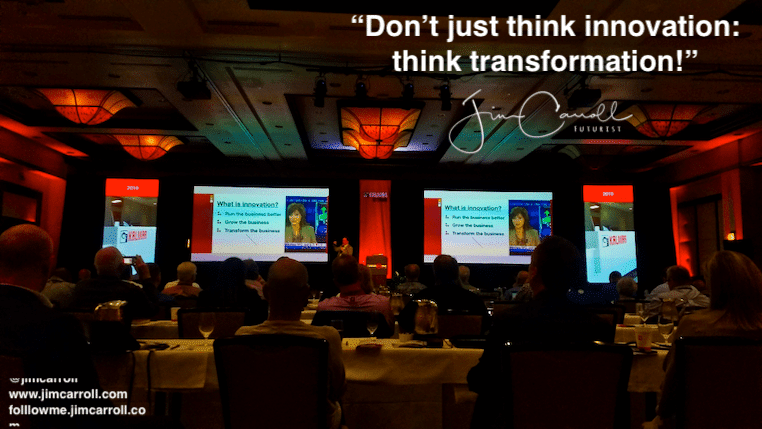
 I’m also referring to situations in which I’ve seen a company or organization form a special innovation team. They start up their project, go into a special room — and everyone wonders, ‘what’s up?” This fails because it makes innovation special; it makes it seem like it is something you do once as a project; it is just wrong on so many different levels. Innovation is a corporate culture — an attitude driven from the leadership that continually challenges everyone to ask themselves, “what can I do to run this better, grow the business, and transform the business.”

  • 10 surefire ways to destroy innovation – Form a secret committee 


The International Dairy, Deli and Bakery Association has invited me to be the closing keynote speaker for the 2012 international conference in New Orleans. I’ll appear before an audience of 8,000 key players in this massive global industry.

I’m honoured to join a list of previous keynote speakers that includes Mike Ditka, General Colin Powell, Emeril Lagasse, John Cleese (!), and even Sinbad.

This is another sign that innovation, and keeping up with high velocity change — my main themes — continues to rise to the top in many corporations and associations. Consider what I’m talking about : here’s the brochure copy which announces my participation:

The New Normal: Innovation, Hyper-niching, and Transformative Change

The “new normal” says nothing will ever be normal again. Instead, deep substantial change is transforming nations, markets, industries, jobs, and knowledge. We’re at the leading edge of the merger of three perfect trends: the rapid and massive mobile infrastructure with increasingly intelligent devices; pervasive location awareness as a result of GPS and location intelligence-mapping trends, and a consumer mindset that is increasingly open to new forms of interaction. The result is massive business model disruption, market change, and obliteration of old assumptions aobut the nature of customer relationships. Futurist, Trends & Innovation Expert Jim Carroll will show new ways to uplift product in retail space, how to change customer loyalty through new forms of interaction, and how to enhance one-to-one conversations through hyperniching. He’ll walk us through the impact of increasing business intensity, innovation, and creativity as it relates to the world of food.

The key phrase to think about is “deep substantial change.” And the key thing to think about, is are you ready for it? Is your leadership team, innovation strategy, partners, infrastructure, culture and mindset aligned for transformative change?

Folks, we’re going to look back at 2012 as a year in which the world began to change even faster than any other year prior.

My key phrase has always been, “the future belongs to those who are fast.”

Are you?

Here’s some of the key trends that I see unfolding through 2012 and beyond.

My unique job allows me the opportunity to see and hear what a lot of CEO’s and senior executives in a lot of organizations are thinking about. The  nature of my keynotes and small board / leadership meetings allows me to understand what folks are focused on. The research I do, whether for a major manufacturing conference in Las Vegas or a small corporate meeting with an ice cream company allows me to see the key trends that are unfolding right now.

And so given this unique perch, here’s some of the most important trends which will play out in the year to come.

  •  Biz competes again. North American and Western European companies have lived with constant fear, with the rapid rise of China, the BRIC countries and the N11 on the world  stage. And yet, we’re now witnessing a scene from the movie 2010: “HAL-9000 – ‘What’s going to happen?’ DAVE – ‘Something wonderful.‘ My sense is that a wide variety of industries, from agriculture to manufacturing to industrial design have been going through a renaissance of thinking in the last few years, and have learned what they need to do to re-innovate, grow again, and aggressively return to local and global markets. Read my “Build-America” blog post for some of what I’m thinking here — and stayed tuned!
  • The rise of the tinkering economy. The future is once again being built in the garage next door. But this time, it’s the hyper-connected, innovation oriented tinkering economy which is driving things forward. Get used to phrases like “micro factories,” “hobby designers” and”personal factories.”  The future of design, business and manufacturing is being reinvented at collaborative idea factories such as Ponoko, Etsy and  eMachineShop.com. There’s a revolution underway which is being driven by a globally connected, creatively driven new generation of hobbyists, and the impact is going to be massive!
  • Relationships change. Everywhere around us, the relationship that we have in our lives with the things that surround is, well, changing. Our relationship with food is changing as mobile technologies come to influence what we buy, how we shop,  and how we track our food intake. Our relationship with our body is undergoing a change as we come to use those same mobile technologies to monitor our diet, track our blood pressure another vital signs. Our relationship with clothing is changing as embedded technology becomes a part of what we wear — think about GPS enabled shoes for Alzheimers patients and Zephyr’s smart-clothing — which can be used by athletes to track their performance. When relationships change, everything changes, and opportunities for growth and innovative thinking abound!
  • Generational re-generation: everywhere we look, there’s a massive generational turnover underway, with a change in ownership of organizations from slow moving change adverse baby-boomers to a younger generation that inhales change as a form of innovation oxygen. As family farms and ranches are passed on from father to son and daughter, the rate of adoption of new farming and herd management ideas takes on a greater degree of speed.  As older doctors and nurses who were weaned on the paper-heavy patient file head into retirement, they being replaced by new medical residents who are arriving in the clinic, operating room and by the hospital bed with their iPads, ready to plug in! A shift from change-aversion to change-is-the-greatest-drug is a trend that speeds up our world even more!
  • Revenue reinvention. Every company is coming to face the reality that they have to become just like Apple in order to survive. The fact that Apple generates over 60% of its revenue from products that didn’t exist 4 years ago might today be an aberration, but given the increasing velocity of business cycles, product innovation, the arrival of new business models, changing customer expectations, the impact of social networks and a series of other trends, and soon every organization will find itself in a reality in which constant, relentless reinvention of its product or service line will the crucial to future success.
  • The Dominance of Design. We’re on the edge of a massive new era of creativity, with a trend that we might even call the ‘IPad-ization of Life.’ All one has to do is look at the new Nest thermostat to realize that a new generation of brilliant creativity is about to remake our world. We’re not doomed to a future in which everything around us in the future is going to look just like it did in the past – Apple’s design influence is quickly going to impact everything around us – from the cars we drive to the lamps we use to the fridges we open, to the buses we catch. Clean, simple, easy interfaces and crisp, cool lines, But it’s not just the looks — its the fact that with this new era of design comes intelligence. Our future is going to look great , intelligent and interactive!
  • Chip-velocity! Moore’s law used to apply only to the computer industry. Yet the rule that the processing power of a computer chip doubles every year while its cost cuts in half is taking on new meaning, as your phone becomes a credit card, your car watches how well you drive on behalf of your insurance company, and your clothing talks to your doctor! All of a sudden, in the era of relentless, pervasive connectivity, innovation in every single industry speeds up when Silicon Valley takes over the innovation agenda!
  • Life beyond politics. While the US Presidential election and political turmoil will dominate the headlines for 2012, a new generation of leaders are focused on BIG THINKING, BIG IDEAS, and BOLD MOVES. There’s a realization that political gridlock is the new normal, whether its the Democrats and Republications staring each other down, or France and Germany looking at Italy and Greece with a mystified sense of stunned confusion. So while politicians fail to get things done, innovative organizations are casting their mind to the future trends which will really provide opportunity in the future. It’s fascinating — the future is back in vogue again! And the thinking that is driving it is that we aren’t going to fix the problems of the future by doing what we’ve done in the past. And if we do things differently with those problems – that’s how we’ll discover the next big opportunity. This is the new mindset driving activities in the world of energy, the environment and healthcare!
  • Leading locally. There’s something odd going on — as the world gets global, we’re all going local.  We’re seeing it with sustainability  and local foods; angst and anger at banks and moves to credit unions; and a new volunteerism – as unemployment grew to 7.6%, volunteer service grew by 16%! We’re seeing it with local business – a University of Pennsylvania study found that areas with small, locally owned business (<100 employees) had greater per capita income growth than those with the presence of larger, nonlocal firms! There’s a new focus on local co-ops — with more than 100 million people employed worldwide in some type of local co-op. Thats’ why its fitting that 2012 is the International Year of the Cooperatives, a business model that has stood the test of time for over 150 years. Where-ever you look, while we are thinking global, we’re acting local!
  • Strategy re-dos. The impact of all these trends? Executives quickly coming to realize that what they’ve been doing in the past isn’t to hold them forward into the future. It’s time to throw out all the old assumptions and try things that are new!

Here’s to 2012!

This article was released in my CAMagazine column in March 2009. shortly after the great economic collapse of 2008.

Inertia — real or implied — establishes a culture of inaction, and that can lead to another slippery slope

Given the new economic volatility, shrieking stock market headlines, and the reappearance of a sense of dread in the corporate world in September 2010, it’s probably a good time to re-read the article.

There are countless examples where history has shown us that it is those organizations who focused on ensuring that they were still actively pursuing innovation — whether through product development, the exploration of new business models, external partnerships, the pursuit of new markets and customer groups — were those who managed to achieve the greatest success in the long run.

Catch the key line at the end: “The greatest mistake any organization can make right now is to do nothing.”


Keep Those Ideas Coming
Jim Carroll, March 2009

I have started to think about the events of the past few months in the context of economic grief — an emotional process closely related to the stages of bereavement. The economy unraveled so quickly that many organizations still find themselves in the early phases of economic grief, marked by shock and denial. Corporate idea factories have come to a standstill and innovation paralysis is settling in.

The result is that we’re not just in an economic recession; we’re entering an idea recession, similar to that of the last downturn starting in 2001. Yet, in allowing innovation to dry up, businesses are missing out on great opportunities for success. After all, companies such as Burger King, Microsoft, CNN and FedEx were all started up during recessions.

The Wharton School of the University of Pennsylvania released a provocative article in November 2008 suggesting a recession is the perfect time for disruptive innovation — that is, rewriting an industry’s business model to achieve significant growth. Think of Steve Jobs and the iPod, which he first released during a less-than-rosy economy in 2001.

So what do companies need to do to make the most of this recession? First, accept the economic reality. Those unable to move past shock, denial and anger through to acceptance will be innovation laggards and will only be ready to innovate once the market and industry recovery is underway. Unfortunately, that may be too late.

Innovation leaders, however, are prepared to keep their idea factories running (perhaps not at full tilt, but running nevertheless) in the face of uncertainty. They know there is still a place for innovative thinking despite the vast sections of the economy under stress. They know there are growth markets and opportunities for marketplace, distribution-channel and operational innovation. These leaders are aware ongoing change in consumer behaviour means there are still new ways to brand, grab customer mind share and forge unique and distinct relationships.

It is critical that organizations begin to undertake a series of bold actions that reorients them to face future challenges. These actions should include several integrated elements.

  • Boost the experiential capital of the organization. Get your teams working on projects and ideas that build up their experience. For example, they might explore new methods of branding and marketing (particularly to the next generation); investigate technologies that can stream-line business processes; or work with distribution models that expand market potential.
  • Identify weaknesses or areas for improvement. Consider what elements of the organization’s product line, skills or structure could benefit from specific innovation efforts. For example, are competitive threats emerging that you haven’t really thought about? What should you be doing to innovate your way around those challenges?
  • Explore key opportunities through a variety of risk-oriented initiatives. If, for example, you focus on a customer-retention strategy (such as visiting every customer in the next three months to see if you are meeting their needs) can you put a stop to future revenue leakage?

The greatest mistake any organization can make right now is to do nothing. Inertia — real or implied — establishes a culture of inaction, and that can lead to another slippery slope. Today, innovation isn’t simply an option — it’s critical because it is the best way to gain traction.

One of the biggest challenges in being an innovator is keeping faith in your belief as to where trends are going to take you.

You’ll find no shortage of people who will detract you from your goals, using one of the most effective innovation killer phrases: “that’s the dumbest thing I ever heard.”

Certainly history has taught us this lesson! Consider how some have reacted in the past to what proved to be very significant, transformative developments:

  • There will never be a bigger plane built.” A Boeing engineer, after the first flight of the 247, a twin engine plane that carried ten people.
  • There is not the slightest indication that nuclear energy will ever be obtainable. It would mean that the atom would have to be shattered at will.” – Albert Einstein, 1932
  • Computers may weigh no more than 1.5 tons.” – Popular Mechanics, 1949
  • There is no reason anyone would want a computer in their home.” – Ken Olson, president of Digital Equipment Corp. 1977
  • This telephone’ has too many shortcomings to be seriously considered as a means of communication.” – Western Union memo, 1876
  • No imaginable commercial value. Who would pay for a message sent to nobody in particular?“- David Sarnoff’s associates in response to his urging investment in the radio in the 1920′s.
  • The bomb will never go off. I speak as an expert in explosives.” – Admiral William Leahy, U.S. Atomic Bomb Project.
  • Airplanes are interesting toys, but they are of no military value whatsoever.” – Marechal Ferdinand Fock, Professor of Strategy, Ecole Superieure de Guerre
  • While theoretically and technically television may be feasible, commercially and financially it is an impossibility.”- Lee DeForest, inventor
  • Radio has no future. Heavier-than-air flying machines are impossible. X-rays will prove to be a hoax.” – William Thomson, Lord Kelvin English scientist, 1899
  • Nuclear powered vacuum cleaners will probably be a reality within 10 years.” - Alex Lewyt, quoted in the New York Times, 1955
  • Video won’t be able to hold onto any market it captures after the first six months. People will soon get tired of staring at a plywood box every night.” — Darryl F. Zanuck, Head of 20th Century-Fox Studios, 1946

When in a period of transformative change — as many industries now find themselves – it is all too easy to use disbelief to cling to the past. In order to be innovative, you’ve got to be willing to ignore the naysayers!

"We really don't understand it all, and so we aren't going to do anything!"

A few years ago, when I was the closing speaker for the Swiss Innovation Forum in Zurich, I made the observation that many  ”organizations fail, because their have failure engrained in their corporate culture!”

Do you?

It can be difficult to try to be innovative in many organizations. Many people with an innovation-oriented mindset often find their enthusiasm stymied when they approach senior management with an initiative. And when their effort is turned back, it can extremely frustrating!

One of the most typical situations today in which we are seeing innovation-dead-in-its-tracks involves the many initiatives that people are pursuing with social networks and/or mobile applications. They know that we live in transformative times in which major changes are occurring with branding, production promotion, customer relationships and just about everything else!

So they set off to build a sophisticated customer-oriented Facebook initiative; they roll out a prototype mobile iPhone app; or they simply get a very basic Twitter feed happening that includes a stream of useful news updates that customers might actually appreciate.

Enthusiastic as heck, they take their project to the senior management team — and its’ rejected, with a litany of reasons as to why the organization just isn’t ready to deal with their new ideas right now.

Any number of reasons can be given; each and every one of them is indicative of the fact that a sort of organizational sclerosis has set in, that clogs up the ability of the organization to deal with anything new. Consider the attitudes that you might encounter if you are trying to get something happening:

  • we don’t understand it, so we don’t think we need to do it
  • it’s too easy to not confront the tough issues
  • we are too busy fighting fires right now!
  • we don’t have the skill sets to deal with this. That’s a weak excuse
  • we haven’t thought about this in our strategic planning process
  • we have really spent a lot of time thinking about what comes next
  • we don’t have a budget for that!
  • what we’ve been doing all along is perfectly ok, isn’t it?
  • there’s so much going on, and we don’t know where it might fit in terms of priorities!
  • it’s too far ahead of its time!

Of course, it’s easy to take this wall of negativity and step back from the project and curb your enthusiasm — and give up! Here’s a clip from my keynote in Zurich in which I talk about the challenges you might face.

But real innovators don’t give up! They work to address the organizational sclerosis that might be in place. What you should do  is confront these excuses head on: there are a variety of different reactions depending on the different excuses that are used:

  • if they don’t understand it, educate them! This might involve building a better business case for the initiative; bringing them up to date on the key business drviers and trends that require some bold steps and dramatic change.
  • help them that those who tackle the tough issues usually win. This is a good time to put into perspective the concept of accelerating change. You need to make sure that the leadership team understands that everything around us today is changing faster than ever before, and will continue to do so: business models, methods of customer interaction, new forms of competition. Business today is all about continually confronting a flood of tough issues; we should be bulking up our capabilities to deal with a world of incessant change.
  • if the organization is always in fire-fighting mode, change the agenda. Maybe they won’t be fighting as as many fires over the long term if they have a clear view of the future, and have a strategy that aligns to that future. So rather than asking, “whoah, where’d that come from,” they’re asking “ok, what comes next, and what do we need to do about it?
  • skill sets don’t give us the capability: That’s a weak excuse: if there are shortfalls in certain key skills to deal with current business realities, deal with it and fix it fast. Ensure that you work with HR to undertake a skills inventory with respect to the area you are trying to innovate within, and work to plug the holes.
  • if it’s not part of the strategic planning process, make it part of it. Every organizations has multiple processes in which issues and activities rise to the top because they’ve been idenitified as fitting within the overall strategic plan. If yours isn’t part of the plan, work to get it there; and again, this comes through education, a clear business case, as well as internal discussions with those who are involved with and shape the strategic planning process.
  • get people thinking about what comes next: Does the organization have a regular series of forward looking leadership meetings? Does it take the time to assess the trends which might impact it on a 1, 2, 5 and 10 year basis? Is it busy looking at we have really spent a lot of time thinking about what comes next
  • we don’t have a budget for that! Following the process of getting the initiative into the strategic plan will help to lead to the next step: getting the project properly approved and funded within the overall budget process for the organization. There’s a process for budgeting — and you have to be intimately involved in and respect the process.
  • make it clear that it isn’t ok to keep doing the same thing that has been done in the past. You’ve got to clearly articulate the new threats the organizations faces and the opportunities that it can pursue as a result of ongoing change.
  • there’s so much going on, and we don’t know where it might fit in terms of priorities! This is a tricky one, because in this type of situation, its pretty well certain that there is some weak management in place who doesn’t know how to set a clear action plan that the team must follow. Best bet is to address the other issues on the list, and work to put in place a clear business and strategic plan for your initiative, with sound business reasoning as to why it needs to be done.
  • it’s too far ahead of its time! Frame the future to the organization this way: do we want to always be fast followers, or do we truly want to be market leaders?

In Zurich,I noted on stage that “we develop corporate cultures that stifle — that kill our ability to try to do anything new…..” That’s what you’ve got to work to avoid — it’s not easy to do — but absolutely necessary!

It was a busy September, with keynotes and leadership events for the likes of PPG, the Utah League of Cities and Towns, St. Joseph’s Health Center, Transcontinental Media, the Ohio League of Bankers, the Illinois League of Financial Institutions, the Minnesota Hospital Association CEO Summit, Allied Solutions and many other events.

A common theme for many of the keynotes I’ve given for senior executive events at these groups has been the focus on ‘what do world class innovators do that others don’t do?” In that context, there are several key themes I’ve been relentless on:

  • fast beats big: we have never lived in a period of time that has involved such rapid change with business models, competitive landscapes, product and service innovation, challenging consumers, a new political dynamic, and countless other new realities. World class innovators are those who move fast, get things done, and keep getting things done.
  • bold beats old: all around you right now, there are countless numbers of people and organizations who are out to mess up your business model. They’re making bold steps, aggressive moves, and big decisions. This is not a time for timidity; it’s a time for BIG ideas and the pursuit of the offbeat
  • velocity trumps strategy: careful strategic planning can be a critical step in adapting to the future, but in some areas, things are happening so fast that you can’t take the time to strategize: you just need to jump in and go. That’s experiential capital it’s one of the most important investments that you need to be making now. Understand what it is, and why you need to be investing in it NOW.
  • flexibility beats structure: successful innovators have mastered the ability to form fast teams: they know their that their ability to quickly scale resources to tackle fast emerging opportunities or challenges are the only way that they can win in the future. They avoid the organizational sclerosis that bogs too many organizations down
  • disruptors destroy laggards: step into any industry, and there are people who are busy messing about the fundamental business models which have long existed. Start your own disruption before you find yourself disrupted
  • connectivity is the new loyalty: with the forthcoming dominance of mobile technology in everyday lives, everything you know about customer relationships is dead. Right now, it’s all about exploring and building new relationships throughout the mobile data cloud in which the customer lives. If you don’t get that, your brand is dead.
  • location is the new intelligence: with connectivity comes location, which results in new applications, business models, methods of customer interaction, and just about everything. If you don’t have a location strategy for your business, you really don’t understand how quickly your world is changing around you

For more on this thinking, check out the ‘innovation’ tag on my blog.

What do innovative organizations do? They re-orient themselves for an economy in which their ability to react to fast paced change will increasingly define their success.

In this clip, Jim Carroll outlines for an audience of several thousand the key attributes of today’s innovation heroes:

In essence, these organizations concentrate upon:

  • an accelerated innovation cycle
  • the rapid ingestion of new technologies / methodologies
  • faster time to market
  • rapid re-focusing of resources to deal with new opportunity or threat
  • a rabid focus on operational excellence
  • a  rapid response to volatility
  • and a re-orientation to fast paced consumer and brand perception

Jim has studied the innovation attitudes of hundreds of global organizations, and has carefully come to define what it is that allows some organizations to achieve stunning levels of innovation success, while others become innovation laggards. These attributes are a good part of the defining characteristics for success.

What do you think?

Ask yourself this question: do you work in an organization that just simply doesn’t get it? Who is oblivious, blind, completely unaware of just how much business model change is occurring out there?

Here’s the thing — there are three types of people in the world:

  • those who make things happen
  • those who watch things happen
  • and those who say, “what happened?”

I’ve often pointed this out on stage, and have emphasized the point, by suggesting that  the folks who find themselves last on the list sit back and say, “whoah, dude, what happened? Where’d that come from?”

In other words, they’ve been completely blind to the trend which would cause massive upheaval within their industry, or refuse to accept the significant business model disruptions which are already occurring.

Guess what — it’s happening right now as a lot of financial institutions don’t realize just how quickly mobile technology is going to change everything in the consumer financial services industry! Or in countless other industries where the blindness of current market leaders is leading them to their own “whoah, dude” moment.

So let’s make it simple: when it comes to innovation, make sure that you are in the first camp!

What should you do if you make that conscious decision, and are trying to steer your organization into the future?

  • turn forward! establish an overall organizational culture in which everyone is firmly focused on the future while managing the present.
  • change the focus: make sure that you link the corporate mission of today to the major trends and developments that will influence the organization through the coming years;
  • pursue speed: use a leadership style that encourages a culture of agility and allows for a rapid response to sudden change in products, markets, competitive challenges and other business, technological and workplace trends;
  • watch more stuff: establish and encourage an organization-wide “trends radar” in which all staff keep a keen eye on the developments that will affect the organization in the future;
  • share more: make sure that you’ve got a culture of collaboration in which everyone is prepared to share their insight, observations and recommendations with respect to future trends, threats and opportunities;
  • change responsibilities: ensure that staff are regularly encouraged to not only deal with the unique and ongoing challenges of today, but are open and responsive to the new challenges yet to come;
  • take risks: you won’t get anywhere if you don’t make sure that are encouraged to turn future challenges into opportunities, rather than viewing change as a threat to be feared.

I continue to be stunned by how many organizations today continue to be caught flat-footed by the pace of rapid trends that impact them. It seems like it should be so simple to avoid this. Yet there likely still lots of “whoah, dude” dudes out there.


I’ll often be lined up for a conversation with the CEO of a client organization when I’m preparing for a private client CEO leadership/innovation keynote.

It’s part of a careful diplomatic dance. They want to ensure that the framework of my keynote addresses the key issues and challenges that they need to address to ensure that they can become a high velocity innovation hero. I often work with them to help them understand the unique innovation perspective I am bringing into the room.

During the conversation, I often prepare a summary list of the issues that they put on the table that I’ll use in preparing my talk.

I’ve got dozens of scribbled notes from such conversations. Here’s one that I just came across for an event over a year ago; the CEO of this Fortune 1000 organization (obviously, not named) outlined some of the key themes that I needed to address. As he put it, “we need to:”

  • increase our bench strength. We don’t seem to have the right skills and the right capabilities at the right time for the right purpose. We need to get better at our skills mix and agility if we are to max out our creative capabilities.
  • institutionalize learning. We tend to fall behind and miss opportunities because our people don’t know enough about what is going on “out there”
  • grow high value customer relationships. We could get much better in solving customers problems before they know they have a problem. If we could do that, we could extend existing revenue faster.
  • accelerate product innovation. We’re slow. By the time we get to market, our competitor has already been there. We need to speed things up.
  • have a better talent pipeline. We’ve got a lot of “dead wood” lying around, performing a lot of tactical, non-strategic work. We need to ensure that we are developing/ingesting new talent faster, for the faster emergence of new issues.
  • reduce our structural costs through collaboration. Simply put, there is simply too much duplication of effort. It’s the era of social networks; why can’t we be “social” internally?
  • suck less. There’s still huge opportunity to reduce product costs through process innovation and better project execution. (Yes, he did use this phrase)
  • scale faster. We really, really need to get better at identifying and capturing growth markets.
  • plug knowledge gaps. There’s lots to learn about things we don’t know about. We need to invest more in risk oriented projects. We have to fail faster.

What’s fascinating about these conversations is that the CEO knows the challenges that need to be addressed, and is confiding in me those concerns; my role is helping to build a message for the team as to what they really need to do to become high velocity innovation hero’s.

The simple list above — and this is but one of dozens of such summaries — gives a bit of insight into how you can take innovation beyond simple product oriented innovation.

Remember – innovation is all about answering the questions: “What can I do to run this business better? What can I do to grow this business? And what can I do to transform the business!”

I’ve been quite priviliged through the years to be able to observe, within my global blue chip client base (which includes clients such as the National Australian Bank; Diners Club; HJ Heinz, General Dynamics / Northrop Grumman Nestle), some of the fascinating innovation strategies that market leaders have pursued.

What is it they do? Many of them make big, bold decisions that help to frame their innovative thinking and hence, their active strategies. For example, they:

  • make big bets. In many industries, there are big market and industry transformations that are underway. For example, there’s no doubt that mobile banking is going to be huge, and its going to happen fast with a lot of business model disruption. Innovative financial organizations are willing to make a big bet as to its scope and size, and are innovating at a furious pace to keep up with fast changing technology and even faster evolving customer expectations
  • make big transformations: I’m dealing with several organizations who realize that structured operational activities that are based on a centuries old style of thinking no longer can take them into a future that will demand more agility, flexibility and ability to react in real time to shifting demand. They’re pursuing such strategies as building to demand, rather than building to inventory; or pursuing mass customization projects so that they don’t have to compete in markets based on price.
  • undertake big brand reinforcement: one client, realizing the vast scope and impact of social networking on their brand image, made an across the board decision to boost their overall advertising and marketing spend by 20%, with much of the increase going to online advertising. In addition, a good chunk of existing spending is being diverted as well. Clearly, the organization believes that they need to make bi broad, sweeping moves to keep up to date with the big branding and marketing change that is now underway worldwide.
  • anticipate big changes: there’s a lot of innovative thinking going on with energy, the environment and health care. Most of the organizations that have had me in for a keynote on the trends that are providing for growth opportunities have a razor sharp focus on these three areas, anticipating the rapid emergence of big opportunities at a very rapid pace.
  • pursue big math: quite a few financial clients are looking at the opportunities for innovation that come from “competing with analytics,” which offers new ways of examining risk, understanding markets, and drilling down into customer opportunity in new and different ways.
  • focus on big loyalty: one client stated their key strategic goal during the downturn this way: “we’re going to nail the issue of customer retention, by visiting every single one in the next three months to make sure that they are happy and that their needs are being met.” Being big on loyalty means working hard to ensure that existing revenue streams stay intact, and are continually enhanced.
  • focus on big innovation: one client stated their innovation plan in a simple yet highly motivating phrase: “think big, start small, scale fast.” Their key goal is to build up their experiential capital in new areas by working on more innovation projects than ever before. They want to identify big business opportunities, test their potential, and then learn how to roll out new solutions on a tighter, more compact schedule than ever before.
  • thinking big change in scope. One client became obsessed with the innovation strategy of going “upside down” when it came to product development. Rather than pursuing all ideas in house, they opened up their innovation engine to outsiders, looking for more partnership oriented innovation (with suppliers and retailers, for example); open innovation opportunities, and customer-sourced innovation. This lit a fuse under both their speed for innovation as well as their creativity engine
  • innovate in a big way locally: we’re in a big, global world, but that doesn’t mean that you can’t innovate locally. One client in the retail space pursues an innovation strategy that allows for national, coordinated efforts in terms of logistics, merchandising and operations, yet also allows a big degree of freedom when it comes to local advertising, marketing and branding.
  • share big ideas. One association client pursued an innovation that was relentless on community knowledge sharing. They knew if they could build an association culture in which people shared and swapped insight on a regular basis on how to deal with fast changing markets and customers, that they could ensure their members had a leg up and could stay ahead of trends. Collaborative knowledge is a key asset going forward into the future, and there’s a lot of opportunity for creative, innovative thinking here.
  • be big on solving customers problems. Several clients have adopted an innovation strategy that is based on the theme, “we’re busy solving customers problems before they know they have a problem,” or conversely, “we’re providing the customer with a key solution, before the customer knows that they need such a solution.” That’s anticipatory innovation, and it’s a great strategy to pursue.
  • align strategies to the big bets. There’s a lot of organizations out there who are making “big bets” and link innovation strategies to those bets. WalMart has bold goals for the elimination of all packaging by a certain date; this is forcing a stunning amount of innovation within the packaging sector. Some restaurants aim to reduce food and packaging waste by a factor of dozens; this is requiring stunning levels of creativity in the kitchen.

These are but a few examples and the list could go on; the essence of the thinking is that we are in a period of big change, and big opportunity comes from bold thinking and big creativity!

What happens when Silicon Valley takes over the innovation agenda within an industry? In this video clip from a recent keynote, Jim challenges his audience to think about what happens in the world of banking, particularly with the likely fast paced emergence of contact-less payment technology based on mobile devices.

Innovative organizations need to make sure that they understand the external factors that will influence their future, and need to react appropriately. And as we enter the era of hyper-connected intelligent devices, with the impact of location-intelligence technology and the rapid adoption of mobile technologies, we’re likely to see every industry — even beyond financial services — impacted.

New business models, disruptive competition, a shift in control, customer churn — everything is up for grabs once Silicon Valley seizes control and defines your future!

A key innovation message that I spend time with my clients focusing upon involves the concept of “thinking big, starting small, and scaling fast.”

(With all due respect, the thought process comes from a customer-service oriented strategy at McDonald’s many years ago, but it is easily extended to encompass innovation in general.)

What does the message imply:

  • think big: identify the long term transformative trends that will impact you. These could include significant industry change, business model disruption, the emergence of new competitors, product or service transformation; anything. Essentially, you need to get a good grounding in the “big changes” that will impact your future over a five or ten year period
  • start small: from those trends, identify where you might weaknesses in skills, products, structure, capabilities, or depth of team. Pick a number of small, experiential orientated projects to begin to fill in your weak points, and learn about what it is you don’t know. This will give you better depth of insight into what you need to do in order to deal with the transformative trends identified above
  • scale fast: from those small scale projects, determine which areas need to be tackled first in terms of moving forward more aggressively with the future. Develop the ability to take your ‘prototyping’ of skills enhancement from the small scale projects into full fledged operations

It sounds simple, but its’ extraordinarily complex. Having said that, it does give you and your team a good conceptual framework for innovation, and orienting yourself to the trends which will provide you with the greatest opportunities and challenges in the years to come.

How might a company use such thinking? Let’s say you are in the banking industry. You know that mobile, text message, and location-sensitive banking trends are going to have a big impact on you. You know little about what is going. Think about how you might have redefined your customer service out on a ten year basis; where you might see new competitors emerge; and what you need to do to ensure that you stay on top of changing consumer demands. Then start small — take on a number of projects that build up the experience of your team with specific mobile technologies: how quickly can we get financial apps developed? From those ongoing efforts, build up the capability to scale — that is, separating the successes from the failures with these smaller projects, and learning how to quickly roll them out on a national or international basis.

Leave a comment : let me know what you think, suggest or ideas where you’ve seen the concept work!

In a whirlwind of activity over the last ten days, I’ve been the keynote speaker for conferences that probably represents the vast majority of global Fortune 1000 organizations, speaking to the trends that will impact the future of ‘corporate facilities.’

These have included keynotes for the  Professional Retail Store Maintenance Association annual conference in Orlando; the CoreNet Global Summit in New Orleans, and the International Asset Management Council Spring Summit in Colorado Springs. With these groups, we’ve got the folks who manage facilities for a good chunk of the world’s biggest retailers (including Apple, the Gap, Costco and others); commercial real estate executives for Fortune 1000 and government; and the senior executives who manage the same for large industrial and manufacturing organizations (Alcoa, Caterpillar, Whirlpool).

What are they thinking about? Adjusting to an economy that is more and more turning to growth. And to do that, I covered a wide variety of trends:

  • they need to actively shift their role from tactical (managing costs in a downtown) to strategic (‘how do I help my organization to scale and support growth strategies?’
  • ensure that the organization has the flexibility in terms of facilities and workforce to adjust to more rapid market and product innovation, faster competition, and more rapid change in consumer demand and choice
  • take advantage of emerging opportunities with intelligent building management infrastructure
  • be willing to challenge process and assumptions as to operations. I consistently used my story of broken business models, vs. business models built on rapid change – my Honda vs. Chrysler story
  • adapt to a reality in which skills flexibility and innovation will be a key success factor. These folks need to access a lot of unique skills that are in short supply (i.e. green engineers), and so increasingly their success will come from their ability to access the right skills at the right time for the right purpose

Are people really thinking about growth? Here are the live results from a text message poll that I ran from the stage at the IAMC conference in Colorado Springs yesterday:

More information

  • Innovation and the concept of ‘chameleon revenue’
  • Riding fast paced trends in the consumer / retail sector 
  • Finding growth with knowledge exponentiation (construction trends)  
Performance Optimization WordPress Plugins by W3 EDGE