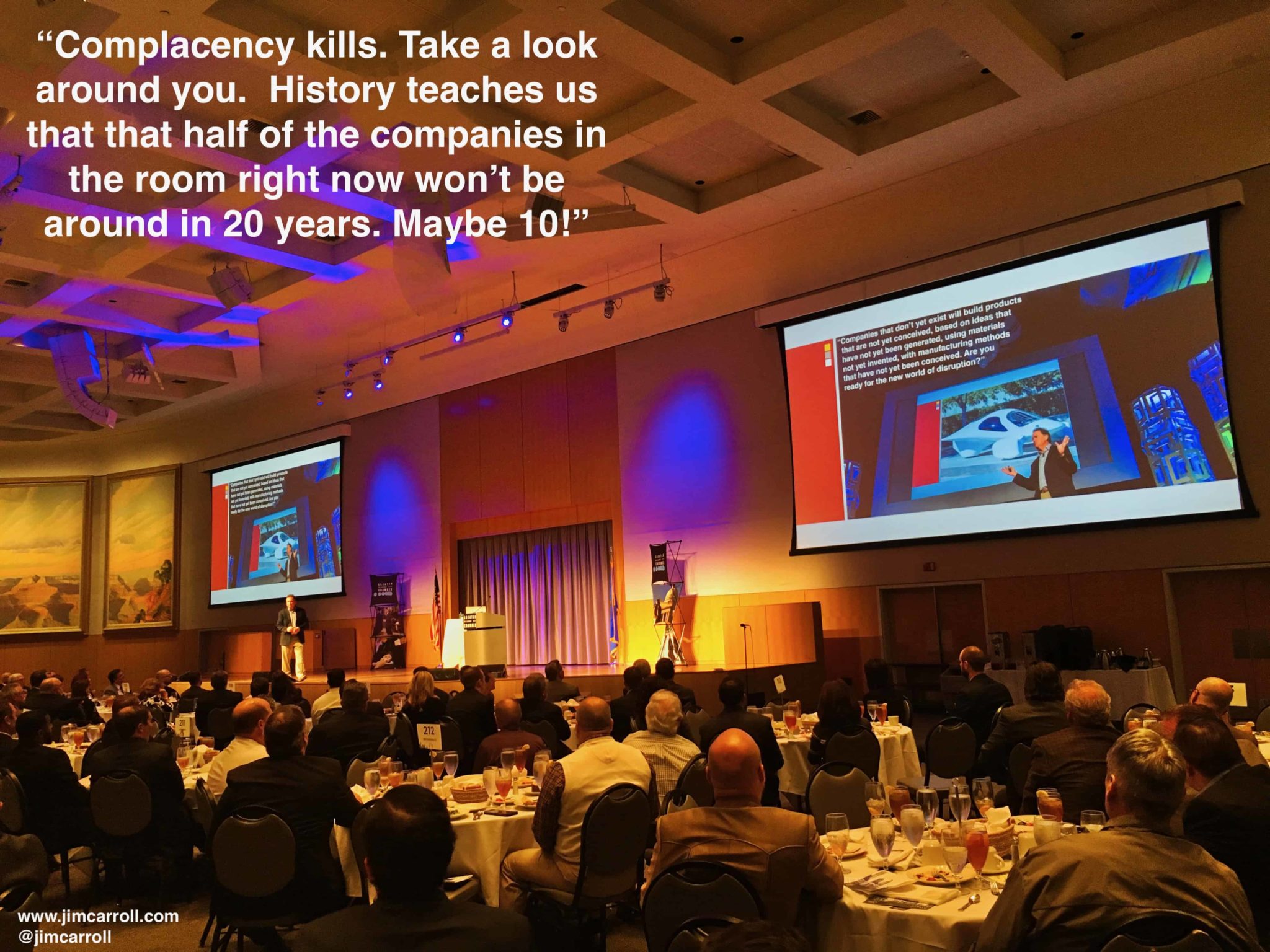
The USPTO receives 55 patent applications every hour

Home > Archives

Retail

The average consumer scans some 12 feet of shelf space per second. Mobile interactions in the retail space are about to become common. You've got but multi-seconds to grab their attention.

Some of Jim's retail clients include • Yum! Brands (KFC, Taco Bell, Pizza Hut) Global Leadership Conference • Burger King Global Franchise Meeting • VIBE (Very Important Beverage Executives) 2010 Summit • Manufacturing Jewelers Suppliers of America • National Home Furnishings Association • Do It Best Corporation • US Department of Defence Commissary Agency • Readers Digest Food & Entertainment Group Branding/Retail Summit • Professional Retail Store Maintenance Association • Convenience U annual conference • Point of Purchase Advertising International Association • Chain Drug Store Association of Canada • Canadian Council of Grocery Distributors • Canadian Federation of Independent Grocers

I just came from giving a keynote for the annual conference of a major customer loyalty organization, with the talk focused on some of key trends impacting the world of retail today.

There’s certainly a lot going on and a lot to think about. Extremely rapid business model change, the emergence of new competitors, ongoing consumer confidence volatility, rapid product turnover and faster product life-cycles.

So what are they really, really worried about? Let’s put in context the people I had in the room — senior VP’s and managers in major retailers representing several billions in revenue in a wide variety of markets, including pharmaceutical, grocery, consumer goods and electronics. Not to mention quite a few bankers, responsible for credit card portfolio’s, loyalty programs and other customer oriented programs and infrastructure.

Given all that, the top of mind issue is — new methods of customer interaction.

Look at the poll results below. The issue stands out far and away as the most important concern of the day!

Hence, my keynote was bang-on. I didn’t touch too much on the social networking phenomena, as this type of crowd has been drowning in social-networking Powerpoints.

My focus was on interactivity, location, and intelligence,, and the extremely rapid emergence of new forms of in-store interaction and product sales uplift. Things like digital signage, in-store electronic promotional displays, iPod based coups. A flood of new stuff and new ideas that promote new ways of

Listen folks, I know I’ve said it here before, but I’ll say it again.

2010 is the year of location, combined with mobility, and it’s happening faster than you think.

I’m pumped about this topic and the reaction, so I’ve rolled this into a new keynote description:

Location is the New Intelligence: Customer Interaction in the Era of Pervasive Mobile

We’re at the leading edge of the merger of three perfect trends: the rapid and massive emergence of a massive mobile infrastructure with increasingly intelligent devices. Pervasive location awareness as a results of GPS and location intelligence/mapping trends in those very same tools. And a consumer mindset that is increasingly open to new forms of interaction. The result is massive business model disruption, absolutely transformative market change, and complete obliteration of old assumptions as to the nature of the customer relationship. Smart, innovative super-heroes know that this is an unprecedented time to jump on the emergence of location as the new intelligence, in order to provide for new ways of product uplift in the retail space, changing the very nature of customer loyalty through new forms of interaction, and enhancing existing one-to-0ne conversations through a more direct, distinct and fascinating new form of location based relationships. Futurist, Trends & Innovation Expert Jim Carroll is setting the retail, marketing and advertising world on fire with his fast paced insight into one of the most important trends to shape the customer-business relationship in the last few decades. Move over social networking — location is the new intelligence!

Read more: Location is the new intelligence

In a whirlwind of activity over the last ten days, I’ve been the keynote speaker for conferences that probably represents the vast majority of global Fortune 1000 organizations, speaking to the trends that will impact the future of ‘corporate facilities.’

These have included keynotes for the  Professional Retail Store Maintenance Association annual conference in Orlando; the CoreNet Global Summit in New Orleans, and the International Asset Management Council Spring Summit in Colorado Springs. With these groups, we’ve got the folks who manage facilities for a good chunk of the world’s biggest retailers (including Apple, the Gap, Costco and others); commercial real estate executives for Fortune 1000 and government; and the senior executives who manage the same for large industrial and manufacturing organizations (Alcoa, Caterpillar, Whirlpool).

What are they thinking about? Adjusting to an economy that is more and more turning to growth. And to do that, I covered a wide variety of trends:

  • they need to actively shift their role from tactical (managing costs in a downtown) to strategic (‘how do I help my organization to scale and support growth strategies?’
  • ensure that the organization has the flexibility in terms of facilities and workforce to adjust to more rapid market and product innovation, faster competition, and more rapid change in consumer demand and choice
  • take advantage of emerging opportunities with intelligent building management infrastructure
  • be willing to challenge process and assumptions as to operations. I consistently used my story of broken business models, vs. business models built on rapid change – my Honda vs. Chrysler story
  • adapt to a reality in which skills flexibility and innovation will be a key success factor. These folks need to access a lot of unique skills that are in short supply (i.e. green engineers), and so increasingly their success will come from their ability to access the right skills at the right time for the right purpose

Are people really thinking about growth? Here are the live results from a text message poll that I ran from the stage at the IAMC conference in Colorado Springs yesterday:

More information

  • Innovation and the concept of ‘chameleon revenue’
  • Riding fast paced trends in the consumer / retail sector 
  • Finding growth with knowledge exponentiation (construction trends)  

2010PRSM.jpgAt many of my keynotes, I focus on some of the most successful creativity and innovation attributes that I see within organizations. Here’s a list of guidance from a recent keynote for a group of executives in the consumer goods sector:

  • Adapt to more challenging customers: customers expectations and needs are changing rapidly, and yet they are more demanding than ever before. Loyalty disappears….at the same time they expect creative perfection from you, they are more fickle, and far less loyal …. I’m not even sure the concept of loyalty exists any more for many brands! Continue Reading

How do you master innovation? Through the powerful story in this video clip, I point out the challenges that organizations face with the different generations in the workplace — and introduce the concept of “generational collaborative capability” as being a key component of succcesful innovation.

2010SiliconValleyInnovation.jpgMy January / February CA Magazine article is out; entitled “Stranger than Science Fiction,” it examines a major theme that has been part of many of my keynotes throughout 2009: what happens to your industry when the pace of innovation is no longer set within the industry itself, but rather, is set by the blistering rate of change as set by Silicon Valley?

Stranger than Science Fiction

by Jim Carroll, CAMagazine, January 2010

Is your industry in the midst of a transition at Silicon Valley speed? If it isn’t, it could be very soon, because I’m seeing it happen wherever I go. Take the global credit card industry. For a long time, the pace of innovation has been relatively slow and deliberate; aside from the chip found in your new credit card, it’s still been about the same old piece of plastic.

Continue Reading

A Key Trend for 2010! A huge number of global organiztions have me in to challenge their team to think about how to deal with the increasing speed of change in the world of business.

Here’s a clip from a Las Vegas keynote, in which I speak to the topic of business velocity. I believe that in 2010, a greater number of organizations will need to deal with ever increasing rates of change!

2009BurgerKing.jpg
There are two types of organizations in the world today: those that have retrenched, shut down their idea machines, and are trying to coast through the recession. Then there are those who are making sure that they keep their team focused on the future, opportunities, and the need for innovative thinking.

I’ve been confirmed to be the opening keynote speaker for the next global leadership/franchise conference for Burger King, one of the largest QSR chains in the world.

This is really quite an honor, and I think is indicative that my theme that “organizations need to stay on the innovative edge despite the recession” resonates strongly.

Continue Reading

2009Yum.jpgI was thrilled to be the opening keynote speaker for Yum! Brands 2009 Global Leadership Meeting. It’s the world’s largest restaurant company.

The organization, the owner of such iconic brands such as KFC, Taco Bell and Pizza Hut, certainly finds itself in the midst of high-velocity change. There are fast paced trends in terms of new branding challenges and marketing methodologies (think Web 2.0), consumer behavior, and many other issues. Yet, there are tremendous opportunities for growth through innovation.

My keynote addressed a variety of trends which are impacting the QSR (quick service restaurant) industry today:

  • opportunities for global growth. Chain restaurants account for but 1% of China’s commercial food service sales, and in Europe, it is but 2%. (Compare that to the US, which is at 50%.) Clearly, growth will come from continued expansion into global markets.

Continue Reading

09SpringANLA.jpgIn the last week, Europe has suffered through a dreadful cold spell. A huge polar arctic air mass is coming into North America next week. It could very well snow in Washington on or around Inauguration day.

My family and I ski every weekend, and I love the cold.

There are many others who don’t. And this cold winter, combined with dark economic clouds, provides people with a degree of gloom.

That’s why innovation and thinking about future trends is important! And always after winter, there’s a springtime!

I’m thrilled that I’ve been confirmed to be the closing keynote speaker for the American Nursery and Landscape Association annual conference, aka as the 2009 Management Clinic.

The cool thing is that this is a repeat booking; this organization had me in for another event in 2006 in Vail. It’s always a thrill to know that you’ve had such an impact on people that they bring you back for more.

Continue Reading

There are a lot of hits coming into my web site searching for “food industry trends 2009″ or “2009 food trends.”

I’ve spent a fair amount of time through the last few years, focused on trends in the consumer, food and retail sector, talking about some of the unique trends which influence shopping behavior.

Here’s a clip from a major food symposium I keynoted in New York City in September 2008; I spoke to a wide variety of trends impacting the industry. In this short clip, I’m speaking to the issue of market fragmentation, and the need for ever more small niche markets:

The key point: while economic trends are impacting consumer choice, there are still many other trends at play. At the conference, I spoke about a variety of other the “new influencers,” rapid product innovation, fast-paced consumer choice change, and the impact of brand interactivity.

RDA-08-KLJ.jpgA few weeks ago, I keynoted an event for the Readers Digest Food & Entertainment group (who publish Everyday with Rachel Ray, and own and manage the popular online social network recipe site, AllRecipes.com) in New York City. The audience consisted of executives and creative types from Madison Ave advertising agencies, food and packaging companies and other organizations.

They’ve released a summary of the overall day; in addition to my own insight, participants included Katie Lee Joel (pictured on the right), author of the Comfort Table; as well as “supermarket guru” Phil Lampert.

I spoke to a variety of trends that are impacting retail and food markets; for example, the trend in which in store display technology — a “new influencer” — will come to influence how shoppers shop, faster than we think:

This new shopper is not only more scattered and more connected, but also faster — scanning 12 feet of shelf space on average per second.

In-store influencers will now evolve at the pace of the iPhone and the Blackberry, challenging marketers to keep up with the pace. Faster is the new innovation and innovation isn’t just about new product design – it’s about responding to fast-paced consumer change.

Marketing Implication: Marketers must work harder than ever to capture the attention of the consumer and make a connection. Brands must keep up with the pace of consumer change in order to stay relevant.

More information:

Read the RDA Food & Entertainings Consumer Food Symposium summary (PDF)

RDA-2008.jpgWhen the Readers Digest Food & Entertainment Division, based in New York, went looking for a keynote speaker on marketing and advertising trends within the consumer goods sector, they went with Jim Carroll.

In an event co-sponsored with Advertising Age, the publisher of such innovative titles as Everyday with Rachel Ray wanted to provide a concise, inspirational but challenging overview of the trends impacting innovation, marketing and advertising within the food sector … and decided that Jim’s message on how to innovate at high-velocity was the ideal fit for their symposium.

Ironically, the event fell smack-dab in the middle of one of the wildest economic corrections that we’ve ever seen, and much of the discussion through the day focused on how to innovate in a fast-paced, ever more challenging economic environment.

I outlined how innovation-oriented organizations will use the economic challenges as an opportunity — they’ll examine the emergence of fast-paced trends, and will adjust their actions, products, services, and brand message accordingly.

Continue Reading

I’m in Manhattan tomorrow, speaking at an event for food, advertising and packaging companies on behalf of Readers Digest Food & Entertaining Division. 2008-RDA.jpg

I’ll be offering a late morning wrap up of observations about the high-velocity change that continues to envelop the sector, particularly the following trends. Dig through the blog — particularly, the retail or consumer product categories — and you’ll find a little bit more insight about each of them.

  • the new consumer is faster — and innovation isn’t just about new product design — it’s about reaching and interacting with the consumer in new and different ways
  • the new consumer is connected — and interactivity is the new brand foundation
  • the new consumer is no longer nuclear — and hyper-nicheing is the new brand reality
  • the new consumer is influenced differently — and social-networks are the new brand influencers
  • the new consumer is shifting their focus faster — and faster paced preference change is the new reality
  • the new product is rapidly re-defined — and time to market and corporate agility are the new corporate capabilities
  • the new product is up-side down as innovation changes — and partnership is the key method to speed things up

Continue Reading

RD2008Food.jpg

We’re witnessing hyper-innovation with packaging, design, in-store promotion, new product introductions, rapid change with branding, and perhaps most important, a massive and permanent shift of advertising and influence dollars from traditional media to the online world.

These are all themes that I will be exploring later in the month, when I provide my insight for the Food & Entertaining Division of Readers Digest, the group behind AllRecipes.com, and the magazine Every Day with Rachel Ray, among other properties, at an invitation only event in New York City.

Also sharing their insight during the Symposium will be Phil Lempert, who specializes in providing deep insight into supermarket trends, and Katie-Lee Joel, Top Chef judge and author of the book The Comfort Table.

Continue Reading

I just returned from a keynote for the Direct Seller Association; the industry dedicated to selling products to individuals in their homes. One might think in the Internet era that such an industry is on the skids; yet organizations like Avon, Mary Kay, and new direct selling companies continue on a growth trajectory; through innovation in traditional markets, and through fascinating growth in the Asia Pacific region.

My keynote focused on two primary trends: how the customer of today is changing; and how marketing and advertising are changing. I then spoke about how these organizations need to continue to keep up with the rate of change that is occurring around them.

So what’s with the picture? One of the trends I covered was that today’s consumer is influenced differently when it comes to their purchasing activities. It used to be all word of mouth; it still is, but WOM has changed to a significant degree: it’s widened to include the world of social networking.

Continue Reading

The media is all abuzz with the concept of “user oriented innovation,” and that is certainly an important innovation trend. But it’s not the only trend. Innovators would do well to recognize that there are many, many other concepts that can help to focus and refocus their innovation efforts.

While everyone focuses on having “customers” modify and design their next product, there is an even more powerful and important trend underway. I call it “upside down innovation,” and it involves new levels of innovation partnership between organizations.

It’s when packaging companies, retailers, and food producers get together to examine new markets and branding opportunities through powerful new ideas. Or when a retailer works with its suppliers to come up with “pre-packaged lifestyle solutions” that offer time starved consumers a neat-solution or new idea. It’s when organizations in a supply chain or industry learn to innovate together — and that can be more powerful than when customers innovate.

Continue Reading

dubaicityofgold.jpgI keynoted the 2008 Manufacturing Jewelers and Suppliers of America Expo New York yesterday, on the theme of “”How to Unlock Your Potential in the High Velocity Economy.” Just about a week from now, Dubai will hold a similar event. The challenge for the AJMA members is that they now find themselves in a world that has gone massively global and is far more competitive; and as the world has flattened, so too have their challenges. They’re competing not only against the City of Gold, but countless other highly innovative jewelry centers.

The focus of my keynote: what to do after the world gets flat! How can they innovate to deal with the unique challenges of today? Most certainly, the challenges go far beyond just globalization: rapidly changing consumer attitudes are also playing a key role. I used some recent insight from research firm Mintel UK, which provided a few fascinating nuggets:

  • only 5% of all the customers surveyed buy jewelry frequently – compare that to the trends with consumer electronics spending – a lot of discretionary spending now goes to the latter, and not the former.
  • 22% compare prices before they buy
  • 15% buy online
  • 17% of women are finding jewelry sold in supermarkets an “increasingly attractive” option

These are all the classic signs of commoditization of an industry — wherein existing competitors find themselves in a never-ending black hole of being forced to compete on price.

How do you innovate your way out of this? The advice I included in my 75-minute talk covered a vast number of issues; here’s a few of the things they should focus on:

  • faster time to market : fashion happens faster; they need to deal with this. If P-Diddy appears with a new ear-stud and it gets noticed, kids will want it. Agile jewelers align themselves to such instant production, by revamping their process and cost structure.
  • innovate upside-down. Adopt new design philosophies: rather than innovating, focus on upside down innovation. Work with their retail partners to restart the design process. Innovative organizations recognize they can’t do it all. They seek partners with everything they do, recognizing that there are of lot of really wonderful innovative ideas that transcend their organization and their culture. This allows them to discover new innovative ideas they hadn’t thought of before; a process I call upside down innovation.
  • revamp manufacturing capabilities: a lot of these folks manufacture to inventory, and with the high and fluctuating cost of gold and other metals, that’s an expensive business model to maintain, particularly in the context of increased global competition. Leading edge manufacturers are using CAD/CAM tech to change their design process and are learning to shift their business model as a result.

These were just a few of the issues I covered ; the key is accepting the fast-change that envelopes the industry, and challenging your assumptions and habits to move forward!

More information

  • Read the MJSA article Change Your Mind: Staying One Step Ahead adobe.gif
  • Read What do you do after the world gets flat? Put a ripple in it!

shoppingcart.jpgI spent the day yesterday with management executives and store owners of DoItBest, one of the largest US hardware retailers. It’s a fascinating organization, because in the midst of the current economic challenges in the US, it’s managed to grow its profit at the same time that it saw a dramatic revenue decline.

As with all the keynotes that I do, I undertook an extensive amount of research into the company and industry before I took to the stage; this is combined with the fact that I have keynoted dozens of retail oriented conferences through the years.

What I found was a really cool, and extremely innovative organization. Their online Web site has seen a sales increase of 60%; they’ve included an option where shoppers can have orders sent to their local DoItBest store (of which there are 4,000+). The site is price competitive with Target and Amazon. They are doing a lot in terms of supply-chain, online store portals and rebates. They’ve rolled out three different store designs, and are discovering new micro-markets. All this, while they’ve seen sales fall to $2.81 billion from $3 billion from the year before — and yet, they also achieved record profitability.

In my mind, there are a number of innovative strategies that the organization has pursued that any organization can learn from:

  • rapidly transition challenged product lines: lumber saw price declines of 25%, and panel prices dropped 60% according to an article in Home Channel News. Do It Best stores responded by focusing on all kinds of other lines in hardware and new market opportunities such as home-decord
  • be relentless on customer service: a search of news articles shows any number of articles in which customers rave about the knowledge that a staff member in a Do It Best store has when it comes to hardware, tools, home renovation and just about everything else. They’ve maintained a relentless focus on customer service, even as the big-box chains have lost site of its importance. If you need a power tool: these folks know power tools.
  • recognize that micro-branding works: the new store format design has three components: one for those fully within the DoItBest brand, one that is sort of halfway, and one for those stores that want to maintain a distinct, local, “general store” type of image. The fact is, in this era of homogenized big-box brands, some folks like the feeling they get from a small, local hardware store brand. “Do It Best owners understand the micro-economy” — that’s what Jeff Prupis, of Pomona Paint & Hardware, a Do It Best store in Pomona, NY, stated in another Home Channel News article.
  • when markets commoditize, specialize: at their trade show yesterday, they were featuring a “Christmas in January” theme; with various vendors showing the unique Christmas offerings they might be thinking about. Everywhere you look, you can see some of their stores learning about and experimenting with new premium markets and service opportunities.
  • make life easy for customers: We’re time compressed. We’re in a hurry. We need solutions. We want “fast.” That’s why the comment from Joe Talor, CEO, Taylor’s Do It Center, Virginia Beach, is so appropriate. “We’re like the 7-11 of the hardware industry. You can get in, get out, and get back home to enjoy your weekend.”

I was there to help take them to the next level, with a keynote theme, “Creating the Future: Leadership in An Era of Innovation and Change.” In the talk, I looked at additional ideas that they might pursue to stay on the leading edge.

All in all, a tremendous amount of fun, and a wonderful organization to spend some time with!

Can you innovate across the generations? If you can’t — then you’ve got a big problem to fix!

I do a tremendous number of keynotes that focus on the issue of “managing millenials,” and the complexities of change occurring in the workplace. See, for example, my blog post, “Don’t Mess with my Powder, Dude.” (below)

Yet organizations need to move beyond the staffing issues that come with new generations: they must also ensure that they can innovate at the rapid rates demanded in our new world, and they need to do that by keeping up with the new ideas and innovations occuring with younger staff.

In this video clip, I take a look at the story of the “plasma people” and the “carboard people.” Innovation occurs when different generations — with different attitudes to change — can cooperate and see eye to eye, and take advantage of different strengths. In this clip, I tell tjhe story where this clearly wasn’t the case!

This is a video clip from a recent keynote that I gave for hundreds of executives from the grocery and consumer products industries, titled Faster is the New Fast: Innovating for the New. High Velocity Customer . This story also became the opening chapter in my book, Ready, Set, Done: How to Innovate When Faster is the New Fast.

Related postings:

  • read Don’t Mess with My Powder, Dude!
  • Can you run your business at video game intensity?
  • High velocity retail innovation
  • Creativity, trends and innovation in retail, packaging & consumer goods
  • In the fast paced world of instant obsolsolescence and rapid innovation, time-to-market is becoming a key factor for success.

    This is a video clip from a recent keynote that I gave for hundreds of executives from the grocery and consumer products industries, titled Faster is the New Fast: Innovating for the New, High Velocity Customer. I take a look at what innovative retail, packaging and consumer goods companies do differently. Continue Reading

    UA-117171-1

    Powered by Web Design Company Plugins